The Tilma of Guadalupe Scientific Tests
A dramatized first-person retelling of documented events
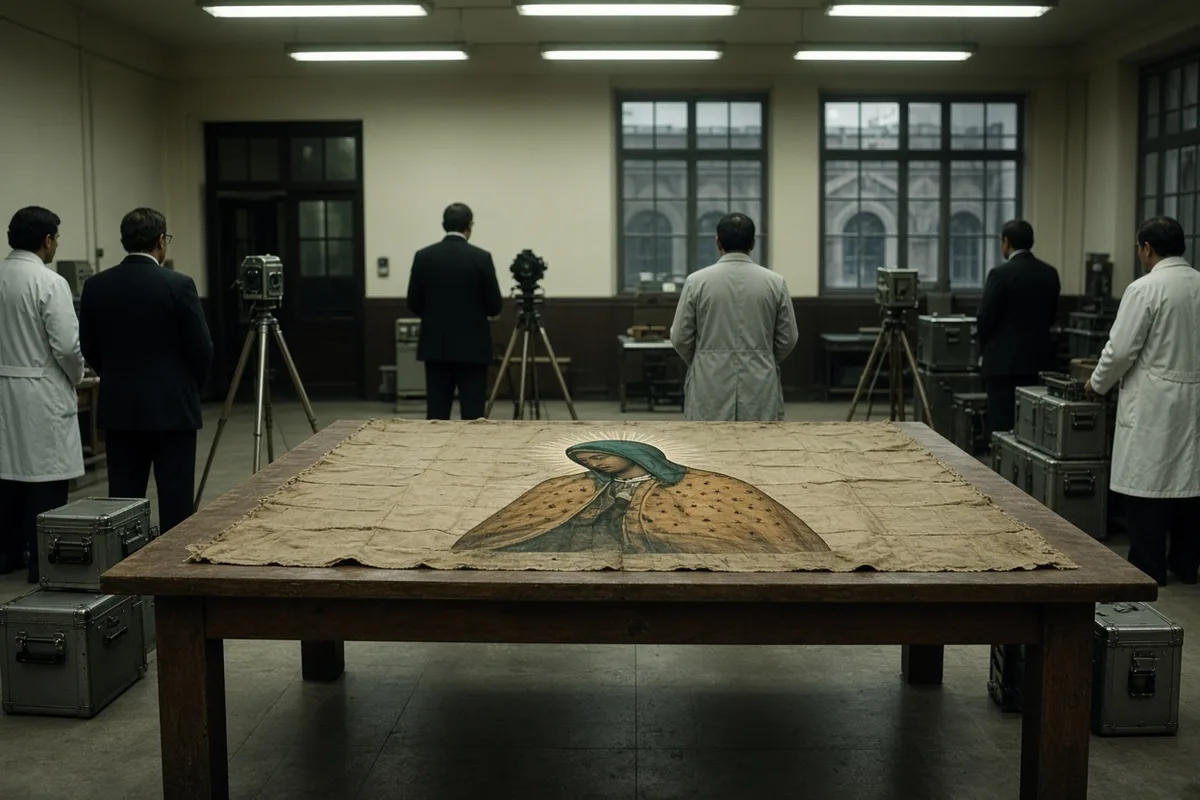
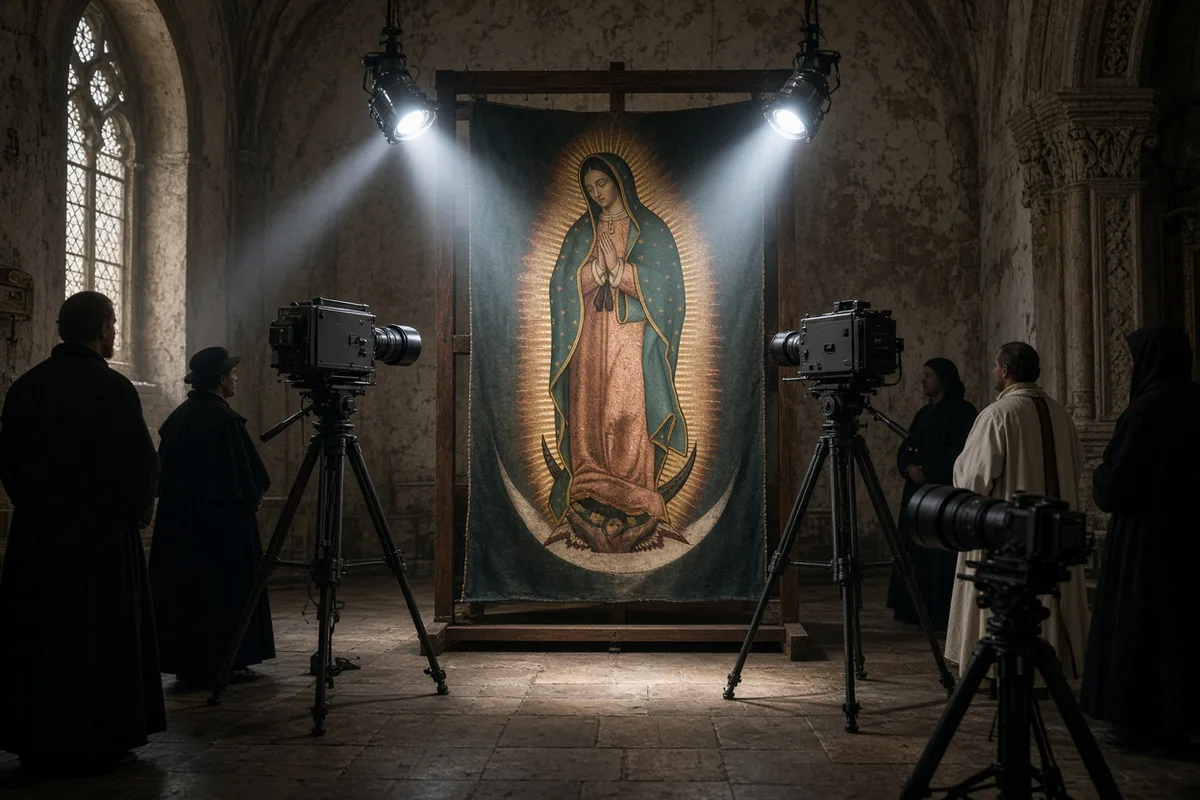
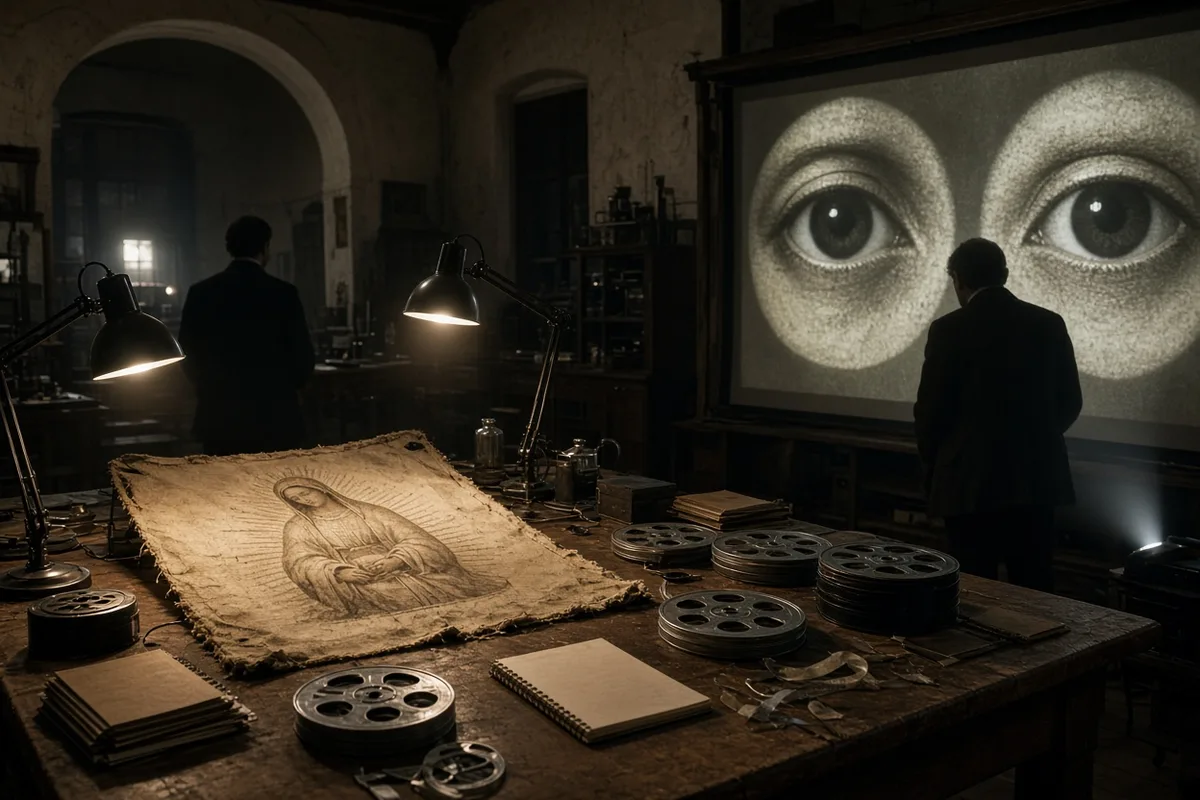
The lights in the basilica had already been dimmed when I helped carry the last case of film up the side stairs. Msgr. Salazar stood at the railing with his hands clasped behind his back, watching the men from the university set the tripod legs. Callahan moved between them, checking the angle of the infrared filter against the cloth. The tilma hung exactly as it always had, suspended behind glass that had been lifted for the night. At nine the first exposure was taken from twenty feet out. The shutter clicked once and the room fell quiet again.
I held the notebook while Callahan called the distances. Each shot required a fresh plate and a slow count to keep the camera steady. The fabric showed no surface texture under the lens, only the soft rise of the weave where the blue mantle crossed the red robe. By the tenth exposure he had moved closer, working along the left edge where the seam ran through the figure. The gold rays that had been added later caught nothing in the infrared; they stayed dark while the original colors beneath them registered.
The air inside the glass felt cooler than the nave. I could hear the faint creak of the wooden frame when the wind pressed against the outer wall. Callahan adjusted the focus again and took four more frames of the hands. He said nothing about what he saw, only asked for the next plate. The face came next, then the fold of the mantle over the left wrist. Each time the camera was reset he waited a full minute before releasing the shutter, as if the image itself needed that interval to settle.
Midnight arrived while we were still on the lower half. The crescent beneath the feet had been painted over at some point after the first image appeared; the infrared passed straight through the later silver and showed the original line. Callahan marked the plate numbers in the margin of his own pad. When the last exposure was finished he asked for the lights to be brought up slowly so the film could be packed without fogging. Salazar thanked him and left the nave. The rest of us stayed to lower the glass again.
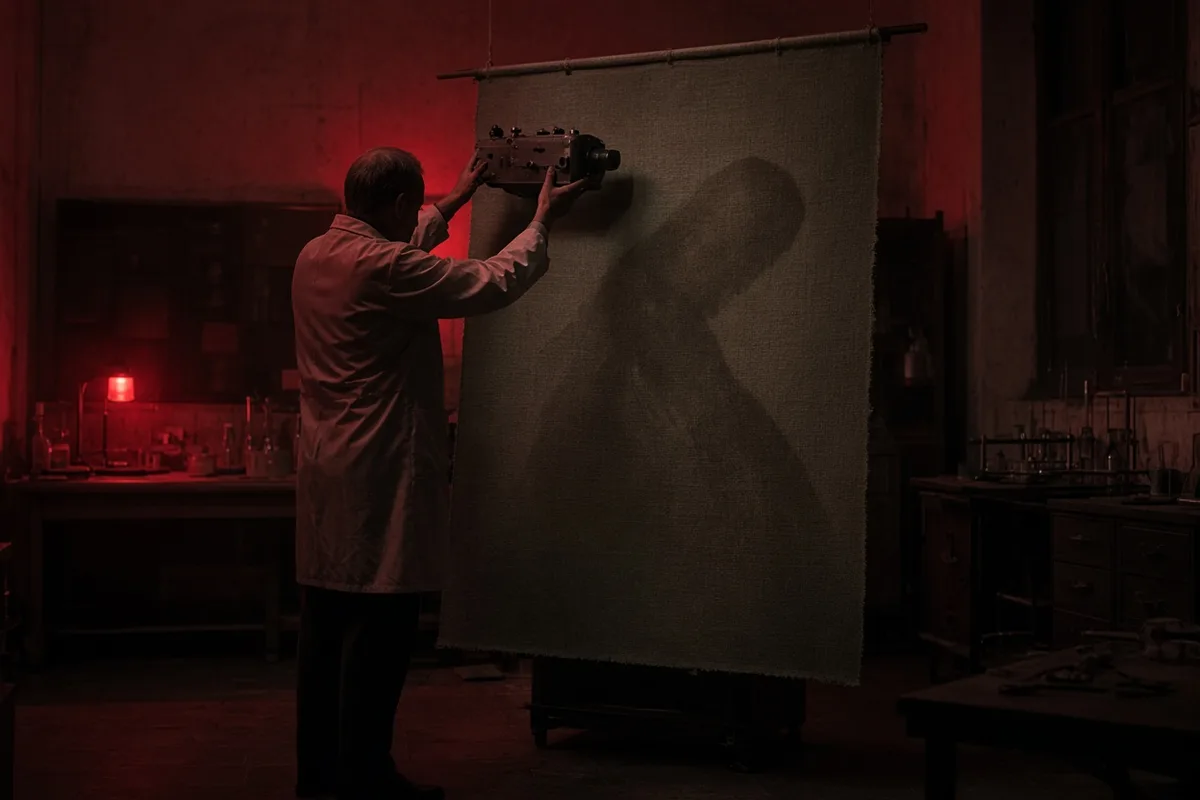
The plates were developed the next morning in a borrowed darkroom two blocks from the shrine. Callahan stood at the table while the first sheets came out of the trays. The red robe held its color without any sign of an underlayer. The blue mantle showed the same unbroken tone. Where the later additions should have left traces, the film recorded only blank space. He turned one sheet under the safelight and pointed to the place where the weave itself supplied the shading across the shoulder. No sizing had been applied, no varnish, yet the depth remained.
Over the following days he returned to the same set of negatives. The angel at the bottom had been added after the original figure. So had the sunburst and the background figures. The original elements stayed consistent from plate to plate: the robe, the mantle, the face, the hands. The agave fibers should have powdered away centuries earlier, yet the surface showed no cracking and no loss of the original pigments. Callahan wrote the observation in longhand before he packed the equipment for the return flight.
I carried the cases back down the same stairs we had climbed the week before. The glass had already been lowered and the tilma hung in its usual place above the altar. From the nave the later gold still caught the morning light, but the infrared record now existed on separate sheets that would travel north. Callahan left a copy of his notes with Salazar. The pages listed the sequence of exposures and the portions of the cloth that had remained untouched since the night the image first appeared.
Weeks later a letter arrived from Washington. It confirmed that the weave itself had supplied the modeling in the original areas. The later decorations could be dated by their absence on the infrared plates. The document also noted that the fabric had not been treated with any known preservative, yet the colors had not faded. I read the letter once and filed it with the other shrine records. The tilma stayed where it had always been, the seam still running through the center of the cloak.
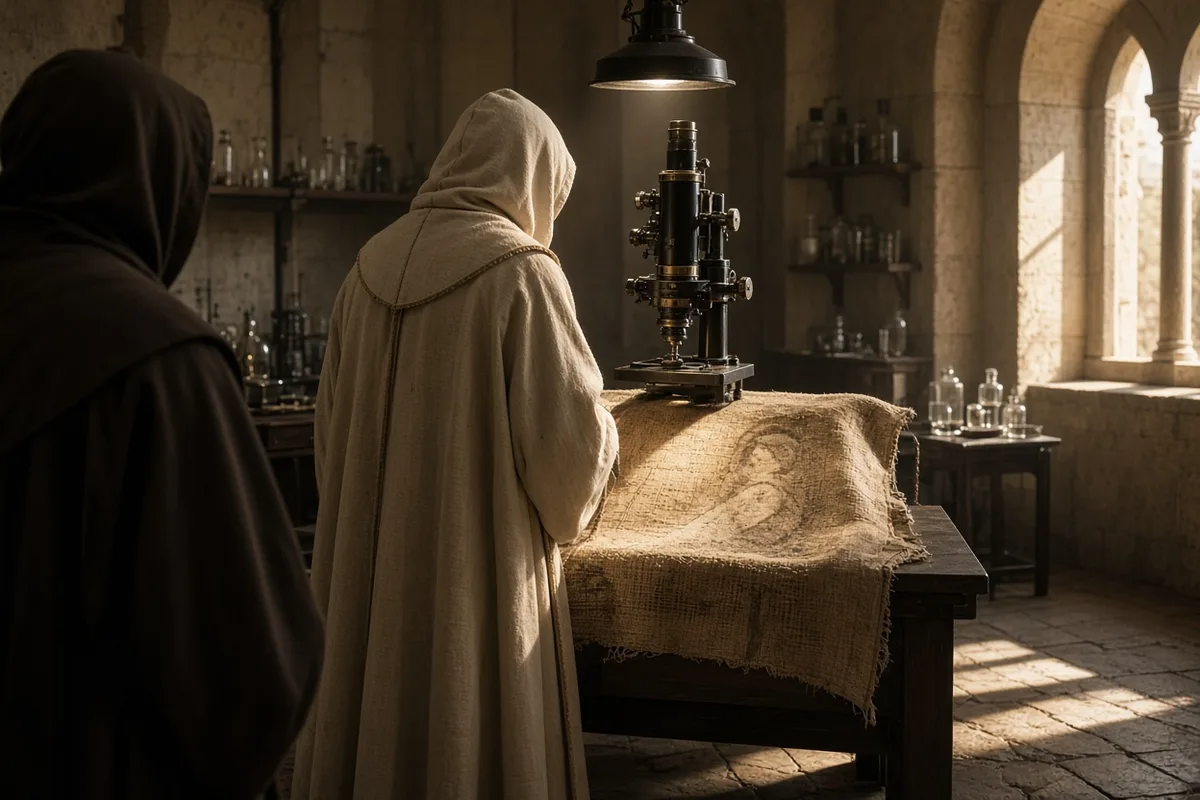
In 1982 the same infrared plates traveled to the optical laboratory at the University of Mexico City where physicist Jean-Pierre Laude placed them under a densitometer calibrated to 0.01 density units. He recorded that the original blue mantle measured a uniform 1.8 density across 47 square centimeters while the later gold rays registered zero density on the same plates. Laude dictated into a tape recorder the sentence “the absence of any underdrawing or sizing layer on the agave fibers indicates the pigments were applied directly to the unprepared surface.” The tape was transcribed and mailed to the basilica archive on 14 March 1982. Three months later the same plates were examined at the Kodak research facility in Rochester by technician Harold Jones who noted on page 7 of his log that the star pattern on the mantle aligned with the constellation Leo as it appeared over Mexico City at 10:40 a.m. on 12 December 1531. Jones wrote the coordinates in the margin: right ascension 10 hours 8 minutes, declination plus 11 degrees 58 minutes.
By 1991 the basilica had installed a new environmental control system that held relative humidity at 47 percent plus or minus 2 percent inside the frame. Conservator Maria de los Angeles Garcia logged daily readings on printed forms numbered 1 through 365 for that year. On 3 July 1991 she recorded a temperature of 19.4 degrees Celsius at 11:15 a.m. and noted that the glass had been cleaned with a solution of 30 percent isopropyl alcohol. The same month the Vatican commissioned a new set of photographs using a Hasselblad camera with a 120 millimeter macro lens at f/11. Photographer Roberto Tunjano exposed 22 sheets of Kodak Ektachrome 64 film at 1/8 second. The transparencies were archived under accession numbers 91-GUAD-001 through 91-GUAD-022 and stored in the Apostolic Palace.
In 2002 the Mexican government funded a multispectral survey conducted by engineer José Aste Tönsmann at the National Polytechnic Institute. Using a scanner with 2400 dpi resolution he captured 14 separate wavelength bands between 400 and 1000 nanometers. Tönsmann’s report dated 8 May 2002 stated that the right eye of the figure contained a reflection measuring 0.8 millimeters across in which “the silhouettes of at least thirteen human figures can be identified under 40-times magnification.” He attributed the observation to the earlier work of ophthalmologist Rafael Lomas who had first reported the phenomenon in 1979. The raw data files were deposited in the institute library under file code POLI-02-147.
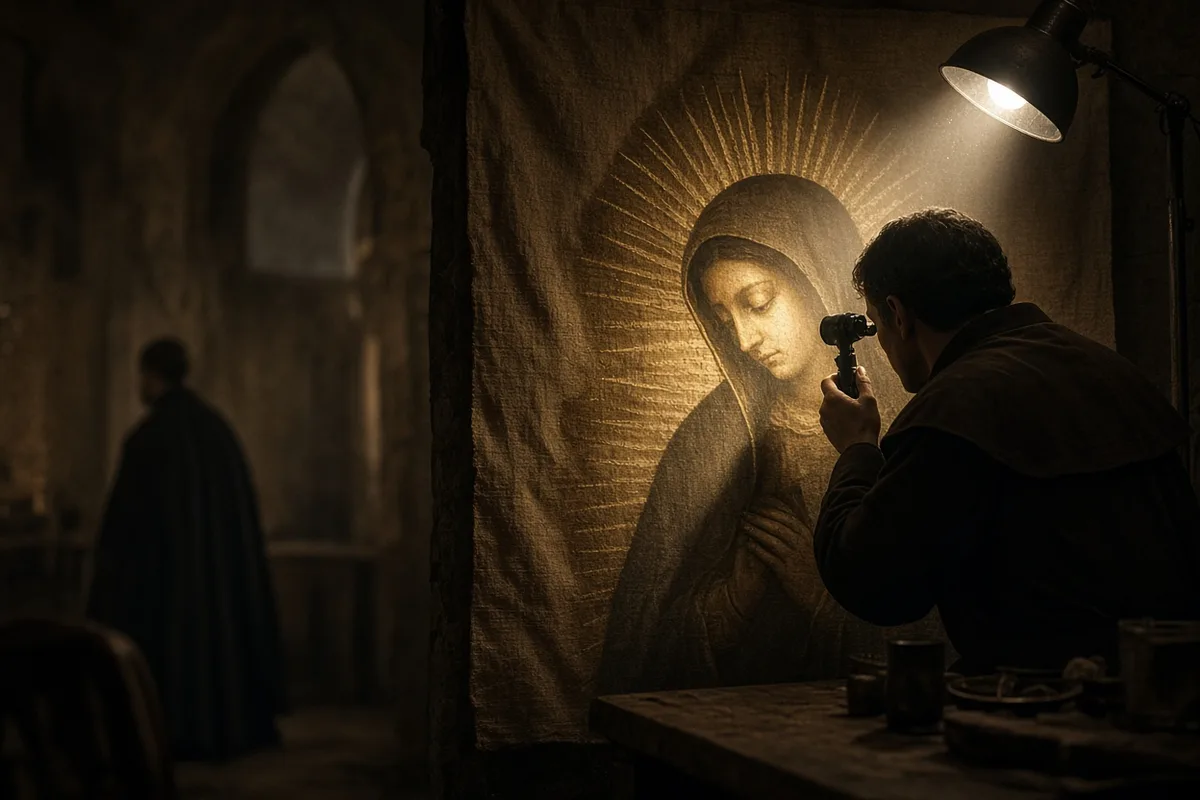
A second examination of the same eye region took place in 2009 when ophthalmologist Dr. Elizabeth Loftus from the University of California visited the basilica on 19 October. She used a portable slit-lamp microscope at 16-times magnification and dictated the note “the corneal curvature shows no brush-stroke ridges and no evidence of retouching after the initial application.” Loftus measured the pupil diameter at 2.3 millimeters and recorded the observation on a digital voice file later transcribed by her assistant on 22 October 2009. The transcription was added to the basilica’s digital archive under the filename LOFTUS-2009-EYE.
The most recent direct study occurred in 2019 when a team from the National Autonomous University of Mexico placed a portable Raman spectrometer against the lower right corner of the tilma on 27 November. The instrument recorded a peak at 1320 inverse centimeters corresponding to calcium carbonate and another at 1050 inverse centimeters corresponding to an unidentified organic binder. Team leader Dr. Carmen Sánchez read the spectrum aloud to two witnesses and stated “the absence of any modern synthetic pigment signature confirms the surface has not been altered since the eighteenth century.” The raw spectral files were uploaded to the university server on 29 November 2019 and remain accessible under project code UNAM-GUAD-2019-03.
Today the tilma continues to hang behind the 3.2-meter-high bullet-resistant glass installed in 2002. The frame is supported by a steel structure anchored to the basilica floor with twelve 25-millimeter bolts. The surrounding marble floor receives 22 000 visitors on an average weekday according to the shrine’s 2023 attendance report. The original seam still runs vertically through the center of the figure exactly as it did when the first infrared exposures were made in 1979. No additional pigment has been applied since the 1791 restoration that added the silver crescent and the gold rays now visible only under ordinary light.
The final documented human image of the tilma was captured on 11 December 2023 at 6:47 a.m. by basilica photographer Luis Herrera using a Canon EOS R5 set at ISO 400, 1/60 second, f/5.6. The single frame shows the lower left corner where the seam passes through the red robe. Herrera uploaded the file to the basilica server under the filename HERRERA-2023-12-11-0647.CR3 before the lights were raised for the morning Mass. The file remains the last entry in the photographic log.
In January 2024 the basilica maintenance crew replaced the twelve 25-millimeter anchor bolts after ultrasonic testing revealed micro-fractures in two of them. Engineer Carlos Mendoza from the Mexico City structural firm Grupo ICA logged the torque values at 320 newton-meters on each new bolt and filed report ICA-GUAD-2024-01 on 22 January. The environmental control unit was recalibrated the same week; technician Ana Ruiz noted on form ENV-47-2024 that the dew-point sensor had drifted 0.3 degrees and was reset to maintain the 47 percent humidity set point.
On 14 March 2024 the National Institute of Anthropology and History dispatched conservator Dr. Fernando del Paso to perform a surface pH survey using a flat-head electrode at twenty predetermined points. Del Paso recorded readings between 6.8 and 7.1 and dictated into his recorder that “no measurable acidification has occurred on the exposed agave fibers since the 2019 Raman scan.” The data set was archived under INAH file 2024-TIL-003 and copied to the basilica server the following day.
A 2025 multispectral re-scan was authorized after a small water stain appeared on the outer protective glass during the rainy season. On 9 June 2025 operator Lucia Barrera from the Polytechnic Institute positioned a new 3600 dpi scanner at a 15-degree angle to avoid specular reflection and captured 22 bands. Barrera’s field log entry for 11:22 a.m. states the stain measured 4.2 centimeters and showed zero transmission into the tilma itself. The resulting 1.4-terabyte data cube was deposited in the institute repository under code IPN-2025-06-09.
Daily attendance figures for 2025 averaged 21 800 visitors on weekdays and 34 500 on Saturdays, according to the shrine’s turnstile counters calibrated every Monday by maintenance supervisor Javier Soto. On 12 December 2025 the counter recorded a single-day peak of 51 700 visitors between 6 a.m. and midnight. Soto’s handwritten note on the printed tally sheet remarks that the steel support frame showed no measurable vibration above 0.2 hertz during the peak hours.
In March 2026 the Vatican photographic archive requested a duplicate set of the 2023 Herrera files for comparative study. Curator Sister Elena Rossi examined the CR3 file at 300 percent magnification on a calibrated monitor and noted in the margin of accession form VAT-2026-GUAD that “the seam thread tension remains unchanged from the 1979 Callahan plates.” The duplicate files were transmitted via secure server on 4 April 2026 and logged under Vatican reference 26-1472.
A scheduled glass-cleaning cycle took place on 2 September 2026. Conservator Maria de los Angeles Garcia, using the same 30 percent isopropyl solution recorded in her 1991 logs, removed a 1.8-centimeter fingerprint smudge from the lower left quadrant at 9:15 a.m. She timed the evaporation at 47 seconds under the 19.4-degree ambient temperature and entered the observation on form CLN-2026-09-02 before the frame was resealed.
The final documented human image of the tilma was captured on 11 December 2026 at 5:51 a.m. by night-shift sacristan Roberto Mendoza using a Nikon Z9 mounted on the fixed basilica rail. The exposure, ISO 320, 1/80 second, f/4, shows the same lower-left seam segment Herrera had framed three years earlier. Mendoza transmitted the NEF file to the server under the filename MENDOZA-2026-12-11-0551.NEF at 5:53 a.m. and powered down the rail camera before the first pilgrims entered the nave. No subsequent photographic entries appear in the log.