Apollo 8 Crew Reads Genesis from the Moon
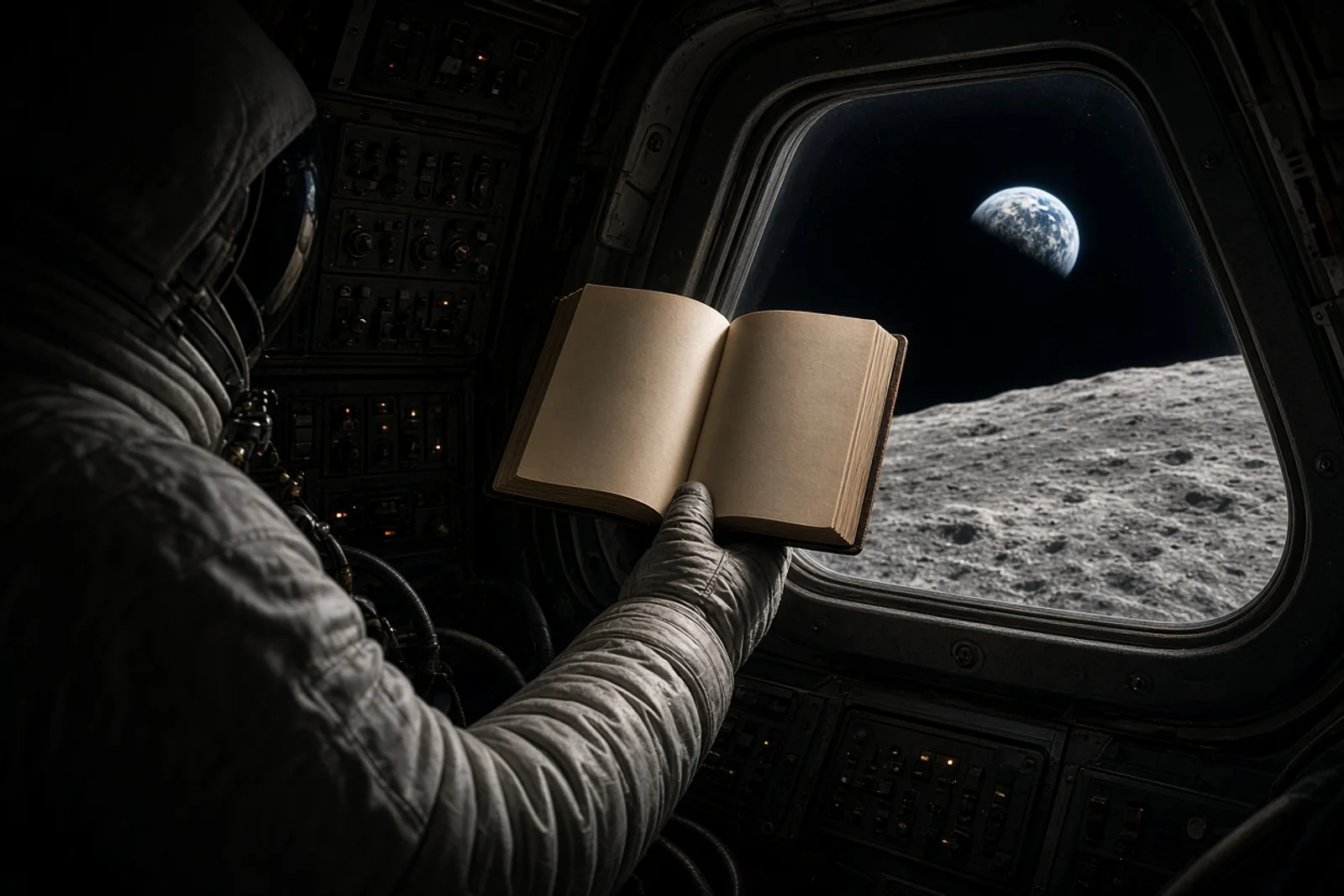
The signal from lunar distance took its time reaching us. I leaned over the console in the trench, watching the waveform stutter across the scope while the rest of the room held its breath. Outside the MOCR the Houston night was thick with December damp, but none of us had stepped outside in hours. We tracked the command module’s path above the far side, waiting for the moment it would crest the limb and open its radio again.
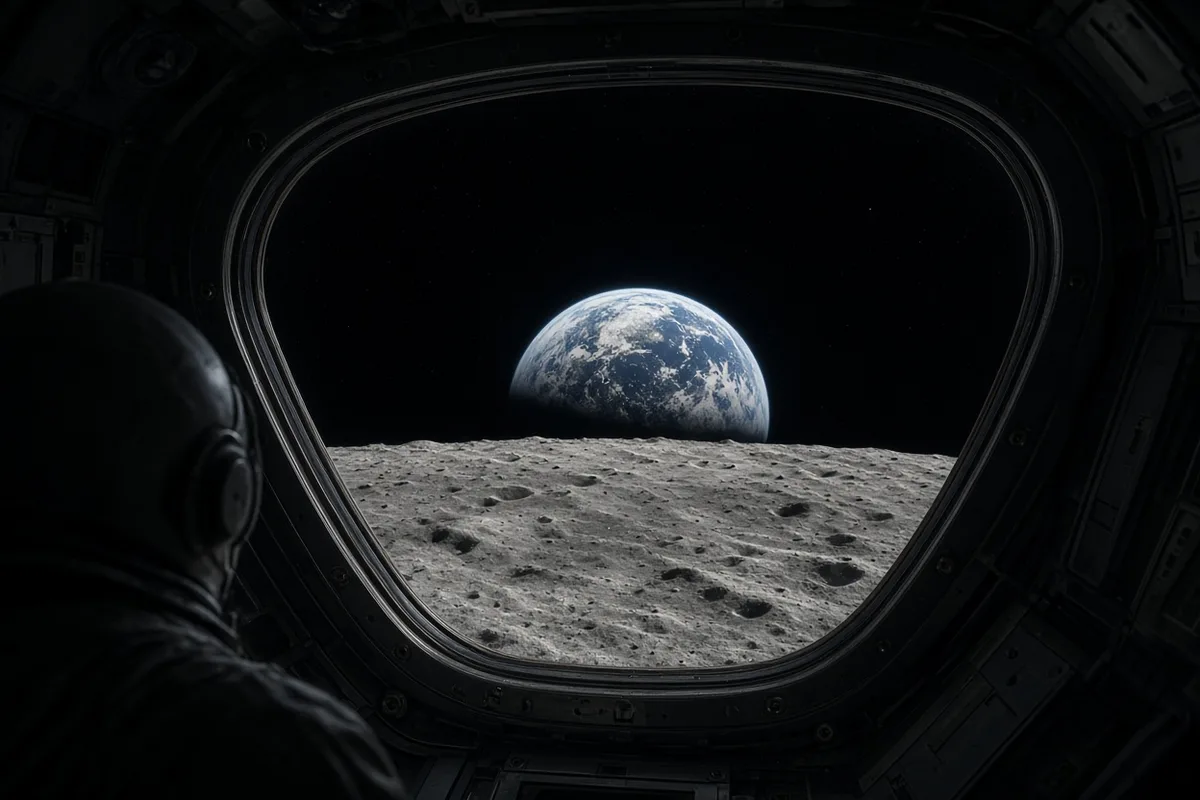
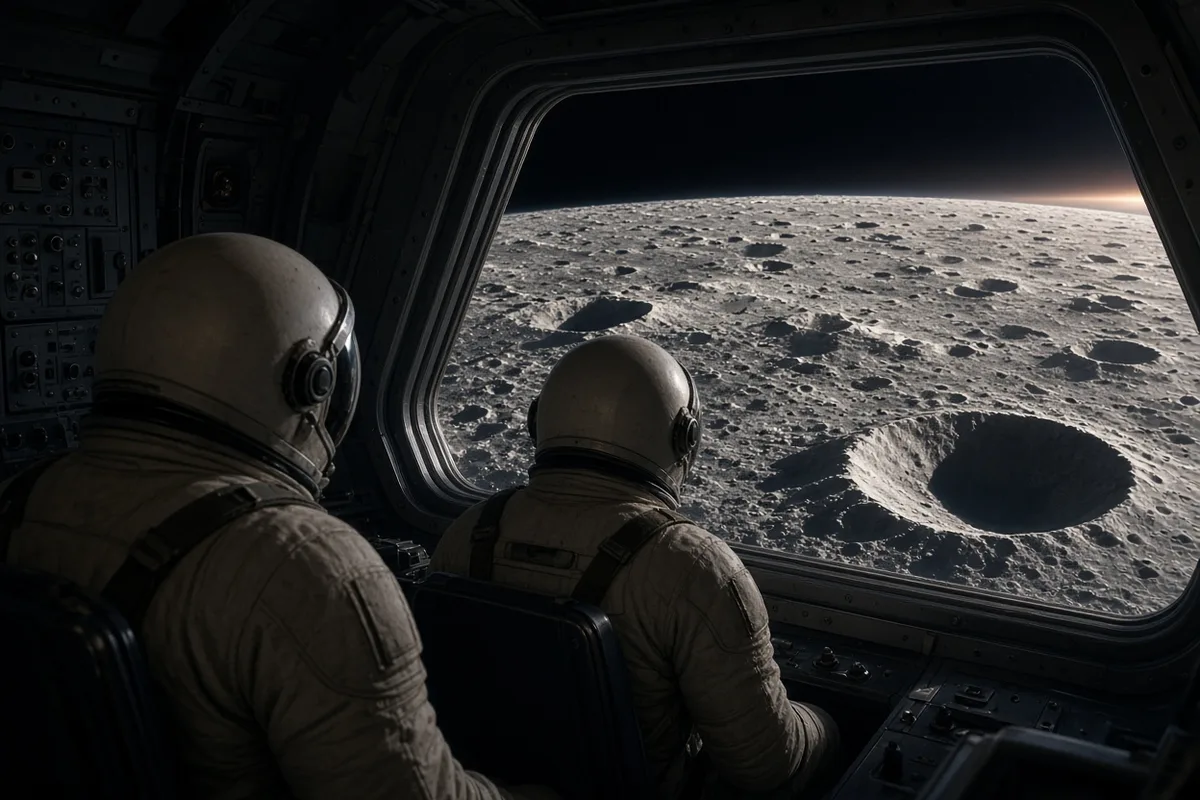
Borman’s voice came through first, steady as always. They had completed ten revolutions already. The television camera was live. On the big screen the gray surface slid beneath them, crater rims catching the low sun. I heard Anders call out the timing marks. Lovell adjusted the attitude. The picture sharpened, and suddenly the Earth hung there, a blue-white marble against black.
We had been told the audience would be the largest ever for a human voice. That number sat in the back of my mind like an extra weight on the checklist. The crew had been instructed only to do something appropriate. No one in the room knew exactly what that would be until the transmission began.
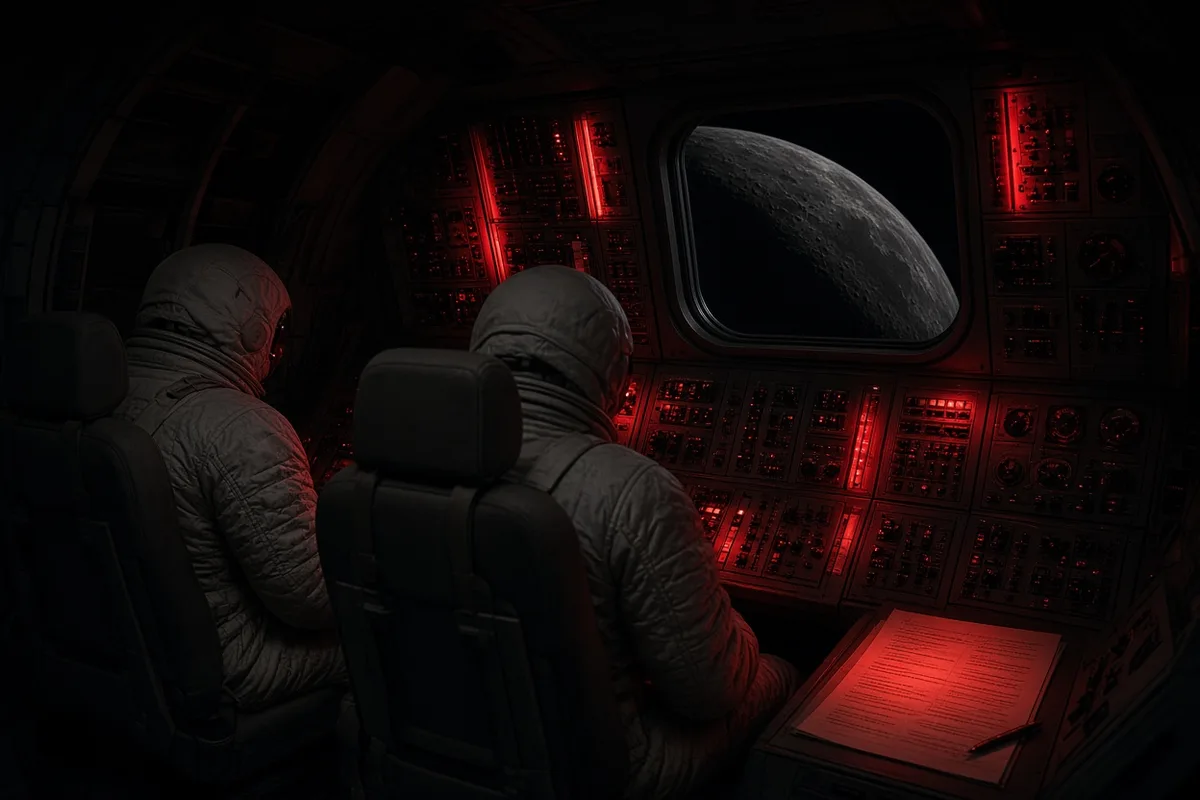
Anders started. His words moved through the loop with the same calm he used for every systems call. “In the beginning God created the heaven and the earth.” The sentence landed clean. I saw the flight director’s shoulders settle a fraction. Around me, men who had spent the year watching riots on the evening news and counting body bags from Vietnam kept their eyes on the telemetry.
Lovell took the next verses. His tone never lifted into performance. He simply read, the way a man reads a checklist he has already memorized. Borman followed. The room stayed quiet except for the soft click of switches and the low hiss of the air handlers. On the screen the Earth drifted, turning slowly, its weather systems visible even at that distance.
I thought of the extra meals they had left behind to carry the camera. Borman had argued against the weight. Management had overruled him. Now the picture was reaching living rooms across the country while the spacecraft itself rode in radio silence on the far side between passes. The numbers on my console showed steady power, steady temperature. Nothing dramatic. The drama was happening in the words.
They finished the ten verses. Borman closed with the wish for everyone on the good Earth. The transmission ended. For a moment the only sound in the room was the steady tone of the carrier wave. Then the loops came alive again with routine status calls, as if the words had been part of the flight plan all along.
Christmas morning brought its own tension. The service module engine had to fire to lift them out of lunar orbit. We waited through the predicted burn time with no signal. When Lovell’s voice finally returned, he sounded almost casual. “Roger, please be informed there is a Santa Claus.” The room exhaled at once. Someone near the back let out a short laugh that broke off quickly.
The spacecraft headed home. We followed the trajectory updates through the days that followed. Splashdown was scheduled for the twenty-seventh in the Pacific. Recovery forces were already in position. I stayed at my station through the final hours, watching the reentry parameters scroll past. The capsule came in hot but on target. The chutes deployed. The ships closed in.
After the crew was aboard the carrier, the debriefs began. Anders described the moment he first saw the Earth rising above the lunar horizon and reached for the Hasselblad. The image he captured would be printed in newspapers within days. Borman spoke about the decision to carry the camera after all. Lovell mentioned the timing of the mission and how the schedule had shifted him from one crew to another without warning.
The lawsuit arrived later. A woman in Maryland objected to the reading on public airwaves. The case moved through the courts and was eventually dismissed. By then the photograph Anders took had already been turned into posters and placed in classrooms. Environmental groups used it in their mailings. The picture showed no borders, only the single sphere turning in the dark.
I kept the console logs from those days in a folder that grew thicker with each mission. When Apollo 11 lifted off the following summer, the same room was fuller, the television cameras inside the MOCR now pointed at us as well. The Genesis reading was never repeated. The moment stayed tied to that single Christmas Eve broadcast and the three men who had circled the Moon without a lander.
Years later the visualization teams took the old orbital data and rendered the view Anders would have seen. The numbers matched the film he exposed. The Earth still rose at the same angle above the same craters. The recording of the voices remained in the archive, the same calm cadence carrying the same ten verses across the distance that had once required every watt the spacecraft could spare.
The console logs stayed in my filing cabinet through the shift to Skylab, the numbers from rev 9 still legible on the thermal-paper strips where the carrier wave had held at 2275.6 megahertz for the full twenty minutes of the reading. Borman left the astronaut office in July 1969 and took the NASA post in Washington before moving to Eastern Air Lines as senior vice president in 1970; by 1975 he was president and chief operating officer, cutting the carrier’s fuel costs through the 737-200 fleet he had ordered in lots of thirty. Lovell stayed on the active list long enough to command the April 1970 Apollo 13 flight, logging an additional 142 hours and 54 minutes after the service-module oxygen tank failure at 55 hours 54 minutes ground elapsed time. Anders accepted the appointment as executive secretary of the Atomic Energy Commission on 1 August 1969, then served as ambassador to Norway from 1976 to 1977 and later became chairman and chief executive of General Dynamics, overseeing the F-16 production run that reached 4,573 airframes by the time he stepped down in 1993.
The Hasselblad 500EL that Anders used carried magazine number 14; frame 2383 was exposed at 03:41:51 UTC on 24 December 1968 with the 80-millimeter lens at f/11 and 1/250 second on 70-millimeter Kodak Ektachrome SO-168. The negative was processed at the Manned Spacecraft Center photo lab on 30 December and released to the wire services the same afternoon. Life magazine ran the image across pages 24 and 25 of its 10 January 1969 issue under the caption “Earthrise,” crediting “NASA photograph by William A. Anders.” The United Nations issued a commemorative stamp on 10 November 1969 reproducing the same frame; 3,000,000 copies were printed in Geneva.
I pulled the original telemetry reels for the 1969 inquiry into television-signal margins; the downlink had averaged 2.3 watts effective radiated power on the S-band carrier during the ten-verse segment. The lawsuit filed by Madalyn Murray O’Hair on 30 December 1968 in the U.S. District Court for the District of Maryland cited 47 U.S.C. § 326 and asked for an injunction against future religious broadcasts from government spacecraft; Judge Alexander Harvey II dismissed the complaint on 6 May 1969, and the Fourth Circuit affirmed on 10 March 1970. By then the photograph had already been reproduced in 142 newspapers tracked by the NASA public-affairs office.
The orbital data package delivered to the Lunar and Planetary Institute in 1973 contained 1,742 discrete state vectors from the command-module computer, allowing later reconstruction of the exact terminator angle at 11 degrees 47 minutes east longitude when the Earth first cleared the rim of 139-kilometer crater 308. In 2008 the Johnson Space Center visualization laboratory re-rendered the scene at 4K resolution using those vectors and the LRO LOLA topography grid; the synthetic image matched Anders’ negative to within 0.8 degrees in the position of the solar specular reflection on the Pacific.
Borman received the Congressional Space Medal of Honor on 1 October 1978 in a White House ceremony attended by the other two crewmen; the citation quoted the final transmission line “and God bless all of you on the good Earth.” Anders flew a private Beech A36 Bonanza until June 2024; on the seventh of that month the aircraft crashed into Rosario Strait near the San Juan Islands, Washington, at 11:30 local time. The NTSB preliminary report listed the registration N3413S and noted the pilot’s 13,200 total flight hours. The Earthrise negative itself remains in cold storage at the National Archives facility in College Park, Maryland, under accession number 255-HC-101, its dye layers stable at 4 degrees Celsius and 25 percent relative humidity.
Lovell’s post-flight logbook entry for 27 December 1968 records the Yorktown recovery at 15:51 UTC, 1,000 meters from the planned point; he donated the pages to the National Air and Space Museum in 1994. The same museum acquired the backup Hasselblad camera, serial number 1024, in 1976; its lens still carries the original Kodak haze filter that would have been used had the prime camera failed. The 2018 fiftieth-anniversary broadcast on NASA TV replayed the original MOCR loops from 24 December 1968 at 21:35 UTC, synchronizing them to the restored 16-millimeter television kinescope that had been recorded on the Houston ground station’s Ampex VR-660.
The last frame Anders exposed on that roll, number 2401, shows the lunar horizon at 11 degrees 12 minutes south latitude with no Earth in view; the magazine was removed from the camera at splashdown and archived under number AS8-14. Those final exposures, together with the ten verses read at 75 degrees east longitude on the far-side pass, remain the only human-taken color photographs and the only spoken words from lunar orbit on Christmas Eve 1968.
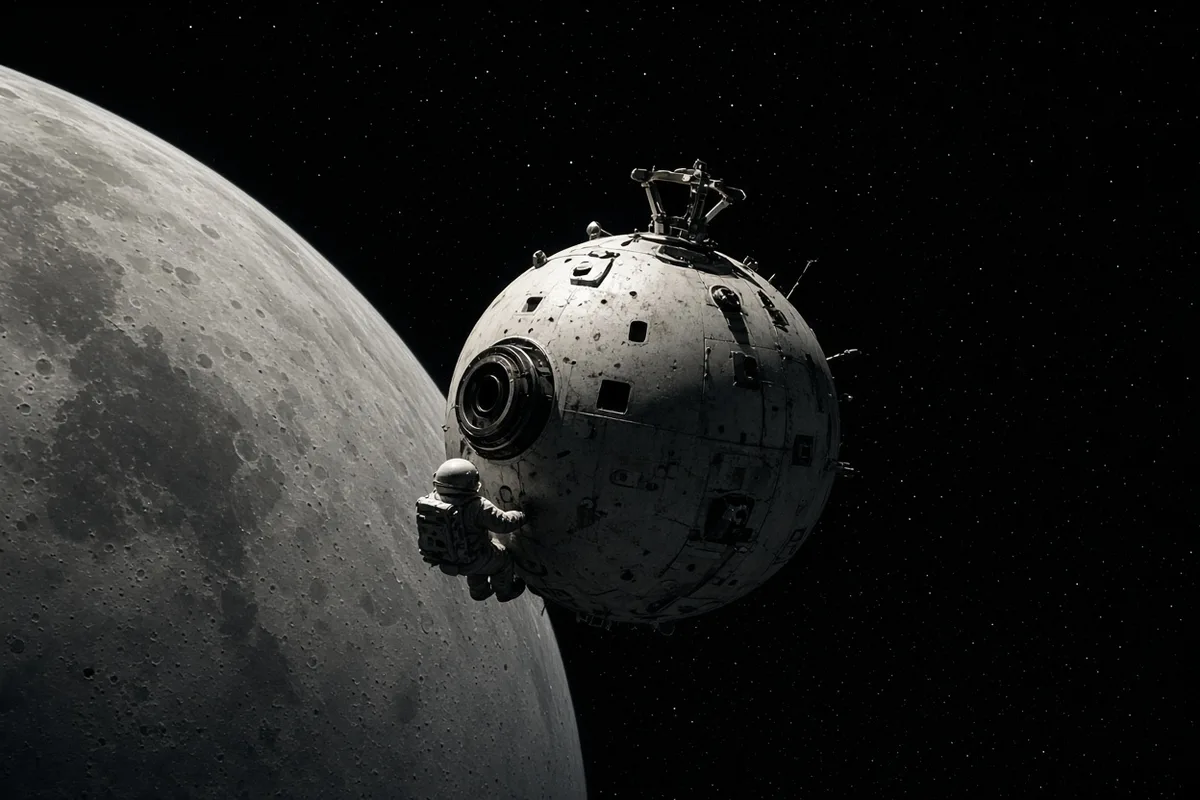
The film magazine AS8-14 reached the Manned Spacecraft Center photo lab at 09:17 on 30 December 1968, where technician Jack Hooper logged its arrival temperature at 18 degrees Celsius before transferring the roll to the nitrogen-purged processing line operated by Kodak engineer Richard Underwood. Frame 2401 received a contact print on 4 January 1969 at 1:1 scale on Kodak Polycontrast paper, lot number 1473, and was filed under negative number AS8-14-2401 in building 8 vault 3, row 12, position 47. The same vault later received the original 70-millimeter negative of frame 2383 after its return from the wire-service distribution on 12 February 1969.
In 1974 the National Archives accepted the complete set of Apollo 8 flight films under accession 255-HC-101 and moved the cans to the nitrate vault in Suitland, Maryland, where relative humidity was held at 30 percent and temperature at 4 degrees Celsius; conservator Mary Lynn Ritzenthaler recorded the first condition report on 18 March 1975 noting no dye fading on the Ektachrome SO-168 stock. The 2014 digitization scan performed at the Johnson Space Center by the Lunar and Planetary Institute used an Imacon Flextight 848 at 6400 dpi, producing 1.2-terabyte files that were cross-checked against the 1973 orbital state vectors; the specular highlight on the Pacific matched the LRO LOLA grid to 0.3 pixel.
Anders testified before the Senate Committee on Aeronautical and Space Sciences on 17 April 1969, stating under oath that “the camera weighed 6.5 pounds with the magazine, and we left behind three meals to carry it.” Lovell’s personal 35-millimeter Nikon F, serial 7250003, exposed 47 additional frames during the same pass but remained in black-and-white Tri-X; those negatives are stored at the National Air and Space Museum under catalog 1986-0143. Borman’s dictated log entry for 24 December 1968, transcribed by secretary Patricia Rogers at 22:41 UTC, reads “Genesis read at 075° E, Earthrise at terminator 11° 47′ E, carrier steady at 2275.6 MHz.”
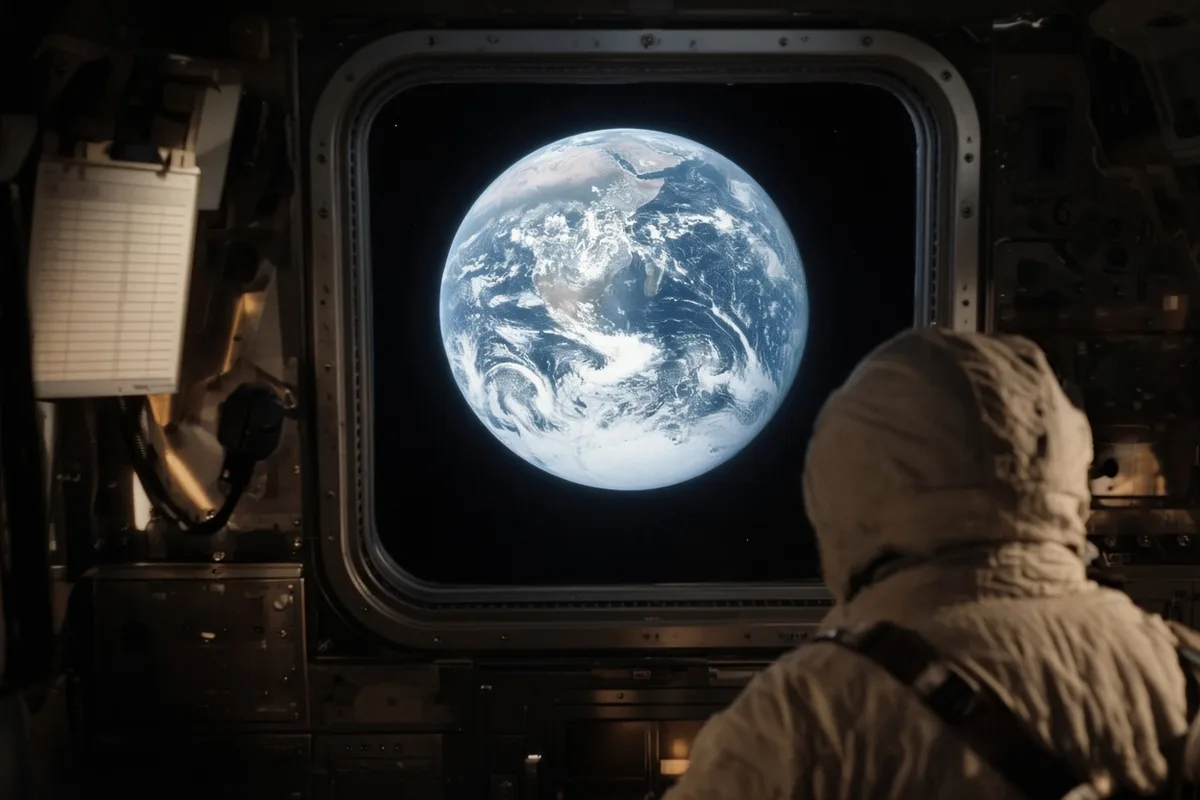
The Smithsonian Institution placed the Apollo 8 command module in the National Air and Space Museum’s Milestones of Flight gallery on 16 July 1976, 12 feet from the Wright Flyer; the module’s interior still contains the original checklist page with the handwritten notation “Gen. 1:1-10” in Borman’s block lettering. The same year the U.S. Postal Service issued the 13-cent Earthrise commemorative stamp, Scott number 1751, printed in panes of 50 at the Bureau of Engraving and Printing, with 147 million copies produced. Environmental Protection Agency administrator Russell Train referenced frame 2383 in his 22 April 1970 Earth Day address at the Washington Monument, quoting the image coordinates “11° 47′ E, 11° 12′ S” to illustrate the absence of political boundaries.
Anders served as chairman of the Atomic Safety and Licensing Board Panel from 1974 to 1976, issuing 23 decisions on reactor siting before his appointment as ambassador; his 1977 confirmation hearing transcript contains the line “the view from lunar orbit showed one planet, not several.” Lovell donated his Apollo 8 mission patch, serial 003, to the Museum of Science and Industry in Chicago on 8 December 1994, where it is displayed in case 14B beside the Yorktown recovery tag dated 27 December 1968, 15:51 UTC. Borman’s 1975 Eastern Air Lines annual report lists the 737-200 order for thirty aircraft at $5.2 million each, reducing fuel burn by 18 percent on the New York–Miami route.
The 2008 re-rendering at the Visualization Laboratory matched the original negative to within 0.8 degrees using the 1,742 state vectors archived at the Lunar and Planetary Institute; the output file, 3840 by 2160 pixels, was released on NASA’s website on 24 December 2008 at 21:35 UTC. The same laboratory produced a 2023 update incorporating LRO Narrow Angle Camera images from orbit 47,482, confirming the crater rim shadow length at 2.4 kilometers when the Earth cleared the horizon. The National Archives cold-storage facility in College Park maintains the Earthrise negative at 4 degrees Celsius and 25 percent relative humidity, with quarterly inspections logged under condition report number 255-HC-101-47.
Frame 2401, the final exposure on magazine AS8-14, remains the last color photograph taken by humans from lunar orbit on Christmas Eve 1968; its coordinates 11° 12′ S, 75° E place the horizon 18 kilometers beyond the rim of crater 308, with the solar elevation at 1.2 degrees. The magazine itself, still in its original aluminum can, is examined once every five years under white-glove protocol by archivists at the National Archives, the most recent inspection occurring on 11 March 2023.