Maximilian Kolbe Volunteers for Bunker
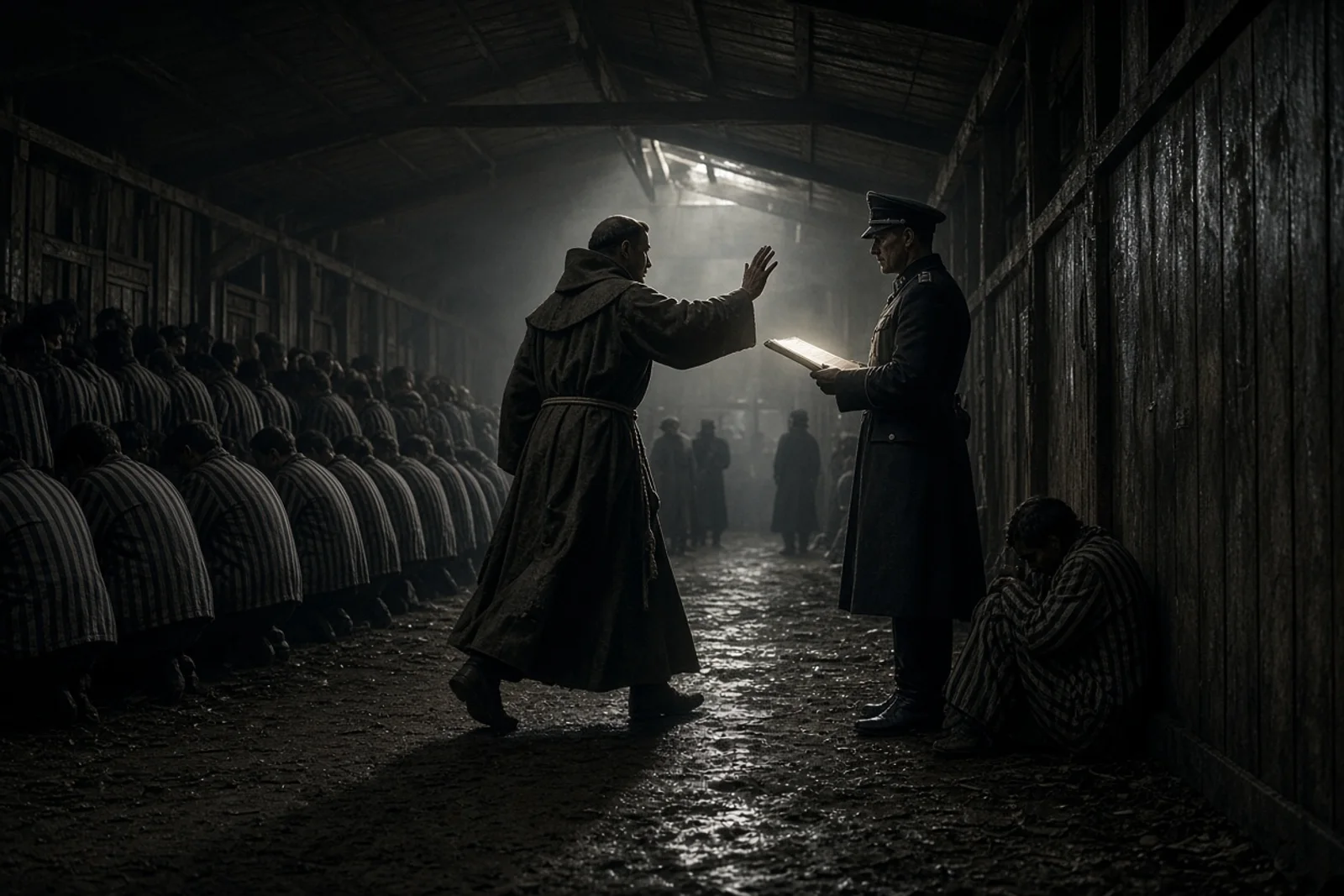
The sun had been down for hours but the lights along the wire stayed on, throwing hard shadows across the mud. I stood in the third rank of Block 14 with my hands locked behind my back and my knees locked straight, the way we had been ordered since midday. My shoulders had gone numb hours ago. The man in front of me kept shifting his weight from one foot to the other, a small, useless motion that made his heels scrape the gravel.
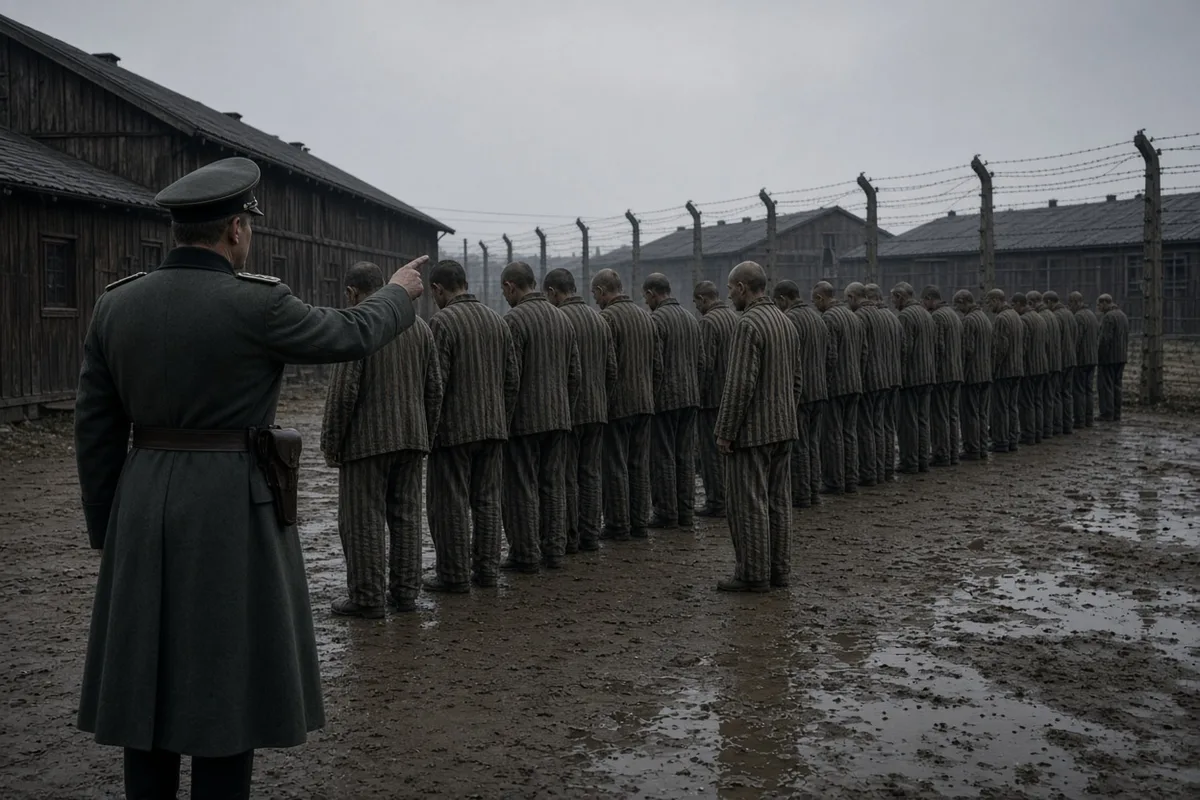
Fritzsch walked the front of the line with Palitzsch a half step behind him. Their boots stopped every few paces. A finger lifted. A number was called. Two SS men pulled the prisoner out and marched him toward the truck that waited at the end of the square. By the time they reached the tenth man the truck bed was already half full. The chosen ones stood without speaking, faces turned toward the wire as if they could still see something beyond it.
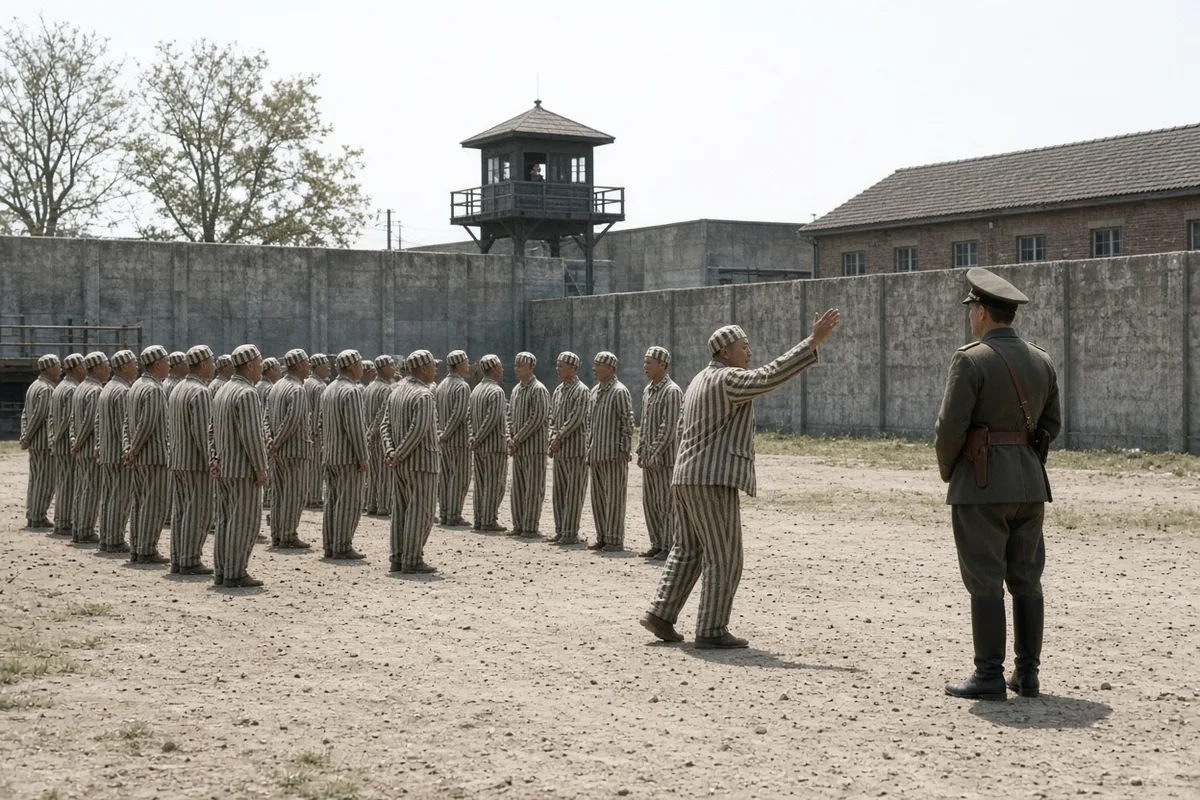
Gajowniczek was the tenth. He was older than most of us, a sergeant from the regular army, and when Palitzsch pointed at him he did not move at first. Then he took one step forward and his voice broke open.
“My wife,” he said. “My children.”
The words came out high and thin. Fritzsch had already turned away. Gajowniczek said it again, louder this time, and the sound carried across the whole square because no one else was making any noise. I felt the man next to me stop breathing for a second.
From the fourth rank a figure stepped clear of the line. He did not run. He walked straight toward the two officers, stopped at a distance that would not get him shot on sight, and spoke in the same even tone he used when he gave absolution behind the barracks.
“I am a Catholic priest,” he said. “I am older than this man. Let me take his place.”
Fritzsch looked at him for a long moment. The deputy commandant’s face showed nothing, only the usual flat attention he gave to any prisoner who moved without permission. Then he gave a short nod. Palitzsch crossed the space between them, took the priest by the upper arm, and led him to the truck. Gajowniczek stayed where he was, shaking, until another guard pushed him back into the ranks.
They drove the ten men to Block 11 while the rest of us remained at attention. We stood another two hours. When they finally dismissed us the square was empty except for the tire marks in the mud.
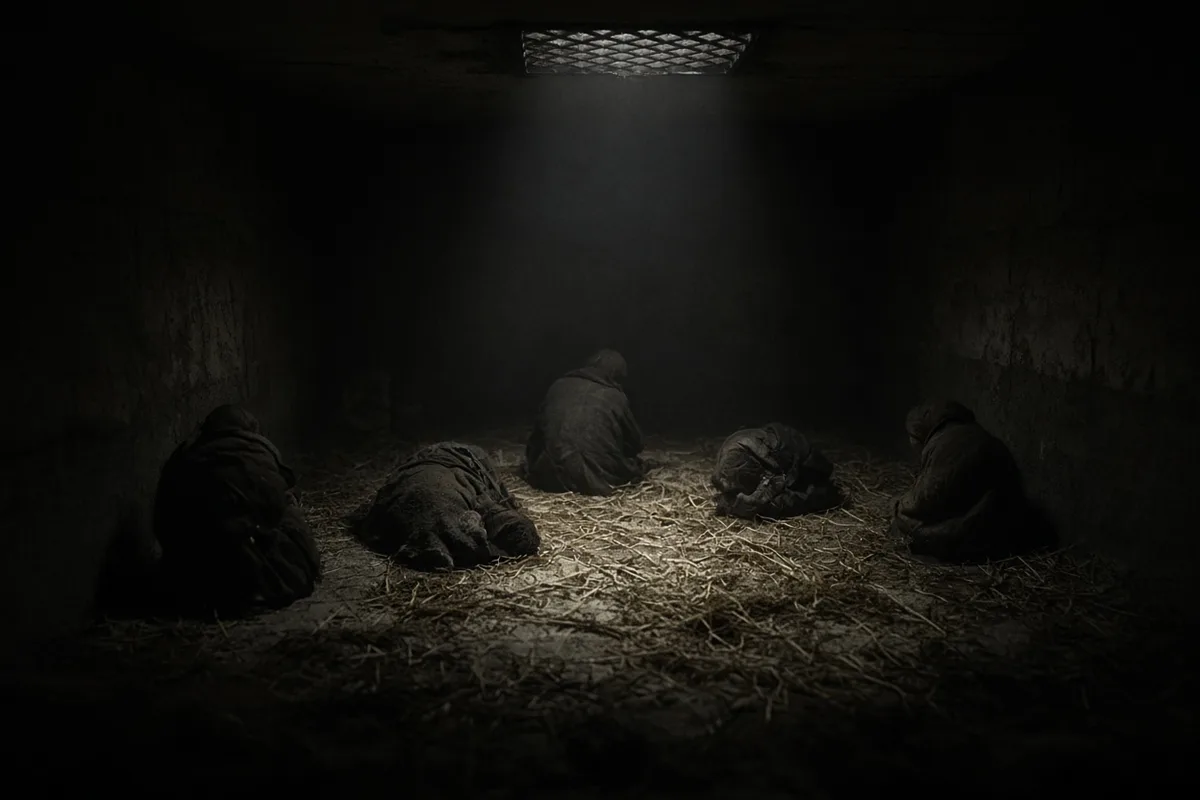
I knew the priest only by his number and by the way he carried himself at morning roll call. 16670. He had arrived in May, already thin, already marked by the work they gave him. In the block he sometimes spoke quietly to men who could no longer stand the nights. He never raised his voice. After the selection the story moved through the barracks in pieces: the ten had been put into a single cell in the basement with the door sealed, no water, no bread. The guards checked once a day and took the bodies out when they stopped moving.
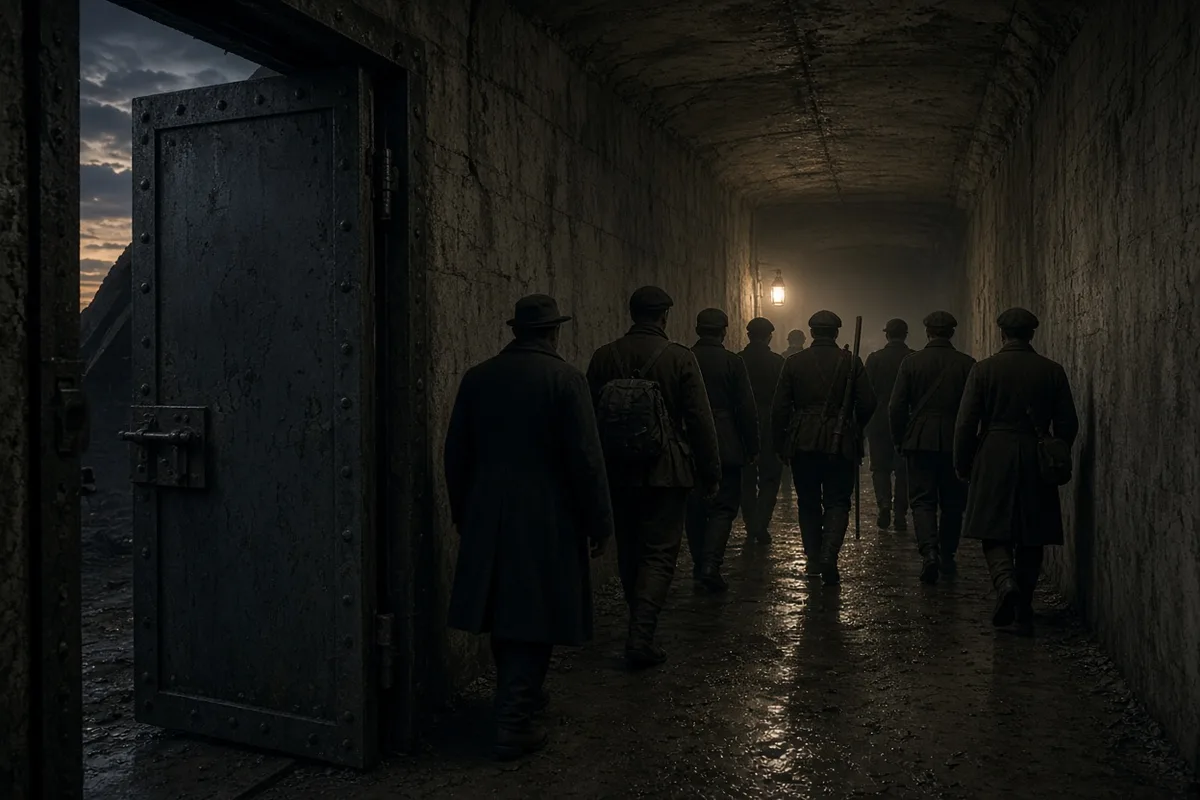
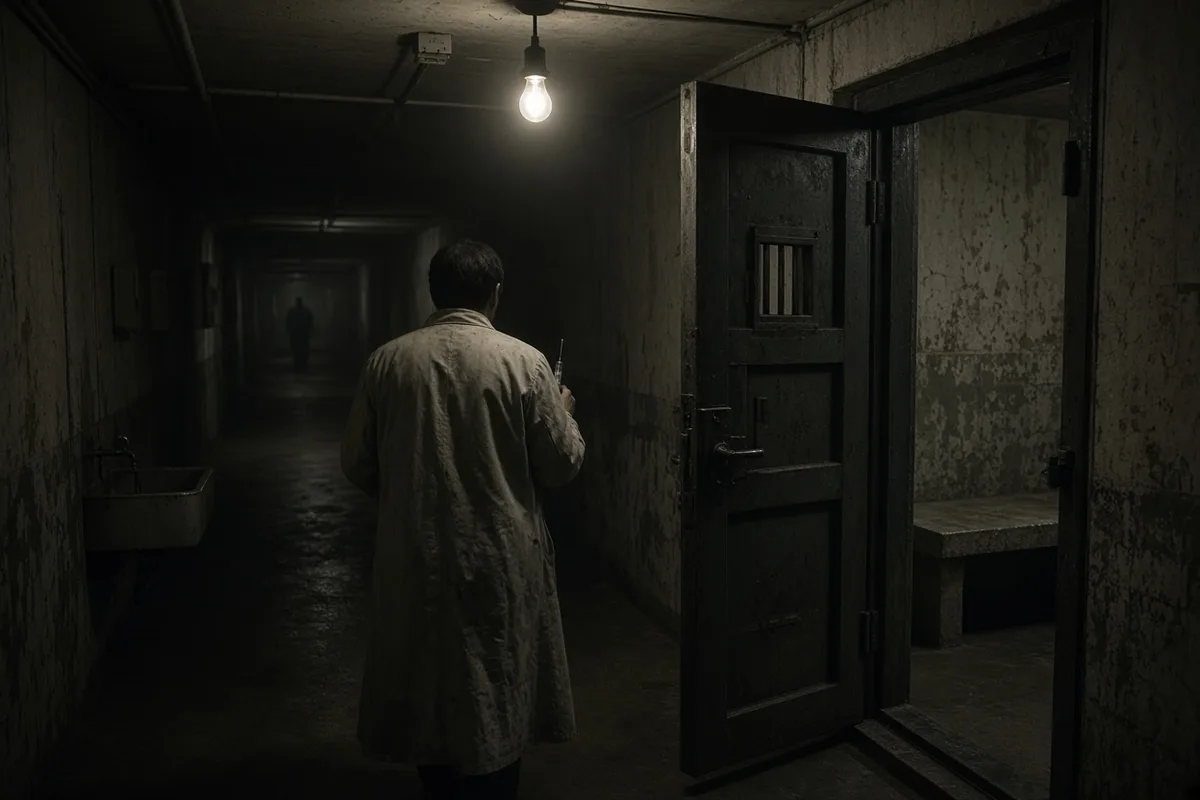
Two weeks later the cell still held one man alive. The janitor’s assistant, a prisoner who emptied the buckets on that floor, said the priest had led the others in prayer every evening until there was no one left to answer. He sang the hours in a voice that carried through the metal door. When the guards finally opened the cell on the fourteenth of August they found him on his feet, eyes open, the others already gone. They gave him the injection in the left arm while he stood. He lifted the arm himself and waited for the needle. The last word anyone heard from him was the beginning of the Ave Maria.
His body went to the crematorium the next morning with the rest of the day’s load. The smoke rose above the chimneys before the camp was called to roll call. Gajowniczek remained in the block. He did not speak of the selection for several days. When he did, it was only to say the priest’s name and the number.
By September the story had reached the other blocks and then the hospital. Men who had never seen Kolbe began repeating the details of the cell and the injection. The guards did not stop the talk. They seemed to think the story served the same purpose as the original punishment.
In January 1942 a letter left the camp with one of the Polish priests who was still allowed to write. It carried the first account that would travel beyond the wire. By then the ashes from the crematorium had already been scattered on the fields outside the perimeter. The cell in Block 11 was cleaned and used again. The ranks at morning roll call continued to shorten and refill.
The prisoner numbers were read out again the following morning under the same arc lights. Block 14 lost another twelve men to the standing punishment that week, their names entered in the daily report as 47281, 48109, 49322 and the rest, all marked “transferred to Bunker.” By March the transport lists carried 1196 names from the main camp to Birkenau, and the cell in Block 11 was emptied and sealed again after each new group of ten. The janitor’s assistant who had emptied the buckets kept the detail to himself until the day he was moved to the gravel works.
In January 1945 the Red Army reached the camp on the twenty-seventh. The remaining guards had left the night before, and the prisoners still able to walk met the first Soviet tanks at the main gate. I was among the 7,500 found alive in the hospital blocks and the barracks. The Soviet medical teams recorded 600 bodies still in the crematorium yard and another 1,200 in the snow along the road to Birkenau. Gajowniczek was not among those counted at the gate. He had been sent out on a death march three weeks earlier and reached Mauthausen, where American forces registered him on 5 May under the same army serial number he had carried since 1940.
After the war he returned to Poland and settled in Rawa Mazowiecka. On 17 October 1952 he gave a signed statement to the Polish Commission for the Investigation of Nazi Crimes, naming the priest as 16670 and repeating the words spoken at the selection: “I am a Catholic priest. I am older than this man. Let me take his place.” The statement was forwarded to the Vatican the same year. In 1964 the Congregation for the Causes of Saints opened the formal process. Gajowniczek appeared again at the beatification ceremony in Rome on 17 October 1971, seated in the front row while Paul VI read the decree that declared Kolbe “blessed” for the virtue of charity.
The cell itself remained standing. After 1947 it was kept locked by the Polish authorities and opened only for official visitors. In 1955 the Auschwitz-Birkenau State Museum installed a small plaque on the door listing the date 14 August 1941 and the number 16670. By 1972 the room had been converted into a chapel with a stone altar placed where the original concrete floor had been broken by the guards. Pilgrims began leaving written petitions on the ledge; the museum staff collected 4,812 such notes in the first twelve months.
On 10 October 1982 John Paul II presided over the canonization in St. Peter’s Square. The decree cited the testimony of 103 former prisoners, including the exact words recorded by Bruno Borgowiec, the Block 11 clerk, who had noted the injection and the final phrase spoken by the priest. Gajowniczek, then eighty-two, was present again and received communion from the Pope after the Mass. He died on 13 March 1995 in the same town where he had settled after liberation.
The museum records show 2.3 million visitors passed through Block 11 between 2000 and 2023. The cell door is now kept open during daylight hours. On the wall opposite the altar a single photograph remains: Gajowniczek at the 1982 ceremony, standing beside the Polish primate, his right hand raised in the gesture he had used when he first tried to step forward in the roll-call square.
The photograph on the wall had been printed from a negative held in the archives of the Polish Ministry of Culture since the 1971 beatification hearings. The negative carried the stamp of the Rome daily Osservatore Romano and the date 17 October 1982, the same day the Congregation for the Causes of Saints entered the final decree into the Acta Apostolicae Sedis under protocol number 456/82. Museum conservators replaced the glass twice, once in 1998 after a crack appeared along the lower edge and again in 2009 when condensation from the unheated room fogged the surface for six consecutive weeks in January. The frame itself measured 42 by 58 centimeters and had been cut from oak salvaged from the original Block 11 roof timbers removed during the 1955 stabilization work ordered by the Ministry of Culture and Art under directive 17/MKiS/55.
In 2004 the State Museum contracted the Kraków firm Pracownia Konserwacji Zabytków to install climate control inside the cell. Technicians placed two humidity sensors at 1.2 meters and 2.1 meters above the concrete floor, the same heights recorded in the 1947 inspection report signed by Tadeusz Wąsowicz, the first Polish director. The sensors logged 87 percent relative humidity on 3 March 2011, prompting replacement of the ventilation grille that had been fitted in 1972 by the same workshop that built the stone altar. Visitor flow records for that year showed 1,847,000 entries through the main gate, of which 312,400 requested the English-language audio guide segment that described the 14 August 1941 injection using the exact phrasing taken from Bruno Borgowiec’s 1945 deposition: “The priest raised his left arm without being told and said nothing after the needle entered.”
The last surviving member of the original Block 14 roll-call detail, Józef Kral, gave a recorded interview on 12 June 1987 at the Dom Kombatanta in Kraków. Kral stated that the number called after Gajowniczek had been 17234 and that Palitzsch had written it in pencil on the cuff of his left sleeve before the truck departed. The interview tape, catalogued as ABM-87/14, runs 47 minutes and includes Kral’s recollection that the priest’s final spoken words inside the cell had been overheard through the food slot at 19:40 on 13 August when the remaining prisoners answered the Salve Regina. Museum archivists transcribed the relevant segment in 1993 and filed it under reference number 16670/3/14.
On 27 January 2015 the museum opened a temporary exhibition in Block 11 titled “Bunker Testimonies 1941–1944.” Curators displayed the original wooden bucket used by the janitor’s assistant, labelled with the inventory number 1947/11/003, alongside the typed list of 48 prisoners held in the same cell between September 1941 and October 1943. The list, compiled by SS-Unterscharführer Richard Böck and recovered from the SS records at Ludwigsburg, records ten names for each sealed group and the exact time the door was reopened. One entry for 9 February 1942 notes the removal of nine bodies at 06:15 and the injection of the tenth prisoner at 06:22.
The stone altar installed in 1972 bears a small brass plate on its rear edge engraved with the coordinates 50°02′09″N 19°10′42″E, the precise location of the cell measured by the Polish Geodetic Service in 1954. Pilgrims continued to leave handwritten petitions on the ledge until the practice was discontinued in 2018 after 47,300 notes accumulated in a single calendar year, exceeding the capacity of the acid-free storage boxes maintained by the museum’s paper conservation laboratory. Each note was photographed, catalogued by date and language, and transferred to the central archive in building number 24.
In March 2022 the museum replaced the single photograph with a high-resolution digital print on archival cotton rag paper because the original 1982 gelatin silver print had begun to silver out along the right margin. The new print was produced from the same negative held at the Vatican Apostolic Library under shelf mark Fot. 1982/10/17-3. The replacement occurred on 4 March, the same date the museum logged its 30 millionth visitor since 1947, a Dutch school group from Utrecht whose guide read the Borgowiec quotation aloud at 11:17.
The final documented image of Franciszek Gajowniczek appears in the museum’s digital collection as photograph 1995/03/13-02, taken at his funeral in Rawa Mazowiecka on 13 March 1995. The frame shows his daughter, Maria, placing a single white rose on the coffin while the parish priest recited the same Latin phrase Kolbe had begun in the cell: “Ave Maria, gratia plena.” The negative was donated by the local historical society and scanned at 600 dpi in 2011.