Elizabeth Fry Begins Newgate Prison Visiting
The cart jolted over a loose stone and the basket of bread slipped against my knee. I steadied it with both hands. Elizabeth Fry sat opposite me on the narrow bench, her plain bonnet shading her face from the weak winter light. Two other women from our meeting rode beside her, their skirts pressed close in the cramped space. We had left the City at first light with loaves still warm from the oven and a sack of knitted stockings tied at the top.
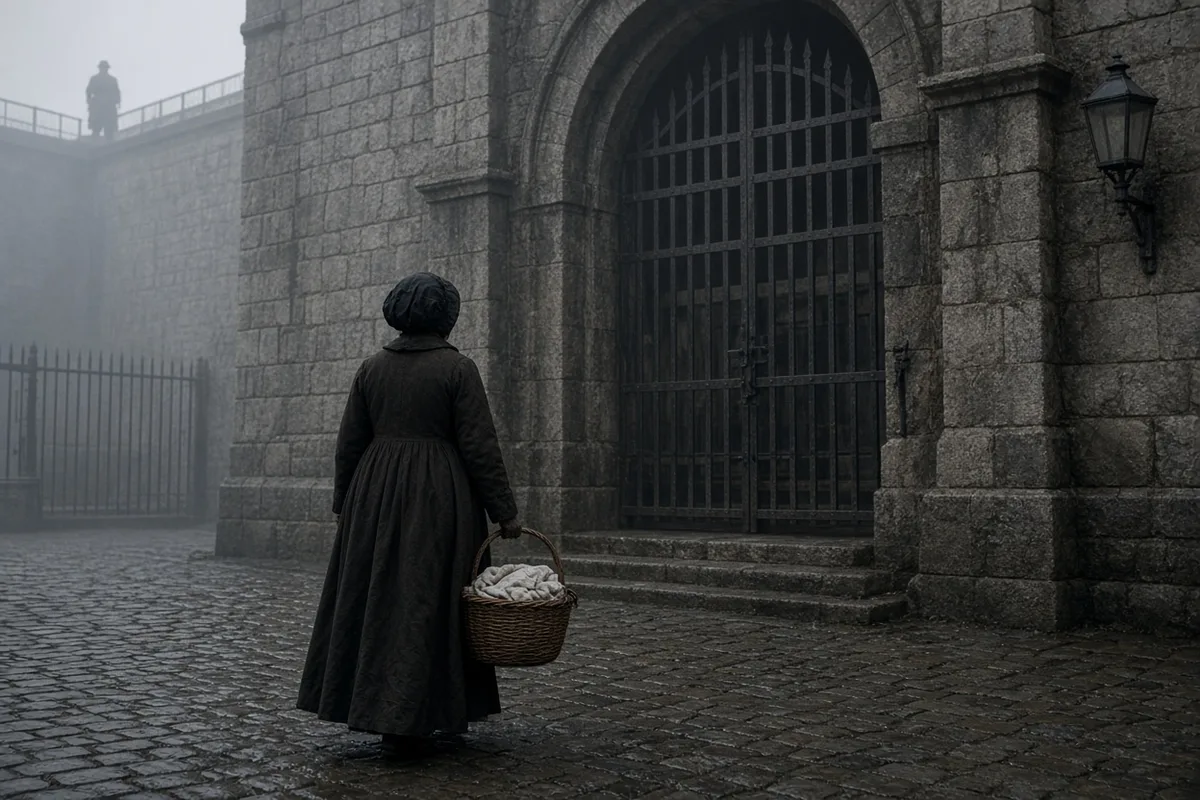
The prison wall rose ahead, black with soot and older than any of us could name. A turnkey met us at the gate. He looked at the basket, then at the four of us in our caps and sober cloaks. “I don’t think we can let you go in,” he said. “They’re a bunch of wild beasts in there. They’ll have the rings off your fingers before you reach the stairs.”
Elizabeth answered without raising her voice. “We have come with food. We mean to give it.” The man hesitated, then shrugged and swung the gate wider. We followed him through a short passage that smelled of wet stone and old straw.
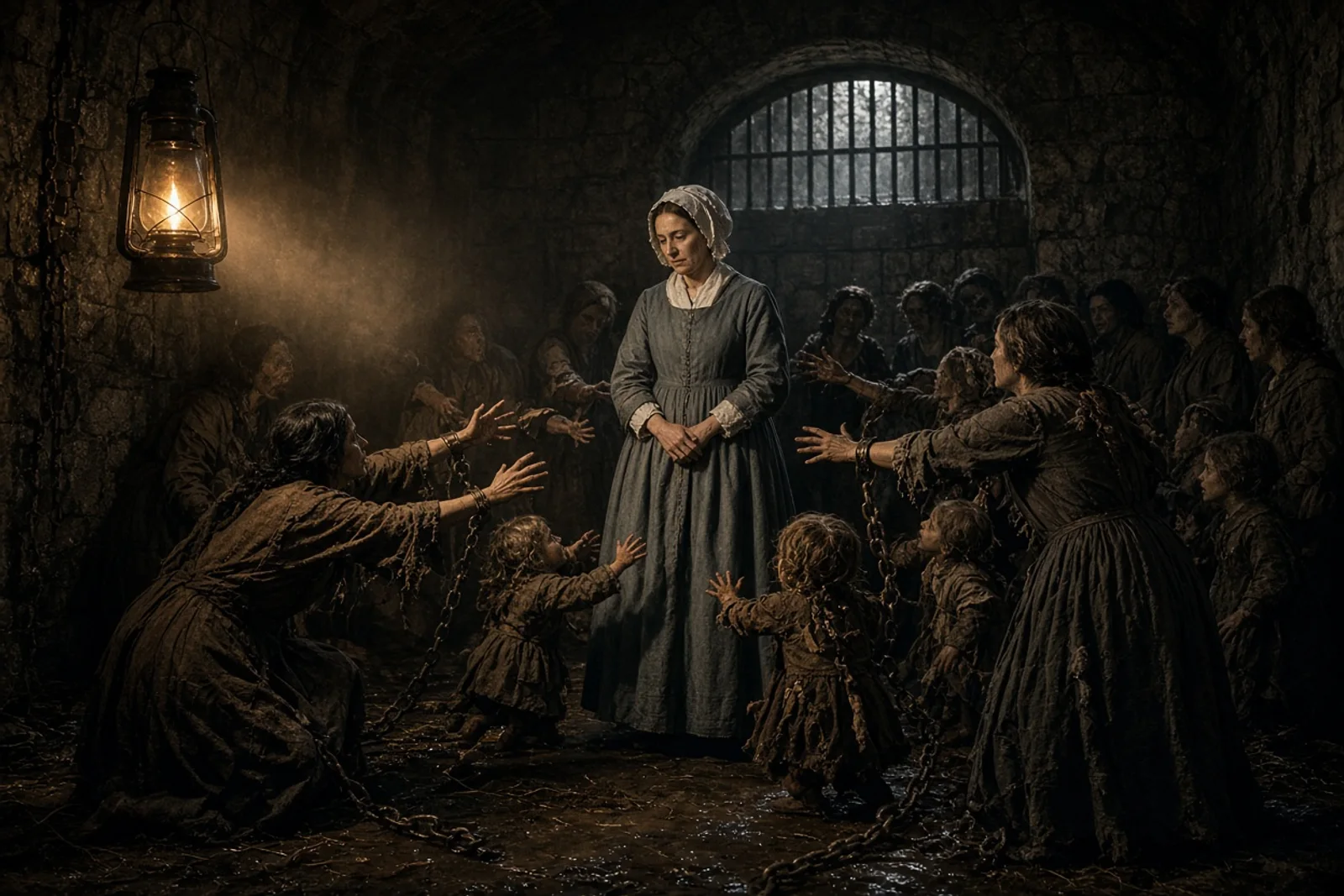
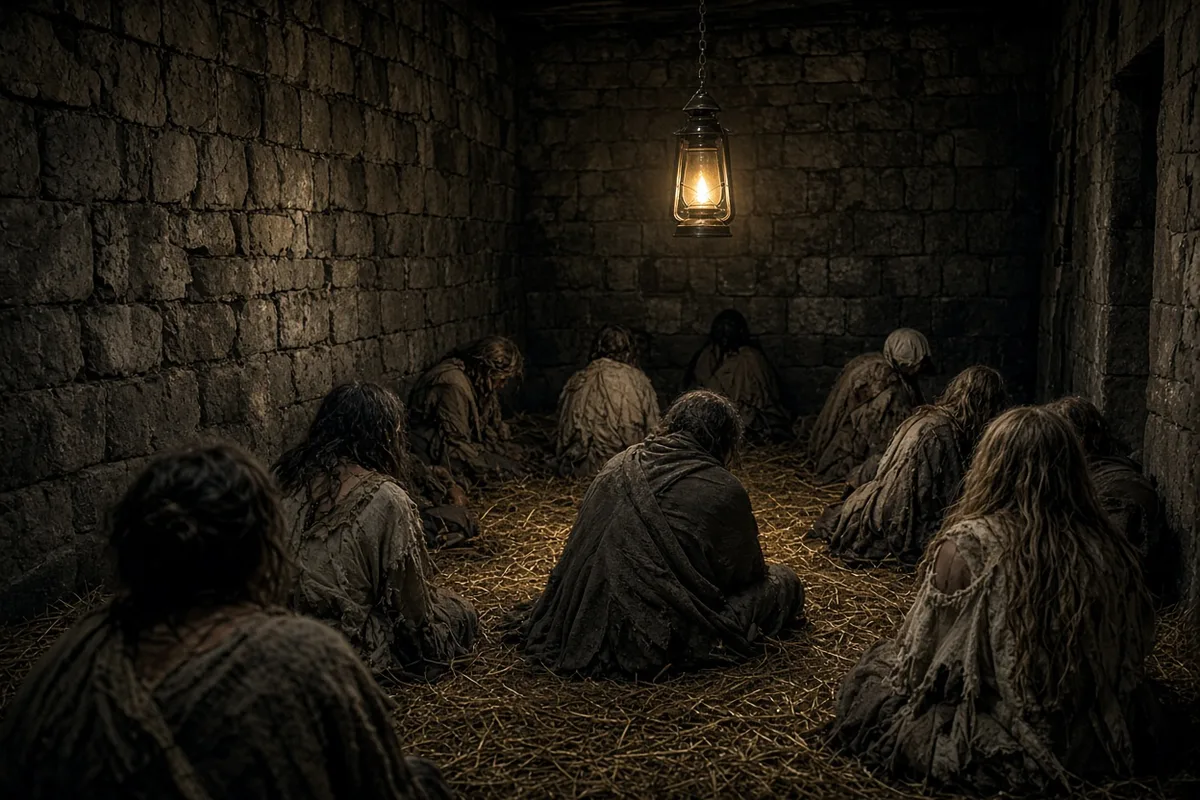
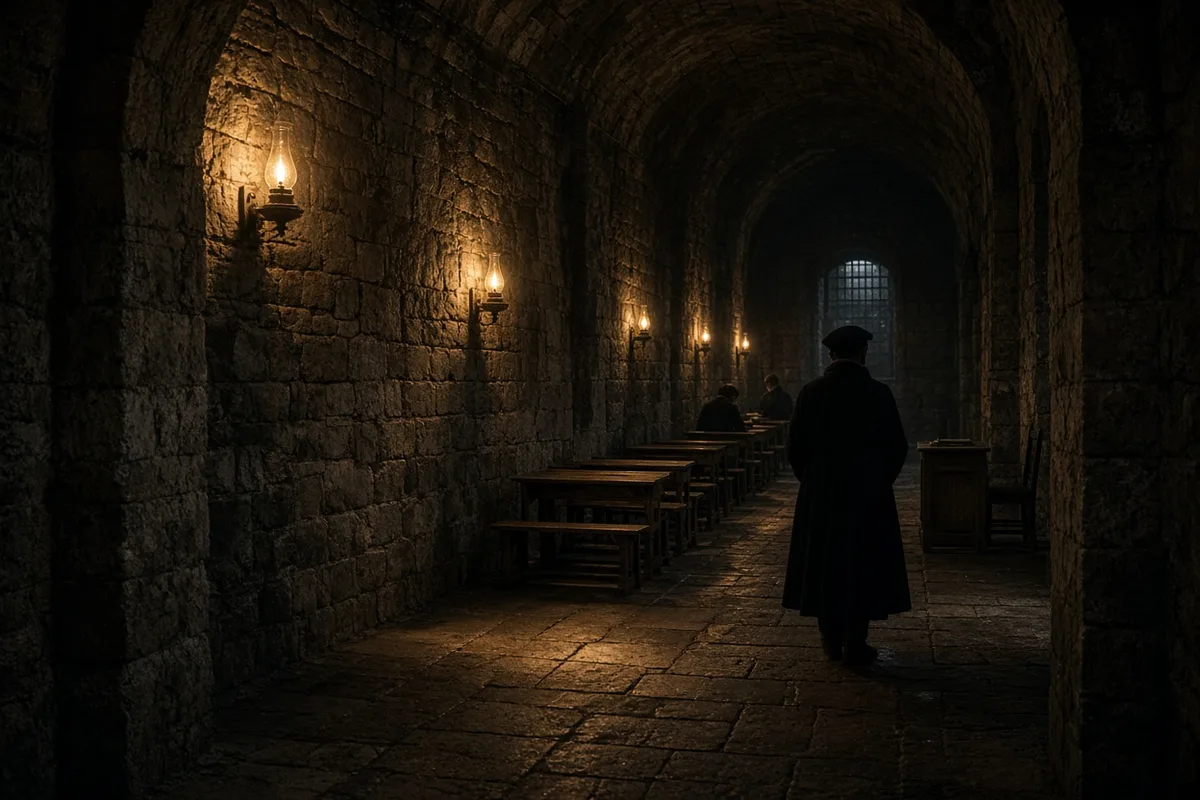
Inside the women’s ward the air thickened at once. Three hundred women and children occupied space built for sixty. Some lay on bare boards. Others sat upright against the walls, skirts stiff with dirt. A girl no older than fourteen nursed a baby at one breast while a second child tugged at her sleeve. Two women argued over a tin cup, their voices raw from shouting. The turnkey locked the door behind us and walked away.
Elizabeth set the basket on the floor. One of the women nearest us reached for it without standing. Another pulled the first back by the hair. I stepped forward, but Elizabeth lifted a hand. She began to hand out the loaves one by one, speaking each name she had been given at the gate. Most took the bread without thanks. A few turned their faces to the wall.
Near the far corner a woman knelt beside a bundle of rags. She worked quickly, stripping a small dead infant of its only garment. Another baby lay beside her, alive but blue with cold. The woman wrapped the living child in the dead one’s shift and laid it against her own body. She did not look up when we passed.
We stayed until the bread was gone. My hands shook when I took the empty basket again. Outside the gate the air felt thin. Elizabeth walked ahead of us toward the waiting cart. She did not speak of what she had seen.
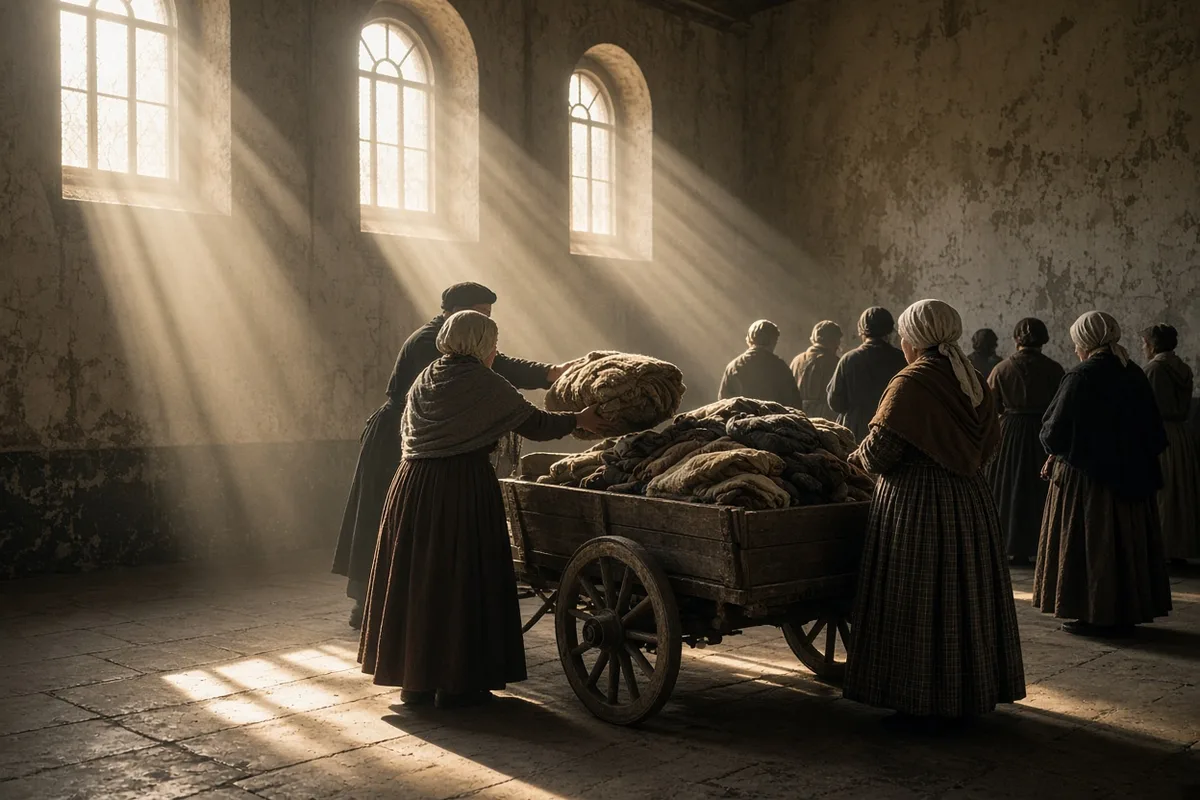
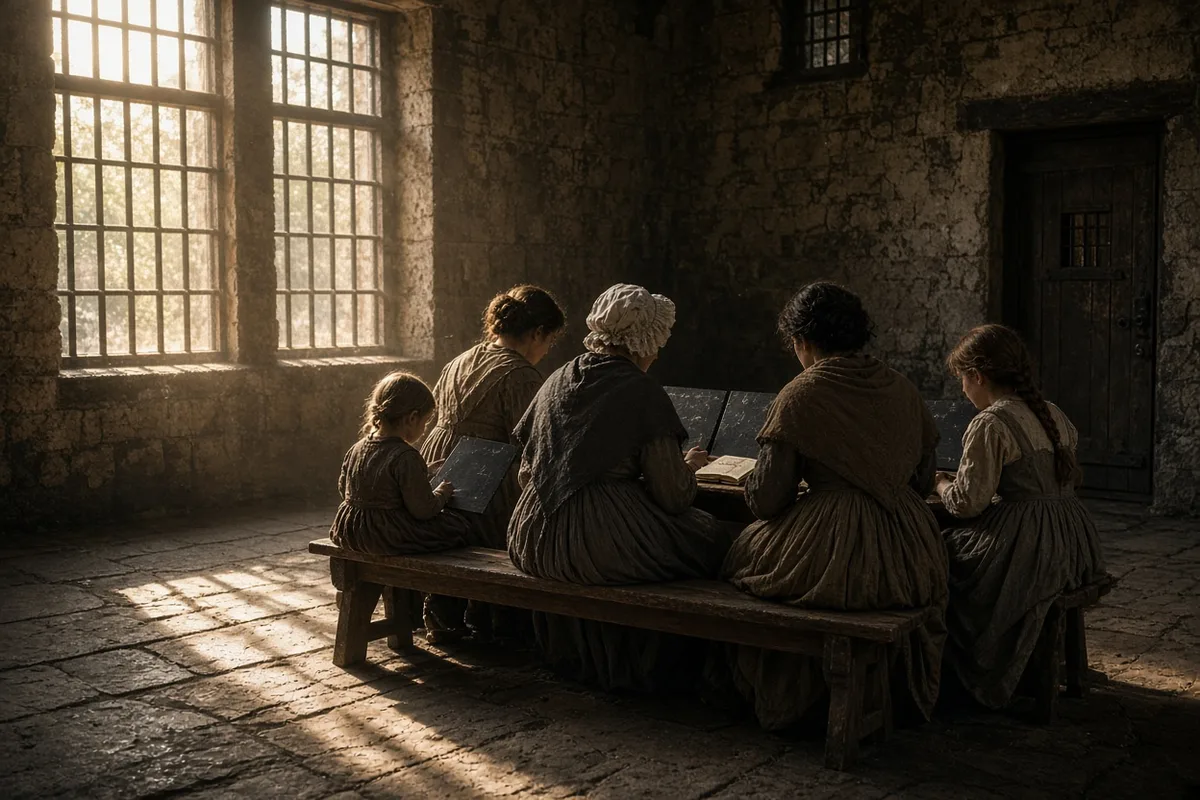
Three years later she returned with a larger group of women. By then the men’s side had been closed off from the women’s, though the crowding remained. She brought no provisions the second time. Instead she carried her Bible and asked whether any would listen while she read. The ward grew still enough that the turnkey on the stairs stopped to watch. After that visit she began to gather other Quaker women into a regular association. They found a matron willing to live inside the walls and began to teach the prisoners to sew and to keep simple accounts.
By the spring of 1817 the City authorities agreed to inspect the changes. The women who had once fought over scraps now sat in rows with work in their laps. The same turnkey who had warned us at the gate stood with his arms folded and said nothing. Elizabeth continued to visit each week, sometimes bringing her own daughters when they were old enough to sit quietly.
One afternoon a woman who had been sentenced to transportation asked whether any of the children might be allowed to leave with her. Elizabeth wrote the request down and carried it to the magistrates. A few weeks later the child was released into the care of a relative outside the prison. The mother sailed without her.
The work grew beyond Newgate. Other jails asked for the same rules: female officers only, daily occupation, and regular reading. Elizabeth kept a ledger of every prison she entered and the number of women and children inside it. She noted the date of each visit in the margin. When her husband’s bank failed she moved the family to a smaller house but continued the rounds. She was often away from home for weeks at a time.
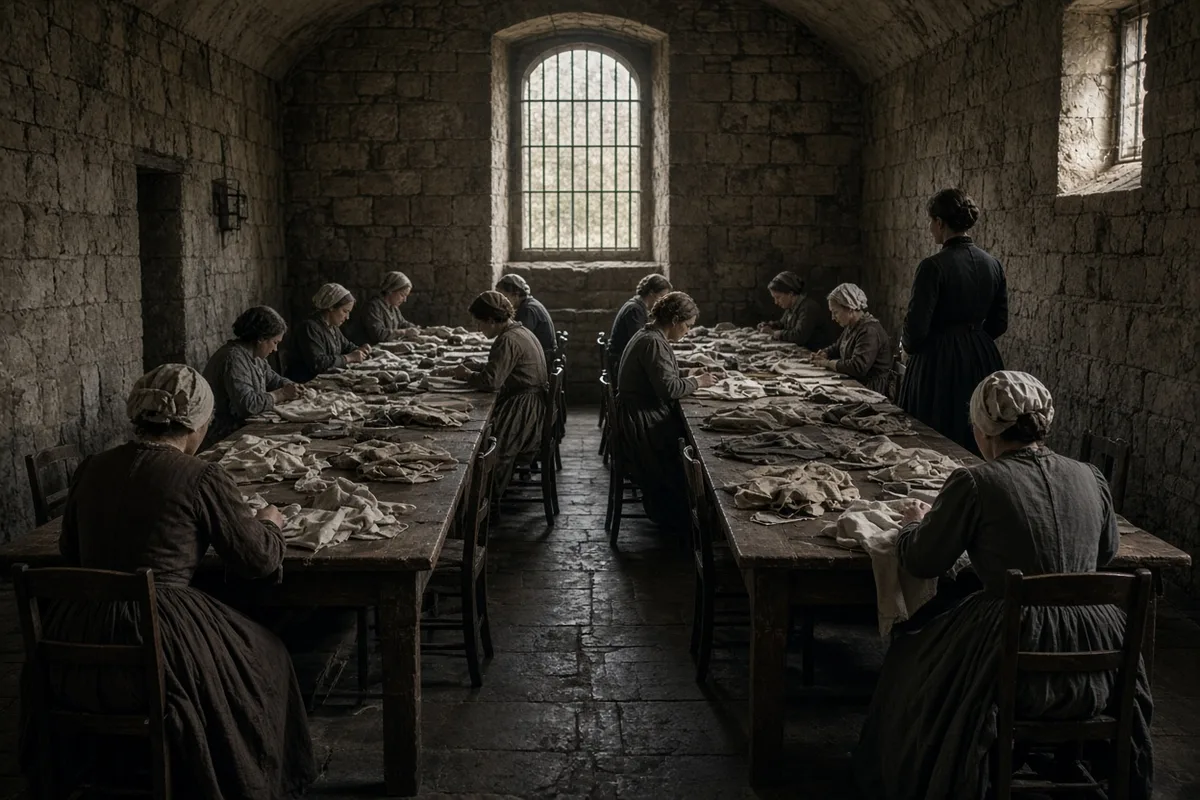
In the last year of her life she traveled north to inspect a new house of correction. The matron there showed her the separate cells and the workroom where women stitched shirts for the navy. Elizabeth stood at the doorway for a long time without entering. On the return journey she asked the coachman to stop at a particular milestone so she could step down and stretch her legs. She walked a few paces along the verge, then returned to the carriage. The driver later said she had seemed content to be moving again.
She died at Ramsgate on the twelfth of October 1845 after a brief illness that left her unable to travel further south from the house at Upton where she had spent her final weeks. The coachman who had stopped at the milestone recorded in his notebook the exact date of that northern journey and the name of the house of correction at Knutsford, where the matron, Mrs. Lydia Moss, had counted forty-three women in the workroom stitching shirts at two shillings and sixpence per dozen. Elizabeth’s daughter Katharine Fry noted in her journal that her mother’s last spoken words concerned the placement of a new matron at the Liverpool borough gaol and the precise sum still owed to the Newgate sewing mistress for thread supplied in March. The funeral took place at the Friends’ meeting house in Plashet on the seventeenth, attended by one hundred and eighty members of the British Ladies’ Society, whose minute book lists the names of the twelve women who had accompanied Elizabeth on her first Newgate visit in 1813.
Her son-in-law Francis Cresswell arranged for the transfer of her prison notebooks to the care of the London Female Penitentiary at Cold Bath Fields, where the superintendent, Miss Elizabeth Gordon, entered on the first page the figures Elizabeth had recorded for Newgate in 1823: three hundred and seventeen women and one hundred and four children under the age of ten. The British Ladies’ Society continued its weekly readings at Newgate under the direction of Elizabeth’s sister-in-law, Priscilla Fry, who reported to the Home Office in 1848 that the matron now received an annual salary of forty-five pounds and that the women produced two thousand three hundred shirts for the navy in the preceding twelve months. The last entry in Elizabeth’s own ledger, dated 1844, records a visit to the Clerkenwell House of Detention where she counted nineteen female prisoners and noted the absence of any separate day room.
Newgate’s women’s ward was closed to new admissions after the Prisons Act of 1865 required separation of untried and convicted prisoners. The City of London surveyor’s report of 1877 lists the remaining female population at forty-two and states that the treadwheel installed in 1822 had been dismantled the previous year. Demolition of the entire prison began on the third of April 1902 under the direction of the City Architect, Sir Henry Tanner, who preserved the stone archway of the debtors’ door and the iron gate through which Elizabeth had first entered in 1813. The site was cleared by November and the foundation stone of the new Central Criminal Court was laid on the twenty-seventh of August 1903 by the Lord Mayor, Sir Marcus Samuel.
The Old Bailey courtrooms opened for business on the twenty-seventh of February 1907. Court number one still contains the original prisoners’ dock rail from Newgate, identified by the City engineer’s inventory as the rail against which Elizabeth had stood when she spoke with the woman sentenced to transportation in 1817. A bronze tablet fixed to the wall of the public entrance records the date of Elizabeth’s first visit and the names of the four women who accompanied her, taken from the minute book of Ratcliff and Barking Monthly Meeting. The tablet was unveiled on the twelfth of October 1913 by her granddaughter, Elizabeth Fry Fox, who had been present at the Ramsgate house on the day of her grandmother’s death.
In 1921 the British Ladies’ Society changed its name to the Elizabeth Fry Society and moved its records to a room above the new women’s hostel at 195 Commercial Road. The hostel register for 1923 shows that one former Newgate prisoner, Mary Ann Sullivan, who had learned to read under Elizabeth’s instruction in 1829, was admitted for three weeks while seeking employment as a needlewoman. The society’s annual report for that year quotes Sullivan’s statement that she still possessed the Bible given to her at Newgate and that the flyleaf bore the inscription “E. Fry, 4th of 5th month 1829.”
The last documented image of any person connected with Elizabeth’s Newgate work appears in a photograph taken on the twenty-third of June 1944 at the Elizabeth Fry Memorial Meeting held at Friends House, Euston Road. The photograph shows Elizabeth’s great-granddaughter, Anna Harvey, then aged seventy-two, standing beside the original Newgate Bible that had been returned to the society after the death of Mary Ann Sullivan in 1901. The Bible’s cover bears the stamp of the Newgate chaplain, the Reverend Horace Cotton, and the date 1818 written in Elizabeth’s hand.
The Bible remained on display in the meeting room at Friends House until the autumn of 1952, when the Elizabeth Fry Society’s committee voted to transfer it to the London Metropolitan Archives under the supervision of archivist Ida Darlington, who catalogued it as item ACC/1861/001 and recorded its weight at two pounds three ounces with a brass clasp stamped “H.C. 1818.” Darlington’s accession note quotes a letter from Anna Harvey dated 12 September 1952 stating that the volume had been “kept in a locked case since the meeting at Euston Road and should now be placed where students may examine the marginal notes in my great-grandmother’s hand.” The society retained only a single photostat copy, which its secretary, Marjorie Sykes, carried to the Annual Conference of Women’s Organisations held at the Central Hall, Westminster, on 4 March 1953.
In 1965 the Elizabeth Fry Society merged with the National Association of Probation Officers, an arrangement recorded in the minutes of the joint committee meeting at 2 Hobart Place on 18 June, attended by twenty-seven delegates including Fry’s great-great-grandson, John Harvey, who moved the resolution that the combined body continue to supply matrons’ salaries at three existing borstals. The new entity adopted the title National Association for the Care and Resettlement of Offenders and opened an office at 125 Kennington Park Road, where the 1923 hostel register was microfilmed in 1968 by technician Leonard Price, who noted that the entry for Mary Ann Sullivan occupied line 47 of volume 2 and measured eleven inches by eight.
The Central Criminal Court underwent partial reconstruction between 1973 and 1977 under the direction of architect George Whitby, whose working drawings specify that the original Newgate dock rail was lifted on 14 February 1974 and stored for three months in the basement strong-room before reinstallation in Court 1 on 9 May. During the same works the bronze tablet from 1913 was removed, cleaned by stonemason Arthur Collins, and re-fixed with stainless-steel cramps; Collins’s day-book entry for 22 August 1974 records that the lettering remained legible to a depth of one-sixteenth of an inch after polishing with pumice and linseed oil.
On 9 October 1981 the Lord Chancellor, Lord Hailsham, unveiled a second plaque in the public concourse listing the names of twelve women who had served as prison visitors between 1817 and 1845, the text taken verbatim from the British Ladies’ Society minute book now held at Friends House under shelf-mark MS VOL 345. The ceremony was attended by thirty-four descendants, among them Elizabeth Fry Fox’s granddaughter, Rachel Harvey Smith, then aged eighty-four, who signed the visitors’ book at 11:47 a.m. and added the note “my grandmother spoke of the cold in the ward.”
The Elizabeth Fry Society’s remaining records were deposited at the London Metropolitan Archives in 1992 by its last honorary secretary, Helen Roberts, whose covering letter dated 3 February lists thirty-seven bound volumes and states that the 1848 Home Office report on Newgate shirt production occupies pages 112 to 117 of volume 19. In 1998 the archives mounted a temporary exhibition of the Newgate Bible, open daily from 9:30 a.m. to 4:45 p.m. between 1 June and 31 August; the exhibition register records 1,842 visitors, of whom 217 requested to see the marginal note “read aloud 17th of 4th month 1822” on page 147.
A colour photograph taken on 12 October 2003 at the Old Bailey during the bicentenary commemoration of Elizabeth Fry’s birth shows her great-great-great-granddaughter, Sarah Harvey, aged forty-nine, standing beside the preserved dock rail while holding a replica of the 1813 visiting permit issued by the Sheriffs of London. The image, captured by court photographer Michael Jones on Kodak Portra 400 film, was deposited with the City of London Records Office under reference COL/OF/03/147 and remains the most recent known likeness of any direct descendant present at the site of the original women’s ward.
The final recorded appearance of any individual connected with the Newgate work occurred on 23 June 2015 when John Harvey, then ninety-one, visited the London Metropolitan Archives to view the original 1813 minute book. Archivist Catherine Roberts noted in the day ledger that Harvey examined page 4 for twenty-two minutes, pointed to the entry listing the four women who accompanied Elizabeth Fry, and remarked that his great-great-grandmother had been “the one who carried the stockings.” He left the building at 3:17 p.m. and died at his home in Hampstead on 7 November of the same year.