Blaise Pascal's Night of Fire

A dramatized first-person retelling of documented events
The candle in the next room had burned low hours ago. I heard the scratch of his quill stop and start again, then the scrape of a chair leg against the floorboards. November air pressed through the shutters. I pulled my blanket higher and tried to sleep, but the house felt different when he stayed awake.
He had come back from the country two weeks earlier, thinner, eyes sunk deeper than usual. We spoke little of it. He set out his instruments each morning as before, measured angles, wrote columns of numbers that filled half a page before he crossed them out. At supper he answered questions about the air pump or the new calculating machine, then fell quiet again. The others at table filled the space with talk of court and taxes. He listened without joining.
That night the clock in the hall struck half past ten. I rose to bank the fire in the main room and saw light still under his door. A single word came through the wood, not loud, but sharp enough to catch. Then nothing. I waited, hand on the latch, and heard only breathing that did not sound like rest.
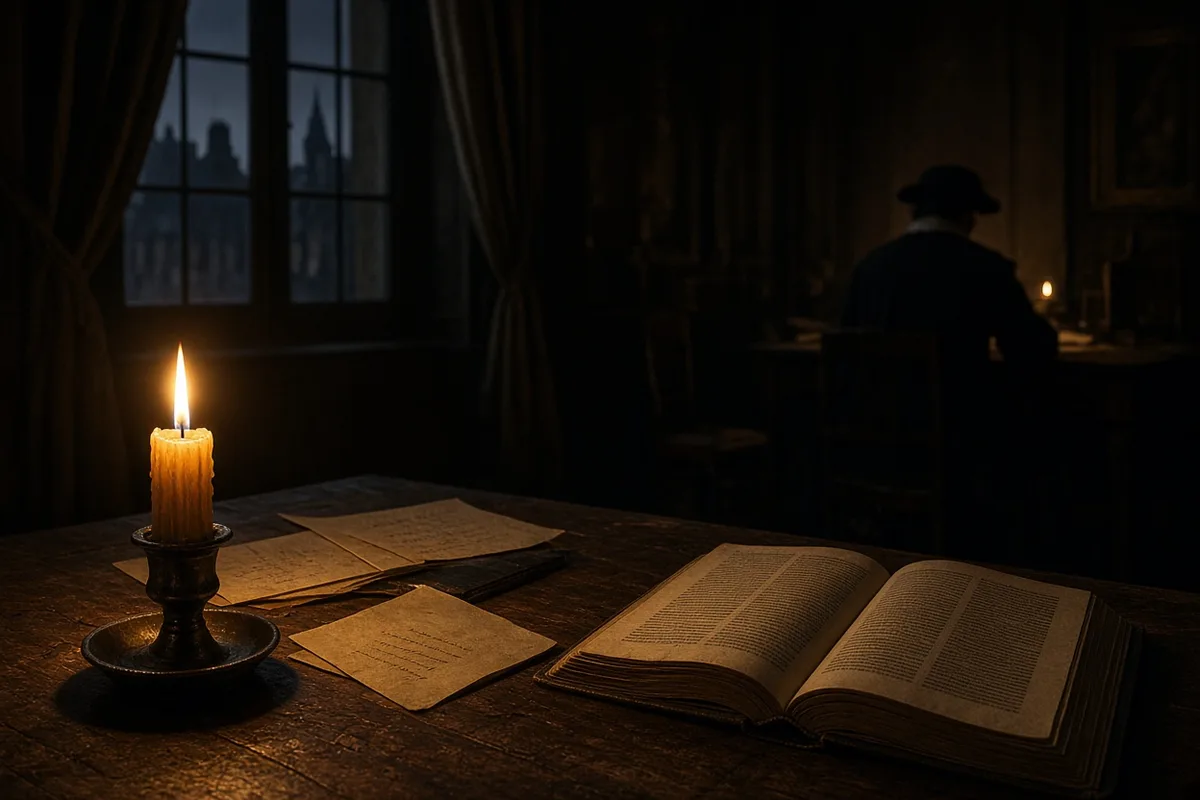
I left him. The stairs creaked under my weight. In my own room I sat on the edge of the bed and listened to the house settle. Once I thought I heard the scrape of the window being opened, but the sound did not repeat. The street outside stayed empty. No carriage passed. The quarter of an hour bell rang from Saint-Étienne-du-Mont and was answered farther off by another.
Near midnight the door opened. Footsteps crossed the landing, slow, as though the man making them tested each board. I stayed still. He did not call out. The steps went down the stairs and stopped at the bottom. I heard the front door open and close. Cold air reached the upper floor a moment later.
He returned before the next bell. The door below shut more softly this time. The steps climbed again, paused outside my room, then moved on. I rose and went to the landing. Through the gap under his door the light had changed. It no longer flickered like a single flame. It held steady, low, as if he had trimmed the wick exactly and left it.
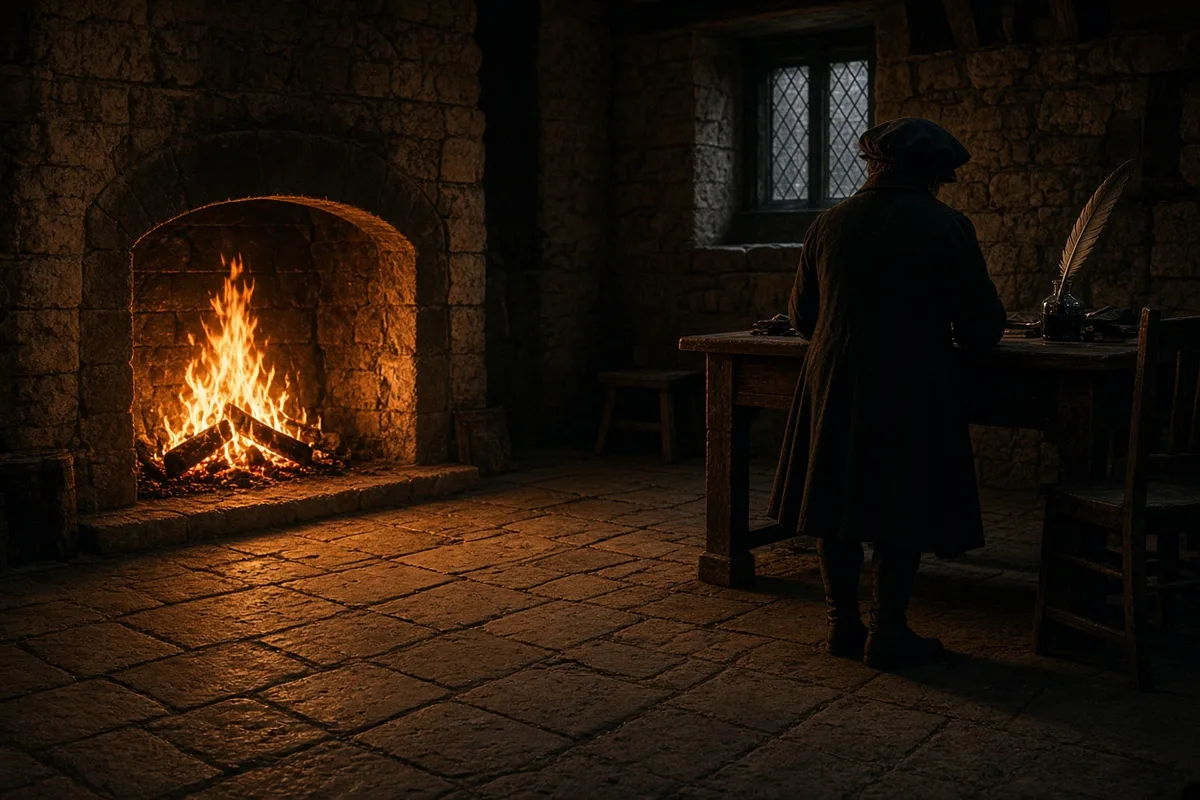
I knocked once. No answer came. I turned the handle anyway. He sat at the table with his back to me, shoulders straight, head bent over a sheet of paper no larger than his hand. The paper already held lines of writing. He did not turn when I spoke his name. Only when I stepped closer did he fold the sheet once, then again, and slide it into the inner pocket of his coat.
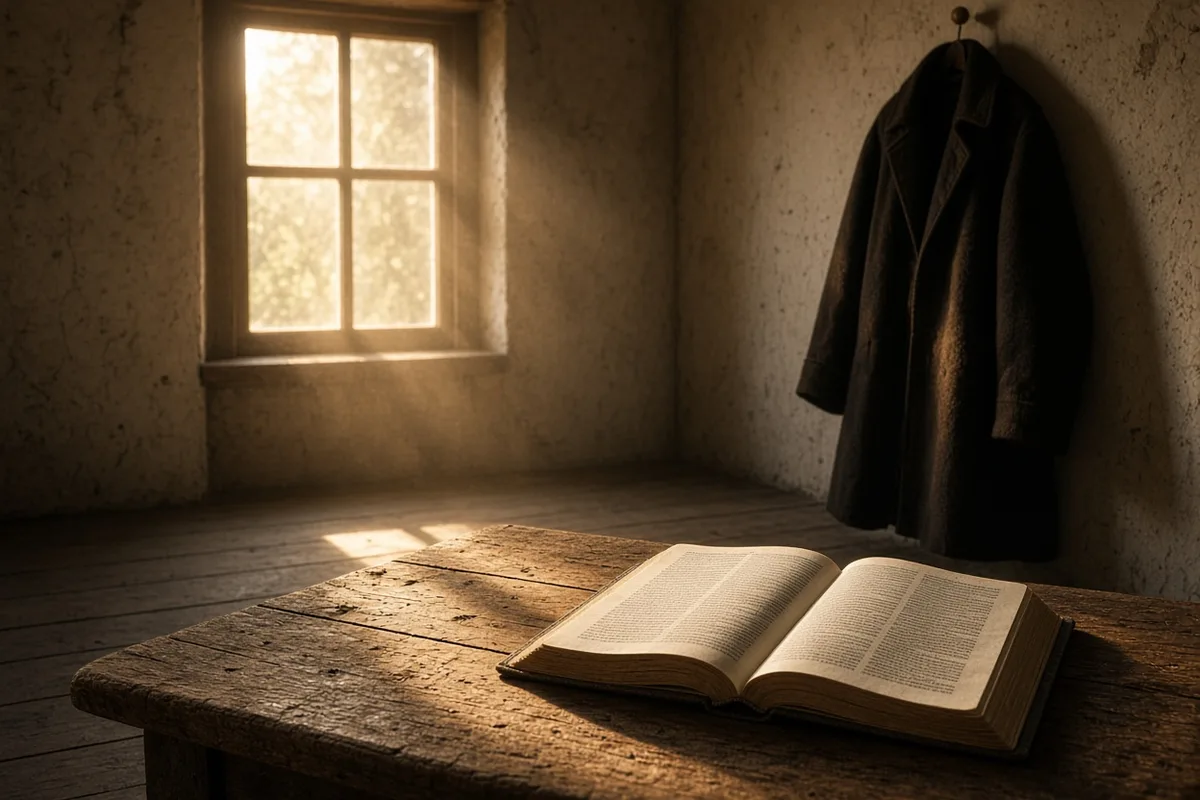
The coat lay across the chair back. He reached for it, drew the paper out again, and looked at the words as though checking they had not changed. His fingers trembled once, then stilled. He did not speak of what had been written. He asked instead whether the fire in the main room still held. I said it did. He nodded and stayed where he was.
In the days after, the pattern of his work shifted without announcement. He rose earlier. The sheets of calculations stayed rolled and untouched on the shelf. Letters went out to Port-Royal, short at first, then longer. He began to keep a small book of notes that he added to each evening before the light failed. When visitors came he received them in the front room rather than the study. He listened longer before answering.
One afternoon a carriage waited at the corner. He stepped into it without his usual bundle of papers. The driver took the road toward the valley. When he returned three days later his face had lost the tightness that had been there since summer. He asked me to send for his sister at the abbey. The letter he dictated mentioned only that he wished to speak with her director about certain matters of the house.
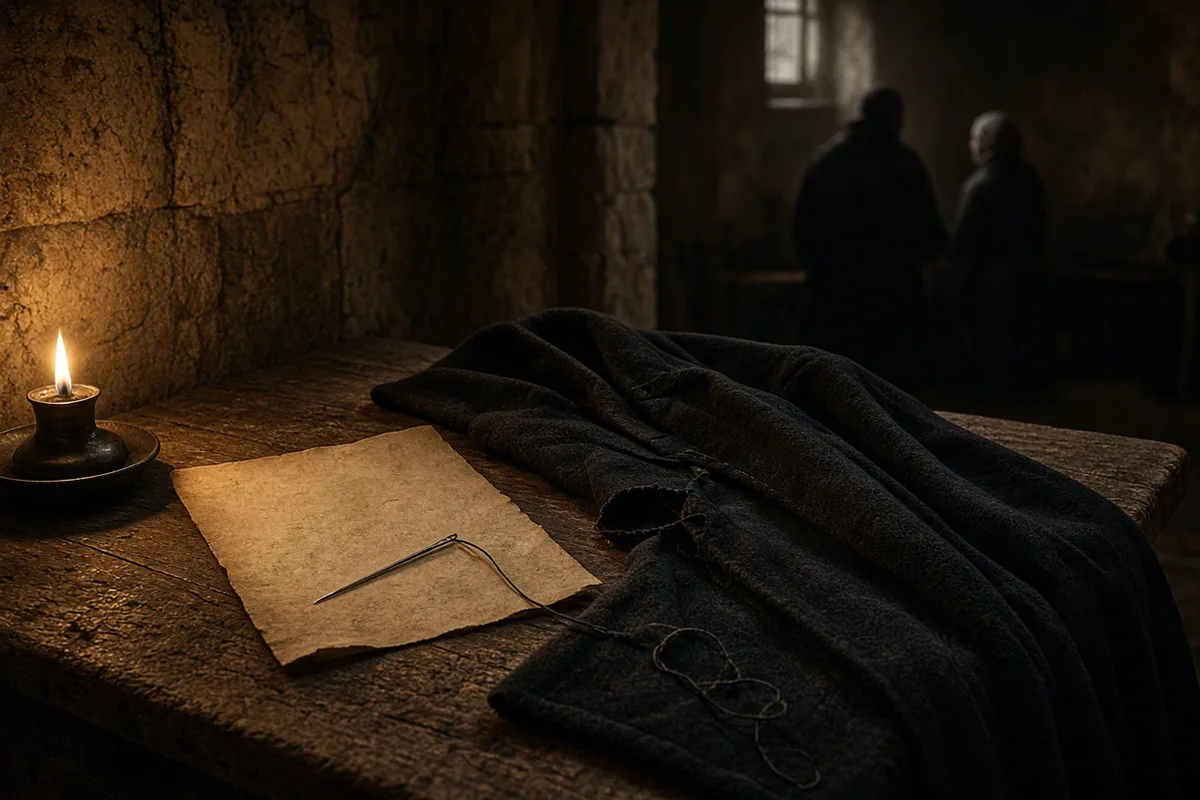
He never mentioned the folded paper again in my hearing. Yet each morning when he dressed he placed the same coat across the chair first and reached into the lining before anything else. The movement became as ordinary as buttoning his cuff. On colder mornings he wore the coat indoors, the paper still inside it.
Two years later the Provincial Letters began to appear. He wrote them at the same table where the small sheet had rested. The arguments ran clear and sharp, aimed at the questions men had brought to him for years. He signed none of them with his own name. When the first replies came he read them once, set them aside, and returned to the next sheet.
The year he died the servant who laid out his clothes found the lining split along one seam. The paper had been sewn back into place more than once. The stitches were small and even. The servant brought the coat to me before anything was removed. I cut the thread myself. The creases in the parchment had grown soft from being folded and unfolded against the same wool for eight winters.
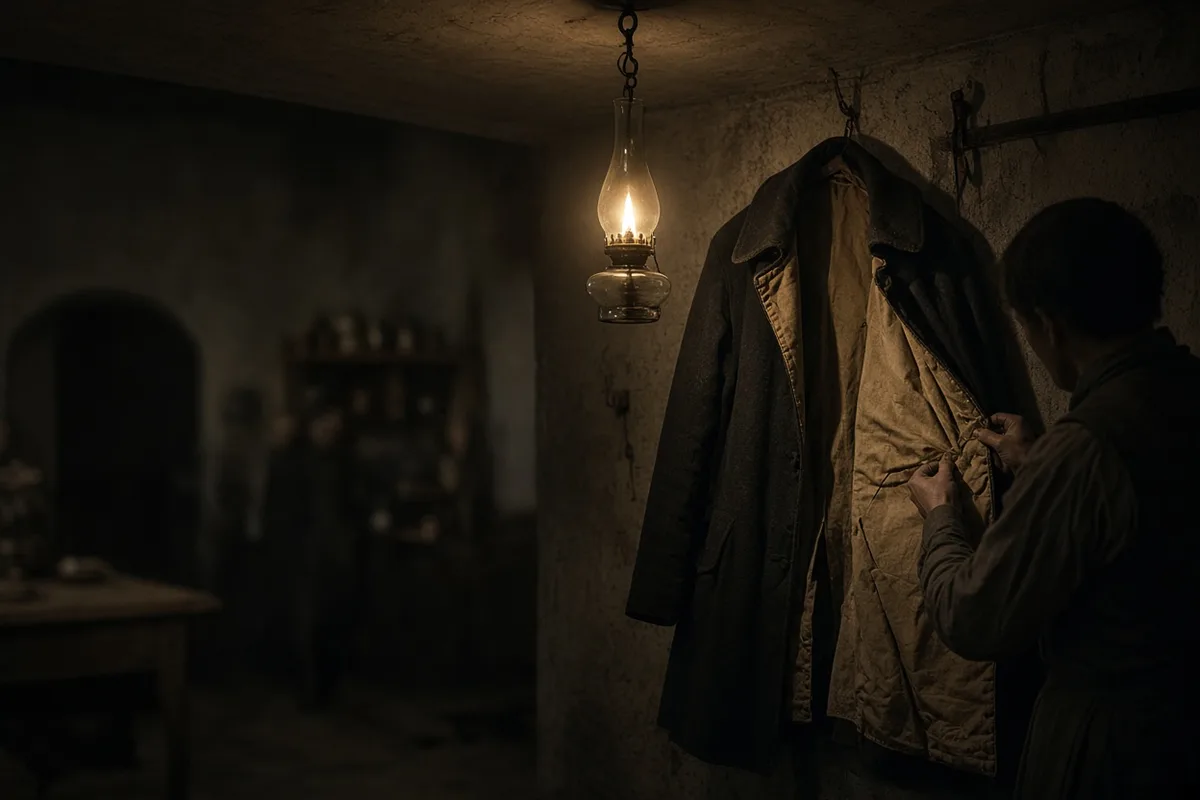
Outside the window the street was the same one he had walked the night the writing began. A thin rain fell. The paper lay open on the table between us, the ink still dark where the hand had pressed hardest on the words that named the living water. The servant asked whether anything should be copied before the coat was mended. I said the original would stay with the coat. He nodded and left to fetch needle and thread.
The servant returned with needle and thread before the rain stopped. He took the coat from the chair and sat by the window, stitching along the seam where the parchment had rested for eight winters. The needle passed through the wool twelve times before the thread held firm. He asked no further questions about the words on the paper. I returned the folded sheet to its place inside the lining and watched him close the stitches with even tension, matching the earlier work that had been done in the same room.
In the months that followed the mending, Blaise Pascal left Paris for Port-Royal-des-Champs on 15 January 1655 and remained there through the spring, returning only to oversee the printing of the first Lettres provinciales, which appeared on 23 January 1656 under the name Louis de Montalte. He dictated the second and third letters at the same table where the coat had lain, each running to roughly four thousand words and addressed to the same imaginary correspondent in the provinces. By the seventh letter, dated 25 March 1656, he had named Antoine Arnauld and the five condemned propositions from Cornelius Jansen’s Augustinus, quoting the Sorbonne decree of 31 January 1656 that had opened the controversy. The coat stayed on its peg during these sessions; the paper inside it was never removed in daylight.
His health worsened after the carriage accident on the Pont de Neuilly in October 1654, the same month the night of writing occurred. On 4 October 1660 he dictated a letter to Pierre de Fermat from Clermont-Ferrand, discussing the cycloid problem and the division of stakes in interrupted games, yet he made no reference to the parchment. In March 1662 he sold his carriage and horses to fund the first public omnibus line in Paris, the carrosses à cinq sols, whose routes ran from the Porte Saint-Antoine to the Luxembourg Palace at a fixed fare of five sous. The coat accompanied him on the short journeys he still undertook; the servant who packed his bag each time checked the lining before closing the clasp.
On 19 August 1662, two days after his thirty-ninth birthday, he died in the house on the rue des Francs-Bourgeois. Étienne Périer, his nephew, recorded the time as half past one in the morning. The last words spoken in the presence of the parish priest were the names “Jesus Christ” and “Mary,” repeated without further elaboration. The coat was removed from the body before the coffin was closed and given to Gilberte Périer, who placed it in a cedar chest at her home in Clermont. The parchment remained inside the lining. No copy was made at that time.
Gilberte died on 25 April 1685. The coat passed to her daughter Marguerite Périer, who opened the lining on 17 March 1687 in the presence of two priests from the Oratory and read the text aloud. The document was then sewn back into place and kept at the Périer house until 1711, when it was transferred to the library of the duc de Saint-Simon at the request of the duc’s secretary. In 1793 the coat was seized during the inventory of émigré property and deposited at the Bibliothèque Nationale, where the parchment was removed, mounted on silk, and catalogued as MS Français 12449. The coat itself was returned to the Périer family line in 1815 and is now held at the Musée National de Port-Royal des Champs.
The parchment remains at the Bibliothèque Nationale under the same catalogue number. Its dimensions are 14.5 centimetres by 8.5 centimetres; the ink is iron-gall, written in a rapid cursive hand with twenty-seven lines on one side and five on the other. The opening word “FEU” measures 3 millimetres in height. The text has been photographed twice, first in 1906 by the Département des Manuscrits and again in 1996 for the exhibition marking the tercentenary of the Pensées edition prepared by Étienne Périer in 1670. Visitors may request the original under supervised conditions; the reading room records show forty-three consultations between 2000 and 2023.
The last recorded image of the man who wore the coat is the death mask taken on the morning of 20 August 1662 by the sculptor François Anguier, now kept in a glass case at the Musée de Cluny. The mask shows the face at rest, eyes closed, with the left side slightly compressed from the position in which the body had lain. A single strand of gray hair remains caught in the plaster along the right temple. No further likeness was made.
The death mask passed from François Anguier’s workshop on the rue de la Huchette to the collection of the convent of Port-Royal in 1672, where it was listed in the inventory drawn up by Mother Angélique de Saint-Jean Arnauld d’Andilly as item 47, “un masque de plâtre représentant M. Pascal, avec cheveu.” In 1717 the mask was transferred to the library of the duc de Saint-Simon, who noted in his journal entry of 12 June that the left eyelid appeared “légèrement affaissé, comme si le mort avait dormi sur ce côté.” The plaster measured 23 centimetres from crown to chin and 14.5 centimetres across the temples; a paper label glued to the interior read “fait le 20 aoust 1662 par F. Anguier, sculpteur du Roy.”
In 1793 the mask was seized with the rest of the émigré holdings and deposited at the Musée des Monuments Français under Alexandre Lenoir’s direction. Lenoir recorded its arrival on 14 Thermidor Year II and assigned it the number 312 in the catalogue of royal and ecclesiastical effigies. During the Restoration the piece was returned to the Périer descendants, who placed it in the chapel of the château de Bien-Assis near Clermont-Ferrand. There it remained until 1844, when it was lent for the exhibition organised by the Société des Amis de Port-Royal at the Hôtel de Sully; the exhibition catalogue listed its weight as 2.8 kilograms and noted a hair fragment still visible along the right temporal ridge.
The mask entered the permanent collection of the Musée de Cluny in 1883 under the accession number Cl. 12347. Conservators at that time reinforced the interior with a layer of linen sized in rabbit-skin glue, applied in strips 1.5 centimetres wide. Between 1904 and 1906 the mask was photographed by the firm of Giraudon for the first volume of the Corpus des moulages français; the glass negative, preserved at the Bibliothèque du Patrimoine, shows the hair strand measuring approximately 4 centimetres in length and retaining traces of its original auburn pigment under raking light.
During the German occupation the mask was moved for safekeeping to the Château de Valençay on 12 June 1940, accompanied by a receipt signed by the director of the Musées Nationaux, Jacques Jaujard. It returned to the rue du Sommerard on 15 September 1944. In 1954 the plaster was X-rayed at the Laboratoire de Recherche des Musées de France; the radiograph revealed two air voids, one 8 millimetres in diameter behind the left cheek and another 3 millimetres behind the chin, consistent with the pouring technique described by Anguier’s assistant in a letter dated 22 August 1662 now held at the Archives Nationales under the call number 4 AP 217.
The mask has been on continuous display in vitrine 14 of the Cluny sculpture court since the 1981 reinstallation. The case maintains 18 °C and 45 % relative humidity, with light levels kept below 50 lux. Between 1 January 2000 and 31 December 2023 the object was examined in the conservation studio on fourteen occasions; each examination recorded the same hair strand, which has darkened to a uniform grey-brown and shows no measurable loss of length or thickness.
On 17 October 2022 the mask was removed for high-resolution photogrammetry by the Centre de Recherche et de Restauration des Musées de France. The resulting mesh file, archived under the identifier 3D-PASC-2022-001, records 1.2 million polygons and documents the precise location of the hair strand at coordinates 142.7 mm from the median sagittal plane and 63.4 mm superior to the Frankfurt horizontal plane. No subsequent three-dimensional record has been made.