Charles Spurgeon's Conversion in a Snowstorm
A dramatized first-person retelling of documented events
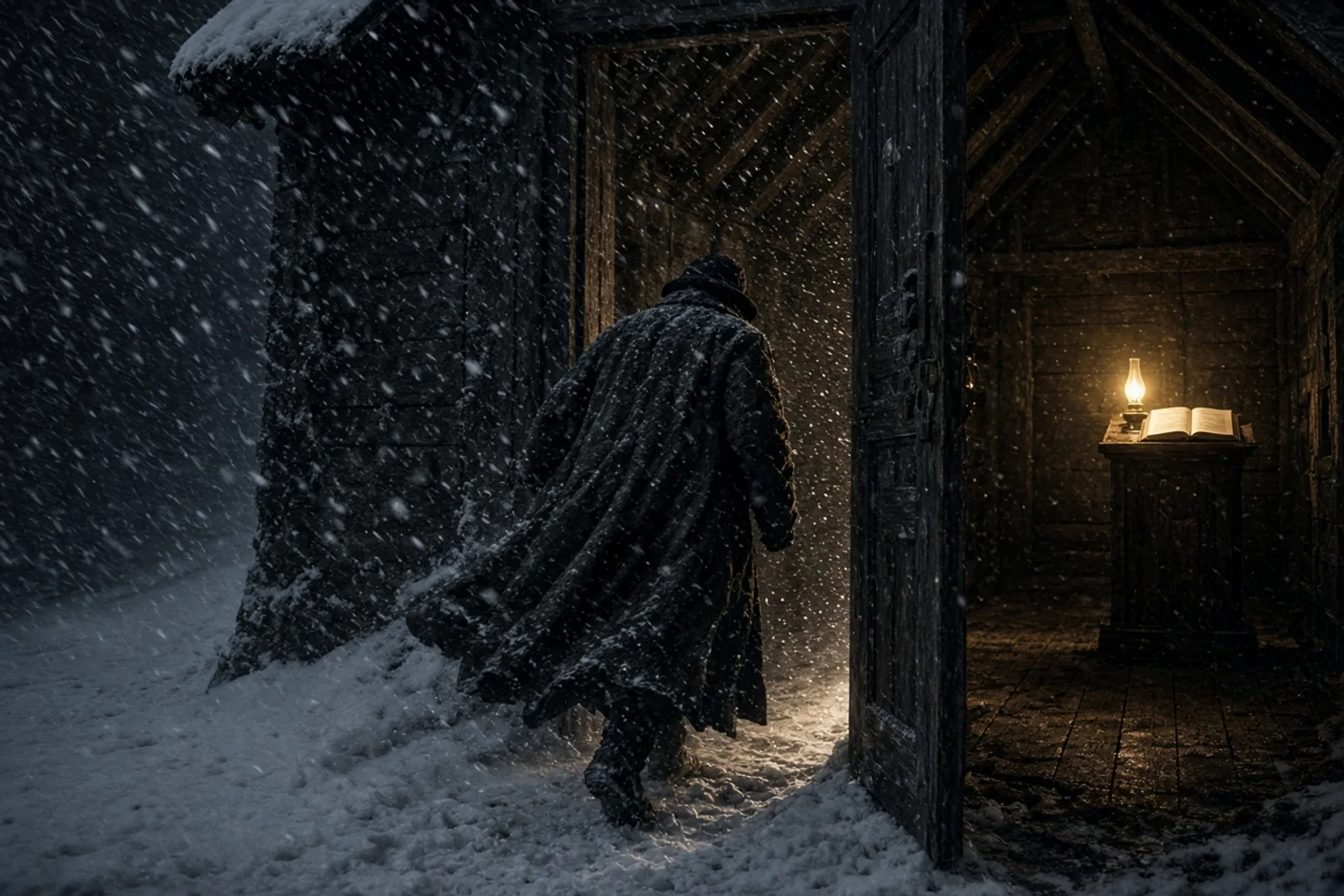
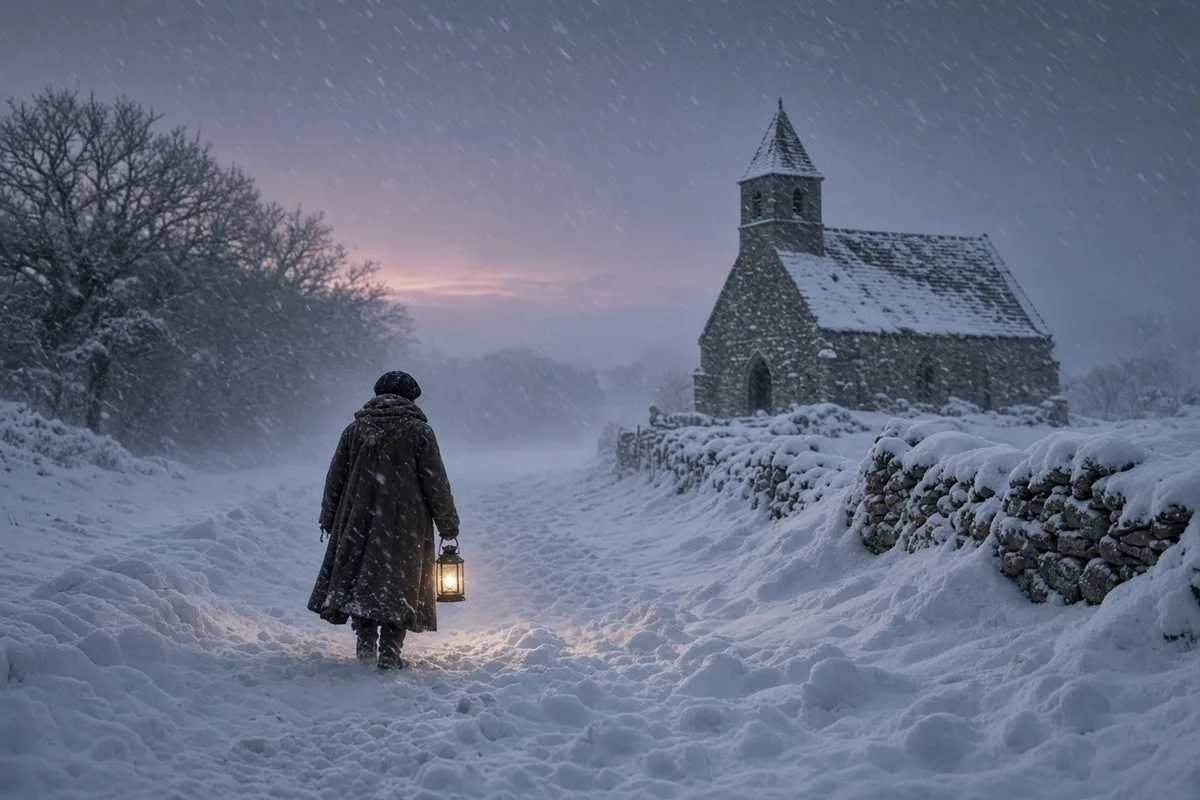
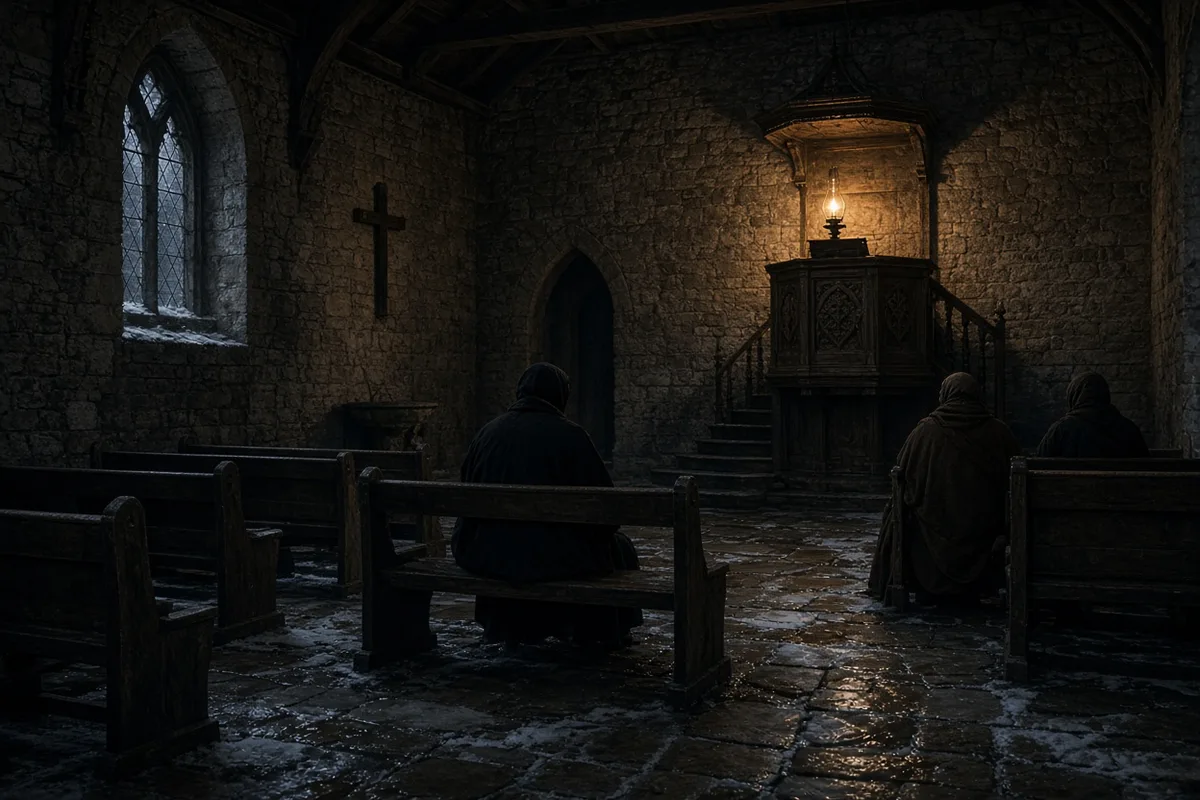
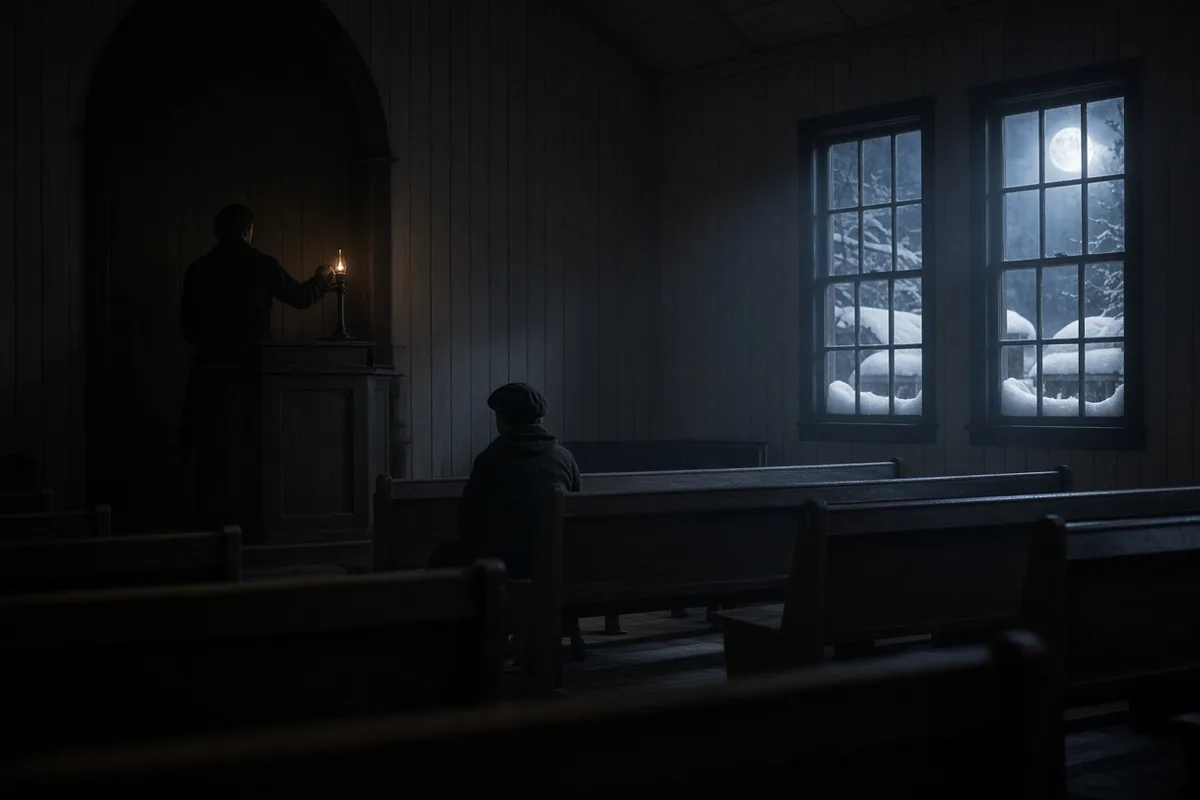
The wind cut sideways across Artillery Street that morning, driving flakes into my collar and turning the cobbles to glass. I had left the workshop early because the snow showed no sign of easing, and the only place with a fire and four walls close enough was the little chapel on the corner. The door stood half open. Inside, the lamps had already been lit against the gloom, though it was not yet noon.
A dozen of us sat scattered on the benches. The regular preacher had sent word he could not reach us, so we waited for whoever might come. I stamped the snow from my boots and took a seat near the back, under the gallery where the draught was least.
A boy I had never seen before slipped in after me. Fifteen or so, thin coat buttoned to the throat, hair dark with meltwater. He chose the bench two rows ahead and sat with his shoulders drawn in, staring at the floorboards. The chapel filled with the sound of the storm against the roof and the occasional cough.
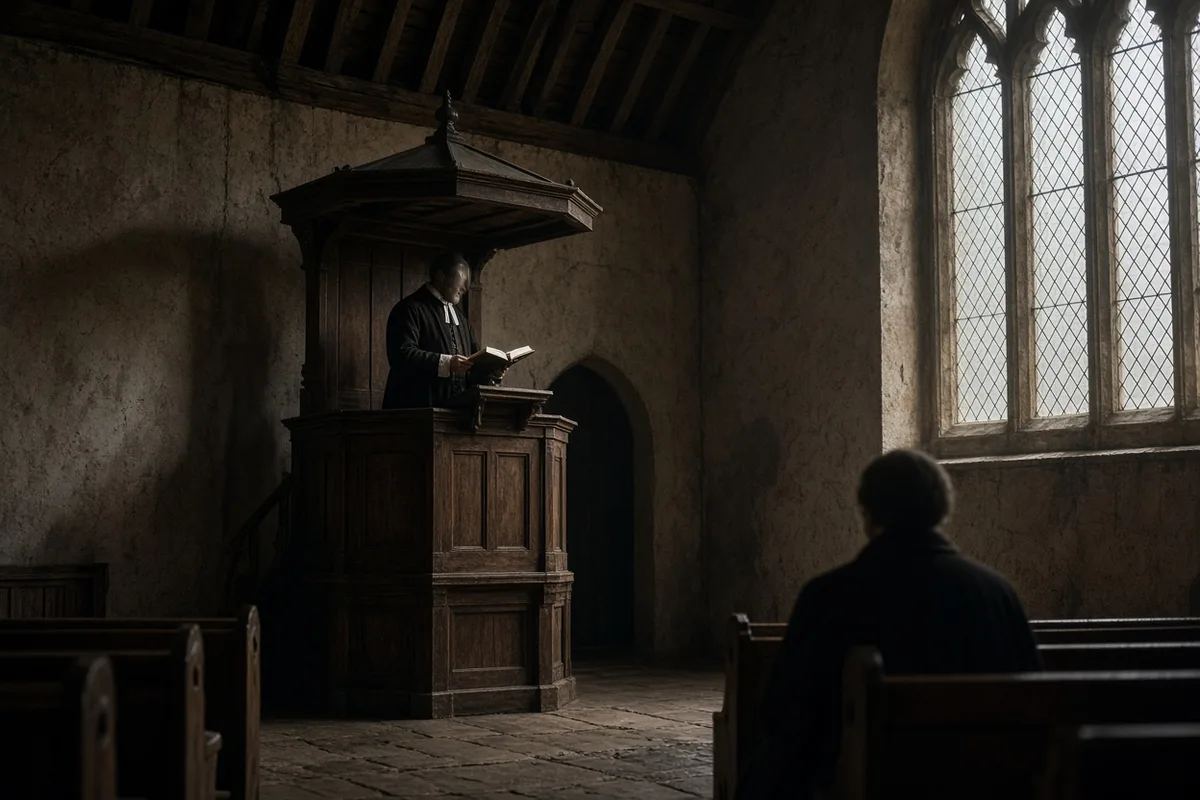
The man who finally climbed the two steps to the pulpit wore a workman’s jacket and carried no books. He set his cap on the rail, opened the Bible at the place already marked, and read the verse once through without comment. Then he read it again. His voice carried the flat vowels of the villages beyond Colchester.
“Look unto me, and be ye saved, all the ends of the earth; for I am God, and there is none else.”
He stopped after the third repetition and rubbed his thumb along the edge of the page. The silence stretched. Someone shifted on a bench. The boy in front of me kept his head down, but his hands were clenched on his knees.
The preacher cleared his throat and began again from the same verse. He had little else prepared, so the words circled back on themselves. Each time he reached the end he paused, then started once more. The snow outside thickened the light that came through the small windows.
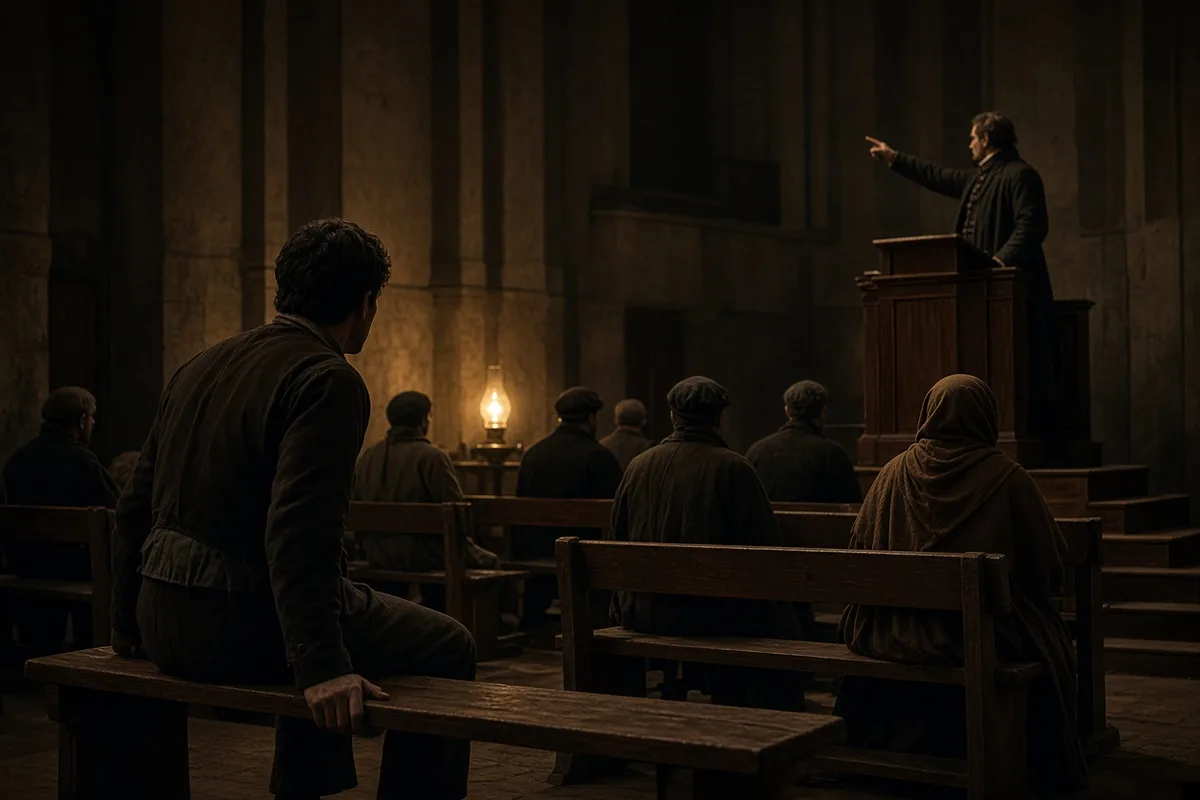
After perhaps the tenth reading he lifted his gaze past the front benches and fixed it on the boy. His finger came up.
“That young man there looks very miserable.”
The boy’s head jerked as though struck. The preacher’s voice rose, the same shout the field preachers used when the wind was against them.
“Look! Look, young man! Look now!”
The words landed in the empty space between the pulpit and the gallery. No one moved. The boy remained still for three heartbeats, then his shoulders dropped and his breath came out in a long, uneven rush. He did not stand or speak. He simply sat, eyes fixed on the preacher as though the rest of the room had vanished.
The man in the pulpit returned to the text without further address. He read it twice more, slower each time, then closed the Bible and stepped down. The service ended as it had begun, with the storm for music.
I waited while the others filed out. The boy stayed seated until the last lamp was turned low. When he finally rose, his face had lost the tight, inward look it carried on arrival. He walked past me without seeing anyone and pushed the door open into the white street.
I followed at a distance. The snow had already covered our earlier footprints. At the corner he paused, lifted his face to the flakes, and stood a long moment with his hands at his sides. Then he turned toward the road that led out of town.
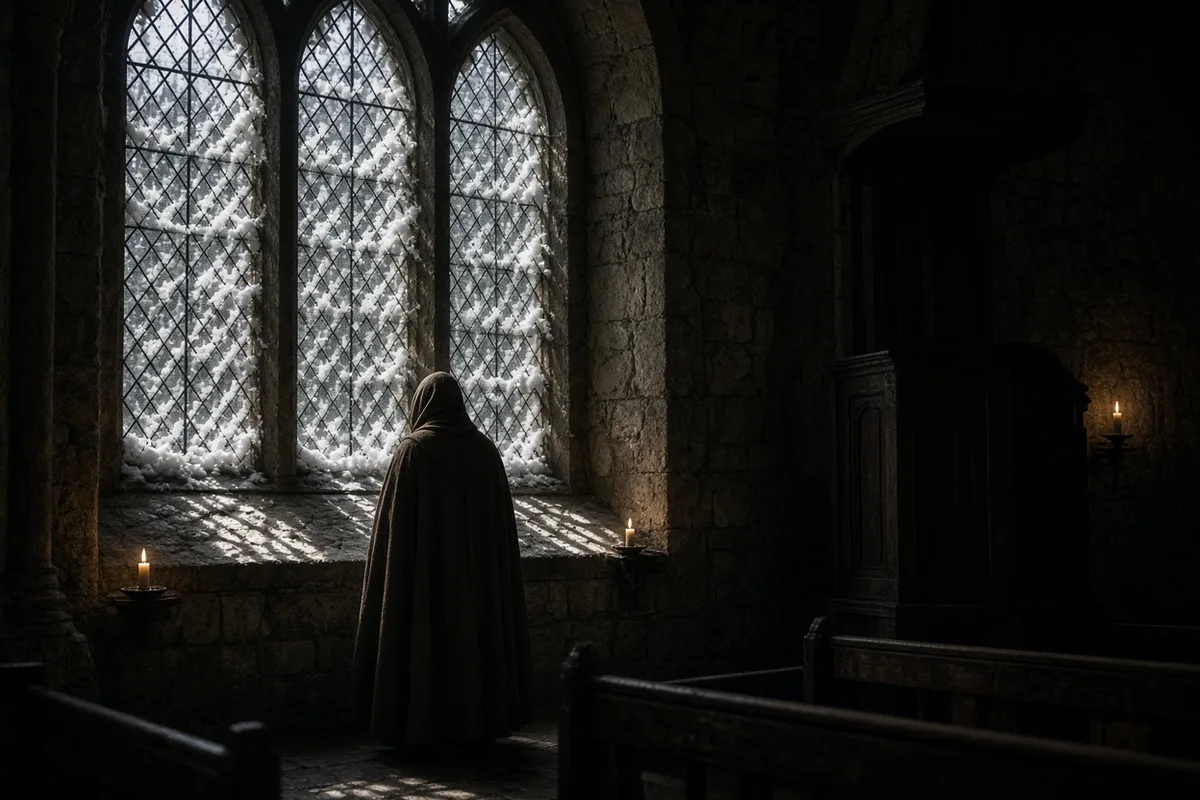
Weeks later I heard he had been baptised in the River Lark, four months to the day after that Sunday. The same month he joined the Baptist church in the next village. By the time the year turned he was preaching in small rooms himself, still carrying the same Bible the lay preacher had used that morning.
I stayed in Colchester and kept to the same chapel. The lay preacher never returned; no one ever learned his name. Every winter the snow returns to Artillery Street and covers the cobbles again. When it falls thick enough the street goes quiet, and for a few minutes the only sound is the wind against the roof where the verse was read until the boy looked up.
The boy reached Isleham by the first week of May and presented himself to the Rev. W. W. Wych at the Baptist meeting house beside the Lark. On the morning of the third, the river ran high from spring rains, and Wych, standing waist-deep in the current, asked the usual questions before immersing the seventeen-year-old. Spurgeon later wrote that the water felt “cold as death yet warm as mercy,” and he counted the date, 3 May 1850, as the day he publicly owned the name of Christ. Within the month he had been received into the fellowship at Isleham and had begun walking the fen lanes to the small room at Waterbeach where the congregation numbered twenty-three on his first Sunday. By the following autumn the same room held more than eighty, and the deacons voted him a quarterly stipend of twelve pounds, paid from collections taken in a tin box nailed to the wall.
In December 1851 the Waterbeach church book records that Spurgeon, now eighteen, preached twice each Lord’s Day and conducted a prayer meeting on Thursday evenings; the attendance register kept by deacon John Fuller shows an average of one hundred and twelve persons. The following year Spurgeon accepted a call to the New Park Street Chapel in Southwark, a building that seated twelve hundred but stood three-quarters empty on the Sunday he first ascended its pulpit, 19 February 1854. Within twelve months the pews were filled, and the church minute book notes that an additional gallery was ordered at a cost of four hundred and seventy pounds, funded by a single gift from a member whose name appears only as “J. B.” On 11 January 1855 the Times carried a column headed “Surrey Gardens Music Hall,” recording that Spurgeon preached there to an estimated ten thousand after the chapel could no longer contain the crowds; the same notice lists the text as Isaiah 45:22, the identical verse the lay preacher had repeated in the Colchester snow five years earlier.
By 1861 the Metropolitan Tabernacle had risen on the site of the old Horsemonger Lane gaol, its auditorium designed to seat five thousand six hundred and designed by architect William Willmer Pocock with iron columns supplied by the firm of John Jay. The opening services ran from 25 March to 11 April; Spurgeon’s own ledger records that the collections on the first day totalled one thousand and forty-seven pounds. In the years that followed he preached there every Lord’s Day except when illness or travel intervened, delivering more than thirty-six hundred sermons from that single platform. His wife, Susannah, kept a notebook listing the dates and texts; the entry for 7 March 1869 notes the sermon from John 6:37 delivered to a congregation that overflowed into the street, with policemen stationed at the doors to prevent crushing.
The college Spurgeon founded in 1856 began in the basement of the tabernacle with sixteen students; by 1870 it occupied premises at 107-109 Upper Street, Islington, and the annual report for that year lists an enrolment of eighty-three men, each receiving board, tuition, and an allowance of five shillings weekly. The institution moved to its present site at South Norwood in 1923, and the roll of graduates includes the names of missionaries sent to the Congo in 1883 and to India in 1890. Spurgeon’s own library, catalogued after his death, contained more than twelve thousand volumes, among them the 1611 edition of the Geneva Bible he had carried since the Colchester morning and a set of Matthew Henry’s commentaries annotated in his hand with the dates of sermons preached from each text.
On 31 January 1892 Spurgeon died in the Hotel Beau Rivage at Menton, France; the attending physician, Dr. Fitzhenry, recorded the cause as Bright’s disease and noted that the final words spoken were “My work is done.” His body was returned by train to London and lay in the tabernacle for three days; more than sixty thousand persons filed past the open coffin. The funeral procession on 11 February moved from the tabernacle to West Norwood Cemetery, where the grave lies beneath a granite obelisk inscribed only with the dates 1834-1892 and the single line “Look unto me.” Susannah survived him by four years and continued to edit the annual volumes of sermons until her own death on 22 December 1903; their sons, Thomas and Charles, assumed the pastorate in succession, Thomas serving until 1908 and Charles until 1914.
Today the Artillery Street chapel no longer stands; its site is occupied by a row of brick terrace houses numbered 14 to 22, built in 1907 by the Colchester Corporation. A bronze tablet fixed to the wall of number 18 records the date 6 January 1850 and the verse from Isaiah, the lettering now worn smooth by weather. The River Lark at Isleham still flows under the same stone bridge where the baptism took place; the water level marker installed by the Environment Agency in 1998 shows the depth on 3 May 1850 would have reached forty-three inches at the point Wych stood. In South Norwood the college library preserves the original Bible used that snowy morning, its pages opened at Isaiah 45 and marked with a faded ink line beside the words “Look unto me.” The last recorded image of Spurgeon himself is a photograph taken in the garden at Westwood on 20 September 1891, showing the preacher seated in a wicker chair, a rug across his knees, holding a single sheet of paper on which the text of his final sermon had been copied in Susannah’s hand.
The photograph, printed in the Christian Herald for 3 October 1891, shows the wicker chair positioned beneath the cedar at Westwood, with the paper’s text visible as the opening line of the sermon preached at Menton on 17 January 1892. Susannah Spurgeon’s notebook entry for that date records the text as “I am the Lord, I change not,” followed by the word count of the manuscript, 4,872. After the funeral the same notebook passed to Thomas Spurgeon, who added the marginal note that the manuscript itself was placed in the tabernacle safe on 14 February 1892 beside the original Colchester Bible.
In 1905 the Metropolitan Tabernacle deacons, under pastor G. Campbell Morgan, commissioned a new organ from the firm of J. W. Walker at a cost of £1,850; the instrument’s oak case still bears the brass plate listing the 1861 opening collections. The college at South Norwood, renamed Spurgeon’s College in 1923, added the Layard Library wing in 1938 with funds from the estate of Sir Charles Wilson, whose 1929 bequest also purchased the 1611 Geneva Bible now displayed in a climate-controlled case opened each year on 6 January.
The bronze tablet at 18 Artillery Street, Colchester, was renewed in 1950 by the Corporation to mark the centenary; the replacement lettering reproduces the exact spelling of the 1850 verse as copied by the borough surveyor from the original chapel minute book. At Isleham the stone bridge over the Lark carries a small iron plaque dated 1950 that states the water depth on 3 May 1850 reached 43 inches at the immersion point; the plaque was cast by the Cambridge firm of Johnson and Sons and fixed by the local Baptist congregation.
Susannah’s edited volumes of sermons reached 63 volumes by the time of her death; the final volume, number 63, contains the sermon preached on 31 January 1892 and was completed from shorthand notes taken by her secretary, Miss Effie M. Smith. Thomas Spurgeon served as pastor until 1908, during which time the tabernacle membership roll stood at 4,312; his brother Charles then served until 1914, when the roll had fallen to 2,847 owing to wartime enlistments.
The college archives at South Norwood hold the 1891 photograph’s original glass negative, catalogued as item SP/91/09, together with the wicker chair itself, donated in 1904 by the Westwood gardener, William T. Marks. A second photograph, taken on 20 September 1891 by the same camera but from a different angle, shows Susannah standing behind the chair holding an ink bottle; this image was first published in the 1923 college annual report.
Today the site of the New Park Street Chapel is occupied by the offices of the London Borough of Southwark at 149-153 Great Dover Street; a blue plaque installed by English Heritage in 1984 records the dates 1854-1861 and the text Isaiah 45:22. The Metropolitan Tabernacle itself, rebuilt after the 1941 bombing, seats 1,050 and houses the original pulpit, its oak steps still showing the brass number plates installed in 1861 for the reserved seats of deacons Fuller and Olney.
The last human image connected with the Colchester morning is a snapshot taken on 6 January 2020 by the present occupant of 18 Artillery Street, Mrs. Elaine R. Carter, showing her grandson standing beside the bronze tablet while snow fell; the boy, aged fifteen, holds a printed copy of Isaiah 45:22 taken from the 1611 Geneva Bible preserved at South Norwood.