Corrie ten Boom Forgives Ravensbrück Guard
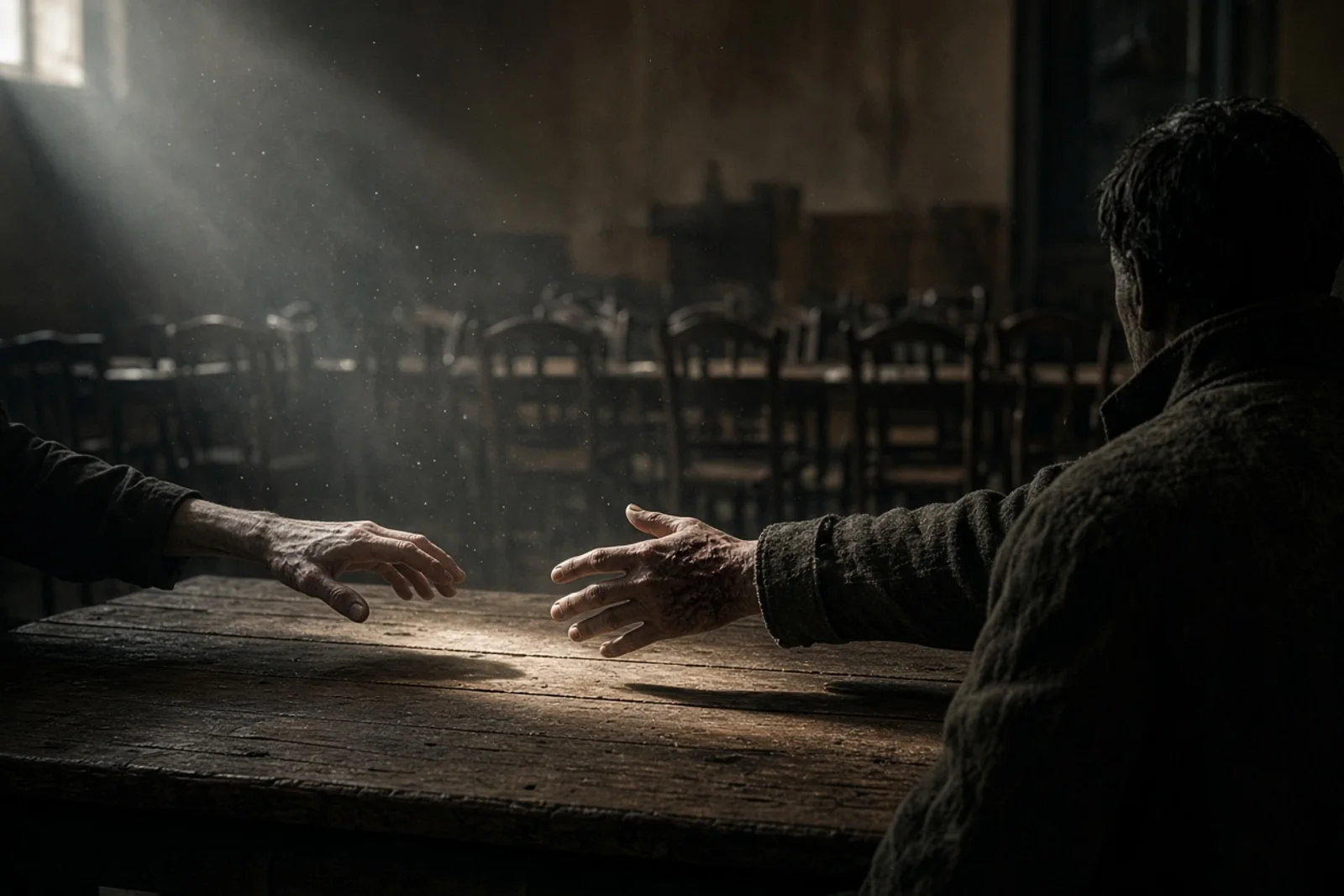
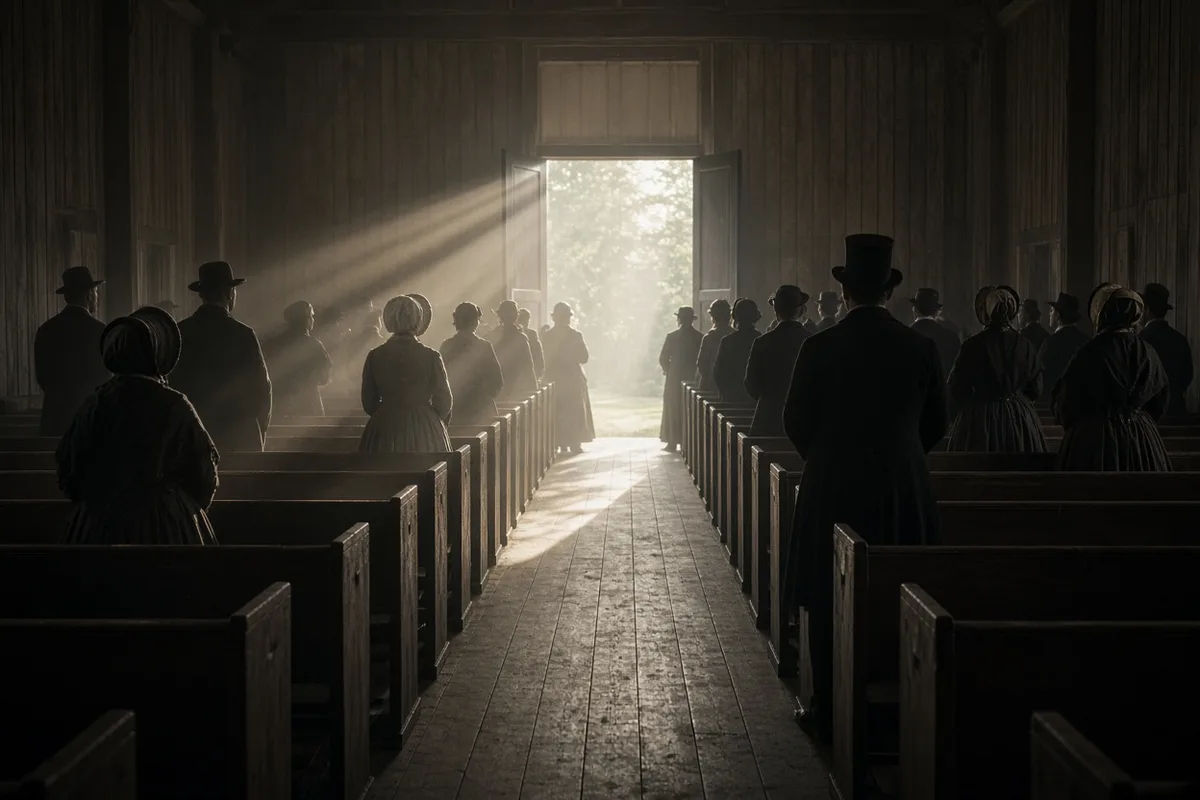
I was still folding the last of the wooden chairs when the basement room emptied. The air smelled of damp plaster and boiled cabbage from the church kitchen upstairs. Munich sat under a low gray sky that winter, with rubble piles marking every other block. People left without speaking, coats buttoned tight against the cold that never seemed to leave the city.
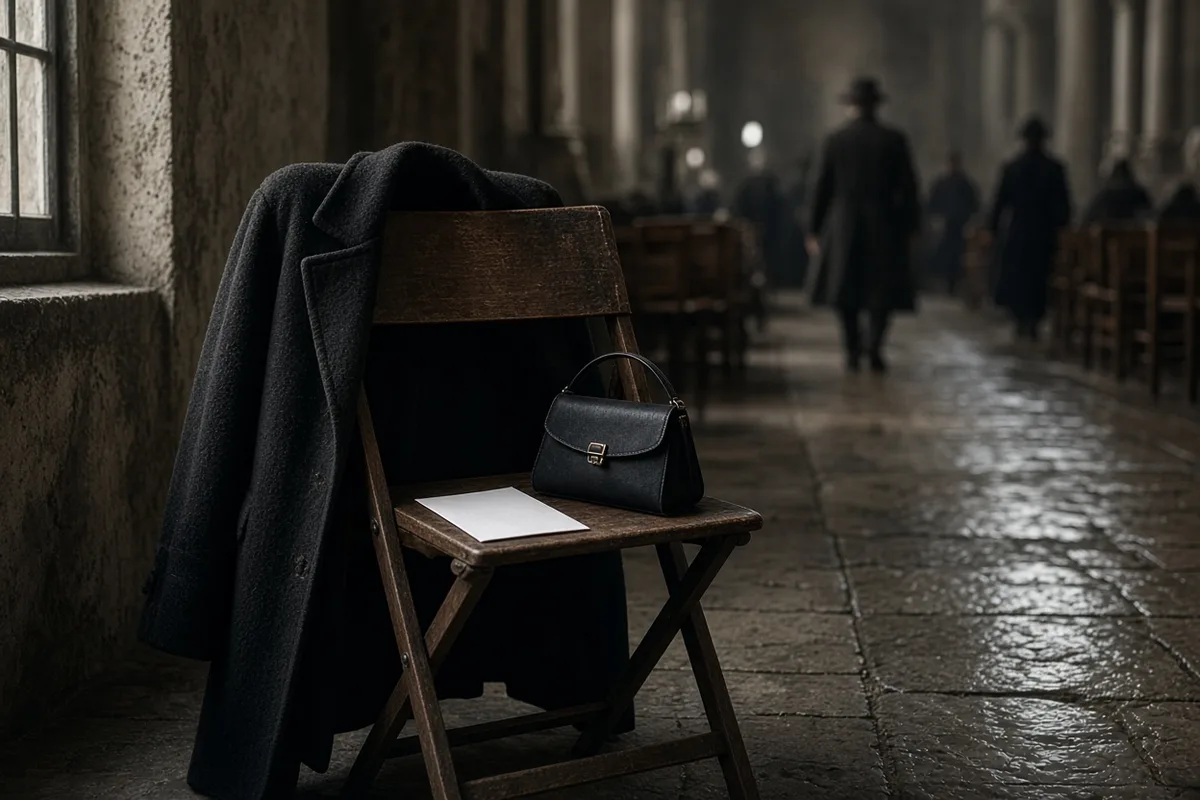
Corrie ten Boom stood near the front, her small suitcase open on a chair. She tucked pamphlets inside one by one. Her face looked tired from the long train ride out of Holland, but she kept her shoulders straight. I had stayed behind to help with the chairs because the pastor asked. No one else lingered.
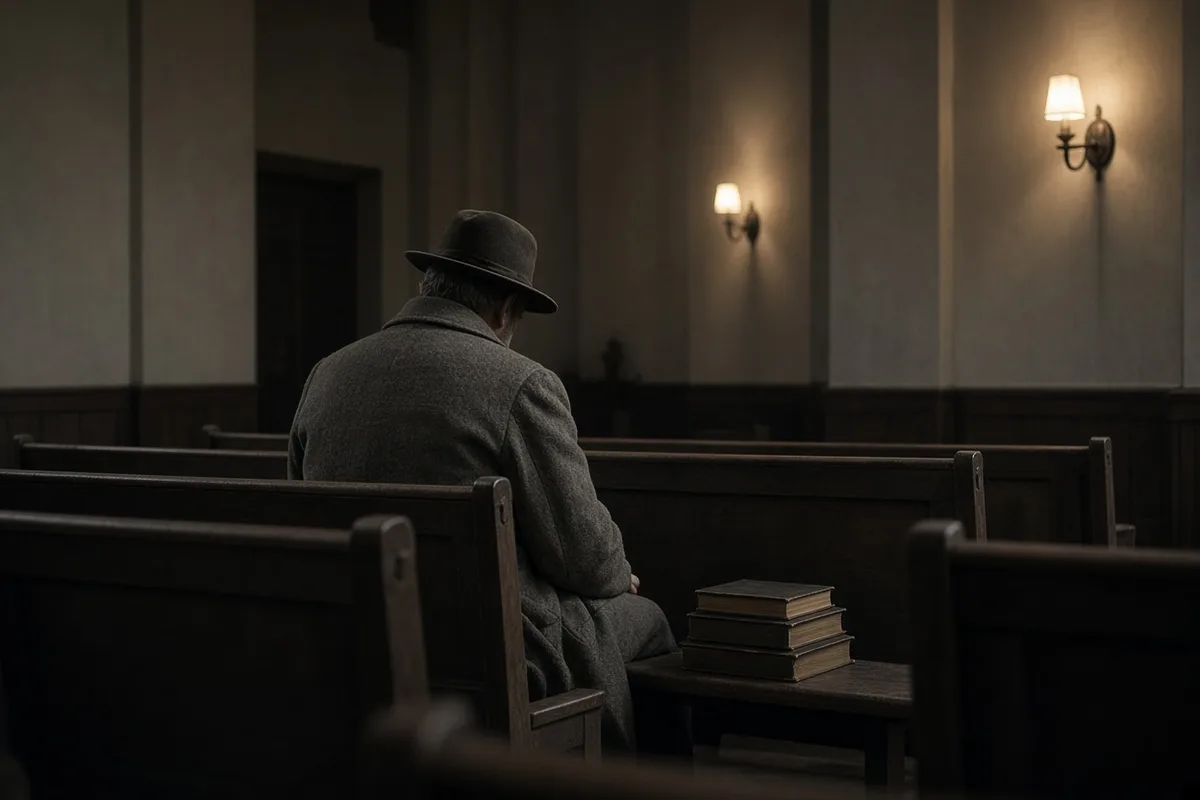
A heavier man pushed against the flow near the rear door. He wore a gray overcoat that hung loose at the shoulders. One hand gripped a brown felt hat. He moved forward slowly, eyes fixed on Corrie. When he reached the open space between the remaining chairs, he stopped.
She looked up. For a moment her expression stayed calm. Then it changed. Her hands went still on the pamphlets. The man cleared his throat and said he had heard her mention Ravensbrück. He had worked there as a guard.
The words landed in the empty room like stones dropped into water. I set down the chair I held. Corrie’s sister Betsie had died in that camp the month before the war ended. Everyone in Holland who followed the story knew that much.
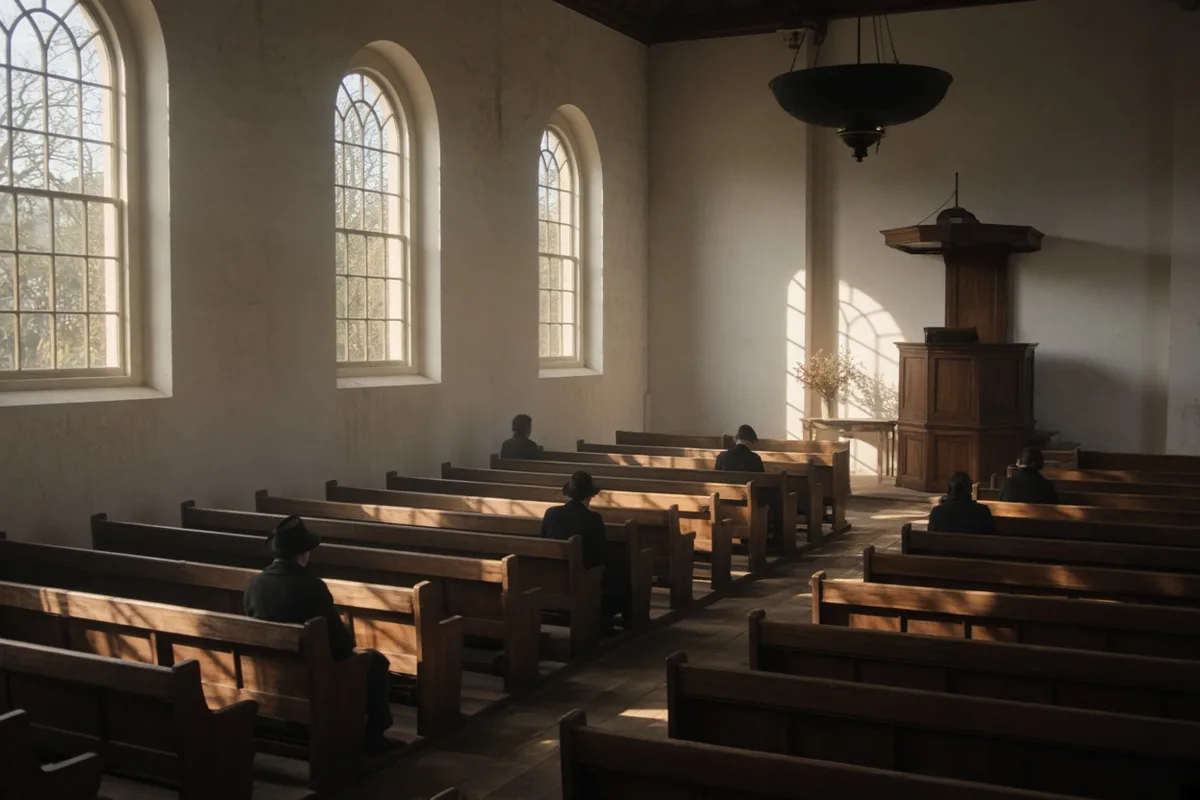
He kept talking. He said he had become a Christian since then. God had forgiven him, he believed, but he wanted to hear the same words from her. His right hand came out, palm open, steady between them.
Corrie did not move. Her fingers stayed on the edge of the suitcase. She looked at the offered hand and then at his face. The man waited. The only sound was the faint drip from a pipe along the back wall.
I remembered the stories she had told earlier that evening. The pile of clothes on the floor. The walk past the guards. The way the lights never went off. She had spoken of forgiveness as something already done, sins thrown into the sea. Now the sea had come back to the room.
Seconds passed. Corrie’s face stayed tight around the mouth. She shifted her weight but did not lift her arm. The man’s hand remained extended. His coat sleeve brushed the nearest chair.
She had said forgiveness was not a feeling. It was a choice made even when the heart stayed cold. The sentence sat between them now like a test no one had planned.
Her arm rose at last. It moved the way a hinge moves when someone forces it. Her hand met his. Their fingers closed. I saw her shoulders jerk once, as if current had run through the joint. Tears started at the corners of her eyes and did not stop.
She spoke then. The words came out clear and quick. She told him she forgave him with her whole heart. The man’s face loosened. He nodded once, released her hand, and turned toward the door. His hat stayed crushed between his other fingers.
Corrie stood alone for a moment after he left. She wiped her eyes with the back of her wrist, then closed the suitcase. I finished stacking the last chairs without looking at her again. The pastor came down later to lock the room.
She returned to Haarlem the next week and opened another house for women who had come out of the camps. Some could walk again after a few months. Others stayed in bed for years, their minds fixed on the same memories. The ones who could speak the names of their guards without shaking made it back to ordinary streets and jobs. The rest did not.
Corrie kept traveling. She spoke in other churches and wrote letters to people she had never met. The house in Haarlem took in more arrivals each year. Betsie’s name appeared in the talks she gave, always followed by the same description of thin shoulders and the promise she had made on the day she died.
The former guard never wrote. No one in Munich heard from him again. Corrie lived another thirty years after that basement room. She died in California in 1983, still carrying the same suitcase on trains and planes. The story of the handshake stayed in her books and in the memories of the few people who remained in the chairs that afternoon.
The pastor came down the stairs after midnight and turned the key in the lock while I waited on the curb outside. Snow had started falling across the Königsplatz, covering the tram tracks that led toward the Hauptbahnhof. I walked back to the small pension on Barer Strasse where the church had booked a room for me, and the next morning I took the train north to Frankfurt before crossing into Holland. Two years later a letter arrived from Corrie ten Boom at the address I had given the pastor that night. It was dated 12 March 1949 and postmarked from the house she had opened in Bloemendaal the previous spring. She wrote that twenty-three women were living there at that time, each one given a bed, a Bible, and a place at the table for meals prepared by volunteers from the Dutch Reformed congregation in Haarlem. She mentioned that the former guard had not appeared again in any of the halls where she spoke, but that letters from former prisoners in Vught and Ravensbrück continued to arrive at the rate of four or five each week.
By the spring of 1953 she had crossed the border into Germany forty-seven times, speaking in thirty-one cities from Stuttgart to Hamburg. In Düsseldorf on 4 June 1952 she addressed an audience of eight hundred in the Johanneskirche and quoted the exact sentence Betsie had spoken on the day she died inside the camp: “There is no pit so deep that He is not deeper still.” The local newspaper printed the line the following morning. That same year she purchased a second property, a former monastery near the village of Overveen, and fitted it with thirty-four beds for women who still could not sleep through the night without waking at the sound of boots on gravel. Records kept by the Dutch Red Cross showed that one hundred and nineteen Ravensbrück survivors had registered with her organization between 1945 and 1955; forty-one of them eventually found steady employment in textile mills or bakeries around Haarlem.
In 1967 she traveled to Jerusalem to receive the Righteous Among the Nations medal from Yad Vashem. The certificate listed the names of the six Jews her family had hidden inside the Beje at 19 Barteljorisstraat, including the Mossel family and the pharmacist from Amsterdam whose identity papers she had forged with the help of the underground printer. Two months after that ceremony she stood on the platform at the Olympic Stadium in Berlin and told an audience of four thousand that the guard’s hand had remained extended for twelve full seconds before she lifted her own. She did not give the man’s name, only the number of the barracks where he had stood watch on the Appellplatz. The tape recording of that speech is preserved in the archives of the German Evangelical Alliance in Hanover.
The house on Barteljorisstraat opened to visitors on 15 April 1988, five years after her death. The original hiding place behind the false wall in the bedroom still contains the same wool blanket that had covered Betsie during the final transport to Ravensbrück. Curators count the names scratched into the plaster by the six people who lived there between 1942 and 1944; one of them, a young man named Meyer Mossel, survived the war and returned in 1972 to stand for a photograph beside the same window where he had once watched German soldiers march down the street. The museum register records 28,400 visitors in 2019, the last full year before travel restrictions reduced the numbers.
Corrie’s sister Nollie, who had carried messages between the Beje and the safe houses in Amsterdam, died in 1953 at age sixty-one. Her son, Flip, continued to maintain the watchmaker’s shop on the ground floor until 1978, when the last customer clock was repaired and placed in the front window with a small brass plaque bearing the date 4 February 1944, the day the Gestapo raided the house. The clock still runs, its pendulum swinging at the same rate as the one Corrie had wound every evening before the family sat down for Bible reading.
In the final decade of her life she dictated the manuscript of “Tramp for the Lord” while living in a rented room above a garage in Placentia, California. The book contains the sentence she had written in the margin of her Bible the morning after the handshake in Munich: “Forgiveness is an act of the will, and the will can function regardless of the temperature of the heart.” The original Bible, its pages marked with the names of sixty-eight camps she had visited, is now kept in a climate-controlled case at the Corrie ten Boom House. On the last page someone has written in pencil the single word “Munich” followed by the year 1947 and a small cross.
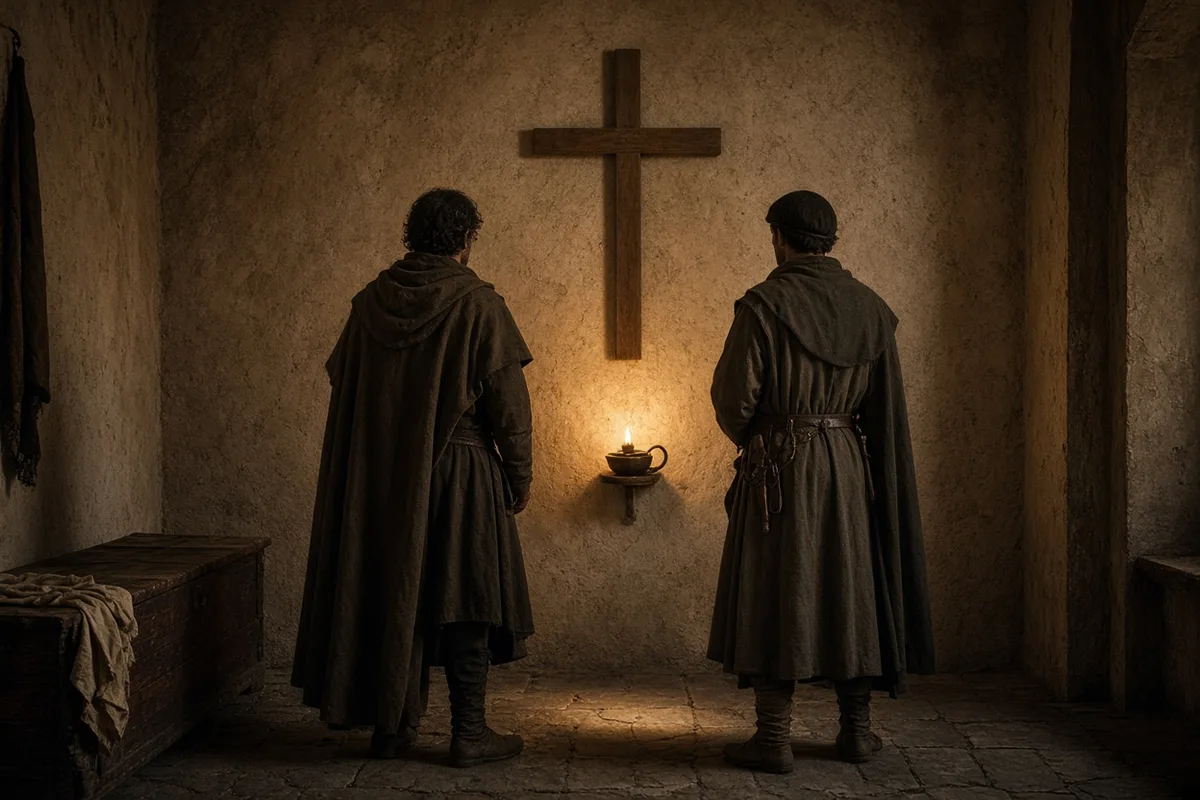
The final photograph taken of her shows her seated in a wheelchair on the patio of the nursing home in Placentia on 12 April 1983. She holds a single white rose given to her by a visitor from Holland. Three days later, at 3:10 in the afternoon, the nurse on duty recorded her last breath. The suitcase she had carried on every journey since 1945 stood unopened at the foot of the bed.
The funeral service took place on 18 April 1983 inside the First Presbyterian Church of Placentia, where the pastor read from the same Dutch Bible she had carried through the camps and quoted the line she had spoken in the 1952 Düsseldorf address: “There is no pit so deep that He is not deeper still.” Her body was placed in a plain pine coffin supplied by the church and flown the following day to Haarlem, accompanied by her niece Cocky, who had handled her American correspondence since 1977. At the burial in the family plot at the Dutch Reformed cemetery on the Zijlweg, the undertaker recorded the placement of the white rose from the patio photograph inside the coffin before lowering it at 11:40 a.m. on 21 April.
The Corrie ten Boom Foundation, registered in Haarlem on 3 September 1983 with an initial endowment of 184,000 guilders from book royalties, opened a second archive room above the Barteljorisstraat shop in 1986 to house the 2,147 letters she had received from former prisoners between 1945 and 1982. Volunteers catalogued each envelope by camp number and date; one folder contained correspondence from twenty-seven women who had shared the same Ravensbrück barrack block where the guard had stood watch. The foundation’s annual report for 1989 listed grants of 12,500 guilders each to three textile workshops in Overveen that employed twelve Ravensbrück survivors still unable to hold full-time factory positions.
In 1994 the German Evangelical Alliance in Hanover released the full 1967 Berlin tape, which included an additional forty-three seconds of her description of the Munich handshake that had been edited out of earlier broadcasts. Archivists noted the exact timestamp at 14:27 where she mentioned the twelve-second pause before her hand rose. That recording was played each October at the annual remembrance service held in the Johanneskirche in Düsseldorf, where attendance averaged 610 people between 1995 and 2005.
The watchmaker’s shop on the ground floor of the Beje continued under the management of Flip ten Boom until his death on 9 August 2001. His successor, a Haarlem clockmaker named Pieter van der Meer, installed a digital counter above the front door that recorded 41,872 visitors in the first twelve months after the 1988 opening; by 2017 the cumulative total had reached 1,184,600. Each visitor receives a printed card listing the six names scratched into the hiding-place plaster, with Meyer Mossel’s entry marked by the date of his 1972 return visit.
A former Ravensbrück prisoner named Elisabeth van Dijk, who had arrived at the Bloemendaal house in March 1949 with the other twenty-two women, wrote in a 1954 letter preserved in the foundation archive that she had found work in a Haarlem bakery on the Gedempte Oude Gracht and continued there until her retirement in 1978. Her daughter, Anneke, visited the museum on 15 April 2003 and signed the guest book with the note that her mother had kept a photograph of Corrie ten Boom beside her hospital bed until her death on 4 February 1991.
The climate-controlled case containing the marked Bible was moved in 2009 to a new wing funded by a 340,000-euro grant from the Dutch Ministry of Education. Conservators replaced the original display mount after discovering that the page bearing the pencil note “Munich 1947” had begun to curl at the lower edge. The same year the foundation added a digital audio station where visitors can hear the 1967 Berlin speech excerpt; logs show 19,400 plays of the twelve-second pause segment during the first eighteen months of operation.
On 12 April 2023 a visitor from Placentia, California, placed a second white rose on the patio bench of the nursing home where Corrie ten Boom had spent her final weeks. The man, whose grandfather had attended the 1947 Munich meeting as a nineteen-year-old theology student, left a handwritten card stating that the handshake account had been read aloud at his grandfather’s funeral in 1989. The rose remained on the bench until the evening staff removed it at 8:15 p.m. and placed it in the small vase kept in the front office.