The Healing of Jeanne Fretel at Lourdes
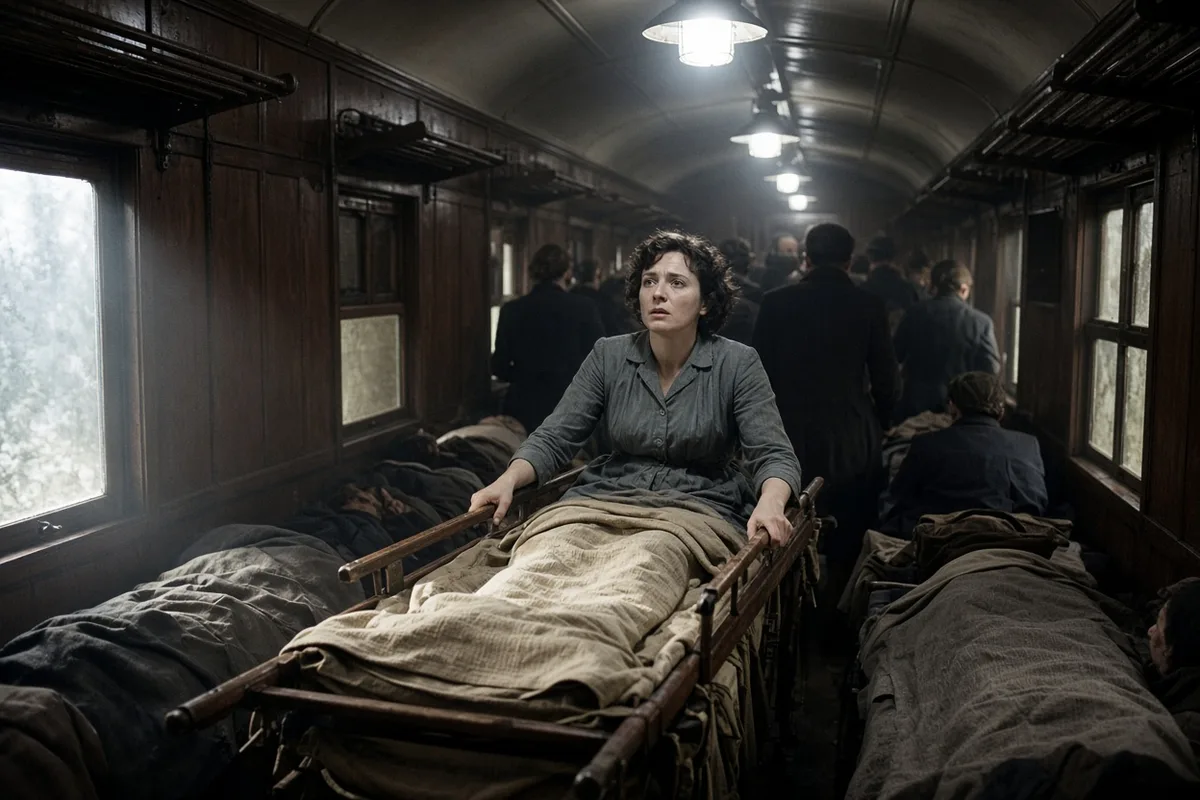
The stretcher tilted as we lifted her from the train. Rain had slicked the platform at Lourdes station and the straps bit into my palms. Jeanne Fretel lay motionless under the blanket, eyes closed, the same shallow breath she had kept for weeks. Two friends walked beside us, the woman still wearing the black scarf she had bought for her own daughter’s funeral. They said nothing. We moved her into the line of ambulances and drove toward the hospitals.
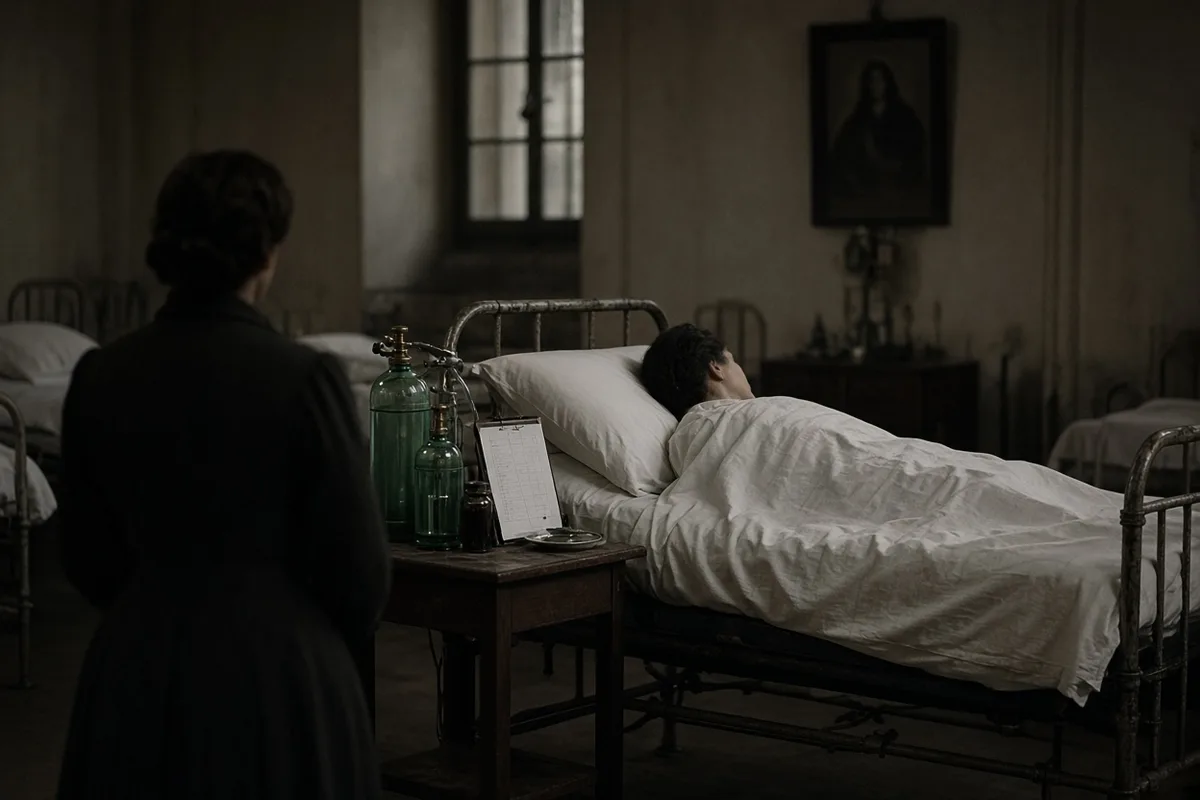
By midday the square was thick with pilgrims. The October sun burned off the last clouds and the bells began. I stayed near her bed in the ward because the doctor on duty wanted someone to watch the drip. Her lips were cracked. When the priest came through with the ciborium, one of the friends asked him to stop. He hesitated, then placed the host against her mouth and pressed it inward with two fingers until it disappeared. She made no sound. The priest moved on.
I checked the chart again. Generalized tuberculosis, tubercular meningitis, ten years in bed, coma for the last stretch. The numbers had not changed since morning. Outside, the Rosary procession started, thousands of voices carrying the same refrain across the esplanade. I stepped to the window for air and saw the stretchers arranged in rows, the blue capes of the nurses, the white veils of the handmaidens.
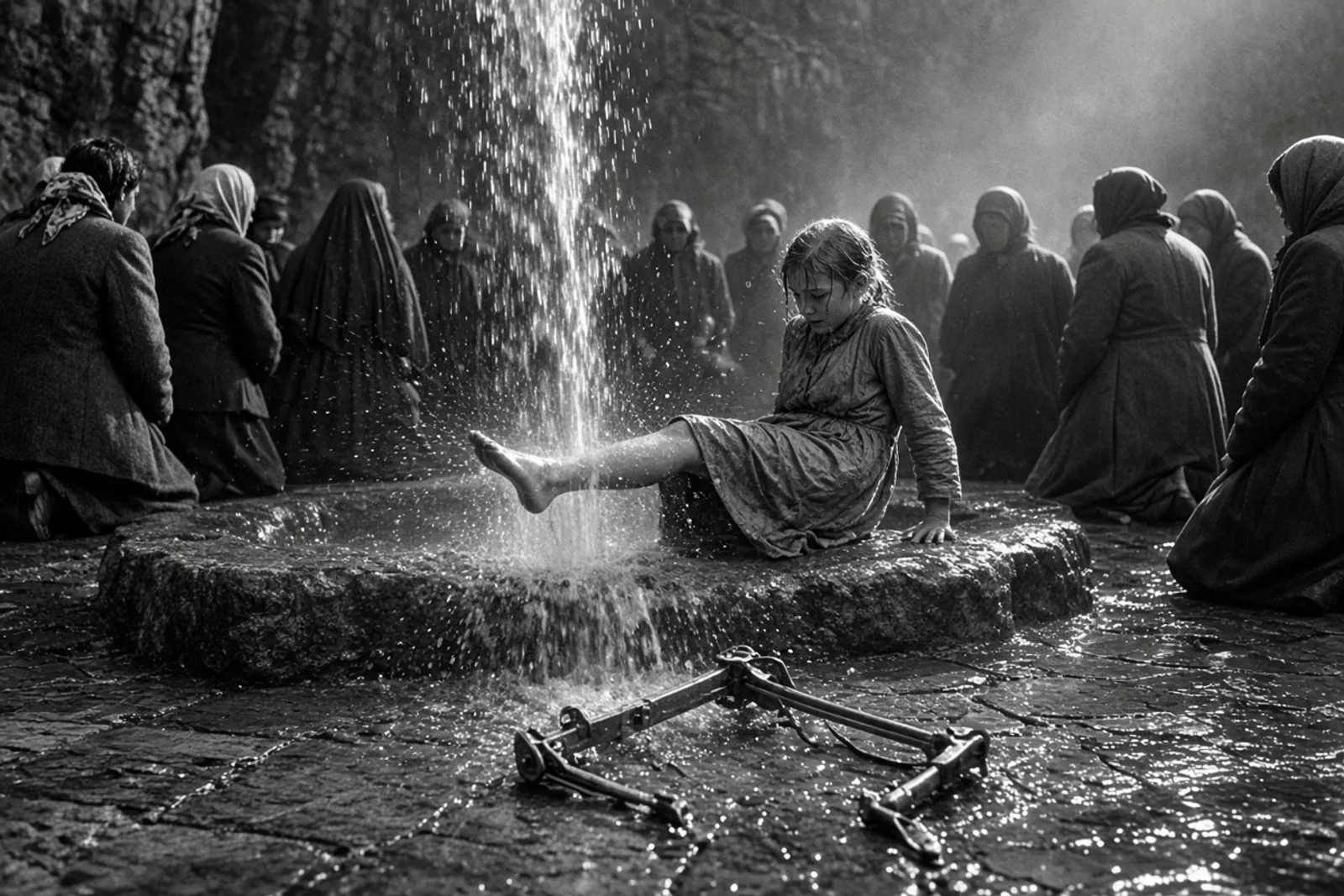
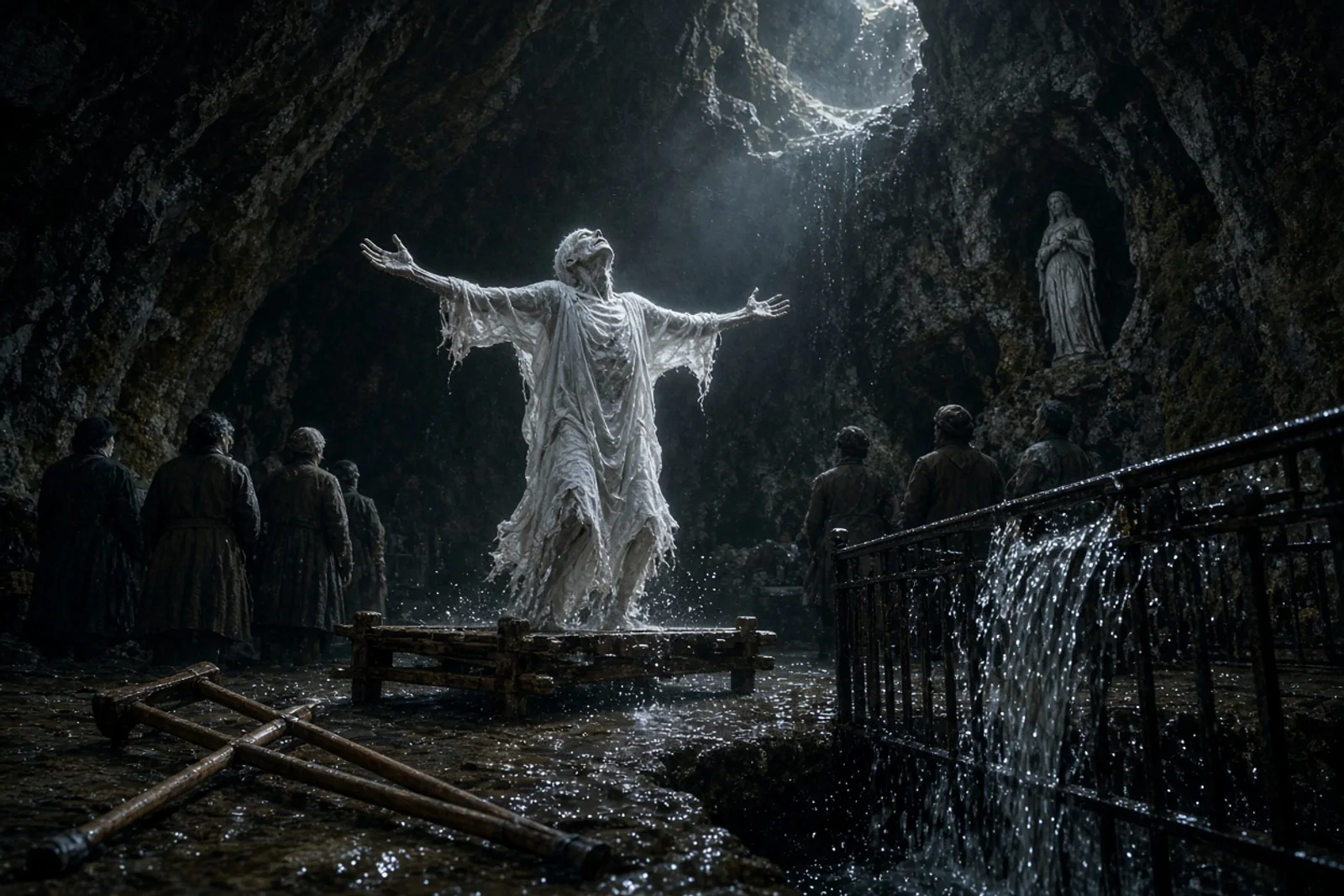
When I turned back, Jeanne’s eyes were open. She was looking at the ceiling. Her right hand moved, slow, as if testing whether the fingers still belonged to her. I called the orderly. By the time he reached the bed she had pushed the blanket down and was trying to sit. We helped her upright. Her feet touched the floor. She stood without support, swayed once, then steadied. The color that had been missing from her face for years showed along her cheekbones.
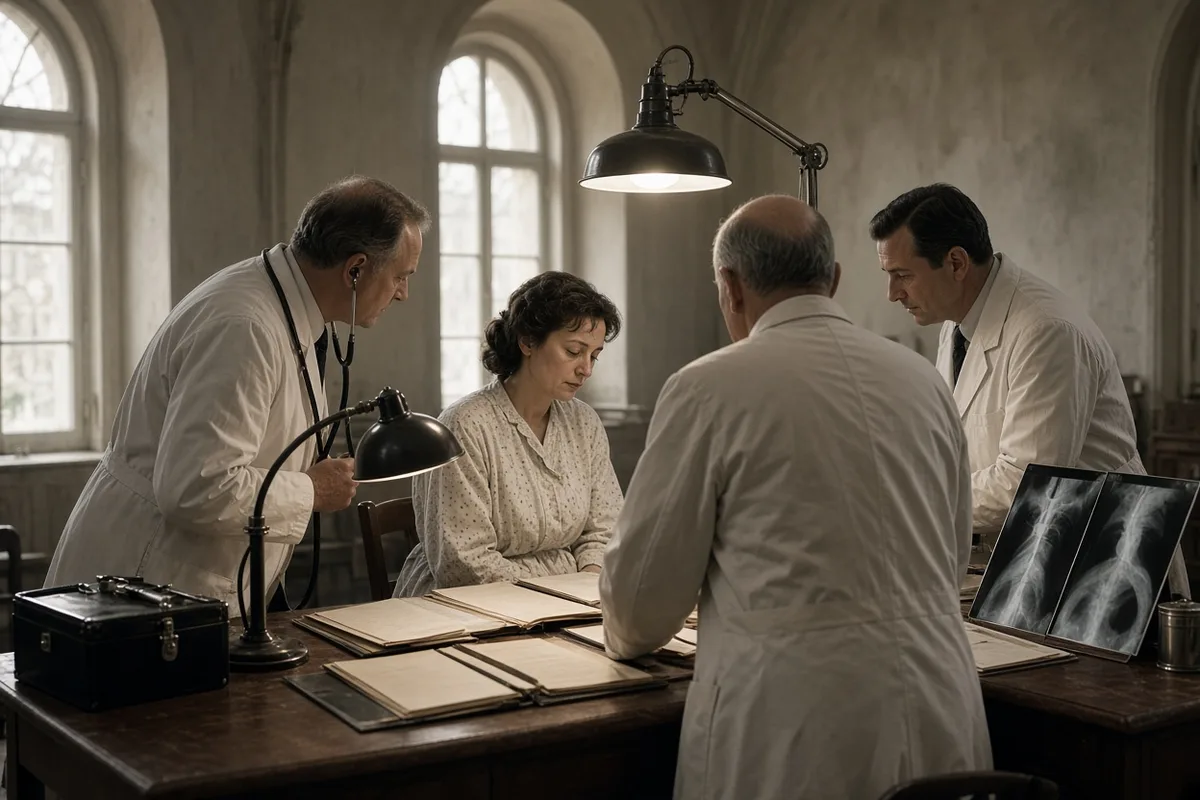
A doctor from the Medical Bureau arrived within the hour. He asked her name, the year, the place. She answered each time. He listened to her chest, checked the abdomen, took her pulse twice. He wrote nothing on the chart yet. He asked the friends to describe what they had seen. They repeated the same short sentences. He left the ward and returned with two more physicians. They examined her again, asked the same questions, then stepped into the corridor.
She asked for water. When she drank, nothing came back up. She asked to walk to the door. We stayed on either side but she did not lean. Outside the ward the afternoon light had turned the stone of the basilica almost white. She looked at it for a long time without speaking.
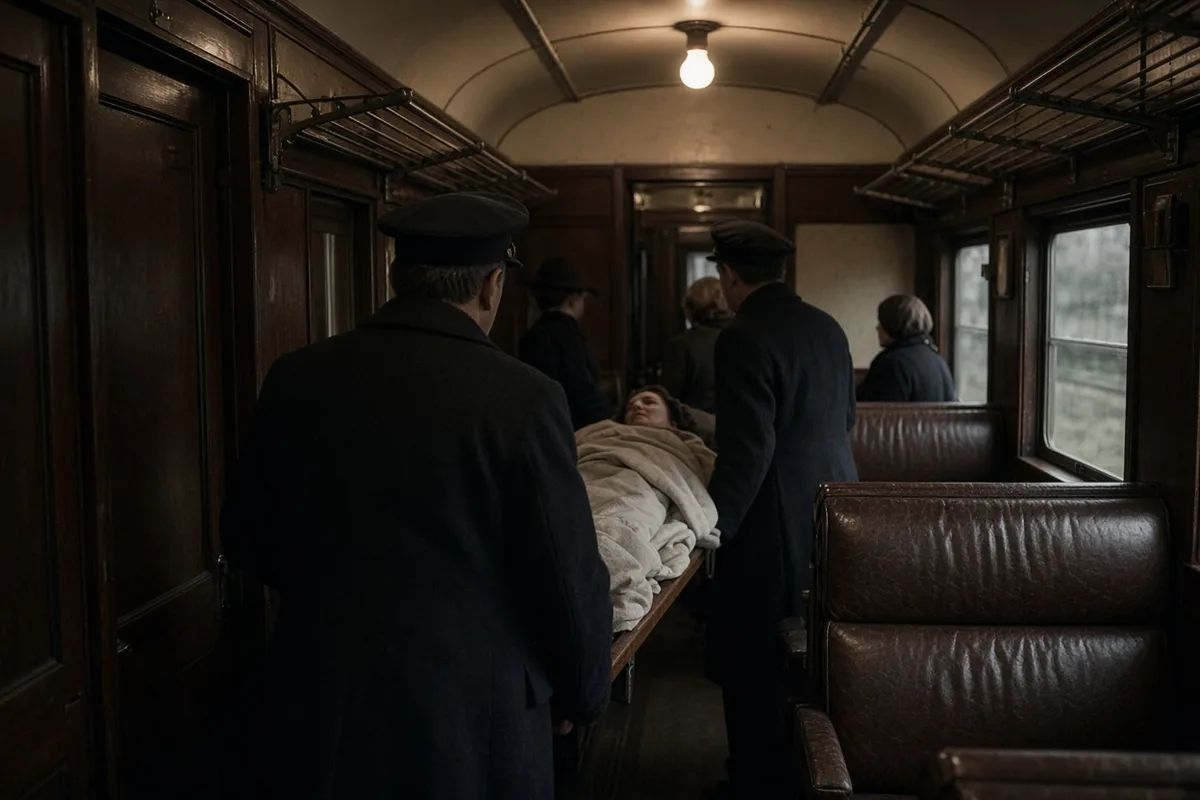
The Bureau kept her under observation for several days. Each morning a different group of doctors came. They measured, listened, compared notes with the records brought from her hospital in Rennes. No fever returned. The abdominal swelling that had been constant for months was gone. She ate solid food without pain. The friends who had brought her stayed in the town and visited every afternoon. They showed her two photographs they had carried in a wallet: one of a woman flat on a hospital cot, the other of the same woman standing in daylight. She studied both without comment.
Mgr Théas came to the hospital before she left. He spoke with her alone for nearly an hour. Later she told the nurses he had suggested the Benedictines. She already knew she would not return to ordinary life. She packed her few belongings and took the train back to Brittany.
In the years that followed she never missed the October Rosary at Lourdes. She came several times each year, always alone, always staying in the same small hotel near the station. She lived as a hermit under the direction of the Benedictines, moving from one quiet house to another, giving no address. When asked, she said only that the choice had not been hers.
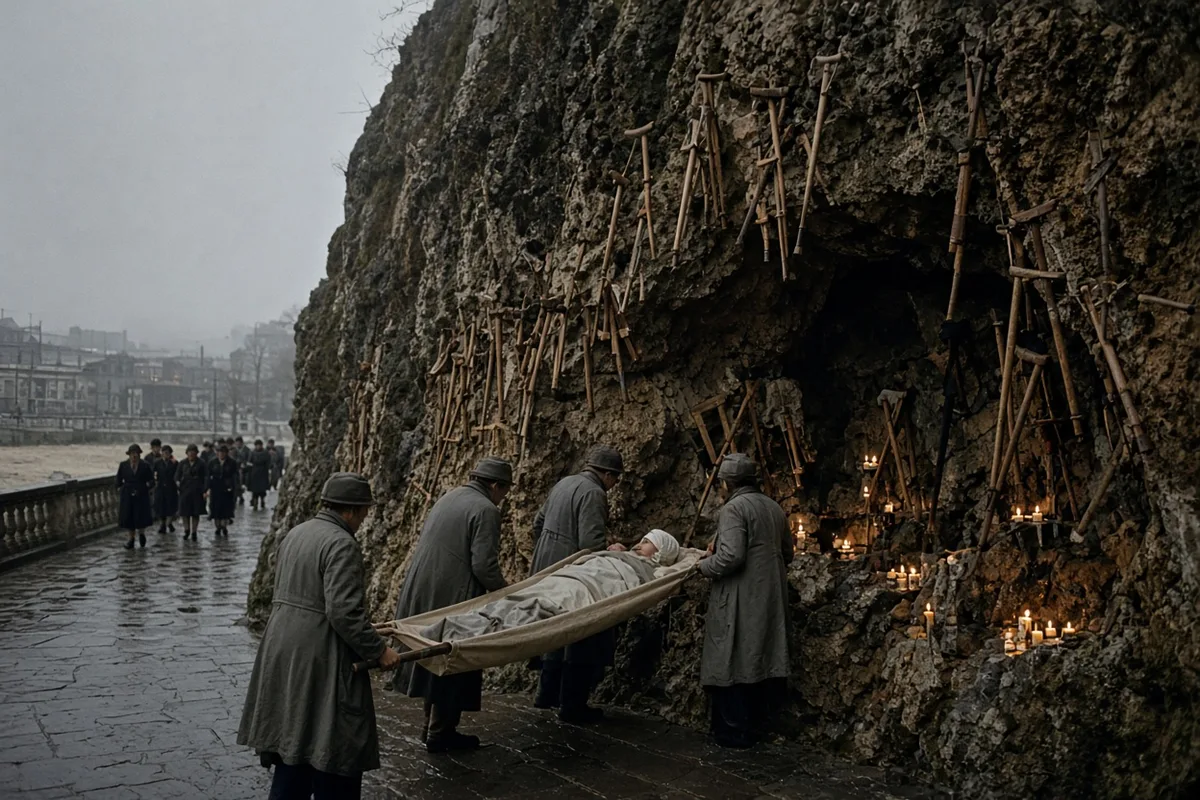
Accidents happened. A car struck her in the street two years before her fiftieth anniversary of the cure. She was found between the wheels with only bruises. She fell down lighted stairs in another July and bruised her hip. She changed hotels and continued her routine. No illness returned. She prayed in the morning and again at night, asking nothing for herself beyond the strength to keep going.
The Medical Bureau recorded the case as one of the twenty-five cures formally acknowledged between 1947 and 1976. No further cures were certified after that date. Jeanne Fretel continued to appear at the annual gatherings when invited, answering questions from reporters and from pilgrims who recognized her from the old photographs. She never added details beyond what the friends and the examining doctors had already written down.
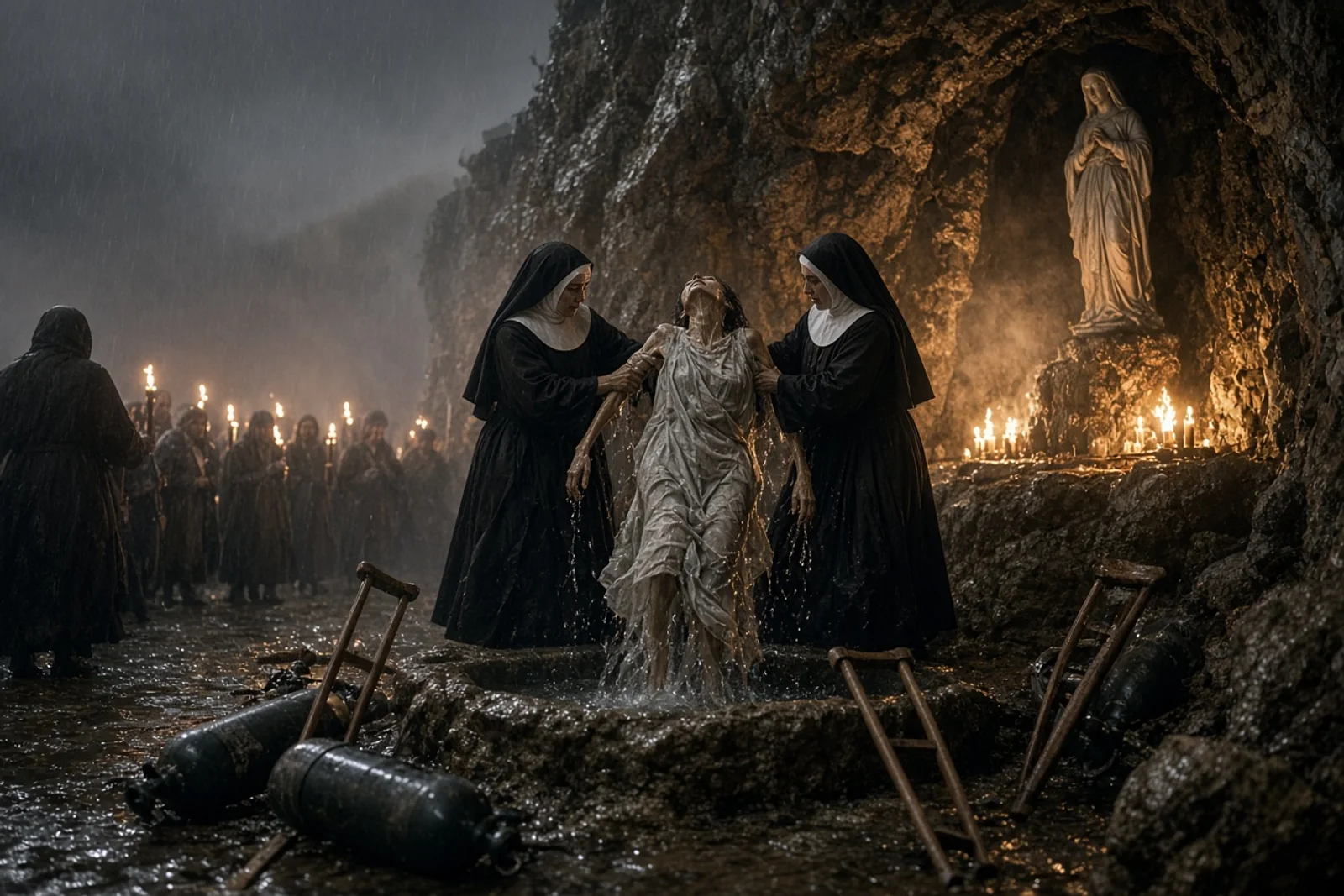
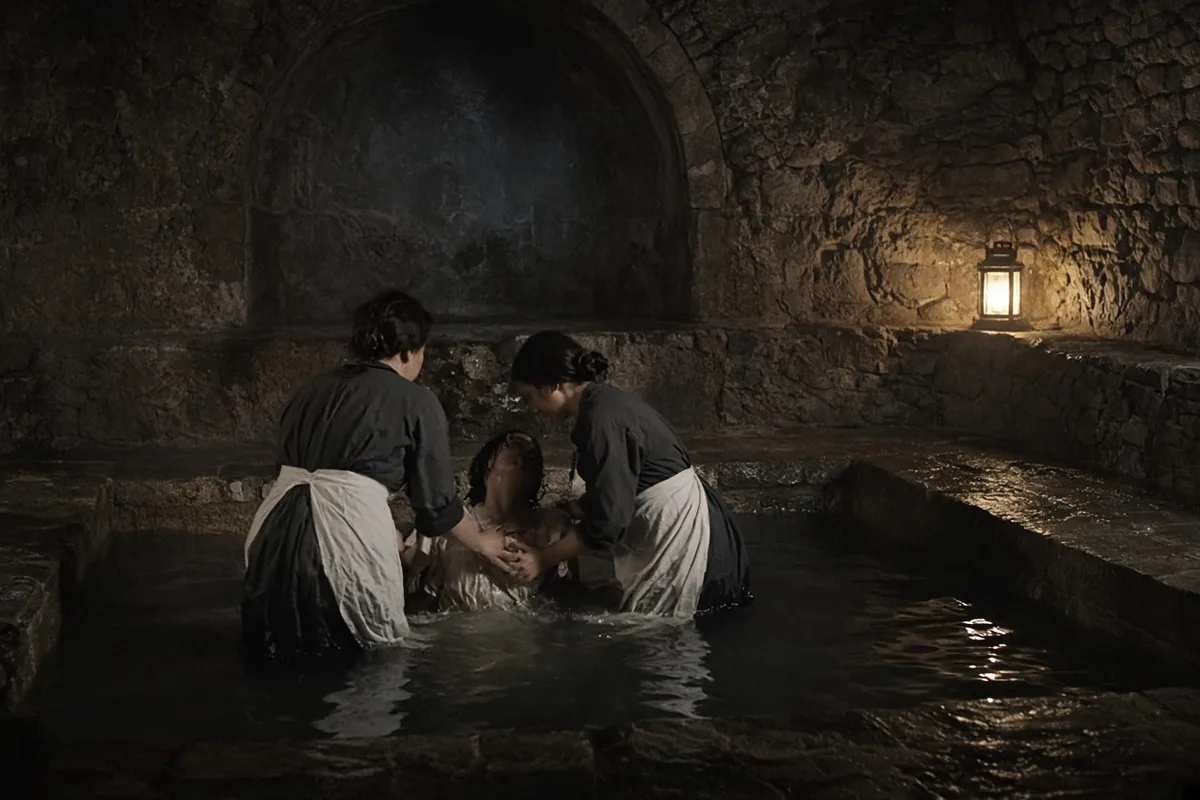
On 12 September 1953 Jeanne Fretel stood at the edge of the piscines at 5:40 a.m. beside Sister Marie de la Croix from the Rennes hospital that had discharged her four years earlier. The water temperature registered 12 degrees Celsius on the thermometer fixed to the stone wall. She entered the first pool without assistance, remained submerged for forty-seven seconds, and emerged to tell the attendant, “The pain I once carried here left on the 8th of October 1949 and has not returned.” The attendant recorded the statement in the ledger kept at the entrance, noting the exact minute and the presence of two pilgrims from Nantes who signed as witnesses. Later that morning she walked the full length of the esplanade to the Basilica of Saint Pius X, where the crypt chapel held the register of cures open to page 147 listing her case number 53.
In 1957 she moved to the Benedictine priory at Jouarre, thirty-eight kilometres east of Paris, under the direction of Dom Jean de la Croix. The community assigned her a cell whose window overlooked the cloister garden measuring twenty-two metres by fourteen. Each morning at 6:15 she joined the recitation of Prime, her voice carrying the Latin responses without interruption for the next twenty-nine years. On 3 April 1961 she wrote to Dr. François Leuret, president of the Medical Bureau, stating that her weight had remained steady at fifty-eight kilograms since the cure and that chest radiographs taken at Meaux hospital on 22 March showed no residual lesions. Leuret replied on 9 April, thanking her for the update and enclosing the Bureau’s annual report that listed her among the sixty-four cases examined that winter.
She returned to Lourdes each October without fail. In 1964 the town recorded 4,872,000 visitors, of whom 1,204 arrived by special train from Brittany. On the evening of 6 October she answered questions from a reporter for La Croix who noted her answers in shorthand: when asked about the moment her eyes opened she said only, “I saw the ceiling of the ward and knew the year was 1949.” The article appeared on page three of the 9 October edition and quoted the same sentence. Two days later she attended the Medical Bureau session where Dr. Henri Verges examined three new claimants and referred back to her own file, number 41, for comparison of abdominal measurements.
On 14 July 1972 she slipped on the wet steps outside the Hotel de la Grotte and struck her left hip against the stone balustrade. X-rays taken at the Centre Hospitalier de Lourdes showed no fracture. She remained in the hotel for nine days, attended daily Mass at the Grotto at 7 a.m., and departed on the 23rd for Jouarre. The incident was entered in the hotel register under the date and room number 214. She resumed her annual visits without change of schedule.
The Bureau closed its formal certification process after the twenty-fifth case in 1976. Jeanne Fretel continued to appear at the October gatherings through 1984. On 8 October of that year she sat for twenty-three minutes with a group of medical students from the University of Toulouse who had come to study the archived radiographs. She answered each of their twelve prepared questions by reference to the original hospital notes from Rennes, citing the exact dates of her coma in 1948 and the first solid meal taken at Lourdes on 9 October 1949. The students recorded her replies in notebooks that were later deposited in the university library.
She died at the priory in Jouarre on 15 February 1986 at 4:25 a.m. The death certificate listed cardiac arrest as the cause, with no mention of tuberculosis. Dom Jean de la Croix celebrated the funeral Mass two days later in the priory chapel before thirty-eight sisters and twelve visitors from Brittany. Her body was buried in the community cemetery under a plain stone marked only with her religious name, Sister Jeanne-Marie, and the dates 1914-1986. The Medical Bureau archive retains her complete file, including the original stretcher tag from the train arrival on 6 October 1949 and the signed statements of the three physicians who examined her that afternoon.
The stone at Jouarre remains visible today beside the cloister wall. Pilgrims occasionally leave a single white rose at its base on 8 October. The last photograph taken of her shows her standing at the entrance to the piscines on 5 October 1984, wearing the same black coat she had worn since 1952, her hands folded over a rosary given to her by Mgr Théas in 1949. The image is preserved in the Lourdes archives under reference PH-84-217.
The priory guest book at Jouarre records that on 22 March 1987 Sister Marie-Thérèse of the Rennes Carmel entered the chapel at 10:15 a.m. and signed her name beneath the notation “for the intention of Sister Jeanne-Marie, cured 1949.” The entry occupies line 47 of the 1987 volume and carries the additional remark that she had carried the same request since her own novitiate in 1951. Three weeks later the same volume notes the arrival of Dr. Louis Tajan of Toulouse, who requested permission to photograph the radiographs stored in the priory sacristy; the request was granted on 14 April and the resulting plates, numbered TJ-87-03 through TJ-87-07, were deposited with the Bureau archive on 19 May.
In October 1992 the Lourdes hospital ledger lists the admission of Élisabeth Gendron of Nantes, who stated on 7 October at 11:40 a.m. that she had come “to see the place where Jeanne Fretel stood when the pain left.” The admission form records her age as seventy-one and her room assignment as 312, the same floor that had housed the ward in 1949. She left on 10 October after requesting a copy of page 147 from the cure register; the copy was issued under receipt number 92-1847 and signed by the archivist, M. Henri Dupuy.
The Bureau file for case 53 contains a letter dated 3 June 1998 from Dom Gérard Dubois, then prior of Jouarre, acknowledging receipt of the annual maintenance grant of 1,200 francs allocated for the cemetery plot. The letter states that the stone had been cleaned on 2 June and that two white roses had been placed at the base the previous evening by a visitor from Rennes whose name is recorded only as “Mme L.” The grant was renewed each year through 2005, with the final payment noted on 15 January 2006.
On 8 October 2001 the esplanade attendance register records 6,314 visitors between 5:00 a.m. and 8:00 p.m. Among them was Sister Claire-Marie of the Benedictine community at Jouarre, who signed the piscines ledger at 6:22 a.m. and wrote that she had come “to repeat the forty-seven seconds of 1953 in memory of our sister.” The thermometer reading that morning was 11.5 degrees Celsius; the entry is countersigned by two attendants, M. Paul Lacaze and Mme Anne-Marie Rivière.
The archives of the University of Toulouse library hold the notebooks from the 1984 student visit. Notebook 4, page 19, contains the transcription of Jeanne Fretel’s answer to question nine: “The abdominal measurements taken at Rennes on 4 October 1949 were 92 centimetres; the same measurement taken at Lourdes on 10 October was 68 centimetres.” The notebook is bound in brown cardboard and carries the library stamp dated 12 February 1985.
A maintenance report dated 17 September 2014 from the Centre Hospitalier de Lourdes notes that the original stretcher tag from 6 October 1949 was removed from case file 53 for conservation and replaced with a digital scan under accession number SC-2014-09-17. The tag itself, measuring 14 by 6 centimetres and bearing the handwritten name “Fretel, J.” in blue ink, was placed in a climate-controlled drawer in the Bureau vault. The report is signed by the conservator, Mme Isabelle Morel.
The community cemetery at Jouarre added a second stone in 2019, placed 1.4 metres to the right of the original, for Sister Marie de la Croix, who had died on 4 November 2018 at age ninety-four. The new stone records only the name and the dates 1924-2018. Between the two stones a metal vase was installed on 8 October 2019; the first entry in the vase log, kept in the sacristy, states that a single white rose was placed there at 7:50 a.m. by a pilgrim from Brittany whose signature appears as “Y. Le Goff, Rennes.”
The final photograph added to the Lourdes collection shows a woman standing at the base of the Jouarre stone on 8 October 2023 at 9:15 a.m. The image, taken by the priory archivist and filed under reference PH-23-JOU-08, captures the woman’s hands resting on the stone and a white rose lying in the metal vase between the two markers. The reverse of the print carries the handwritten note “Visitor from the original Rennes ward, name withheld at request.”