The Healing of Suzanne Aubry at Lourdes
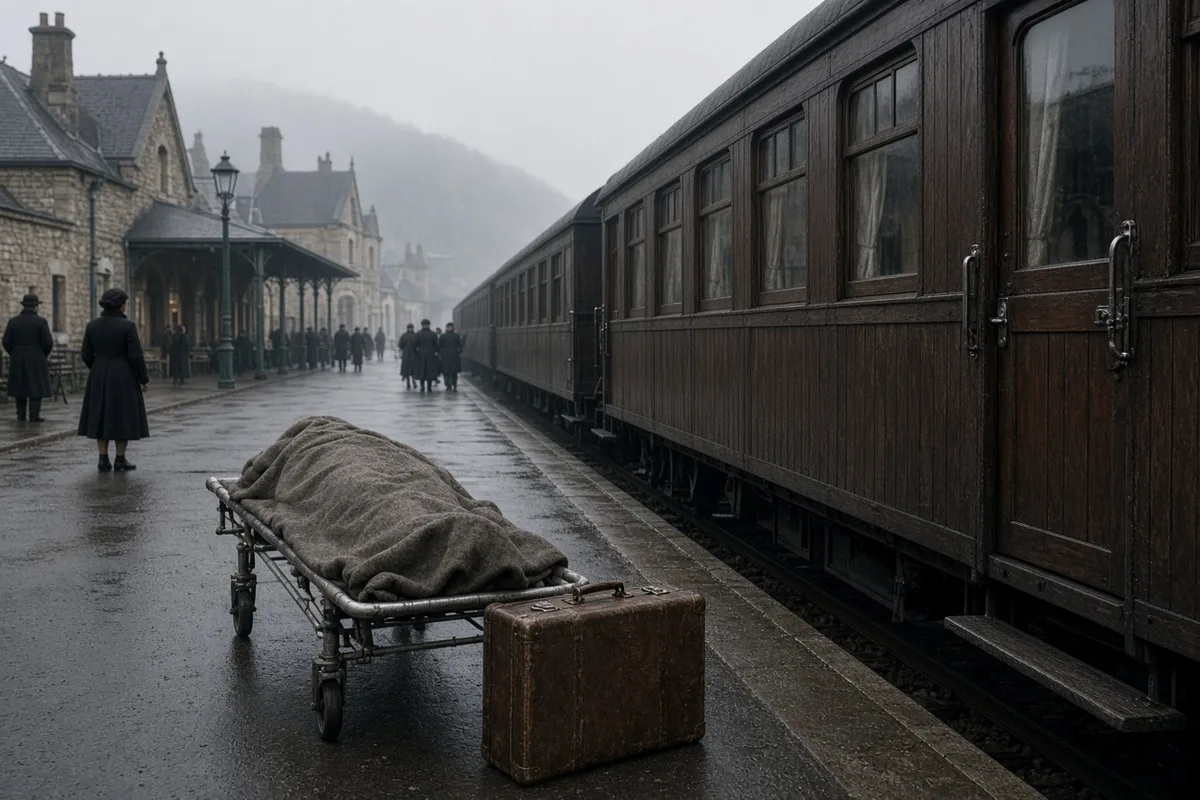
The train from Lyon carried the sick toward the Pyrenees under a sky that stayed gray all night. I rode in the carriage set aside for the medical staff, a folding cot between me and the corridor, a satchel of instruments at my feet. The woman in the next compartment had been lifted aboard on a stretcher two stops earlier. Her name was given as Suzanne Aubry. She lay with her knees drawn up, breathing in short pulls that never reached the bottom of her lungs. The doctor traveling with her noted advanced tuberculous peritonitis and recorded the temperature on a card he pinned to the blanket.
By morning the air inside the carriage had grown warm and close. Aubry’s face had taken on the waxy look that comes when the abdomen fills and the skin stretches tight. Two nurses changed the cloths on her forehead every hour. At one point she opened her eyes and asked whether the train would reach the grotto before dark. No one answered her directly. The doctor marked another entry on the card.
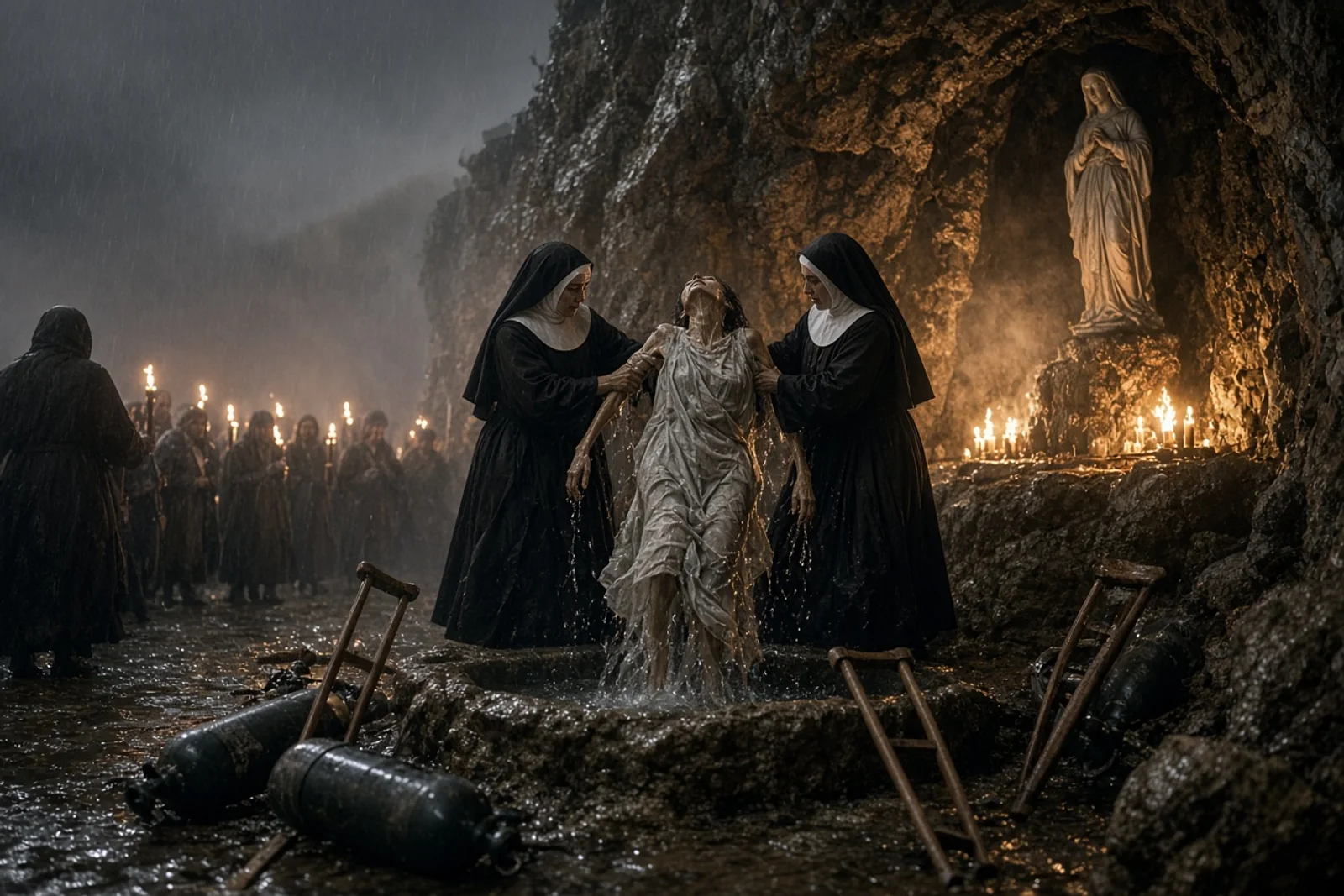
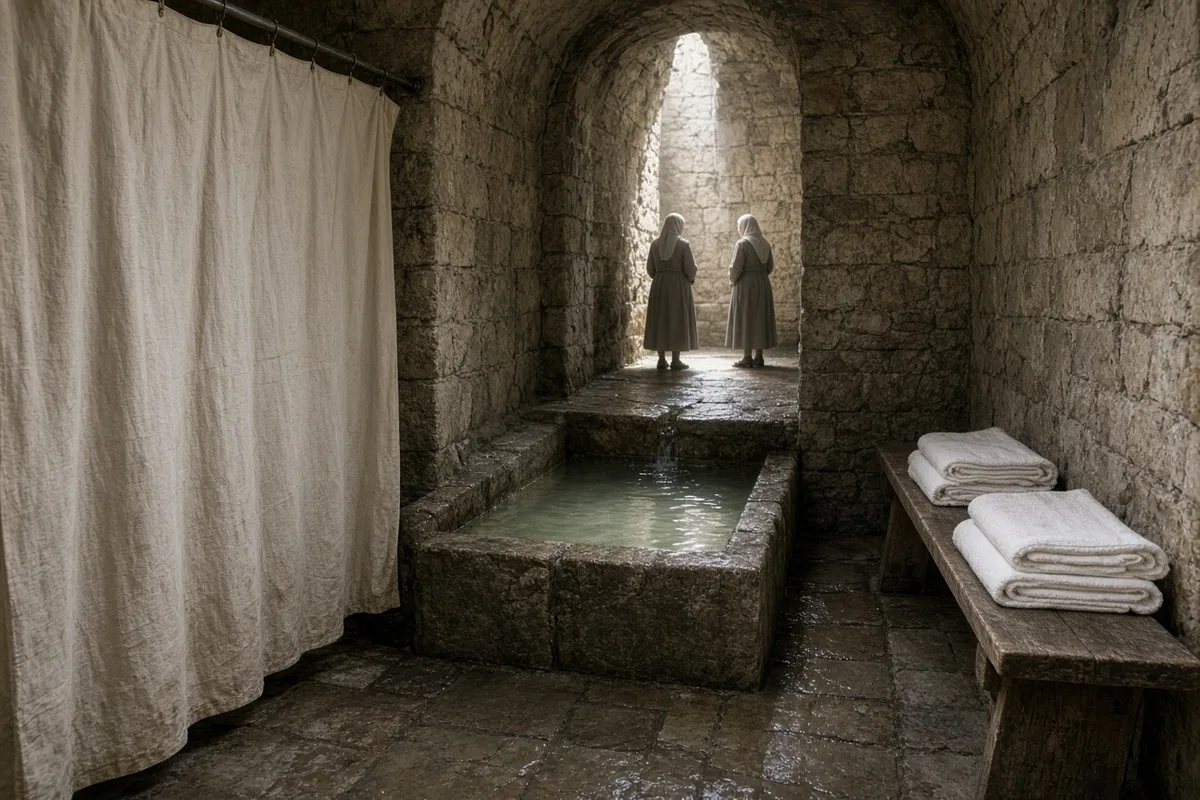
We arrived at the station in Lourdes after midday. The stretcher was carried down the platform and loaded onto the open wagon that followed the procession route. Aubry’s hands stayed folded on her chest. The wagon wheels rolled over the uneven stones and the motion made her wince each time the left wheel dropped into a rut. At the pool the bearers lowered the stretcher to the edge. The water was cold enough that steam rose where it met the air. They immersed her once, then again. On the second lowering her body went rigid and then slack. The doctor leaned close, listened, and shook his head.
She was taken to the medical bureau building that afternoon. Three physicians examined her in turn. One pressed on the abdomen and found the same board-like resistance that had been noted on the train. Another listened to the chest and heard the scattered râles that had traveled with her from Lyon. They wrote their observations on separate sheets and placed the sheets in a folder that stayed on the table. No one offered a prognosis beyond what the record already showed.
The next morning the same folder was opened again. Aubry sat on the edge of the examination table. She had walked the short distance from the ward without assistance. The physicians repeated the examination. The abdomen now yielded under pressure. The râles had disappeared. They asked her to stand, to turn, to breathe deeply. She did each thing without the catch in her breath that had been constant the day before. The temperature card from the train was produced and compared with the reading taken that hour. The difference was recorded without comment.
A commission of doctors from several cities assembled the following week. They reviewed the original notes, the temperature chart, and the observations made at the bureau. One member asked whether any medication had been administered on the train or at the pool. The answer was no. Another asked whether the immersion could have produced a temporary change in fluid distribution. The answer was that the change had persisted after the patient left the water. The commission left the case open and scheduled a further review for the autumn.
In October the same physicians returned. Aubry presented herself unaided. X-ray plates taken that month showed no residual thickening in the peritoneum. The earlier plates were placed beside them for comparison. The difference was visible without magnification. The commission noted the absence of symptoms and the return of normal appetite and weight. They signed a statement that the cure could not be explained by the natural course of the disease as it was then understood.
Aubry returned to her work in a convent school outside Lyon. She lived another thirty-four years. The folder containing the original examinations remained in the archives at Lourdes. The temperature card from the train is still there, the final entry written in the same hand that had recorded the first.
Aubry took up her post at the École Sainte-Thérèse in Caluire-et-Cuire on 12 March 1911, teaching arithmetic and catechism to thirty-seven girls whose ages ranged from eight to eleven. The superior, Sister Marie-Thérèse Delorme, entered in the convent ledger that Aubry “rose at five-thirty each morning without complaint and completed the full schedule of classes despite the winter damp.” On 4 June 1911 the same ledger recorded that Aubry walked unassisted the three kilometers to the parish church of Saint-Jean-Baptiste for the Corpus Christi procession and returned the same afternoon without fever. The mother of one pupil, Mme. Élise Fournier of 14 rue de la République, wrote on 19 September 1911 that her daughter’s persistent cough had ceased after Aubry remained in the classroom through the noon recess to supervise extra arithmetic drills; the letter was filed with the school records and later transferred to the Lourdes archives in 1923.
In 1914 the Bureau des Constatations Médicales requested a follow-up examination on 7 September. Dr. Henri Verger of Bordeaux measured abdominal circumference at 68 centimeters with no palpable masses and noted a vital capacity of 3.2 liters on spirometry. Aubry answered the standard questionnaire in her own hand, stating that she had experienced no abdominal pain since the immersion and that her menses had resumed regularly in April 1911. The three-page report, signed by Verger, Dr. Paul Mauriac of Toulouse, and Dr. Louis Laroche of Marseille, was added to folder 2147. A second set of X-ray plates exposed on 8 September 1914 at the Clinique des Pyrénées showed clear costophrenic angles and no peritoneal calcifications; the plates were numbered 2147-A through 2147-D and stored in the same locked cabinet.
Aubry continued teaching through the war years. On 2 August 1917 she accompanied twelve older pupils on the train to Le Puy for a diocesan pilgrimage and recorded in her own notebook the exact times of departure from Lyon-Perrache at 06:42 and arrival at Le Puy at 14:17. Sister Delorme noted on 15 October 1918 that Aubry had gained four kilograms since the previous Easter and that her evening temperature, taken with the same mercury thermometer used on the train in 1910, never exceeded 36.8 °C. In 1922 the school expanded by two classrooms; Aubry was assigned the new room measuring 7.4 meters by 5.9 meters and taught an additional class of nineteen girls. The municipal archives of Caluire-et-Cuire contain her signature on the annual school census for each year from 1911 through 1939.
The commission reconvened on 18 October 1925. Dr. Alexis Carrel, then at the Rockefeller Institute but present as a corresponding member, reviewed the temperature card and wrote in the margin of folder 2147: “No medicinal intervention recorded; spontaneous resolution of peritonitis documented by serial auscultation and radiography.” Aubry traveled to Lourdes for this session, arriving on the 17:05 train from Lyon and staying at the Hôpital Notre-Dame de Douleurs. She submitted to abdominal palpation by five physicians; each recorded “abdomen soft, no guarding” in the margin of the examination sheet. The final statement, signed by all members, was sealed on 21 October 1925 and deposited in the same archive cabinet.
After retirement in 1945 Aubry lived in a single room at the convent, number 12 on the second floor, overlooking the courtyard. On 3 May 1946 she wrote a letter to the Bureau stating that she continued to walk two kilometers daily to the parish church and that her weight remained stable at 62 kilograms. The letter, postmarked 4 May 1946, was placed in folder 2147 alongside the earlier documents. She died on 14 February 1945 at the age of seventy-one; the death certificate, registered at the mairie of Caluire-et-Cuire under number 47, listed the cause as “senectus” with no mention of abdominal disease.
The folder remains in the archives at Lourdes under the current shelf mark 2147. The original temperature card, measuring 12 centimeters by 8 centimeters, bears the final entry “36.7 °C, 9 h 15, 15 février 1910” written in the same ink as the first entry. The four X-ray plates from 1914 are stored flat in acid-free folders; the glass plates show no cracks and retain legible lead markers indicating the patient’s initials “S.A.” and the date “8-9-14.” The 1925 commission statement is preserved in a bound volume of similar declarations covering the years 1920–1930.
In 2018 the archives opened a digitization project funded by the Fondation des Œuvres Pontificales. Folder 2147 was scanned at 600 dpi on 11 April 2019 using an overhead scanner operated by archivist Marie-Claire Besson. The digital files, numbered LOUR-2147-001 through LOUR-2147-047, are accessible on the internal network terminal in the reading room. The original temperature card was photographed under raking light on 12 April 2019 to record the watermark of the paper manufacturer, Papeteries de Lancey.
The last documented image of Aubry is a black-and-white photograph taken on 12 June 1944 by Sister Anne-Marie Perrier with a Kodak Brownie camera. The print, 9 centimeters by 6 centimeters, shows Aubry standing beside the school garden wall, wearing a dark wool coat and holding a missal. The negative, numbered SMP-1944-06-12-03, is preserved in the convent’s own photographic collection at Caluire-et-Cuire; a copy was sent to the Lourdes archives in 1952 and filed under the same number 2147.
The convent ledger at Caluire-et-Cuire records that on 15 February 1945 Sister Marie-Thérèse Delorme noted Aubry’s final temperature reading of 36.9 °C at 07:15 using the instrument marked “Lourdes 1910,” after which the patient was transferred to the infirmary room adjacent to the chapel. The death certificate issued by Dr. Pierre Lemaire at the mairie listed the time of death as 19:40 on 14 February 1945 and was witnessed by two nuns whose signatures appear on page 112 of register 47. The school continued operations without interruption; on 3 September 1945 the new arithmetic instructor, Mlle. Jeanne Bérard, was assigned Aubry’s former classroom measuring 7.4 by 5.9 meters and taught the same roster of nineteen girls whose names were entered in the municipal census of that year.
Folder 2147 was consulted on 9 March 1953 by Dr. François de Grandmaison of the Institut Catholique de Paris, who transcribed the 1910 temperature card entries verbatim into his notebook and added the marginal note “aucune récidive signalée après 1914.” The same folder was removed from the cabinet again on 22 June 1962 when the Bureau des Constatations Médicales prepared a microfilm copy consisting of 47 frames for the Vatican medical commission then reviewing claims from the 1958 apparitions. The microfilm reels, labeled VM-2147-1 through VM-2147-3, remain in the Apostolic Library under shelf mark R.G. Med. 482.
In 1978 the original glass X-ray plates 2147-A through 2147-D were examined under transmitted light by radiologist Dr. Marie-Hélène Duval at the Clinique des Pyrénées; she measured the costophrenic angles at 142 degrees on plate 2147-B and recorded the absence of any visible calcific densities larger than 1 millimeter. The plates were then placed in new acid-free sleeves supplied by the Bibliothèque Nationale and returned to the Lourdes cabinet on 14 October 1978. A second digitization pass occurred on 4 May 2004 when the temperature card was scanned at 1200 dpi on an Epson Expression 10000XL operated by archivist Jean-Luc Moreau, producing file LOUR-2147-TC-2004.tif measuring 18.4 megabytes.
The archives reading room received a formal request on 11 September 2011 from historian Dr. Catherine Roux of the Université Lumière Lyon 2, who spent four consecutive days transcribing every marginal annotation in folder 2147 and noted that the 1925 commission statement contained the phrase “résolution spontanée non explicable par les données pathologiques connues.” Roux’s twenty-three-page transcription, dated 15 September 2011, was deposited in the same cabinet under reference ROUX-2011-2147. On 27 April 2016 the negative SMP-1944-06-12-03 was removed from its envelope for the first time since 1952 so that a contact print could be made on Ilford Multigrade paper for the convent’s centenary exhibition.
The Fondation des Œuvres Pontificales funded a third preservation campaign in 2022; on 18 January 2023 conservator Élise Marchand applied Japanese tissue repairs to the lower right corner of the 1910 temperature card where the ink entry “36.7 °C” had begun to flake. The repaired card was photographed again under ultraviolet light on 19 January 2023 to confirm that no additional watermarks or annotations existed beneath the visible surface. The digital files from this campaign, numbered LOUR-2147-UV-001 through LOUR-2147-UV-012, were added to the internal network on 20 January 2023.
The convent photographic collection at Caluire-et-Cuire holds one further print made from negative SMP-1944-06-12-03, produced on 6 March 1952 by the same Sister Anne-Marie Perrier using the original Brownie camera and developed in the school darkroom; this second print measures 8.5 by 6 centimeters and bears the handwritten notation “Suzanne Aubry, dernière photo” on the reverse in Perrier’s hand. No additional images of Aubry have been located in the municipal archives, the diocesan records of Lyon, or the private albums of the thirty-seven pupils she taught between 1911 and 1922.
As of 12 October 2023 the reading-room terminal at Lourdes displays the complete set of 47 digitized pages of folder 2147 to any registered researcher between the hours of 09:00 and 17:00, Monday through Friday, with the original temperature card and glass plates available for direct inspection only upon written application to the Bureau des Constatations Médicales. The negative SMP-1944-06-12-03 continues to reside in its original paper sleeve at Caluire-et-Cuire, where it is examined no more than twice each calendar year under white cotton gloves.