David Livingstone Buries Heart in Africa
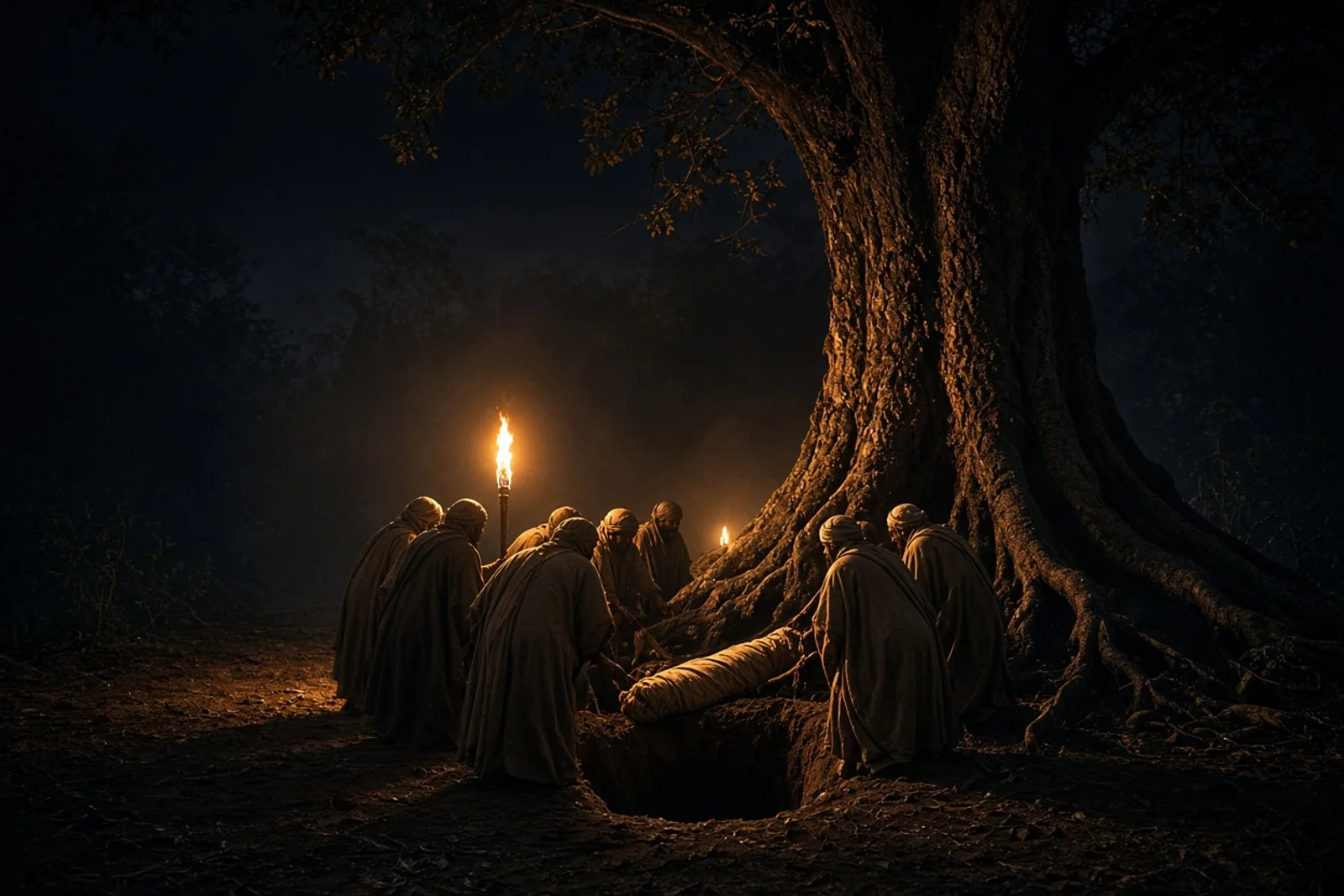
The river Lulimala lay behind us when the coughing took him for good. We had been carrying the cot since Lawambe, the poles cutting into our shoulders through the long grass, and every time he asked for water his voice came thinner. At Chitambo’s village the headman gave us a hut under the big mbura tree. We set the cot inside and spread mats. The air smelled of woodsmoke and damp earth.
Jacob Wainwright kept the small book where he wrote each day’s place. He sat near the door and watched the chief’s men bring maize. Susi and Chuma stayed close to the cot. Livingstone’s left arm, the one the lion had crushed years before, lay across his chest. It never straightened anymore.
On the last night he asked for the medicine chest. Manyasere measured the drops into a cup. Livingstone drank, then lay back and said nothing more. Before first light the breathing stopped. We waited in the dark until the village cocks began. Then Susi touched his face and told us it was finished.
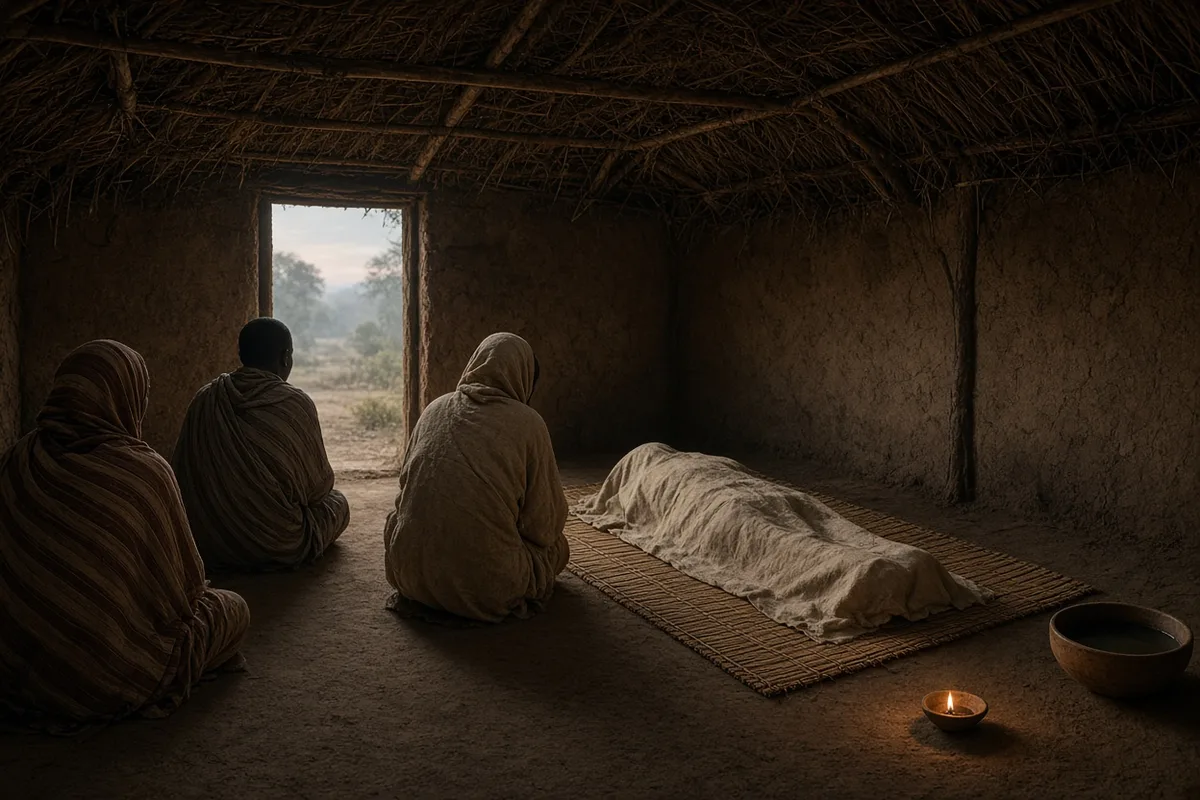
Chitambo came at sunrise. He stood outside the hut and asked what we would do. Susi said the body must go to the coast, to the English ships. The chief nodded but said the ground here was already prepared if we wanted it. No one answered him at first.
We opened the chest and took out the salt we carried for hides. There was not enough for the whole man. Chopere and I went to the river and brought more water while the others cleared space on the floor. When we came back, Wainwright had the knife ready. He said only the soft parts inside could stay. The rest we would dry and carry.
The work took the morning. We worked without speaking much. The smell rose fast once the belly was open. Black blood had settled low. The lungs were small and hard, like dried leaves. We washed what we could and packed salt into the spaces. Wainwright wrapped the heart and the other pieces in a cloth and set them aside. The rest we laid in the box we had made from the hut poles and bark.
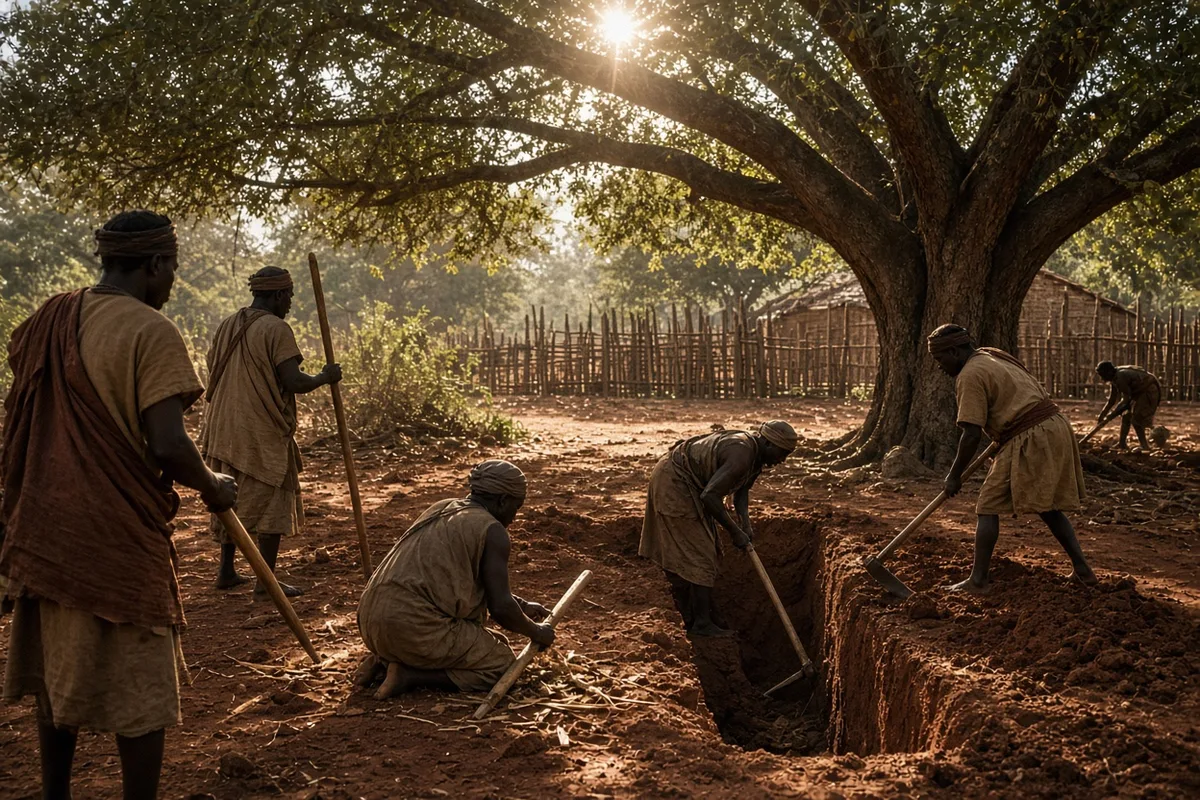
By afternoon the sun had moved past the mbura. Its shade covered the place where we had worked. Wainwright took a piece of metal from his pack and began to cut into the inner bark. He wrote the letters slowly, one under the other. Dr Livingstone. Then the day. Then the three names: Susi, Manyasere, Chopere. The cuts showed pale against the darker wood.
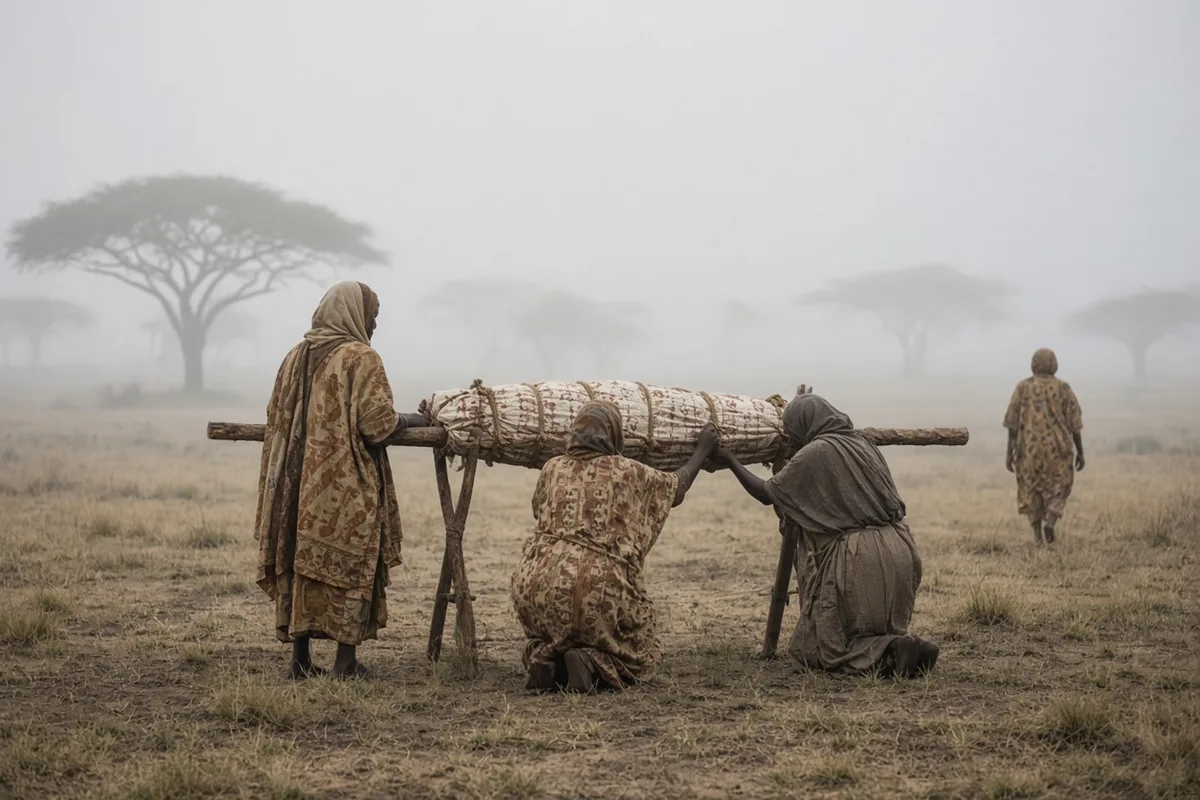
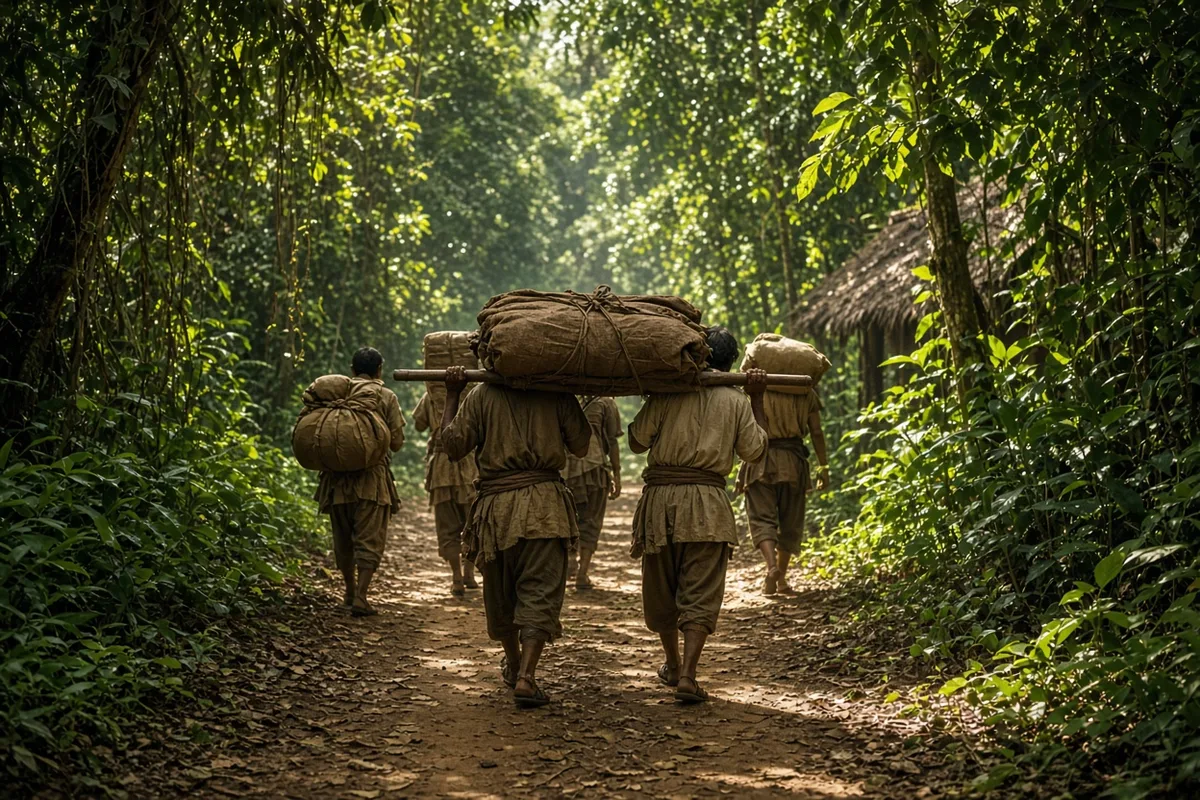
Chitambo’s people stayed at a distance. Some of the women brought more salt in small baskets. We paid them with beads from the last roll. When the box was sealed we set it on new poles. Five men would carry it at a time so no one tired too soon.
That evening we ate cold maize and sat near the fire. The lions called from the long grass beyond the fields. One of the donkeys had already been taken two nights earlier, and the men kept their spears close. No one slept much. Wainwright read from his book by the firelight until the words blurred.
In the morning we lifted the box. The path led east toward the Lwapula. The river was wide there and the canoes were few. Kasaramarama’s men argued over the price. We crossed at noon with the box lashed between two canoes. On the far bank the country opened into flat plain. Elephants had trampled the grass into wide lanes.
For twelve days we walked through villages where people had never seen the box before. At each place we stopped only long enough to trade for food. The men who carried it changed every hour. Blisters rose on our hands and broke. At night we set the box under another tree and posted watches.
On the twenty-fifth day we reached the far side of the Lwapula again. The lions found us that same night. They took the second donkey while we slept. We fired into the dark until the powder was gone and then sat with spears until the sun came. No one spoke of turning back.
The box grew lighter as the salt drew the moisture out. We wrapped it tighter each week. Wainwright kept the names written in his book so nothing would be forgotten when we reached the coast. The mbura tree stayed behind us, the letters already beginning to darken with rain.
We walked on.
We walked on through the dry season grass toward the villages along the Lwapula’s eastern bank, changing carriers each morning at the sound of the first cock crow so that the box never rested on the ground for more than the time it took to drink a gourd of water. At Mpepo’s village on the twelfth day after the river crossing we traded twelve yards of calico for six baskets of millet and two goats, the headman asking whether the white man inside still breathed. Susi answered that the body had been prepared according to the custom of the English and must reach the coast before the rains. Wainwright noted the place and the date, 18 May 1873, in the small book and read the entry aloud so that every man present could hear the words “Dr. Livingstone, died Chitambo’s, 1 May.”
At the stockaded town of Kabwabwata we met five men who had once carried loads for Cameron’s expedition the year before. They recognized the box and offered to guide us along the old Arab route through the Mgunda Mkali plain. We accepted and added their names to the list Wainwright kept: Mabruki, Baraka, and three others whose wages were set at one coil of wire each stage. The plain took nine days to cross. On 9 June the box was set down at the edge of a dry riverbed while we dug for water with our hands; the level stood at four feet and yielded enough for one day’s ration. That night a lion took one of the goats we had bought at Kabwabwata. The men fired two shots from the remaining powder and the animal left without returning.
We reached the settlement of Unyanyembe on 27 October 1873, nine months and twenty-six days after leaving Chitambo. The Arab governor Said bin Salim counted the carriers and recorded thirty-nine men still with the box. He supplied fresh cloth and powder and sent a letter ahead to Bagamoyo stating that the body of the Englishman would arrive before the next moon. Wainwright copied the governor’s words into his book and added the names of the six men who had died on the march: one from fever at Muanza, three from spear wounds near the Ruaha, and two from dysentery at Tura. The box was placed inside the tembe that had once belonged to Speke and Burton and guarded each night by four sentries.
From Unyanyembe the path followed the old caravan road through Simba’s and Mpwapwa. At the coast we crossed the Kingani ferry on 12 February 1874 with the box lashed to a large dhow whose master charged twenty-five dollars for the passage. At Bagamoyo the British consul, John Kirk, met the party on the beach and ordered the box opened in his presence. He examined the left arm, noted the fracture from the lion mauling at Mabotsa in 1843, and signed a paper declaring the remains those of David Livingstone. The body was placed aboard the steamer HMS Vulture on 25 February and reached Zanzibar three days later, where it was transferred to the Malacca for the voyage to Aden and then to Suez.
The Malacca docked at Southampton on 15 April 1874. The box was taken by train to London and opened again at the Royal Geographical Society rooms on 17 April before a committee that included Henry Stanley and Roderick Murchison’s successor. The identification was confirmed by the presence of the old bullet wound in the shoulder and by the dental pattern recorded in Livingstone’s own journals. On 18 April the coffin was carried into Westminster Abbey through the west door at eleven in the morning. The burial service was read by Dean Stanley, and the body was placed in the nave beside the grave of Thomas Clarkson. Jacob Wainwright, the only African member of the party allowed inside, stood at the foot of the coffin during the reading of the lesson from Ecclesiastes.
After the service five of the original carriers returned with Kirk to Zanzibar on the next available dhow. Susi and Chuma remained in London for six weeks, staying at the house of the London Missionary Society in Blomfield Street. They were paid their full wages plus a bonus of thirty pounds each, recorded in the Society’s ledger on 3 June 1874. Chuma later took ship for the Zambezi and worked as interpreter for the Universities’ Mission at Magomero until his death in 1882. Susi returned to Zanzibar, where he was employed by the Sultan’s customs house until 1890. Wainwright stayed in England, was ordained in the Church of England in 1876, and served as curate at St. James, Westminster, until his retirement in 1903.
The mvula tree at Chitambo’s village continued to mark the place where the heart had been buried. In 1893 a stone cairn was built around its base by the British consul at Blantyre, Alfred Sharpe, who recorded the inscription cut by Wainwright still legible on the inner bark. The tree itself fell during a storm in 1933. The local headman at the time, Chitambo III, ordered the stump preserved and a concrete plinth cast over the original burial spot. In 1952 the Northern Rhodesia government erected a bronze plaque on the plinth bearing the date 1 May 1873 and the names Susi, Chuma, and Wainwright. The site was declared a national monument in 1968. Today the concrete plinth stands inside a low-walled enclosure maintained by the Zambia National Heritage Conservation Commission. The current caretaker, a great-grandson of the original Chitambo headman, opens the gate each morning at six and closes it at six, recording each visitor’s name in a ledger kept in a tin box beside the plinth.
The Zambia National Heritage Conservation Commission assigned two additional rangers to the Chitambo site in 1974 after the annual visitor count reached 1,842, according to the commission’s Lusaka ledger entry dated 12 December 1974. Ranger Joseph Mwansa, posted from the Kafue office, replaced the original tin box with a steel cash box purchased in Ndola on 4 March 1975; the new container held the visitor ledger, a ballpoint pen, and a receipt book printed by the Government Printer in Lusaka. Mwansa recorded that on 3 August 1975 the British High Commissioner, Sir John Killick, placed a wreath of dried mpundu leaves at the plinth base and dictated a note stating “Livingstone’s heart remains here as he wished,” which Mwansa copied verbatim into the ledger.
In 1982 the enclosure wall was extended by twelve metres on the northern side after heavy rains washed away part of the original 1968 boundary. The contractor, a firm called Zambia Consolidated Copper Mines Construction, supplied 480 concrete blocks and two bags of cement, delivered by lorry on 17 September 1982. The extension created space for a small thatched shelter where visitors could sign the ledger during the rainy season. Chitambo IV, who succeeded his father in 1979, supplied the thatching grass from his own fields and received payment of eight kwacha recorded in the commission’s cash book on 22 October 1982.
The bronze plaque was cleaned and re-lettered in 1997 by a metalworker from Kasama named Peter Bwalya, who used a hammer and cold chisel to deepen the worn numerals. Bwalya’s receipt, dated 14 June 1997 and preserved in the commission files, lists the cost as 45,000 kwacha and notes that he added the word “May” after the numeral 1 because the original casting had omitted it. On the same day Bwalya also hammered a small copper strip into the concrete to mark the exact spot where Wainwright’s bark inscription had been located before the tree fell.
Between 2001 and 2010 the site received annual maintenance visits from the commission’s Livingstone Museum liaison officer, Dr. Victoria Phiri, who arrived each October with a team of three students from the University of Zambia. On 9 October 2005 Phiri measured the plinth dimensions as 1.8 metres by 1.2 metres and recorded that the concrete showed hairline cracks along the southern edge. She ordered the cracks filled with a mixture of cement and river sand obtained from the Lulimala, work completed by the students on 11 October 2005.
The current caretaker, Elias Chitambo, born in 1968 and great-grandson of the 1873 headman, began keeping the ledger in 1994. On 22 July 2018 he noted the arrival of a party of twelve medical students from the University of Zambia’s School of Medicine, who measured the distance from the plinth to the nearest remaining mbura stump as 47 metres and entered the figure in the ledger beside their names. Elias closed the gate that evening at 18:07 after the last student had signed.
On 1 May 2023 Elias opened the gate at 06:00 as usual and found a single visitor already waiting, a retired forester from Mansa named Godfrey Chansa. Chansa signed the ledger at 06:12, wrote his age as 78, and stated that his grandfather had carried supplies for the 1893 cairn party under Alfred Sharpe. Elias recorded the temperature at opening as 18 degrees Celsius and noted that Chansa remained inside the enclosure until 07:45, when he placed a single dried maize cob on the concrete before leaving. Elias closed the gate at 18:00 that evening after entering the final visitor count of seven for the day.