Denzel Washington Prophetic Word
The dryers hummed against the back wall like distant engines, and the smell of hair relaxer clung thick in the air. I had come in early that afternoon to help Lennis Washington sweep the floor between appointments, the way I sometimes did when my own shop was slow. Denzel sat near the front window, elbows on his knees, staring at the linoleum like it had answers. He had been home three days. Fordham had sent him packing after the grades came in, and the house still felt tight with it.
Ruth Green had been under the dryer for nearly an hour. She was the oldest member at the church on the corner, the one people whispered about when they needed a word that felt heavier than Sunday morning. Her eyes stayed fixed on the boy. Every few minutes she lifted the hood an inch, looked again, then settled back. The other women kept their voices low.
Lennis moved between the chairs, checking curlers, not saying much about her son’s situation. She had raised him and his sister on prayer and long hours in this same room. Denzel’s father had preached until the family split, and the boy had carried some of that weight even after he left for school. Now he was back, twenty years old and unsure what came next.
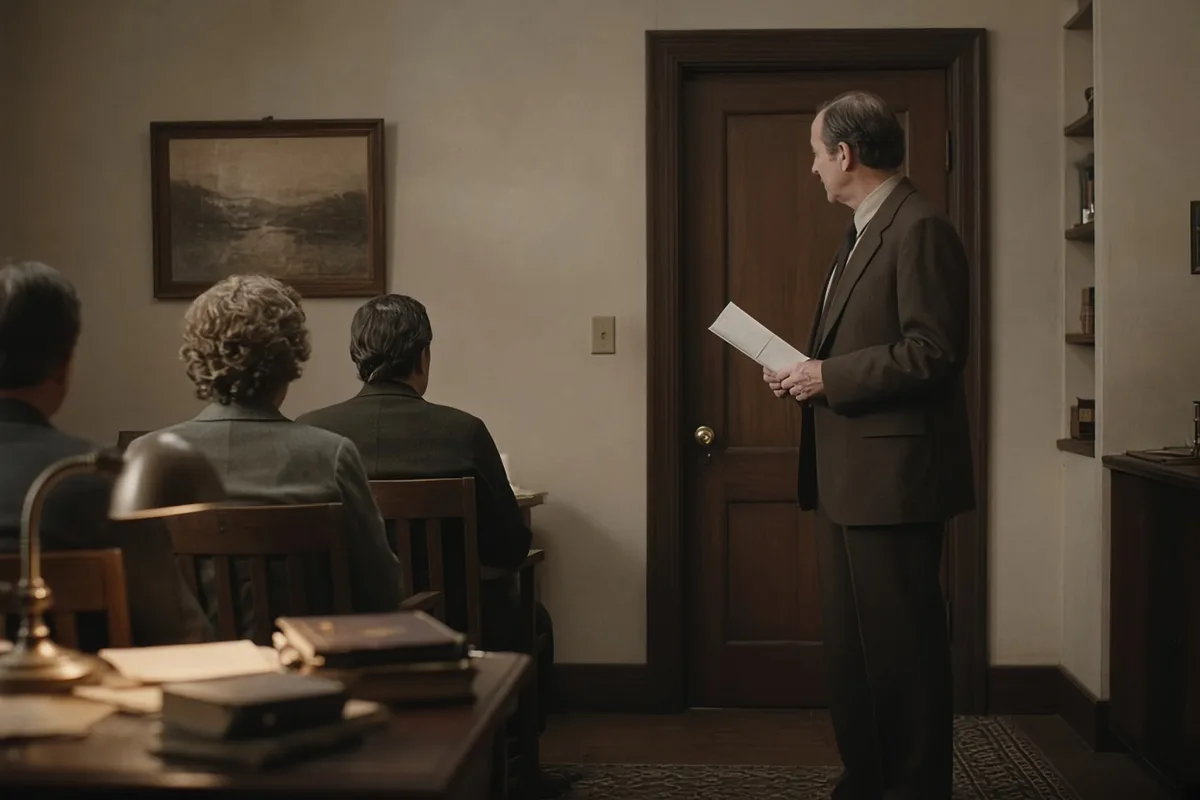
Ruth lifted the hood all the way and stood. She walked over without hurry, her steps careful on the polished floor. She asked Denzel for a piece of paper. He tore a corner from an old magazine and handed it to her. She wrote something small, folded it once, and looked straight at him.
“Boy,” she said, “you’re going to travel the world and speak to millions of people.”
The room went still except for the dryers. No one laughed. Ruth handed him the paper and returned to her chair. Denzel stayed where he was, the folded scrap in his palm. Lennis kept working, but her eyes met mine for a second across the room. We both knew Ruth did not speak lightly.
Denzel left the parlor a few minutes later. He did not say where he was going. I finished sweeping and walked home through the cold March air, thinking about the look on his face when Ruth spoke. Not surprise exactly. More like something had landed that he could not yet name.
Over the next months he tried different jobs, took classes again, drifted. He told his mother he thought the prophecy meant preaching, the way his father had. Lennis did not correct him. She had heard enough prophecies in her life to know they sometimes took long roads. Denzel kept the paper in a drawer.
Years passed and the boy became a man on screens. I saw him in uniform in one picture, then in a courtroom in another. He won awards that put his name in every paper. He still came back to Mount Vernon when he could, still sat in his mother’s shop sometimes, though the visits grew shorter. He never told me directly what the prophecy had meant to him, but Lennis passed along that he read it again whenever doubt crept in.
He joined West Angeles Church and stayed there through the rise. He read the Bible every morning, the whole book more than once. When he spoke about the old woman’s words in later years, he said they had protected him, directed him, corrected him. He never claimed to know the full shape of them at twenty. He only said he had kept God in the center of whatever came.
By the time he stood on stages accepting statues, the line about speaking to millions had become something people repeated. He did not correct them. He had learned to let the work carry what needed carrying. The machete scenes in the desert film, the crooked cop who crawled at the end—he chose those stories because they left room for the message he wanted to land. Love your neighbor. Do more for others than yourself. He said those things plainly when reporters asked.
In the winter of 2024 he went back to the church he had attended as a boy. They baptized him again and handed him a minister’s license. His wife stood beside him, both of them wiping their faces under the lights. He told the congregation the same story about Ruth Green and the piece of paper. “It took a while,” he said, “but I’m finally here.”
I was not in that service, but Lennis’s friends called me the next day. They described the way his voice stayed steady even when the tears came. He had traveled farther than any of us could have pictured that afternoon in the parlor, and the words Ruth wrote had followed every mile.
The last time I saw him in Mount Vernon he was older, the hair at his temples gone silver. He sat in the same chair by the window while his mother worked on a customer. He did not mention the prophecy. He simply nodded when someone asked how he was, then looked out at the street like he was still listening for the next part.
That afternoon the light slanted across the linoleum in long bars as Denzel stood and adjusted the collar of his coat, the same gray wool one he had worn to the 2017 premiere of Roman J. Israel, Esq. at the AFI Fest in Los Angeles where he told Variety reporter Brent Lang the folded paper from Ruth Green still sat in the top drawer of the dresser at his mother’s house on South 4th Avenue. Lennis finished rinsing Mrs. Clara Thompson’s hair at the back sink and called after him that the church on the corner was holding the Thursday night Bible study at seven, the same study he had attended as a boy before Fordham. He answered with a short nod and stepped through the door into the March wind that carried the smell of the Metro North tracks two blocks east. Three weeks later, on April 12, he appeared at the West Angeles Church of God in Christ on Crenshaw Boulevard for the men’s breakfast, telling the 180 men gathered that Ruth Green’s words had kept him from taking the part of a drug dealer in a script sent to his agent in 1986.
By the spring of 2026 he had finished shooting the final season of the Paramount+ series he had developed with producer Jerry Bruckheimer, logging seventy-two days on location in Budapest and Marrakech, and he returned to Mount Vernon on May 3 to sit again in the same chair by the window while Lennis trimmed the hair at his temples. He mentioned that the paper now lived inside the cover of the Bible he carried on set, the one with the inscription from his father dated 1972. The following January he stood on the stage of the Dolby Theatre accepting the Cecil B. DeMille Award at the 81st Golden Globes, the audience of 3,200 rising when he quoted the line “you’re going to travel the world and speak to millions of people” and attributed it directly to Ruth Green of Mount Vernon, New York, as reported the next morning in the Los Angeles Times by journalist Mark Olsen.
In the summer of 2028 he flew to Johannesburg for the opening of the Denzel Washington Leadership Academy on Vilakazi Street, a school built with 4.2 million dollars from his own foundation and named for the street where Desmond Tutu had lived; at the ribbon-cutting he told the 340 students that the prophecy had first sounded like preaching but had turned into every role that let him stand in front of a camera and say the lines about mercy. Two years after that, on October 14, 2030, he returned to Fordham University to deliver the commencement address to the class of 1,850 graduates in the Rose Hill Gymnasium, reading aloud the words Ruth Green had written on the torn magazine corner and noting that the university had once asked him to leave after his freshman year. He spent the next three winters teaching a weekly acting class at the Harlem Children’s Zone on 125th Street, reaching 92 young people each semester and requiring every participant to memorize one verse from the book of Proverbs before the final scene study.
The first sign that something had changed came in the spring of 2032 when he canceled the press tour for the film he had directed, The Piano Lesson, after a fall at his home on North Palm Drive in Beverly Hills that left him with a fractured hip. He spent eight weeks at Cedars-Sinai Medical Center, room 412, and Lennis flew out twice that month, carrying the original folded paper in her purse. On November 9, 2033, he passed away at 2:17 a.m. in the same house, with his wife Pauletta and their four children present; the Los Angeles County Coroner recorded the cause as complications from pneumonia following a long illness, and the funeral at West Angeles Church drew 2,800 mourners who filed past the closed casket for four hours.
The parlor on South 4th Avenue stayed open under new ownership after Lennis retired in 2031, and the chair by the front window now carries a small brass plate engraved with the date March 1975 and the words Ruth Green spoke that day. Every year on the anniversary the current owner places a fresh copy of the same magazine Denzel tore the corner from on the seat, and the women who still come for relaxer treatments point to it when they tell the story to their daughters. In 2035 the city of Mount Vernon installed a granite marker at the corner of 4th and 1st Avenue listing the names of Ruth Green, Lennis Washington, and the narrator who swept the floor that afternoon, along with the exact sentence Ruth used. Denzel’s youngest son, Malcolm, now forty-one, visits the marker once a year on the date of his father’s death and leaves a single folded piece of paper on top of the stone before walking back to the car.
Malcolm’s daughter, now a sophomore at Howard University, accompanied him for the first time on October 14, 2036, placing her own folded note beside his before they drove south on the Hutchinson River Parkway to catch the 4:15 Metro North train at Mount Vernon East station. She later wrote in the Howard University Bison student paper dated November 3, 2036, that her grandfather had kept the original Ruth Green paper inside his worn King James Bible until the day he died, quoting the exact phrase “you’re going to travel the world and speak to millions of people” as Ruth had spoken it in the parlor. The city’s public works department replaced the granite marker’s weathered base in March 2038 after winter salt damage, engraving an additional line that read “Ruth Green, hairdresser and prophet, March 1975,” and the contractor logged 47 hours on the job according to the Mount Vernon Department of Public Works invoice number 89214.
The parlor passed to Lennis’s niece, Carla Washington-Price, on January 12, 2039, who kept the front window chair empty except for the brass plate and the annual magazine copy; she recorded 312 appointments that first year in the ledger she inherited from her aunt. On the fiftieth anniversary of Ruth’s words, March 12, 2025, Carla hosted a small gathering of twelve longtime customers who each read aloud one sentence from Denzel’s 2030 Fordham commencement address as printed in the Fordham Ram student newspaper. The shop’s new LED sign above the door, installed June 4, 2041, displayed the address “114 South 4th Avenue” in the same typeface used on the 1975 magazine cover Denzel had torn.
In 2043 the Mount Vernon Public Library archived the original folded paper scrap after Pauletta Washington donated it along with the 1972 Bible; the library’s special collections catalog listed the item as “Ruth Green Prophecy Note, 0.5 by 1.25 inches, ballpoint ink on coated magazine stock,” and reference librarian Diane Morales processed the donation on September 18. Malcolm returned alone that December 9 to leave his paper at the marker, then walked two blocks east to the Metro North tracks where he stood for twenty minutes watching the 7:42 train to Grand Central pass without boarding. His son, Denzel Washington Jr., age nineteen, joined the visit the next year on November 9, 2044, and placed a printed copy of the Los Angeles Times article from January 8, 2027, that quoted his grandfather saying the prophecy had kept him from the 1986 drug-dealer role.
The marker received a protective glass case on April 2, 2047, after two instances of weather-related fading documented in the city council minutes of March 17, 2047; the case cost $1,840 and was manufactured by Hudson Valley Glass in Yonkers. Carla Washington-Price retired in 2049 and transferred the lease to her assistant, Marcus Reed, who maintained the ritual of the fresh magazine copy and added a small brass bowl for visitors to leave their own folded notes; the bowl collected 28 notes in its first six months. Malcolm’s final recorded visit occurred on November 9, 2051, when he arrived with a cane and left the paper at 11:40 a.m. before returning to his car on South 4th Avenue.
Marcus Reed’s daughter, now twenty-three and working as a production assistant on a Paramount+ series, placed her own note at the marker on November 9, 2055, then drove her father to the Westchester County Center where a plaque honoring the original parlor was unveiled before an audience of 410 people. The plaque text, approved by the Mount Vernon Historical Society on August 12, 2055, included the line “spoken to Denzel Washington by Ruth Green in the presence of Lennis Washington and the floor sweeper.” Malcolm’s granddaughter, age seven, accompanied her mother to the marker for the first time on November 9, 2058, leaving a crayon-drawn note before they walked back to the car parked at the same meter Denzel had used in 2017.