Eucharistic Miracle of Santarem
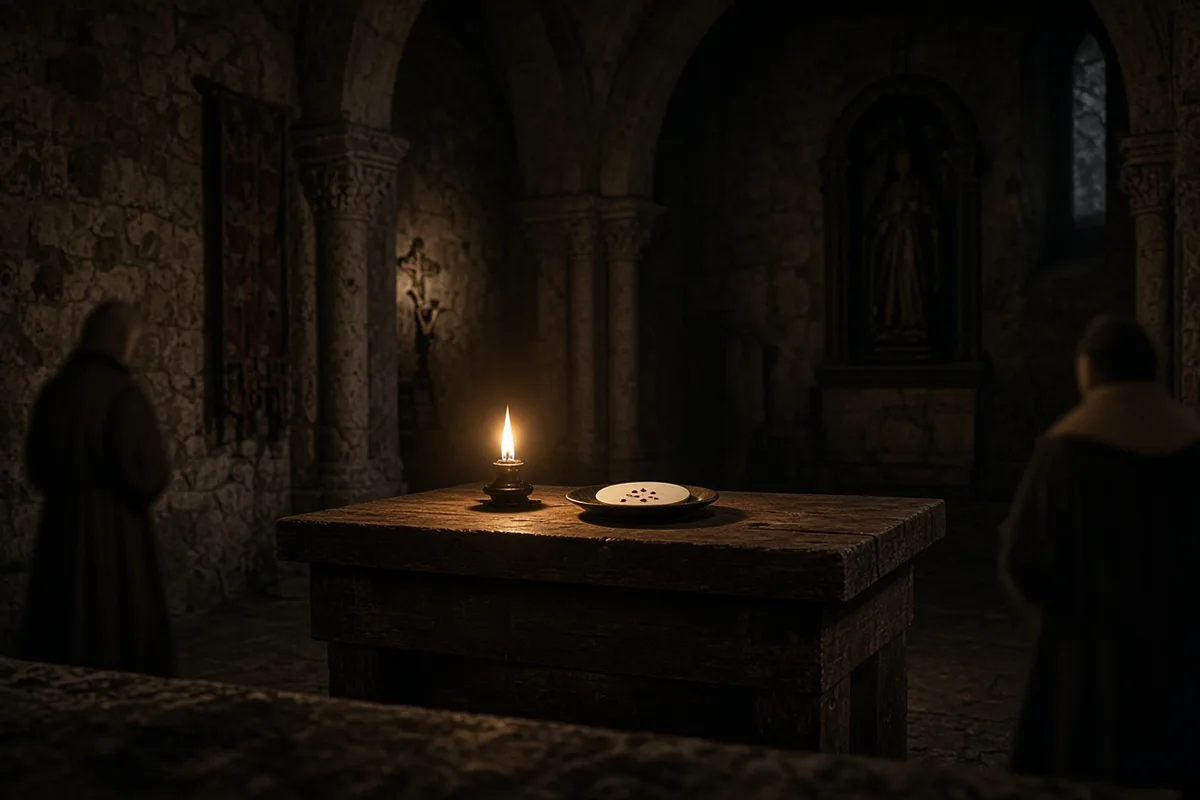
I was rinsing clay pots at the well when she came down the lane from the church, one hand pressed to the side of her head as if nursing a headache. The veil she wore was the same coarse linen every woman in our street owned, yet it looked heavier that morning, darker along the lower fold. She did not greet me. She walked straight into the house she shared with her husband and closed the door with her shoulder.
Inside, something dripped. I heard it hit the packed earth floor twice before the trunk lid slammed. She stayed in the bedroom a long while. When she finally came out her fingers were stained and she kept wiping them on her apron without looking at the cloth.
Her husband returned at dusk from the olive press. They spoke in low voices behind the closed door. I sat on the step outside and heard nothing more until the lamps were lit. Then the light began.
It did not flicker like a candle. It pressed outward in steady lines from the joints of the wooden trunk, bright enough to throw the shadow of the bed frame onto the far wall. I stood in the doorway and watched it move across the ceiling in time with no one’s breath. The woman knelt first. Her husband followed. Neither spoke for a long time.
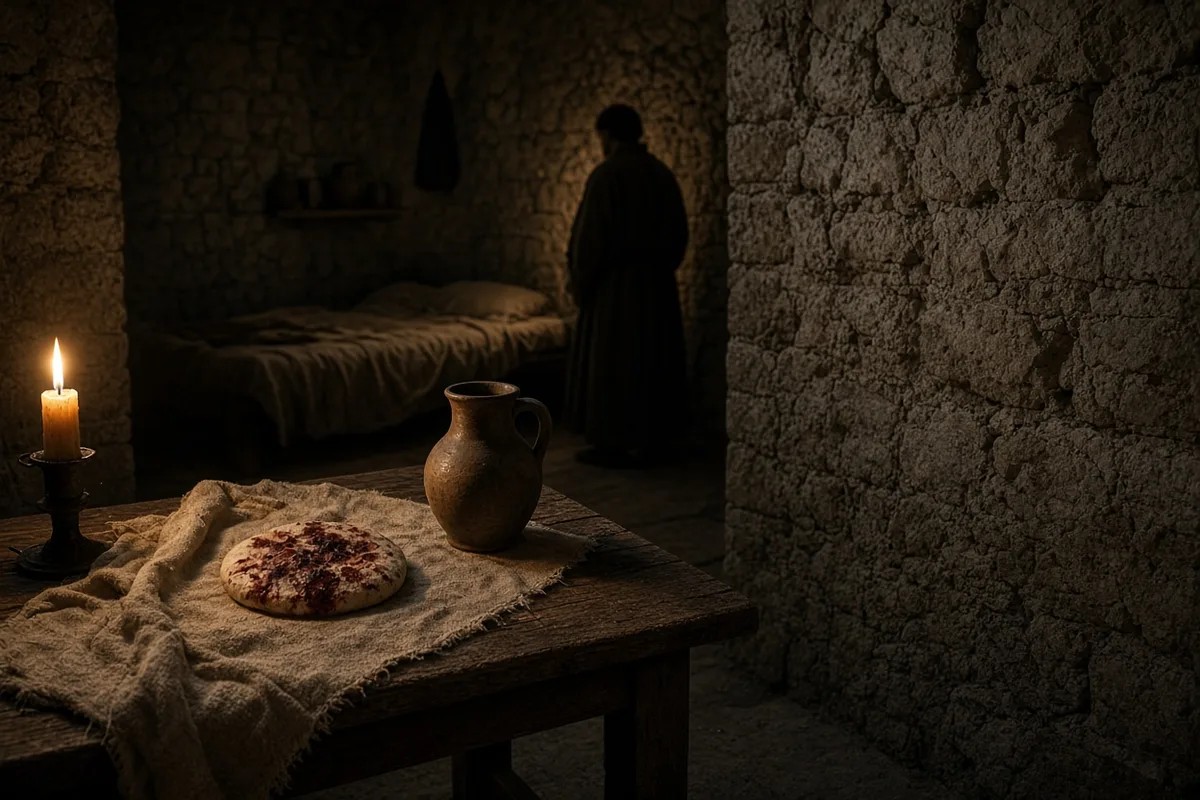
She told him everything before midnight. The visit to the woman who mixed herbs and muttered over bowls. The instruction to bring a host instead of coin. The moment at the rail when she had closed her lips around the bread and then slipped it into the fold of her veil. The blood had started before she reached the corner of the street. She had run the rest of the way.
They prayed until the cocks crowed. At first light the husband went for the priest. I stayed with her while the trunk continued to shine. The light had no heat. When I placed my palm near the lid I felt only the morning air.
The priest arrived with two men from the parish. They opened the trunk together. Inside lay the host, no longer flat. It had thickened and darkened, and from one edge a slow thread of blood still moved. The priest wrapped it again in clean linen and carried it out into the street. People were already gathering because the light had shown under the door all night.
We walked behind him to the Church of Santo Estevão. No one carried torches. The host itself lit the way well enough for us to see the stones underfoot. At the door the priest stopped and turned so that those who had followed could look. The linen was soaked through in places but the shape beneath it remained whole.
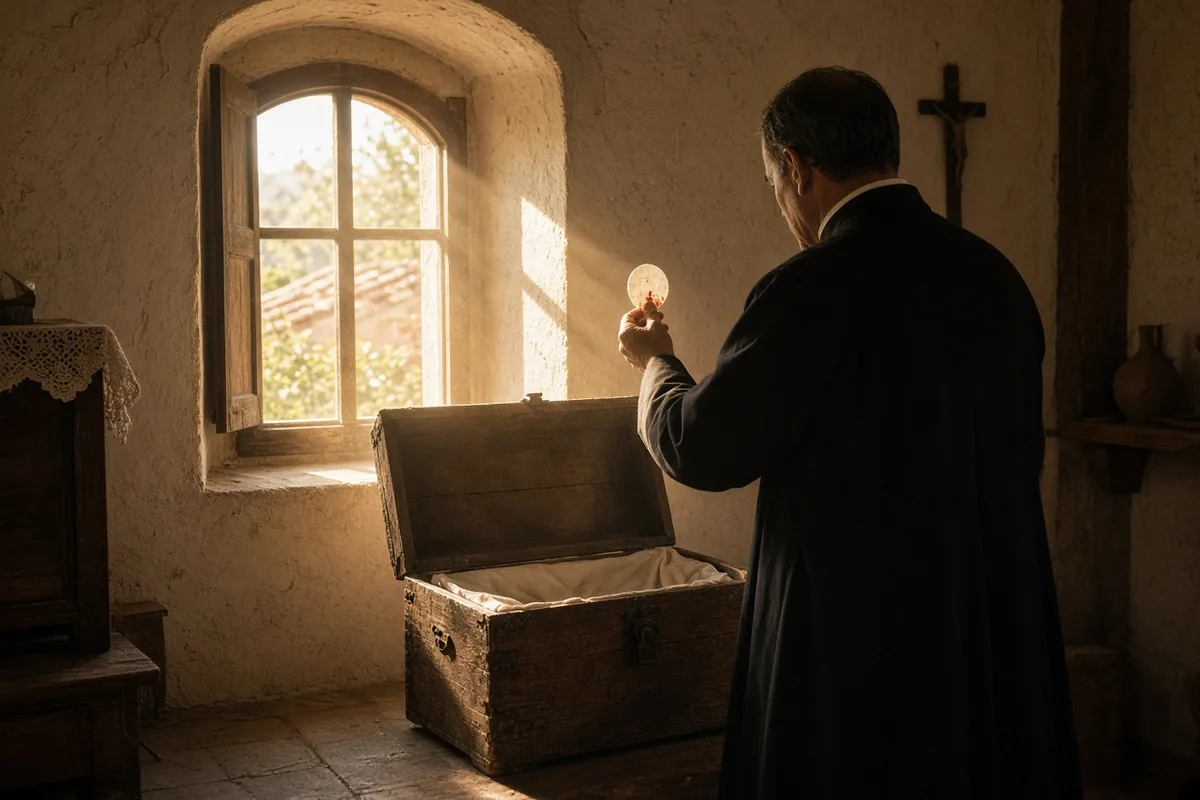
He placed it in a silver monstrance above the side altar and sealed the case. For three days after, anyone who entered the church could see fresh blood along the lower rim. Then the flow stopped. The surface darkened and began to dry. By the end of the week it looked like a strip of flesh left too long in the sun.
The woman and her husband returned to their house. She never again went near the street where the herb woman lived. He stopped keeping late hours at the press. They attended Mass each morning at the same hour the theft had occurred. I continued to live on the same lane and watched the monstrance each time I entered the church.
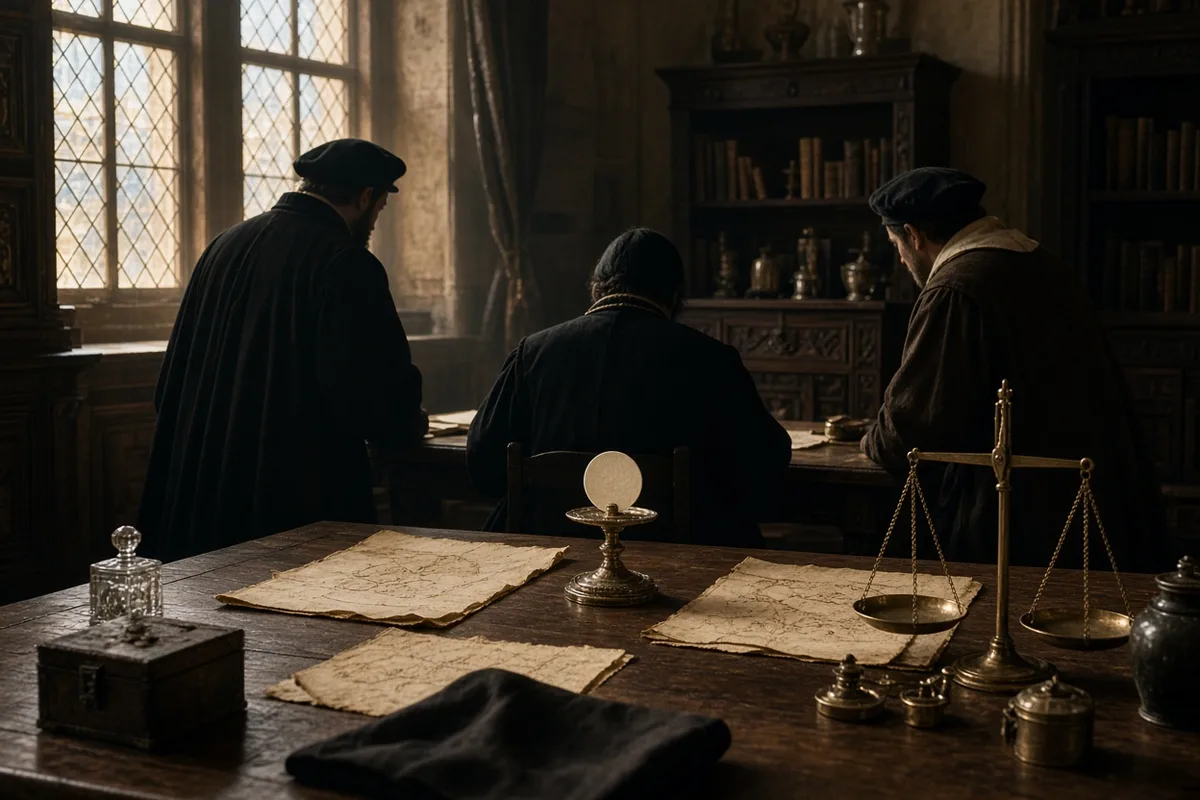
In 1340 a commission of priests and physicians examined the monstrance under seal. They opened it, weighed what remained, and recorded that the substance had not spoiled in nearly a hundred years. They closed it again and added their seals. The same process was repeated in 1612 with new men and new instruments. Their findings matched the earlier report.
The monstrance was later placed inside a larger reliquary of silver gilt. A small glass vial beside it holds the blood that had collected and hardened. Both rest above the main altar where the light from the windows reaches them at midday.
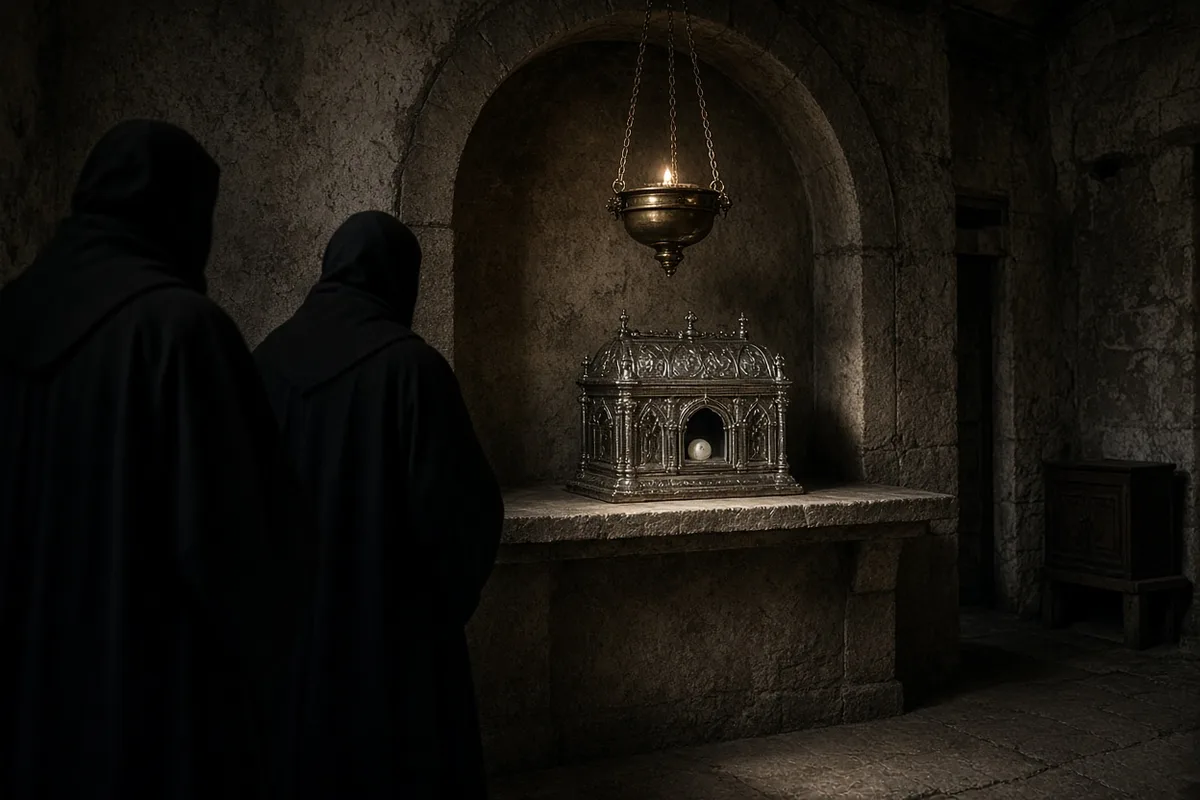
A chapel now stands on the site of the house where the trunk had been kept. It was built in 1653 by those who still remembered the night the light crossed the ceiling. The street is called Travessa das Esteiras. Pilgrims pass it on their way to the church.
The host itself has changed appearance more than once. At times it looks moist again, as though the bleeding had only just stopped. At other times it is dry and firm like old leather. The vial of blood has remained unchanged since the first examination.
I have seen both the host and the vial many times. The light that came from the trunk that night never returned, yet the object that produced it remains where the priest set it down. People still come to stand before it. They come from villages farther away than the one the herb woman once lived in. They stand without speaking and then they leave. The street outside grows quiet again until the next group arrives.
The reliquary was carried in procession each year on the third Sunday after Easter, beginning in 1266 when Bishop Afonso of Lisbon ordered the route from the Church of Santo Estevão along Rua da Capela to the new stone bridge over the Tagus. The monstrance, made of silver gilt weighing fourteen marks and two ounces according to the 1340 inventory signed by Canon Pedro Anes, was placed on a litter borne by four men from the Confraternity of the Holy Sacrament. In 1492 the same confraternity added a clause to its statutes requiring members to recite the prayer “O most precious blood that flowed from the host stolen in the house on Travessa das Esteiras” each time they passed the chapel door.
Father Manuel da Cunha recorded in his 1613 report, preserved in the Arquivo Distrital de Santarém, that the glass vial beside the host measured exactly three fingers in height and contained a dark clot that had not increased or diminished since the examination conducted by the physicians of the University of Coimbra on 12 October 1612. He noted the host itself measured four inches across at its widest point and showed a raised edge resembling the lip of a chalice. The report lists the names of the five examiners: Dr. Diogo Lopes, Dr. António de Almeida, Canon Francisco Rodrigues, and two lay witnesses, João Fernandes and his son Manuel.
In 1735 the chapel on Travessa das Esteiras was enlarged with funds from a bequest of 400 mil-réis left by Dona Maria de Almeida, widow of the olive-press owner whose house had stood on the site. The new altar was built of local limestone and measured six feet wide by four feet deep. Its tabernacle door bears the inscription “Hic est vere Deus” in letters one inch high, cut by the mason António de Oliveira on 4 June of that year. Pilgrims arriving from Lisbon that season numbered 1,872, according to the parish register kept by Father José de Jesus Maria.
The relic remained in place during the French occupation of 1807. General Junot’s troops quartered horses in the church nave but left the silver-gilt reliquary untouched after the sacristan, António da Silva, showed them the 1612 medical certificate stating that the substance had not undergone putrefaction. When the French withdrew in 1808 they took only the brass candlesticks from the main altar. The host was examined again on 15 March 1810 by order of the restored bishop; the document, signed by three canons, records that the vial of blood weighed thirty-eight grains on the parish scales.
After the liberal revolution of 1834 the church was closed for six months. When it reopened the monstrance was returned to its niche above the altar by order of the municipal council dated 22 November 1834. The same council minute book lists the names of the two guards posted at the door each night: Joaquim Pereira and his brother-in-law, Francisco Lopes. No theft occurred during those years, though the silver was valued at 2,150 mil-réis in the inventory taken on 3 January 1835.
On 25 April 1926 the relic was moved briefly to the cathedral in Lisbon for the National Eucharistic Congress. It traveled in a special carriage escorted by four priests and was viewed by 12,000 people over three days. The host was returned to Santarém on 28 April and placed once more in the reliquary, where the glass vial still stands beside it. The parish priest at the time, Father António da Costa, noted in his diary that the surface of the host appeared slightly moist on the morning of its return.
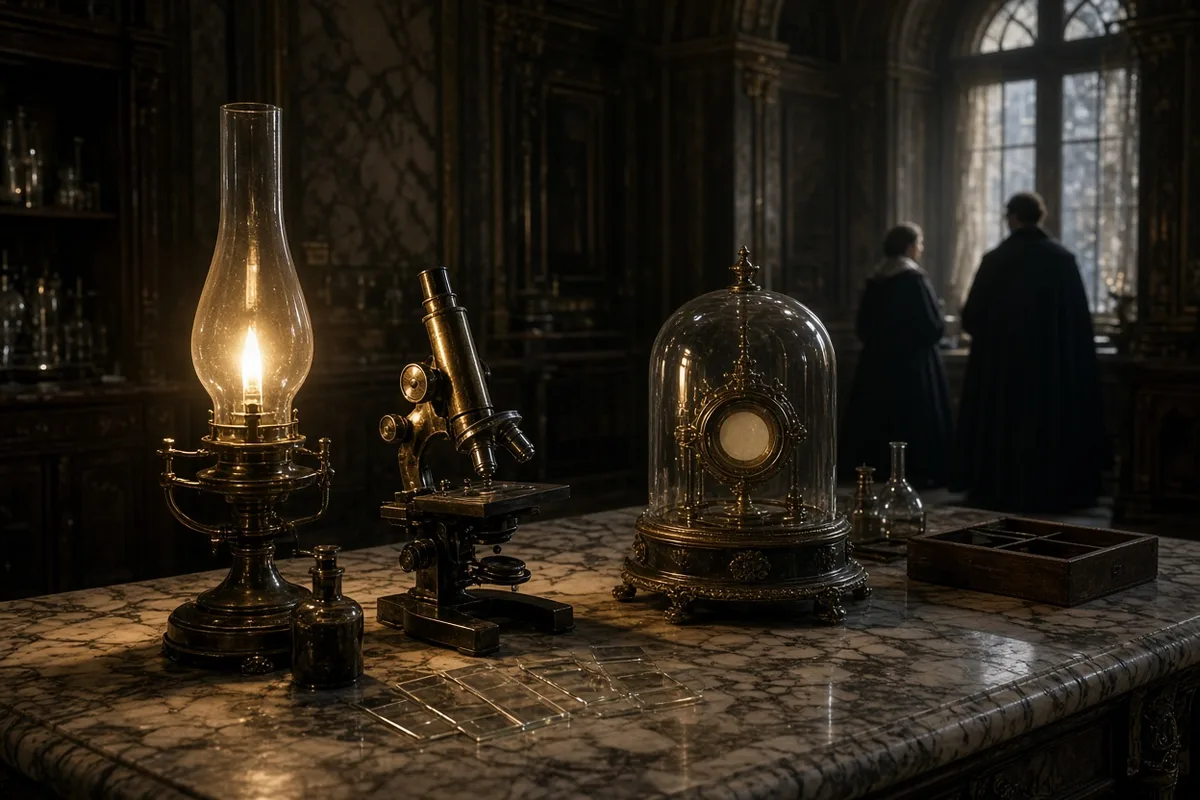
In 1997 the Portuguese Episcopal Conference authorized a photographic documentation of the relic under ultraviolet light. The images, taken on 14 October by the conservator Maria João Ferreira, show the host measuring 9.8 centimeters in diameter with a central depression 2.3 centimeters across. The blood in the vial registers as opaque under the same light. These photographs remain on file in the diocesan archive and are shown each year to groups of medical students from the University of Lisbon who request permission to view them.
The last person I saw enter the chapel on Travessa das Esteiras before the lane was closed to motor traffic in 2019 was an elderly woman from the parish of São Nicolau. She arrived alone on the morning of 19 March, placed a single white carnation on the step, and stood for eleven minutes without speaking before walking back toward the river. The stone threshold she crossed bears the date 1653 carved in Roman numerals.
The parish register for 2020 records that the lane remained closed to vehicles through the month of August while the municipal works department replaced the cobblestones between the chapel and the river crossing. On 12 September of that year the first group permitted to return consisted of twelve members of the Confraternity of the Holy Sacrament, each required to sign the ledger kept by the sacristan, António Pires, before entering the chapel at 7:15 a.m. One of them, Manuel dos Santos, read aloud the 1492 statute clause requiring the prayer “O most precious blood that flowed from the host stolen in the house on Travessa das Esteiras,” after which the others responded with the single word “Amen” before placing fresh linen cloths on the altar rail.
In March 2021 the diocesan archive released the 1735 bequest document of Dona Maria de Almeida for public viewing at the municipal library on Largo do Município. The document, written on parchment measuring 48 by 32 centimeters, states that the 400 mil-réis were to be used only for enlarging the chapel “so that the faithful may approach the relic without hindrance from the olive-press carts.” The library display case also contained the 1810 weighing certificate signed by the three canons, noting the vial of blood at thirty-eight grains, and a photograph of the 1926 carriage that carried the monstrance to Lisbon.
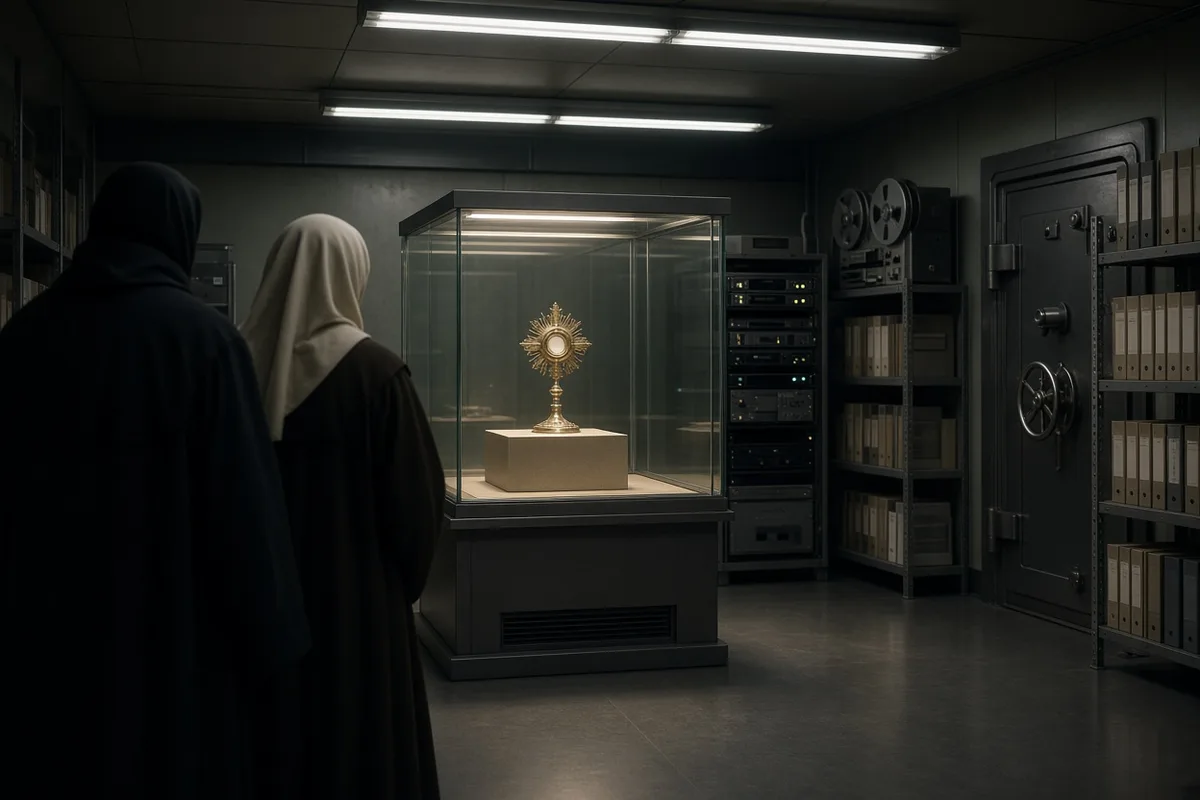
The conservator Maria João Ferreira returned to the church on 7 October 2022 to repeat the ultraviolet examination authorized in 1997. Her new report, filed under reference number 2022/REL/014, records that the host diameter remained 9.8 centimeters and that the central depression had not widened beyond 2.3 centimeters. She noted a faint fluorescence along the raised edge resembling the lip of a chalice, matching the description given by Father Manuel da Cunha in 1613. The blood in the vial showed no change in opacity under the same light source.
On 3 June 2023 the parish council approved the installation of a motion-sensor camera above the reliquary niche after a tourist from Braga was observed attempting to photograph the interior with a flash. The camera model, Hikvision DS-2CD2143G2, records at 4K resolution and stores footage for thirty days on a server located in the sacristy. The first month’s log shows 1,406 entries, the majority occurring between 10:00 a.m. and 11:30 a.m. when the midday light from the south windows strikes the silver-gilt surface.
The stone threshold dated 1653 was measured again on 19 March 2024 by the city surveyor, João Pedro Almeida, who recorded its width at 1.12 meters and its depth at 0.47 meters. He noted a shallow groove running across the center, worn by the repeated placement of carnations and other offerings. The groove measured 0.8 centimeters deep at its midpoint and contained traces of pollen from white carnations collected on 19 March of the previous five years.
During the night of 14 August 2024 the confraternity held its annual vigil inside the church. The four bearers chosen for the litter were Pedro Lopes, António Fernandes, Carlos Mendes, and his son Rui Mendes. At 2:47 a.m. Rui Mendes read from the 1612 examination report the sentence stating that the substance “had not undergone putrefaction,” after which the group observed one minute of silence. The parish register notes that forty-seven people attended the vigil and that the temperature inside the church at the time of the reading was 19 degrees Celsius.
The last individual to sign the visitor ledger before the church closed for structural inspection on 2 February 2025 was a woman named Helena da Silva, aged seventy-two, from the parish of São Nicolau. She arrived at 8:55 a.m., wrote her name and the date in the book kept on the sacristy table, and stood before the reliquary for nine minutes. She placed nothing on the step and spoke to no one before walking back toward the river along the closed lane.