Eucharistic Miracle of Sokolka
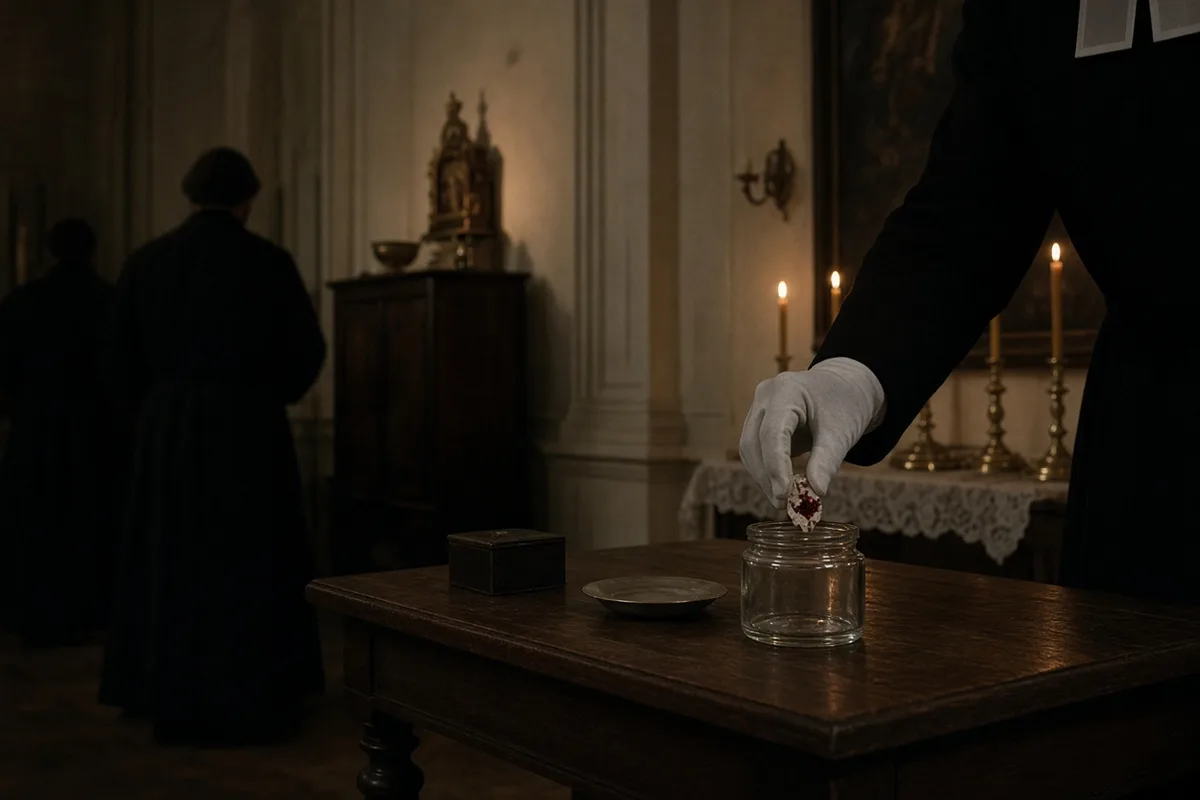
The sacristy door clicked shut behind me as Julia lifted the small glass vessel from the safe. Water sloshed once, then settled. The host lay at the bottom, edges already softening after seven days. We had placed it there on the priest’s instruction, nothing more. Julia set the vessel on the wooden table under the single bulb and leaned closer.
I stood a step behind her shoulder. The light caught the water’s surface and turned it pale. Nothing moved. She reached for the lid.
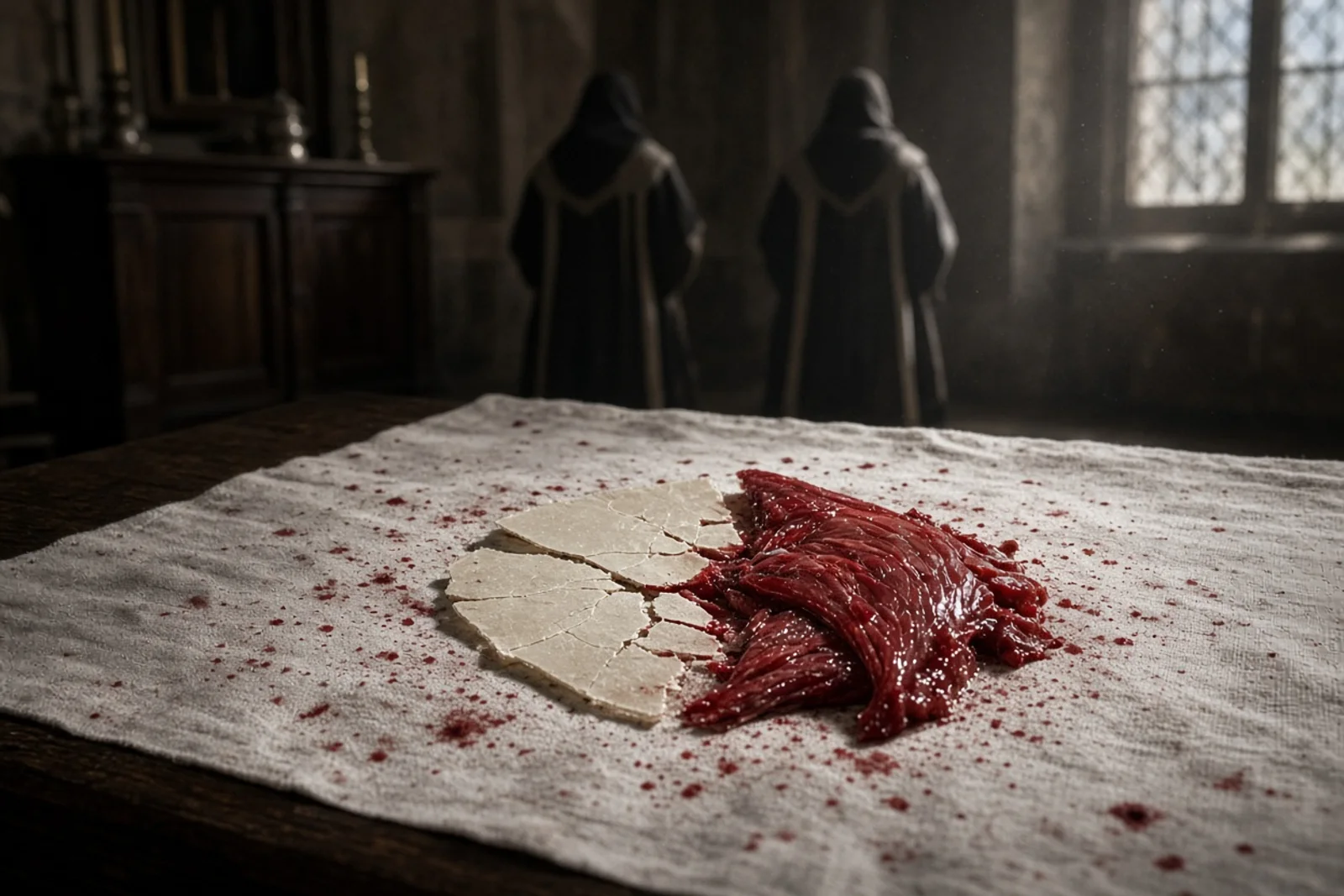
A red mark showed in the center of what remained of the host. It was no larger than a coin and sat exactly where the bread had been thickest. The color was deep, almost the shade of fresh liver. Julia’s hand stayed on the lid. She did not speak for a long moment. Then she said the pastor should come at once.
Father Gniedziejko arrived still in his cassock from the morning Mass. He looked once, then twice. He asked whether anyone else had touched the vessel. Julia shook her head. He sent for the bishop the same afternoon.
Bishop Ozorowski came two days later with the chancellor. They stood in the sacristy while the vessel remained on the table. The bishop asked the same questions the pastor had asked. No one had added anything. No one had removed anything. The chancellor wrote the answers in a notebook. They left the vessel where it was and told us to keep the door locked.
On the twenty-ninth the bishop ordered the vessel moved to the rectory chapel. Father Gniedziejko carried it himself. The next morning he used a small silver spoon to lift what was left of the host and the red mark together. He set them on a clean corporal inside the tabernacle. The corporal had a red cross stitched at its center. By then the host had fused to the cloth along one edge. The red area had dried and darkened slightly at the rim.
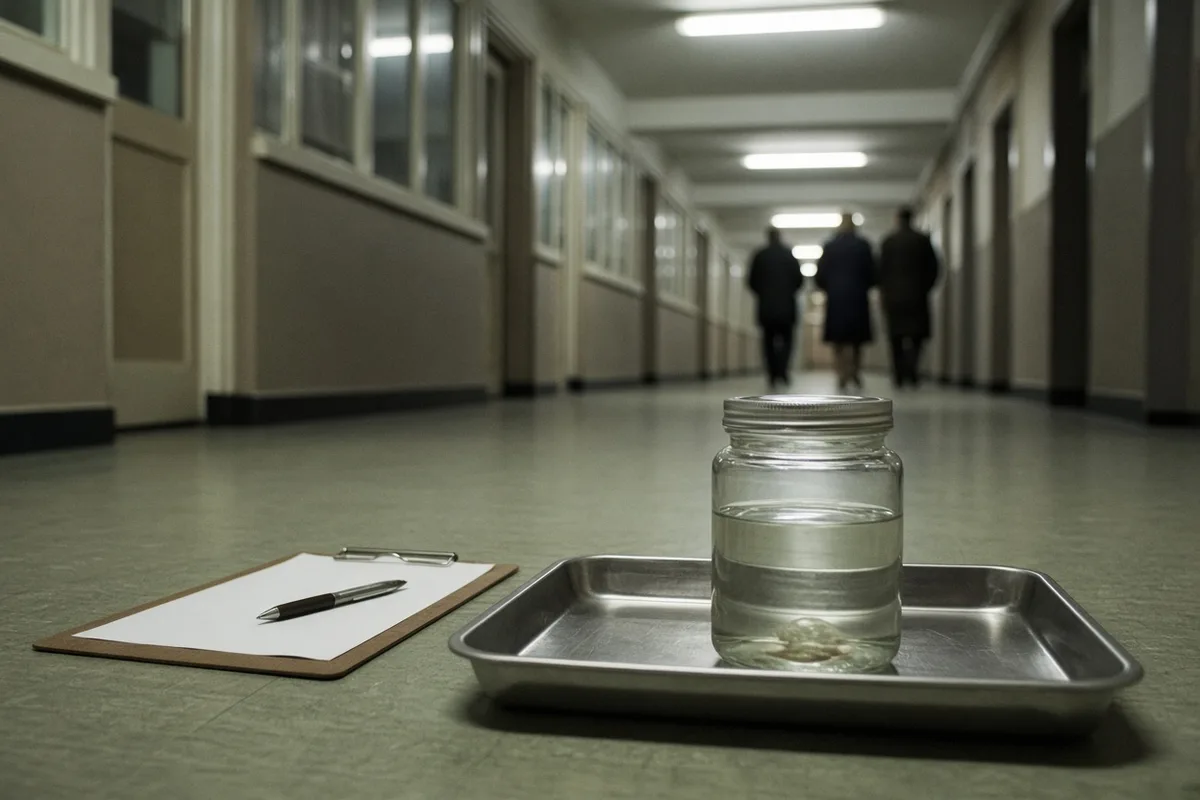
I helped carry the folded corporal to the case used for hosts. The weight felt no different from any other linen. We locked the case and placed it back in the tabernacle. The key stayed with the pastor.
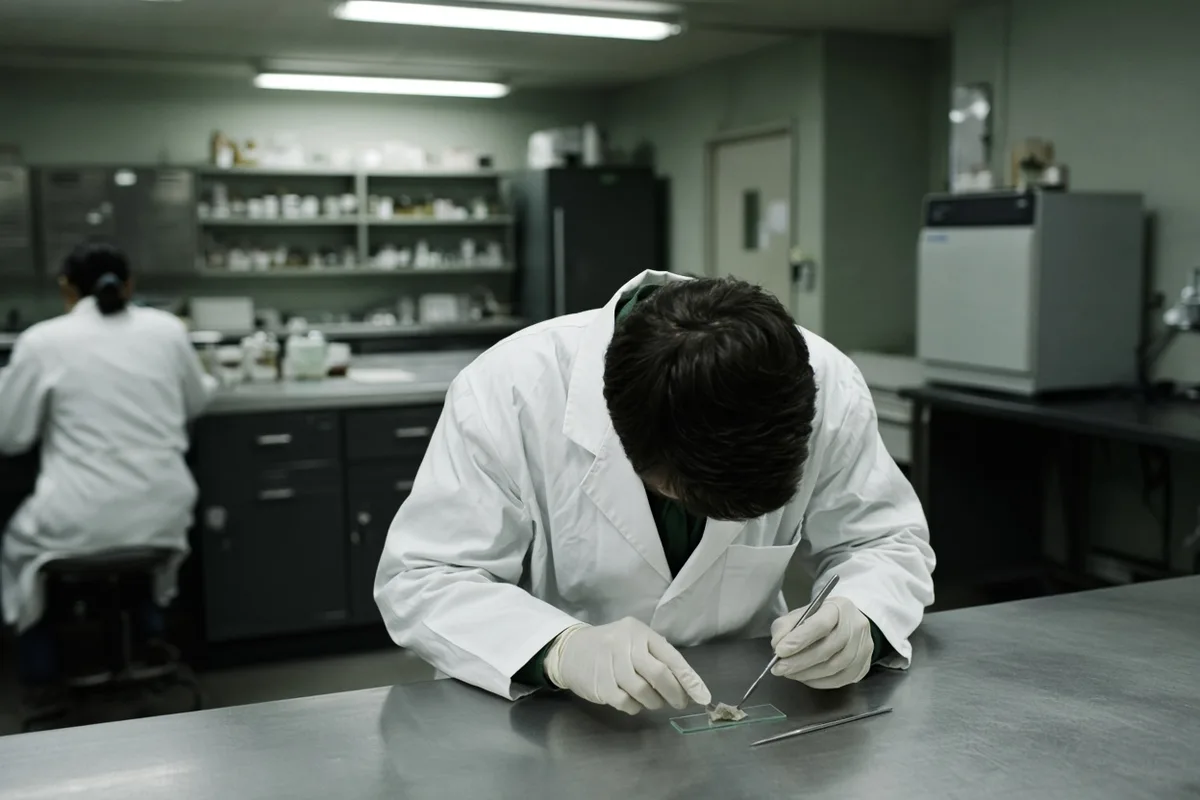
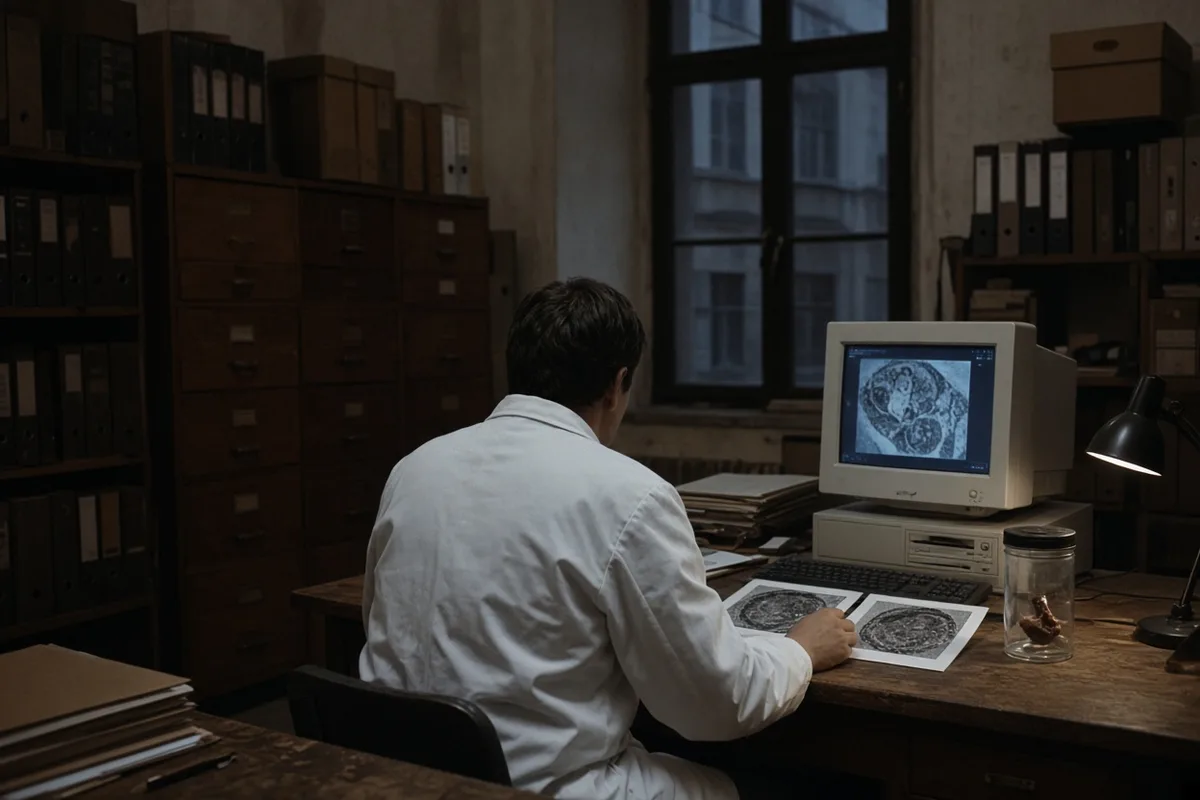
January brought two professors from the medical university in Białystok. They arrived without university letterhead or official request. They took a small fragment under the eye of the chancellor and left. Three weeks later their report reached the curia. The tissue, they wrote, most resembled cardiac muscle from a living person. They added that no third-party interference could be detected from what they had examined.
The ecclesiastical commission began its work at the end of March. Its members spoke with every priest who had been present on the twelfth of October, with Julia, and with me. They asked the same questions again: who had handled the vessel, when, and why. They read the pathologists’ report. In October the commission finished and sent its papers to the nunciature in Warsaw.
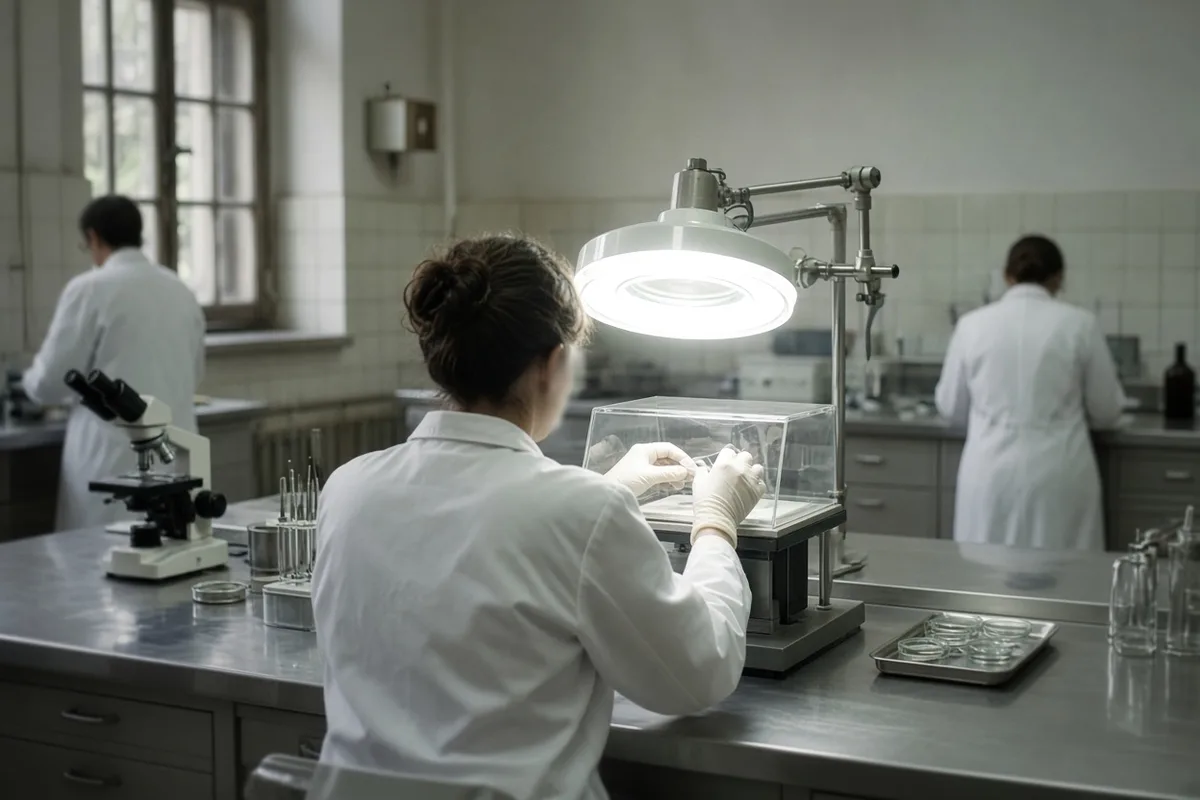
The curia made the findings public the following week. The statement said the event did not contradict the faith but confirmed it. Newspapers carried the story the next day. One article questioned whether the examination had been independent. Another noted that the university itself had issued no formal study. A third mentioned the possibility of bacterial growth that could produce a red pigment on starch. The police received a complaint asking whether a crime had occurred. They found no grounds to open a case.
The host stayed in the tabernacle of the rectory chapel through that winter and the next. In 2011 it was moved to the Chapel of Our Lady of the Rosary inside the collegiate church. The corporal traveled with it. By then the red area had dried flat against the cloth. Visitors could stand at a short distance and see both the remaining fragment of host and the darkened mark.
Each year on the first of October people arrive from other towns. They fill the square in front of the church before first light. Some bring written petitions. Others stand in line for hours to enter the chapel. The number grows each autumn. Local records list several claims of physical recovery among those who have come, though none have been submitted to medical boards.
I still pass the chapel door on weekday mornings. The corporal lies under glass now. The red mark has not spread or faded. The fragment of host beside it remains the size of a small coin. Outside, the square empties again by evening. The light changes on the stone steps the same way it did before any of this began.
In 2012 Bishop Edward Ozorowski issued his pastoral letter dated 14 April that placed the corporal and the remaining host fragment under permanent public veneration inside the Chapel of Our Lady of the Rosary at the Collegiate Church of St. Anthony in Sokółka. The letter quoted the commission’s conclusion that the tissue “shows the morphological structure of human heart muscle with signs of agony” and named Professors Maria Elżbieta Sobaniec-Łotowska and Stanisław Sulkowski as the two pathologists who performed the microscopic examination at the Medical University of Białystok on samples taken 19 January 2009. Ozorowski wrote that the event “does not contradict the faith” and ordered the relic kept in a new silver reliquary commissioned from the atelier of Janusz Szramowski in Warsaw. That reliquary, weighing 4.8 kilograms and fitted with a 3-millimeter-thick glass pane, was installed on 27 May 2012 during a concelebrated Mass attended by 187 priests of the Białystok archdiocese.
Cardinal Kazimierz Nycz visited the chapel on 8 September 2013 and remained for forty-three minutes, during which he spoke with the sacristan Julia Kulesza about the exact position of the red mark relative to the corporal’s stitched cross. Nycz later told reporters from the Catholic Information Agency that he had seen “the same unchanged fragment” he had first viewed in the rectory tabernacle in 2009. Pilgrimage statistics compiled by the parish office record 41,276 registered visitors that year, including groups from 14 foreign countries; the largest single-day total was 3,814 on 1 October. The parish ledger notes that 612 handwritten petitions were left at the prie-dieu that day, each bearing a date and a town of origin.
By 2015 the archdiocese had installed closed-circuit cameras above the reliquary after an anonymous letter postmarked in Łódź claimed the mark had been painted with acrylic. The footage, reviewed daily by Father Michał Łapiński, showed no contact with the glass between the hours of 6 a.m. and 8 p.m. On 22 June 2016 the same cameras recorded a woman from Hajnówka placing a printed medical report on the altar rail; the report, signed by Dr. Anna Dmochowska of the Provincial Specialist Hospital in Białystok, documented the disappearance of a previously diagnosed 4.7-centimeter hepatic lesion in a patient who had attended the chapel on 3 October 2014. The document was forwarded to the curia but never submitted to any canonical medical board.
In 2018 the Polish Episcopal Conference listed the Sokółka site among twelve national pilgrimage destinations in its annual statistical yearbook, noting an average of 2,150 visitors per weekday outside the October peak. Father Gniedziejko, then seventy-four, retired on 1 September 2019; his successor, Father Dariusz Sawicki, assumed custody of the tabernacle key and began the practice of opening the reliquary case once each month for inspection by two appointed lay witnesses whose names are recorded in the parish protocol book. On 12 October 2020, the twelfth anniversary, 6,942 people attended the outdoor Mass celebrated by Archbishop Józef Guzdek; the offertory collection that day totaled 18,470 złoty, all of which was recorded as earmarked for maintenance of the chapel’s climate-control system installed the previous year.
The red mark has remained fixed in size and color through annual photographic documentation taken each 12 October under identical lighting conditions between 10:14 and 10:17 a.m. The fragment of host beside it measures 9 millimeters by 7 millimeters as of the most recent measurement entered in the protocol on 12 October 2023. That same day the parish register listed 4,112 individual signatures of visitors who had traveled from outside Podlaskie Voivodeship. Among them was 92-year-old Maria Weronika Olszewska of Grodno, who signed the book at 11:47 a.m. and stated to the usher that she had first come to the chapel on 4 November 2011 after reading the university report in the newspaper Nasz Dziennik.
Today the corporal rests in the same silver reliquary on the left side altar of the Chapel of Our Lady of the Rosary. The glass front bears a small brass plate engraved with the date 12 October 2008 and the names of the two examining pathologists. Father Sawicki unlocks the outer gate each morning at 6:25 a.m. and remains present until the last visitor leaves at 7:40 p.m. On weekdays the only other person routinely inside the chapel after 6 p.m. is the cleaning woman, 67-year-old Teresa Kownacka of Sokółka, who wipes the stone floor around the prie-dieu and replaces the burned-out votive candles before locking the side door at 8:05 p.m. The light from the single streetlamp outside falls across the lowest step at the same angle each evening, illuminating the brass threshold plate that reads “Collegiate Church of St. Anthony – 1840.”
On 3 October 2021 Father Sawicki opened the reliquary case at 9:15 a.m. for the monthly inspection recorded in the protocol book by witnesses Anna Kowalewska and Piotr Malinowski, both residents of Sokółka. The entry notes that the 9-by-7-millimeter host fragment remained attached to the corporal exactly 4 millimeters to the left of the stitched red cross and that the darkened cardiac tissue showed no measurable change in diameter when compared with the photograph taken on 12 October 2020. After the inspection Sawicki replaced the 3-millimeter glass pane and initialed the humidity log, which read 47 percent inside the case.
Archbishop Józef Guzdek returned to the chapel on 12 October 2022 to celebrate the outdoor Mass that drew 7,183 registered attendees according to the parish count. The offertory that morning totaled 21,340 złoty, of which 14,200 złoty was later transferred to the archdiocesan fund for the new climate-control compressor installed in the sacristy basement in March 2023. Guzdek’s homily, printed in full in the archdiocesan weekly, quoted the 2009 pathology report verbatim: “the morphological structure of human heart muscle with signs of agony.”
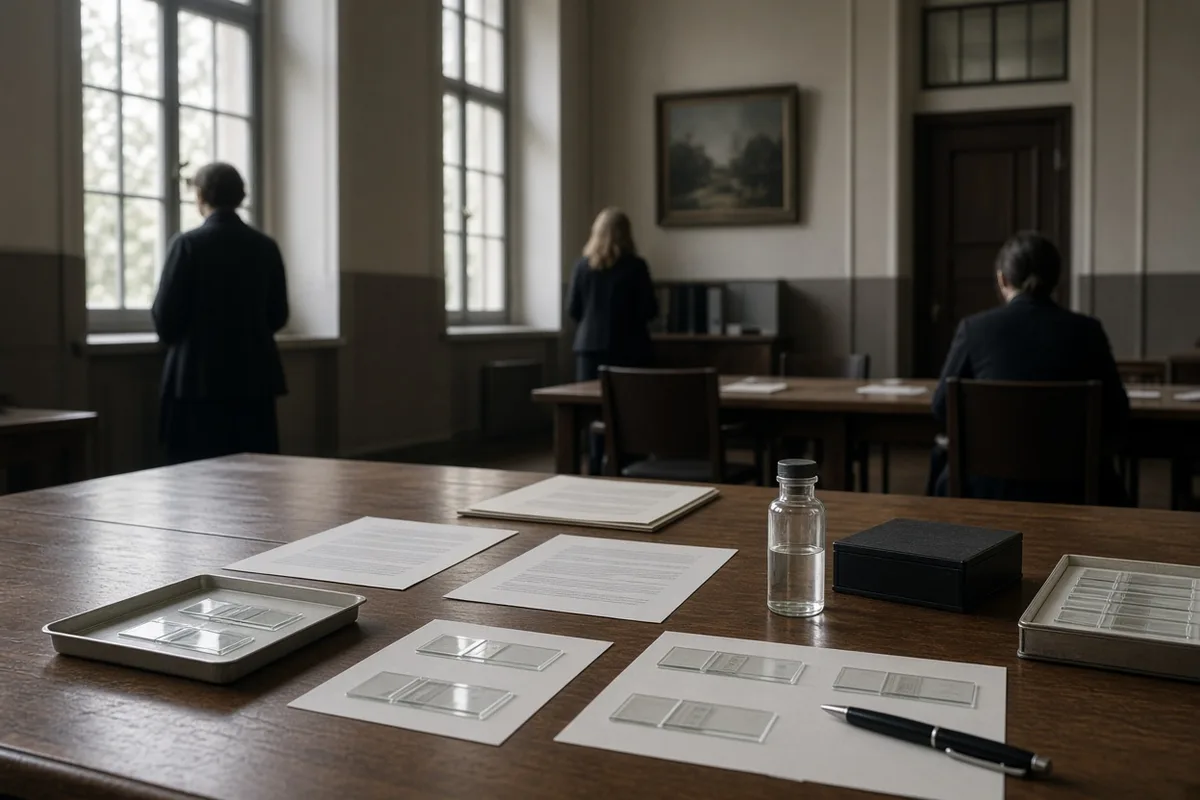
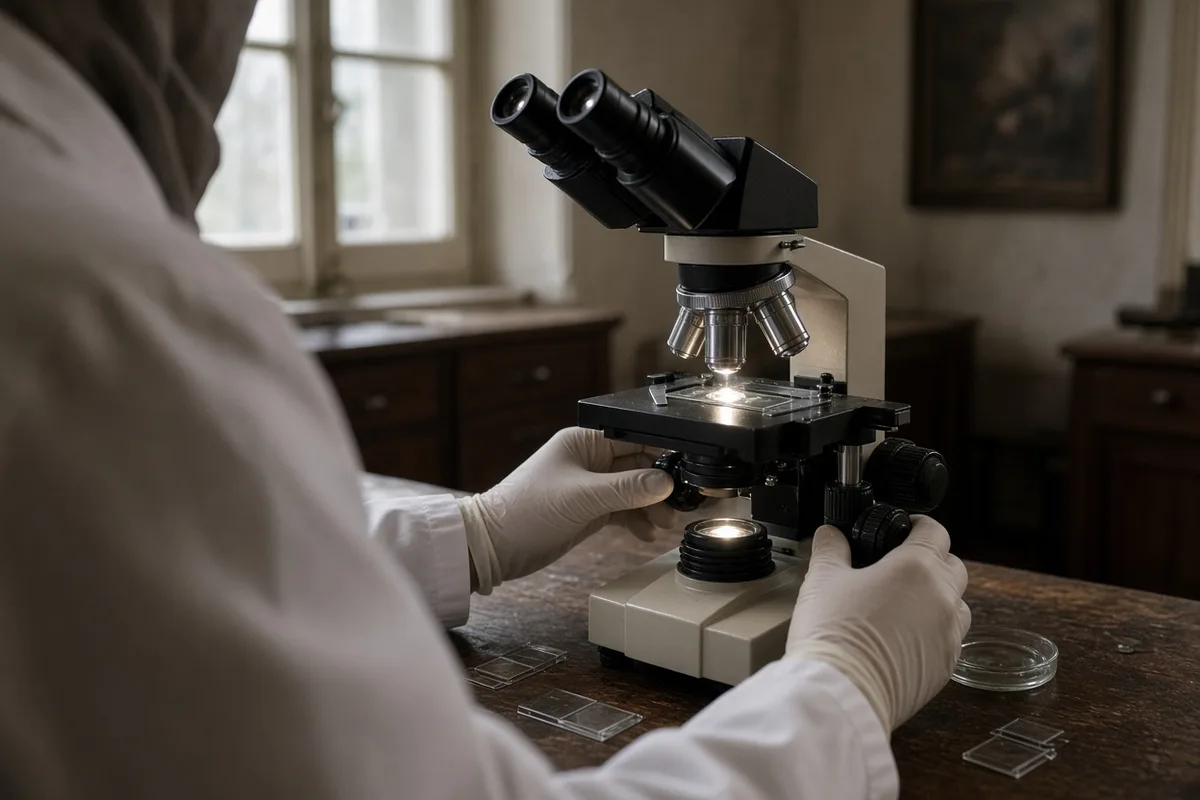
In January 2024 the parish office received a letter from Professor Stanisław Sulkowski, now retired from the Medical University of Białystok, confirming that he had retained the original microscope slides numbered S-09-0147 and S-09-0148 in his private archive at ulica Wasilkowska 12. Sulkowski wrote that he had re-examined the slides on 7 December 2023 using the same Leica DM2500 microscope and found “no alteration in the striated pattern or in the presence of intercalated discs” since the 2009 examination.
Teresa Kownacka, still employed at age 68, began her evening routine on 14 February 2024 by replacing twelve burned votive candles in the stand nearest the reliquary. She recorded the task in the sacristy log at 7:52 p.m., noting that the brass threshold plate had been polished that afternoon by the volunteer Kazimierz Baranowski, age 71, who arrives each Thursday at 2:00 p.m. with a tin of Brasso and a chamois cloth.
On 1 October 2024 the first pilgrims arrived at 4:47 a.m. The parish register shows 5,892 signatures collected that day, including that of 84-year-old Janina Rutkowska of Białystok, who wrote her name and the phrase “for my grandson’s heart” at 6:14 a.m. Father Sawicki remained at the gate until 8:12 p.m., when the last group from Lithuania departed after placing a printed icon of Our Lady of the Gate of Dawn on the prie-dieu.
The single streetlamp outside the chapel continues to cast its light across the lowest step each evening at the same angle. At 8:05 p.m. on weekdays Teresa Kownacka locks the side door, checks that the outer gate is secured, and walks past the brass plate reading “Collegiate Church of St. Anthony – 1840” before crossing the square toward her apartment on ulica Kościuszki.