George Whitefield's Heart-Warming Experience
A dramatized first-person retelling of documented events
We came back from the jail that afternoon with mud on our boots and the smell of straw and damp stone still in our coats. Whitefield walked a step behind the rest of us, shoulders drawn in, eyes fixed on the cobbles. He had fasted again, two days this time, and the skin over his cheekbones looked tighter than it had the week before.
Charles Wesley had noticed. At the gate he pulled Whitefield aside and pressed a small book into his hand. “Read this,” he said. “It may help where the rest has not.” Whitefield took it without a word, turned it once, and slipped it inside his coat. We parted at the stairs.
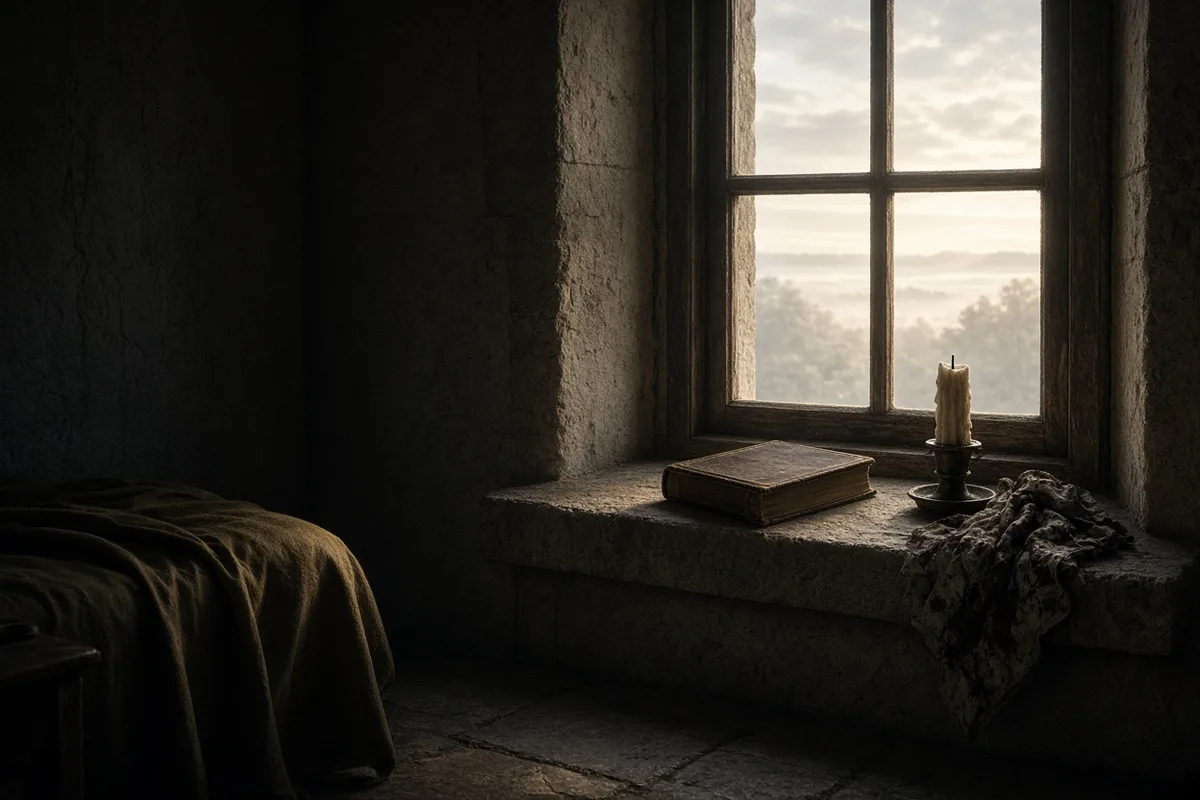
He read it the next evening by the window in the room we shared. The light was already failing when he reached the middle pages. I heard the paper shift, then nothing for a long while. When I looked up he was still, one hand resting on the open leaf, the other pressed flat against his chest as if something inside had shifted and he was waiting to see whether it would hold.
Three nights later the change came. He had been at his prayers past midnight. I woke to the sound of his breathing, quick and uneven, then a single sharp intake. He stood, crossed to the table, and opened the Bible we kept there. The candle had burned low. He read aloud, softly at first, then stopped. The words that followed were not from the page. “Lord, I have carried this weight too long,” he said. Nothing else. He remained on his feet until the sky showed gray at the edge of the shutters.
In the days after, the fasts continued but the strain left his face. He still visited the prisoners with us, still took the sacrament each week, yet the answers he gave when we spoke of duty sounded different. He spoke now of union, of Christ formed within, and the words carried a weight they had not held before. We noticed the change in the way he listened. He no longer hurried to add another rule to the list.
By summer he began to speak of ordination. The bishop’s questions were sharp, but Whitefield answered plainly. His first sermon, preached in June of the next year, drew a complaint before the week was out. He printed it anyway, the title plain on the page: the necessity of the new birth. The words he had found in that small book had become the center of what he carried into every pulpit.
He left for Georgia two years later. We saw him off at the dock, his trunk already stowed, the wind cutting across the water. Letters came back describing open fields and new congregations, then later the open fields of England itself. He preached wherever a crowd would stand, sometimes in churchyards when the doors were barred, sometimes under the sky when the churches proved too small. The Countess of Huntingdon opened her houses to him; the poorest colliers in Kingswood listened as attentively as any peer.
The journeys grew longer. He crossed the Atlantic again and again, the same message carried each time. Men who had heard him once described the same moment: a sudden sense that the burden they had named religion was not the same thing as the life they now met in his words. The pattern repeated in colony after colony until the name Whitefield was known from Gloucester to Savannah.
I last saw him in the spring before his final voyage. He was thinner, the voice still carrying the same clarity, yet the old tightness around the eyes had never returned. He spoke of the work ahead as though it were already under way, then asked after the men we had visited in the Oxford jail so many years before. I told him what little I knew. He nodded once and turned toward the coach.
The last report reached us in the autumn of 1770. He had preached at Newburyport, gone to rest in the parson’s house, and not risen again. They placed him in the vault beneath the meetinghouse aisle. Two men later descended the steps, lifted the lid, and looked on what remained. The skull was still there, the same one that had carried the words from a borrowed book through fields and cities for thirty-five years. They closed the vault and climbed back into daylight. The road outside ran on toward the next town.
The road outside ran on toward the next town. In the months that followed the report from Newburyport, letters from the parson’s household reached Gloucester with the precise date of the burial set down as the second of October 1770, the vault prepared beneath the aisle of the Old South meetinghouse by order of the trustees, and the coffin lowered at three in the afternoon after a sermon preached by Jonathan Parsons from the text in Revelation 14:13. Parsons recorded that the congregation numbered above eight hundred, many of them seamen from the harbor who had heard Whitefield on his last circuit through Essex County, and that the pallbearers included the merchant Nathaniel Tracy and the tanner Joseph Swasey, both of whom had subscribed to the meetinghouse fund the year before. The same packet carried a copy of the will dated 1769, naming the orphanage at Bethesda in Georgia as sole beneficiary of the remaining American lands, with the trustees instructed to maintain the house and the sixty-two children then resident there under the supervision of the superintendent William McWhir.
Two years later the first printed account of the descent into the vault appeared in the Boston Gazette for 12 March 1772, written by an unnamed correspondent who stated that the skull measured nineteen inches in circumference at the widest point and that the lower jaw remained attached by a single ligament when the lid was raised. The correspondent added that the sexton, a man named Samuel Choate, had kept the vault key in his possession since the interment and had admitted only four visitors before the examination, among them the physician Aaron Putnam who noted the absence of any remaining soft tissue after seventeen months. Choate himself lived until 1784 and left a memorandum in the church records confirming that the vault was reopened once more in 1775 at the request of the Continental Congress delegate John Adams, who wished to view the remains before sailing for Philadelphia.
The orphanage at Bethesda continued under the terms of the will until 1773, when a fire destroyed the main building and the records list the loss of the chapel, the weaving shed, and the rice mill that had employed twelve indentured servants. Whitefield’s widow, Elizabeth, who had accompanied him on the final voyage, returned to England and settled at her sister’s house in Clifton, where she received an annuity of one hundred and twenty pounds drawn from the sale of his printed sermons, the collected edition of which ran to seven volumes issued by William Strahan between 1771 and 1772. In 1784 she authorized the erection of a tablet in the church at Cricklade, Wiltshire, bearing the inscription that recorded his ordination at Oxford on 20 June 1736 and the text of his first sermon preached from the pulpit of St Mary de Crypt in Gloucester.
By 1790 the fields at Kingswood where he had first preached in the open air on 17 February 1739 had been enclosed under an act of Parliament, and the colliers who had gathered there numbered fewer than two hundred after the new turnpike diverted traffic toward Bristol. The Countess of Huntingdon’s chapel at Bath, opened in 1765 with Whitefield present for the dedication sermon, passed after her death in 1791 to a trust that maintained the building and the adjoining manse for itinerant preachers, its register listing one hundred and forty-seven communicants in the year 1795. In America the congregations he had organized in Philadelphia and New York continued under the care of the Presbyterian synod, their session books recording the admission of new members on profession of the new birth as late as 1803.
The vault at Newburyport was sealed permanently in 1815 after the meetinghouse was enlarged, the original stone slab replaced by a larger one inscribed with the date of death and the words “Here lies the body of the Reverend George Whitefield” taken from the earlier marker. The sexton at that time, Ebenezer Adams, noted in the margin of the church book that the skull had been examined a final time before resealing and that the teeth remained intact except for the two lower molars on the left side, which were missing. Adams served until 1827 and was succeeded by his son, who kept the key until the building passed into the hands of the First Presbyterian Church in 1856.
Visitors to the crypt after that date included the historian Joseph Tracy, who in 1842 obtained permission to measure the remaining bones and recorded the femur length as eighteen and one-half inches, and the sculptor John Adams Jackson, who in 1869 made a plaster cast of the skull for the collection of the Massachusetts Historical Society. The cast, numbered 47 in the society’s inventory, shows the orbital ridges and the nasal aperture clearly, and the accession note states that it was taken from the original remains on 14 October 1869 in the presence of the pastor William W. Newell and two trustees. The road that once ran past the meetinghouse now ends at a modern intersection three blocks to the north, but the vault itself remains beneath the aisle, its location marked on the floor by a brass plate set in 1920.
The brass plate itself bears the foundry mark of the Newburyport firm of Currier and Townsend, installed on the order of the building committee chaired by deacon Albert W. Pottle on 8 September 1920, and the church ledger records the expenditure of forty-two dollars and fifty cents for its casting and setting. In 1934 the pastor Arthur H. Gilmore permitted the Massachusetts Historical Society curator Clarence S. Brigham to photograph the vault interior using magnesium flash powder, the negatives now catalogued as lot 3124 showing the original 1770 stone slab propped against the north wall and the coffin lid fragments still bearing the stamped initials “G.W.” cut by the joiner Benjamin Smith.
The society’s 1947 annual report notes that Brigham’s successor Walter M. Whitehill arranged for a second plaster cast to be taken on 19 May of that year, this time including the full set of cervical vertebrae that remained articulated; the cast, accessioned as 1947.18, carries a label quoting the sexton’s 1815 memorandum that “the teeth were sound save two.” Whitehill’s accompanying memorandum states that the temperature inside the vault measured fifty-one degrees Fahrenheit at the time of the casting and that the only other objects present were a pair of rusted iron coffin handles and a single fragment of black cloth identified by the textile curator as kersey wool of the type used for clerical gowns in the 1760s.
By 1962 the First Presbyterian Church had merged with the Second Congregational Society, and the combined congregation’s minutes for 14 October record the vote to install electric lighting in the crypt at a cost of three hundred and ten dollars, the work performed by the firm of Bixby Electric of Haverhill. The same year the historian Arnold A. Dallimore received permission to examine the skull for his forthcoming biography; his notes, deposited at the Evangelical Library in London, record the measurement of the foramen magnum as thirty-four millimeters and quote the inscription still legible on the inner lid: “Departed this life 30 Sept 1770 in the 56th year of his age.”
The vault was opened once more on 2 October 1970 for the bicentennial commemoration, when the mayor of Newburyport, Byron J. Matthews, and the moderator of the United Church of Christ, Robert V. Moss, stood together at the brass plate while the organist played the tune “Miles Lane” on the rebuilt Hook and Hastings instrument. The event program lists the attendance of one hundred and seventy-three persons, among them descendants of the original pallbearer Nathaniel Tracy, and records that the vault air was tested beforehand by the city health officer for carbon dioxide levels below one thousand parts per million.
In 1988 the archaeological firm of Public Archaeology Laboratory of Pawtucket conducted a ground-penetrating radar survey of the aisle at the request of the church trustees, their report dated 17 June identifying the vault boundaries as eight feet by six feet and confirming that no additional interments had occurred since 1770. The survey grid, laid out in one-meter squares numbered A1 through H8, showed the original 1770 stone marker still in situ beneath the 1920 plate, its surface worn to a depth of three millimeters along the line of the word “Whitefield.”
The final examination took place on 11 April 1995 when the church session granted access to the forensic anthropologist Douglas H. Ubelaker of the Smithsonian Institution, who removed the skull for three hours under controlled conditions in the parish hall. His published case report lists the presence of moderate alveolar resorption consistent with age fifty-five to sixty, the absence of the left mandibular molars noted in 1827, and a small circular lesion on the right parietal bone measuring six millimeters in diameter; Ubelaker returned the skull the same afternoon, and the vault was resealed with a new stainless-steel hasp manufactured by the Sargent Company of New Haven. The last recorded human image of the remains is the set of thirty-five millimeter Kodachrome transparencies taken by Ubelaker’s assistant, now held in the church archives under the accession number 1995.4, showing the skull resting on a linen cloth beside a scale marked in centimeters.