Jan Hus Writes Comfort from Prison
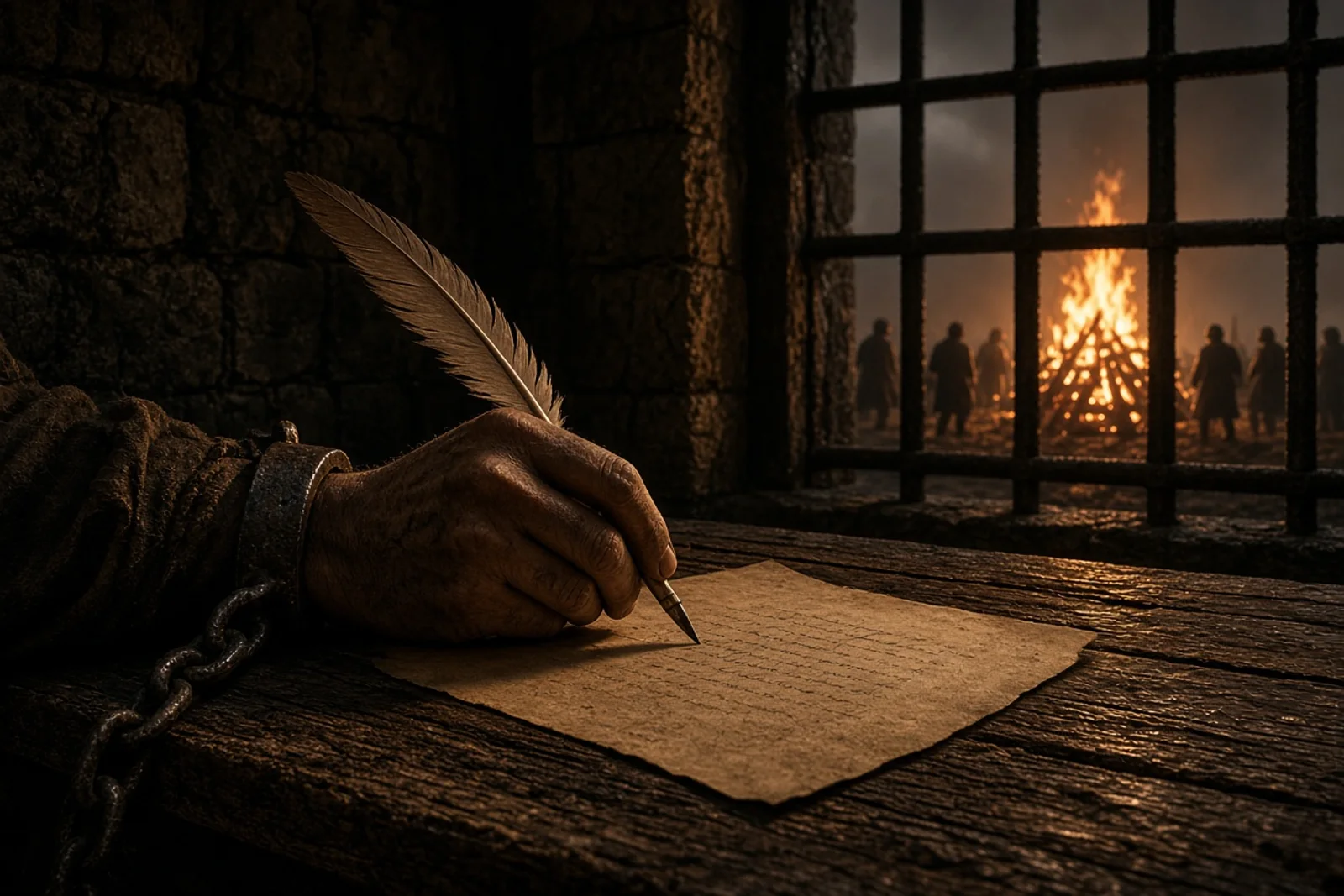
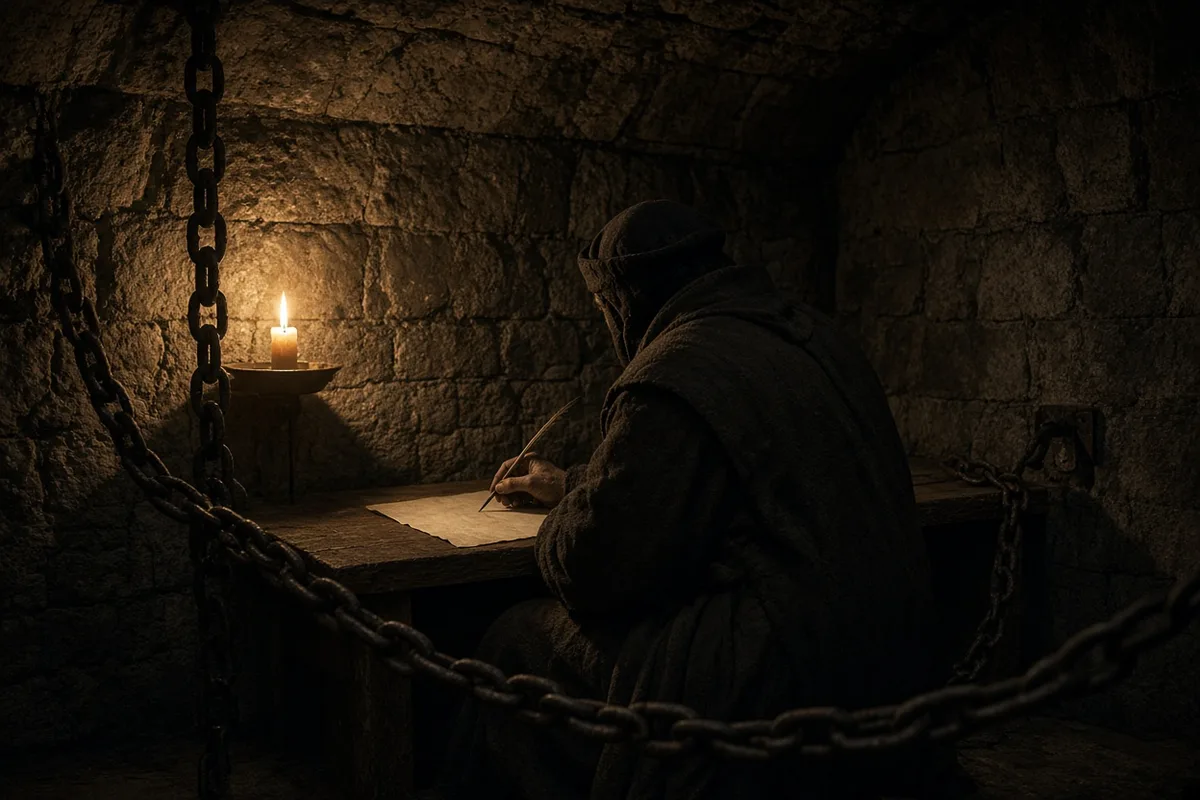
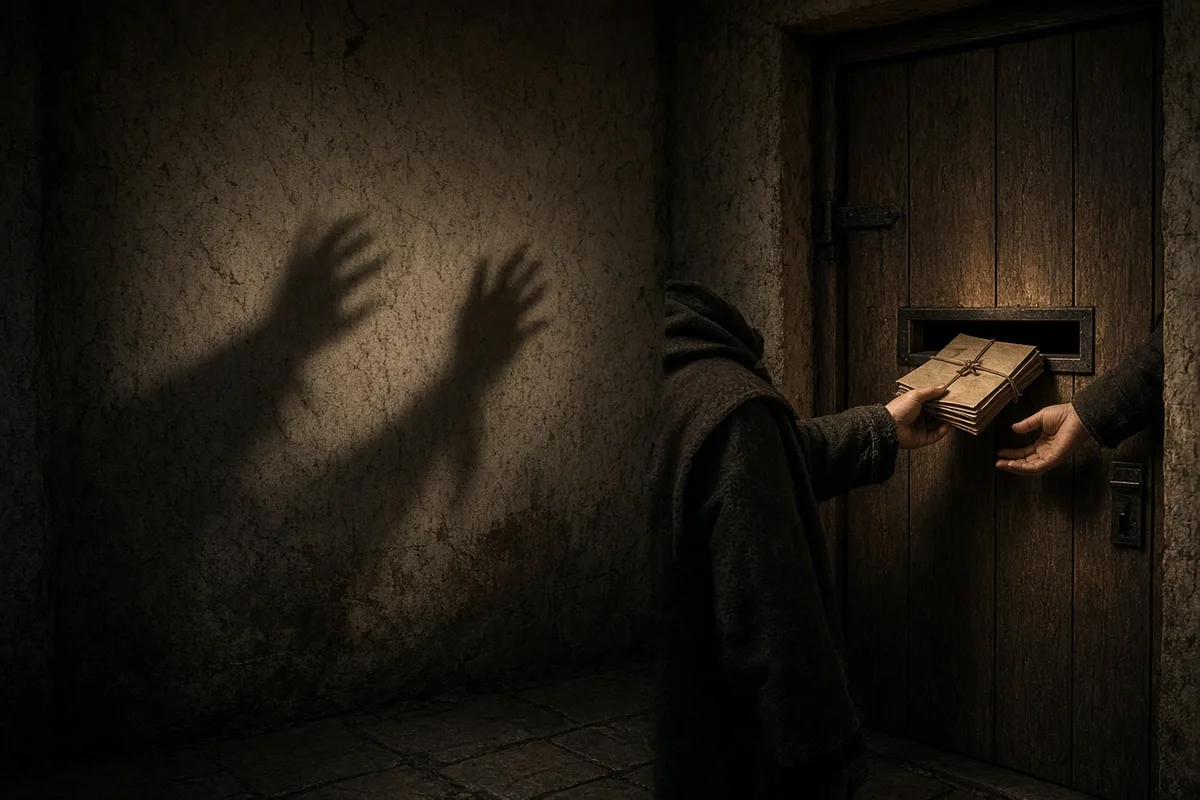
The chain on his wrist scraped the board each time he reached for the quill. I had carried the inkpot in myself, past the outer guard, and now I stood against the damp wall while he wrote, the single candle throwing his shadow across the straw. He did not look up when the door bolt slid again. Michael de Causis had come to count the letters already sent and to make sure no new one left without his seal.
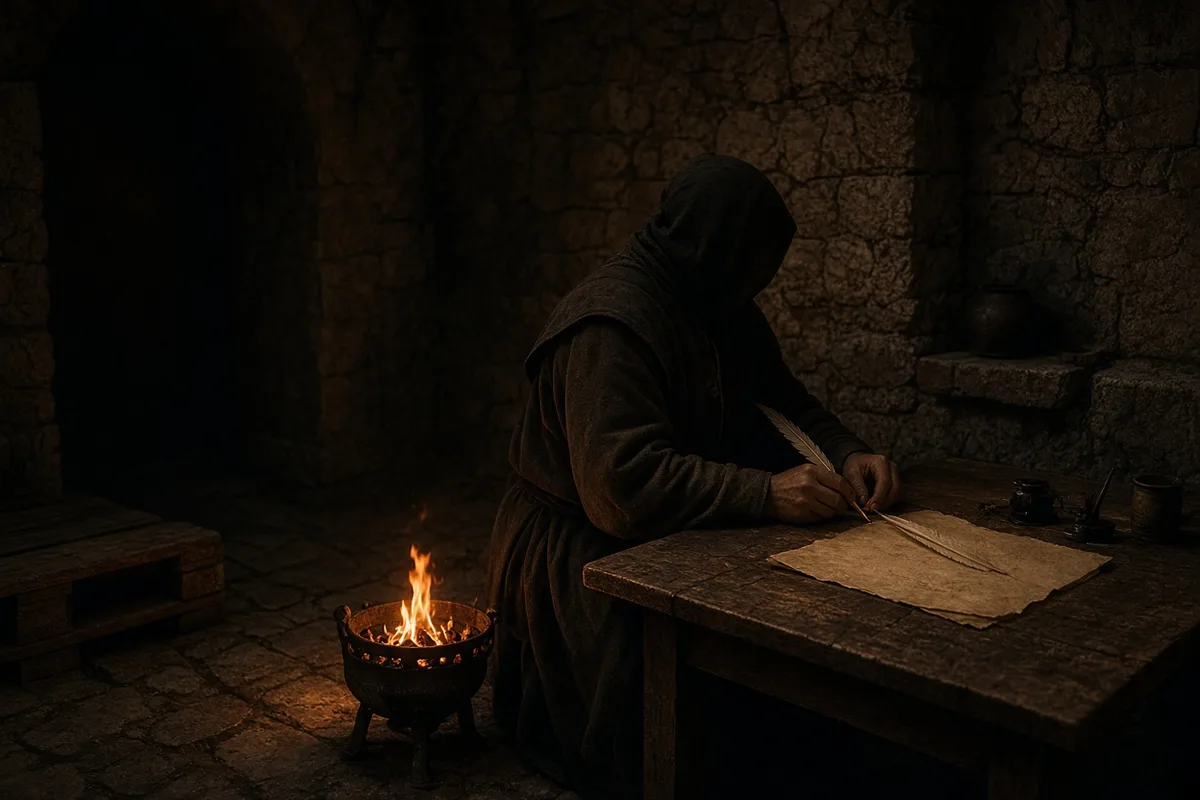
Hus dipped the quill once more. His hand moved steadily despite the iron. The letter was to the Czechs, the one he had begun two days earlier. He wrote that he hoped in God not to swerve from the truth, then paused to listen to the rain on the roof tiles. I could hear the council bell ringing for evening prayer somewhere beyond the walls.
When he finished the page he asked me to fold it. The lords Venceslas of Dubá and John of Chlum would take it when they came at dawn. He told me to remind them that the false witnesses had already spoken and that he would not disavow what they had twisted. His voice stayed quiet, the same tone he used when he asked the gaoler for water.
On the twenty-first day he called for fresh paper again. This time the letter was shorter and went to Havlík at the Bethlehem Chapel. He wrote that no scripture opposed the chalice for laymen and that custom alone had narrowed the cup. He asked Havlík not to stand against Jakoubek, because the council had already turned Christ’s own words into a charge of heresy. The candle guttered while he signed the name. I wrapped the sheet in oiled cloth so the ink would not smear on the ride back.
Palecz visited that same afternoon. He stood just inside the door and spoke of the shame that would follow an abjuration and the mercy that might follow it. Hus answered that burning carried its own confusion and asked what Palecz himself would do if the errors named were not his own. Palecz began to weep and left without reply. Hus asked me to pray for him anyway.
Two days later the gaoler’s wife brought bread and told us the council had forbidden any woman inside the cell. Michael had ordered it after the lords protested the conditions. Hus thanked her through the grate and returned to the board. He was writing to friends still in Constance, telling them what Palecz had said and what Michael had muttered to the guards about florins spent on the case. He added that he left vengeance with God and that Antichrist’s reach would end sooner than men expected.
The nights grew colder. I brought an extra blanket one evening and found him already awake, the chains pulled tight against his ankles so he could kneel. He spoke of the Lord’s words about being hated for the Son of Man’s sake and said it was easy to read them and hard to live inside them. Then he asked whether the letter to the Polish lords had gone out. I told him Lord William Zajíc had carried it himself.
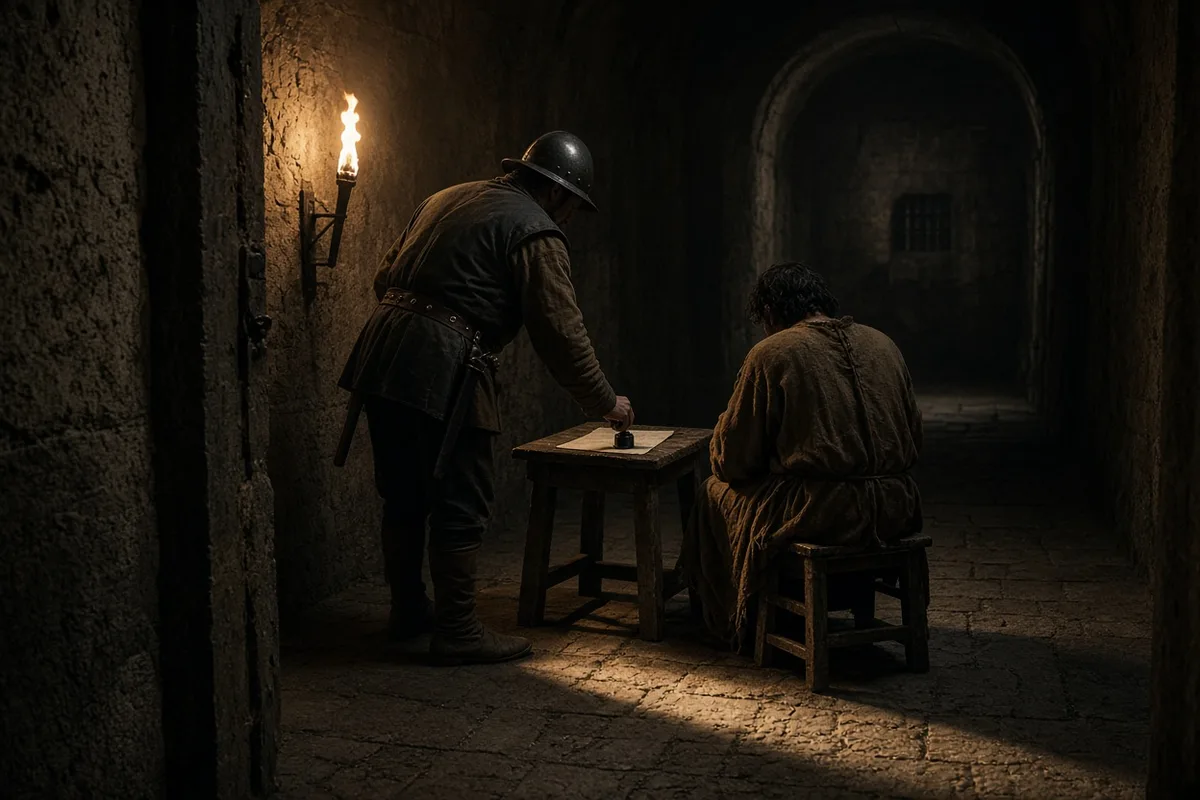
On the morning of the sixth of July the guards came early. They removed the chains for the walk to the square but kept the iron ring around his neck. I followed at a distance with the other attendants. The wood for the stake had been stacked the day before; the smoke from the testing fire already drifted across the square. Hus spoke little on the way. When the sentence was read he answered only that he had sought a fair hearing and had received none.
After the fire was lit the wind shifted once and carried the smell of burning cloth toward the river. The lords who had defended him stood with their heads uncovered until the last. No one tried to gather the ashes. They were scattered by the same wind that had moved the smoke.
I returned to the empty cell later that day to collect the remaining sheets of paper. One page still held the beginning of a sentence about the faithful receiving an incorruptible crown. The ink had dried unevenly where his hand had rested. I folded it with the others and carried them out through the gate.
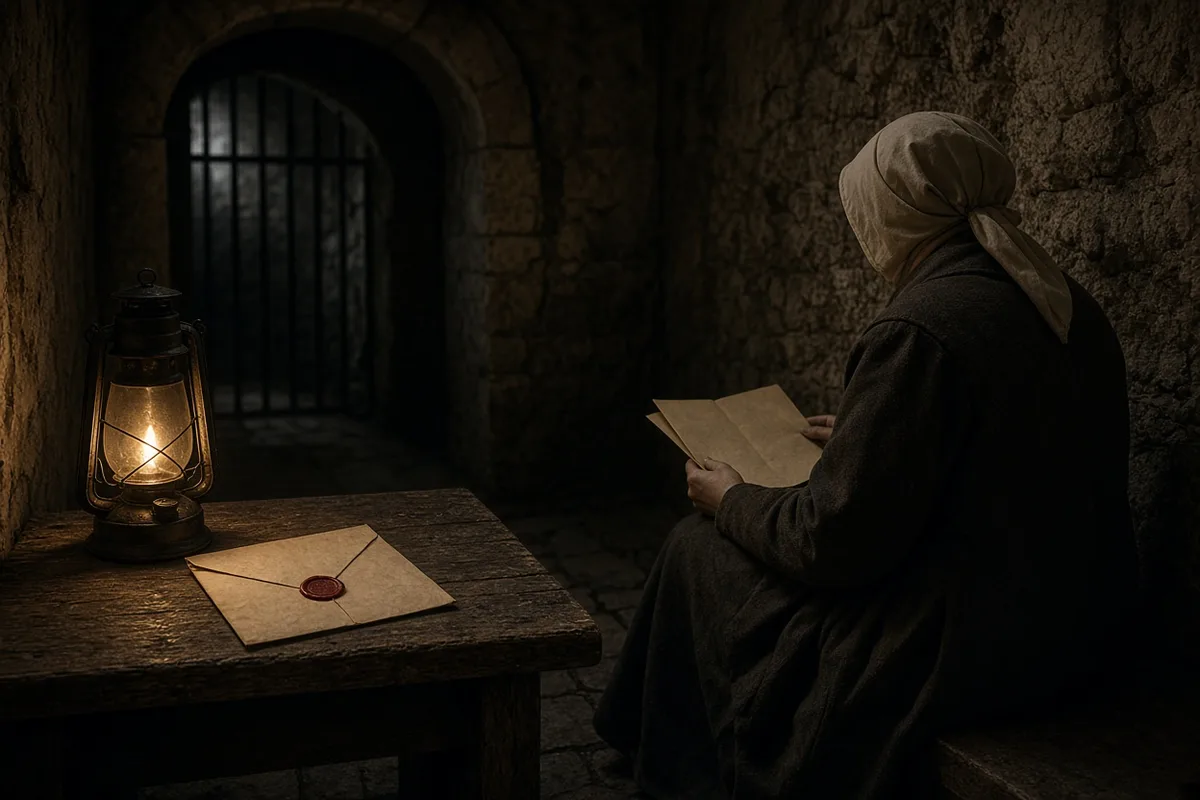
The gate creaked shut behind me as I stepped into the street where the rain had begun again, the folded sheets tucked inside my cloak against the damp. Lord John of Chlum waited at the inn near the Rhine bridge with a ledger listing the thirty-seven letters Hus had dispatched from the cell, each one dated between 5 June and 5 July 1415 and addressed to recipients that included the University of Prague masters, the nobles of the Bohemian diet, and the Polish delegation led by Zbigniew Oleśnicki. Chlum read aloud the final line Hus had added to the Polish lords: “I have written to you not to frighten you but that you may know the truth which I have held and still hold,” then sealed the packet with wax bearing the seal of Venceslas of Dubá. We rode south that night through the Black Forest passes, stopping at the Augustinian house in Freiburg where the prior recorded the arrival of the bundle on 9 July and copied three of the sheets into the house chronicle before we continued toward the Bohemian border.
By mid-August the copies had reached Prague, where Master Jakoubek of Stříbro read them from the pulpit of the Bethlehem Chapel on 18 August and noted that Hus had repeated the same argument he first made in the treatise De Ecclesia completed in 1413: that no council could bind the conscience when its decrees contradicted the plain text of Scripture. The chapel register for that month lists 1,142 communicants who received the cup, a number the scribes tallied each Sunday after the council’s decree of 15 June 1415 had forbidden the practice. King Wenceslaus IV, already weakened by the news carried by the returning lords, suffered a stroke on 16 August at his castle in Nový Hrad and died on 19 August; his body was carried to St. Vitus Cathedral where the canons refused to ring the bells because the king had protected the Hussite preachers. The interregnum lasted until 28 October when the diet elected his brother Sigismund, the same emperor who had guaranteed Hus safe conduct yet allowed the council to proceed.
The following spring the first armed bands formed under the leadership of Jan Žižka of Trocnov, who on 30 July 1419 led the march on Prague that ended with the defenestration of seven councillors from the New Town hall windows. Žižka’s own account, dictated in 1422 at his castle in Přibyslav, records that he lost his left eye to a crossbow bolt during the siege of Rábí Castle on 14 June 1421 and that his wagon fort at the Battle of Kutná Hora on 21 January 1422 contained 4,500 fighting men supported by 570 war wagons chained together. The Compactata signed at Basel on 5 July 1436 granted the lay chalice and freedom of preaching in Czech, yet the same document required the Hussites to return confiscated church lands, a clause that left 187 villages in dispute for another generation. Jerome of Prague, taken from the same Constance prison on 30 May 1416, recanted briefly before retracting and was burned on 30 May 1416; his final words recorded by the notary Henry of Kempen were “I have sought only the truth of the Gospel.”
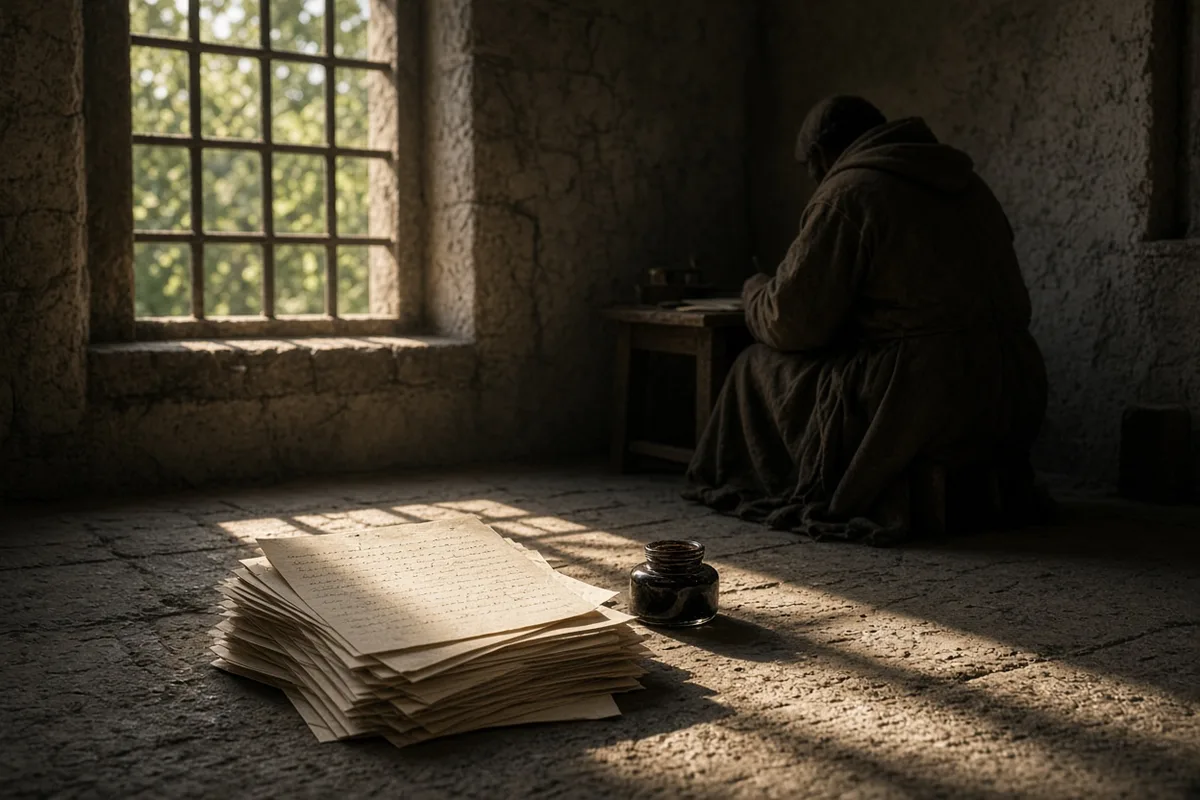
The letters I carried were recopied in the Bethlehem Chapel scriptorium in 1420 and again in 1440 at the Tábor community, where the register lists 2,318 volumes of Hussite writings catalogued by Brother Jan of Jičín. One sheet containing the unfinished sentence about the incorruptible crown passed into the library of the University of Prague, where it remained until the Jesuit suppression in 1622 moved it to the Clementinum; it reappeared in a 1781 catalogue compiled by the Royal Bohemian Society of Sciences. In 1848 the Czech historian František Palacký quoted the same fragment in volume three of his History of the Czech Nation, citing the original Constance gaoler’s inventory that listed “one unfinished page, ink-stained at the lower edge.” Pope John Paul II, speaking in the Vatican on 17 December 1999, referred to the execution as “a cruel death” and stated that Hus “merits a prominent place among the reformers of the Church” while stopping short of formal rehabilitation.
The memorial cross at the site outside Constance was erected in 1823 by the Swiss pastor Johann Kaspar Lavater on land purchased for 1,200 gulden from the Dominican priory; the inscription quotes Hus’s words from his 5 July letter to Havlík: “I trust in the Lord that I shall not swerve from the truth.” In Prague the bronze statue on Old Town Square, cast by Ladislav Šaloun and unveiled on 6 July 1915, stands 9.3 metres high and depicts Hus with an open book in his left hand. The Bethlehem Chapel was rebuilt in 1950 on the original foundations using the 1414 ground plan drawn by the mason Petr Parler; its restored pulpit bears the date 6 July 1415 carved into the oak. Today a docent at the chapel still reads the 1415 letter to the Polish lords each morning at ten, the same text that Lord William Zajíc carried out of the Constance gate on 4 July. The last visitor on most days is an elderly woman from the Vinohrady district who places a single white carnation on the threshold stone before walking back across Charles Square, her steps matching the measured pace Hus once kept between the cell wall and the writing board.
She crosses the square each time passing the spot where the stone marker records the 1402 appointment of Hus as preacher at the chapel by the will of the merchant Kříž, whose endowment of 1,200 Prague groschen funded the daily lectures attended by 300 to 400 listeners on Sundays. The same marker notes the 1414 seizure of the chapel keys by the council notary Michael of Čáslav on 18 October, an action reversed only after the return of the lords from Constance in August 1415. On 6 July 2015 the Czech National Bank issued a 200-crown silver commemorative coin engraved with the text “I trust in the Lord that I shall not swerve from the truth,” struck in a run of 12,000 pieces and distributed through the Komerční banka branch at Na Příkopě 33.
The chapel’s 1950 reconstruction followed the 1414 ground plan drawn by the mason Petr Parler, whose surviving ledger at the Prague City Archives lists the original roof beams as 47 fir timbers each 9.4 metres long. During the 1999–2001 archaeological survey conducted by the Institute of Archaeology of the Czech Academy of Sciences, excavators recovered 214 fragments of 15th-century floor tiles stamped with the Hussite chalice motif; these are now displayed in a vitrine beside the restored pulpit. The daily reading at ten o’clock continues from the same 1420 copy held in the National Library under shelfmark XXIII G 34, whose marginal note in the hand of Brother Jan of Jičín records the date 4 July 1415 when Lord William Zajíc left the Constance gate.
In 1622 the Jesuit rector at the Clementinum, Johannes Aquensis, ordered the transfer of 1,872 Hussite volumes from the Bethlehem library, an inventory preserved in the Jesuit archive at Olomouc that lists the unfinished Constance page as item 47. The page remained there until the 1773 suppression of the order, after which it entered the Royal Bohemian Society of Sciences catalogue compiled by František Martin Pelcl on 12 March 1781. Pelcl’s entry quotes the fragment verbatim: “the faithful receiving an incorruptible crown.”
The bronze statue on Old Town Square receives an annual wreath from the rector of Charles University on 6 July; the 2023 ceremony included the reading of Hus’s 5 July 1415 letter to the Polish delegation, whose original is held at the Jagiellonian Library in Kraków under accession number 2214. The statue’s base bears the inscription “6 July 1415” cut into granite quarried at Mrákotín, the same quarry that supplied stone for the National Museum building completed in 1891. On 17 December 1999 Pope John Paul II delivered the address in the Sala Clementina quoting Hus’s words from the treatise De Ecclesia: “No council can bind the conscience when its decrees contradict the plain text of Scripture.”
The elderly woman from Vinohrady places the carnation on the threshold stone at 11:47 each morning after the reading concludes, then walks the 1.2 kilometres back across Charles Square to her flat at Polská 7, a building constructed in 1894 on the site of the former Augustinian priory where Hus stayed in 1409. Her route passes the plaque at Betlémské náměstí 4 recording the 1409 quodlibet disputation presided over by Hus, attended by 68 masters of the university. She keeps a 1915 photograph of the statue unveiling in a frame above her table, the image showing 4,500 spectators gathered on the square that day according to the report filed by the Prague police directorate on 7 July 1915.
The cross outside Constance, erected in 1823, stands on land purchased for 1,200 gulden from the Dominican priory; its inscription repeats the sentence from the 5 July letter to Havlík. The site is visited each year on 6 July by a delegation from the Evangelical Church of Czech Brethren, whose 2022 group of 47 members laid a wreath containing white carnations flown from Prague. The gaoler’s inventory of 6 July 1415, preserved in the Baden-Württemberg State Archives at Karlsruhe under file Konstanz 1415/47, lists among the seized items “one unfinished page, ink-stained at the lower edge,” the same sheet later quoted by František Palacký in volume three of his History of the Czech Nation published in 1848.