John Bunyan's Awakening in Bedford Gaol
A dramatized first-person retelling of documented events
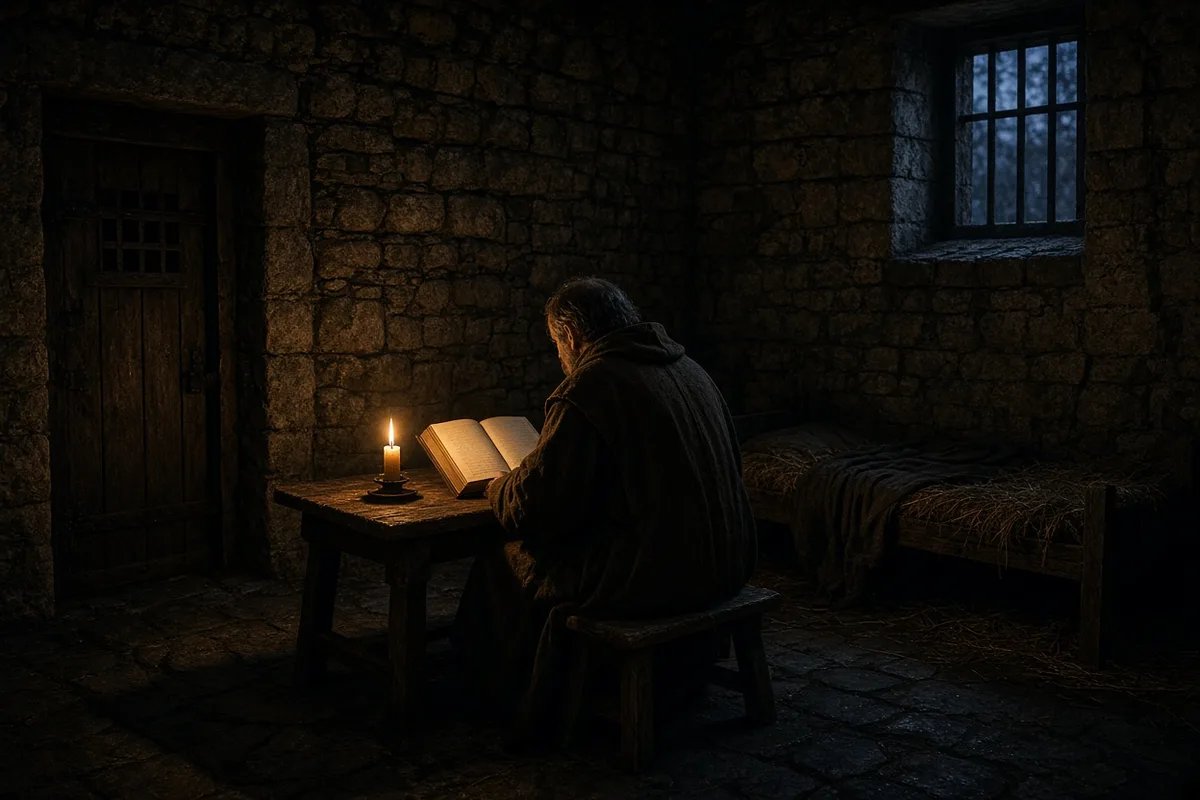
The straw in the corner had frozen stiff by the time they dragged the door open again. I had been counting the nights by the way the frost climbed the iron bars, and this one felt no different until the lantern swung in and showed the new man they had thrown down beside me.
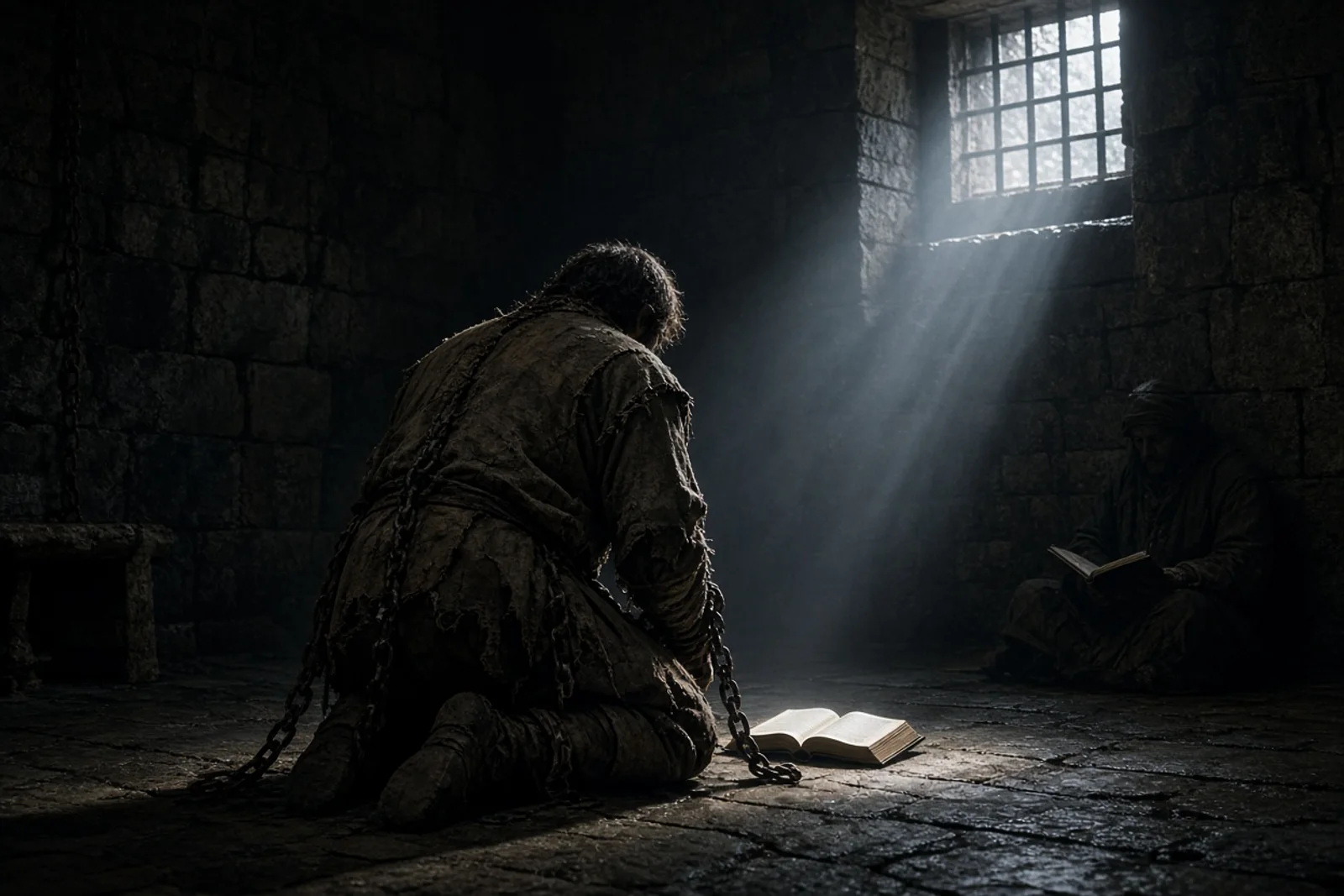
He landed on his knees, breath clouding hard, and stayed there a moment with his hands flat on the flags. The gaoler kicked the door shut without a word. I had seen plenty brought in that way, but this one did not curse or bargain. He only pushed himself upright and looked at the single high window as if he were already measuring how much sky he had left.
I knew the face. John Bunyan, the tinker from Elstow who had taken to preaching in barns and orchards these last five or six years. I had heard him once at a harvest field edge, voice carrying over the stubble without effort. Now the same voice asked the dark, very low, whether anyone else was breathing in here.
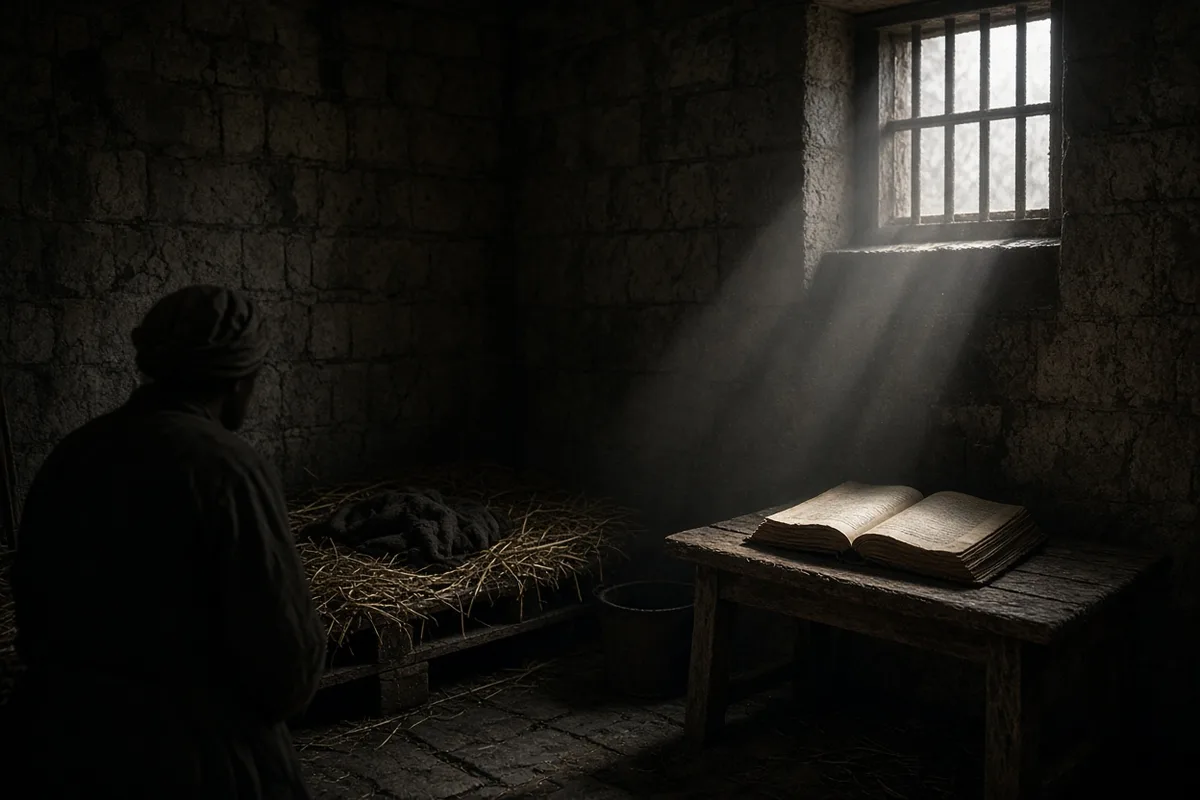
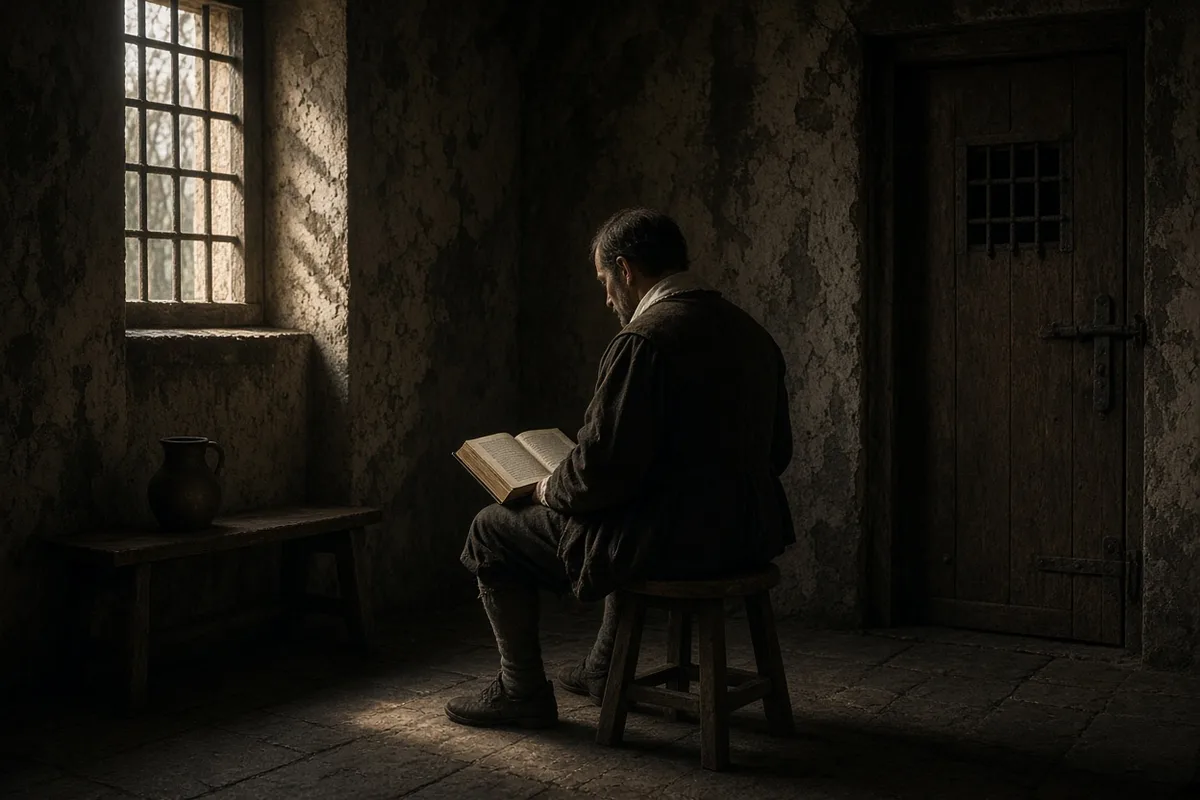
We talked little that first night. He asked my name and what I had been taken for, then fell quiet again. In the morning light I saw the book he had managed to keep, a small stitched volume he set on his knee and opened with fingers that shook from the cold. He did not read aloud. He only traced the lines with one finger and sometimes stopped, lips moving over a single word as though he were weighing it for weight and measure.
Days passed that way. The justice, Wingate, sent word that Bunyan could go free if he promised to stop gathering people to hear him. The answer came back the same each time: he would preach when he was released, because the call had not been withdrawn. After the third refusal they stopped offering. The cell grew colder. Bunyan began to speak more, not to me at first but to the wall opposite, as if someone stood there listening.
He told of the years before any of us had known him, the swearing and the Sabbath-breaking, the way sin had sat on him like a coat he could not shrug off. He spoke of the day the words of Scripture had first struck through the noise in his own head, how he had walked the fields outside Bedford with terror and then, later, with a kind of astonished relief he still could not fully name. I listened because there was nothing else to do, and because the telling did not sound like a man trying to persuade anyone else, only like a man settling accounts with himself.
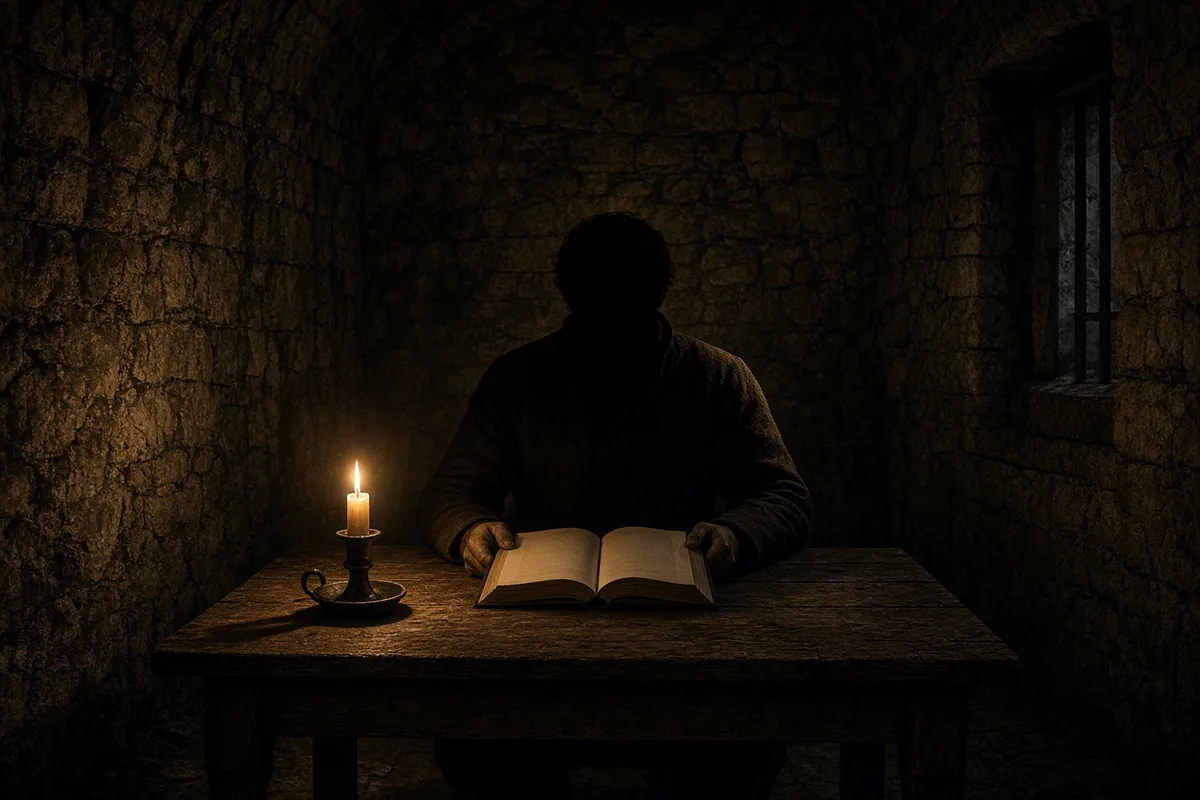
One afternoon he asked whether I could hold a quill steady. My hands were steadier than his by then. He dictated slowly, stopping often to correct a phrase or to sit with his eyes closed while he searched for the next sentence. The pages grew. They were not sermons. They were the plain record of a man who had once believed himself past mercy and had been proved wrong in a way that still left him short of breath when he reached that part of the story.
Visitors came and went. His wife brought what food she could and news of the children. She stood at the grille and spoke softly of the petition she meant to carry to the judges. Bunyan told her to carry it, but not to expect the answer she hoped for. When she left he returned to the pages without complaint. The writing took the place of preaching for him. He said once that if he could not speak to the living, he might still speak to those who would read after he was gone.
Winter thinned into spring. The ink froze in its pot more than once. We took turns warming the bottle between our palms. Bunyan’s voice grew quieter as the months lengthened, but the sentences he gave me grew longer and more careful. He would pause in the middle of a memory of temptation and ask me to read the last line back, then change a single word so that the weight of it fell where he wanted. I never asked him why the work mattered so much to him. The answer was already on the page.
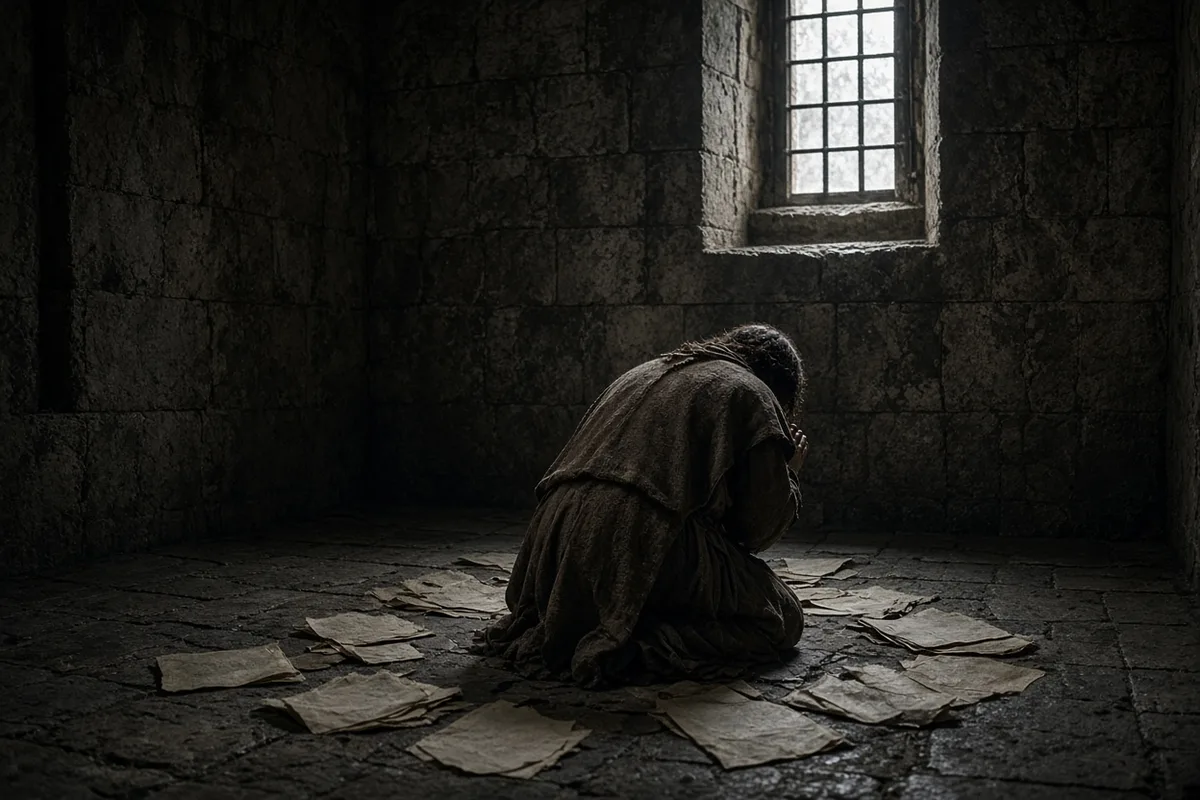
By the time the last sheet was filled and folded, the gaoler had stopped bothering to lock the outer door at night. Bunyan’s name was known now beyond Bedfordshire. People came to the window to hear him pray. He never refused them. When they left he would sit again with the finished manuscript in his lap and run his thumb along the edge as though he were checking that every word had stayed in its place.
They moved him to another part of the prison later that year. I stayed behind with the straw and the frost. The pages went with him. I heard later that they were copied and carried from hand to hand, read aloud in kitchens and by hedgerows. I never saw the printed book. I only knew the man who had spoken the words into the cold air while the lantern burned low, and the way the cell felt smaller and yet less empty once he had finished telling what had been done for his soul.
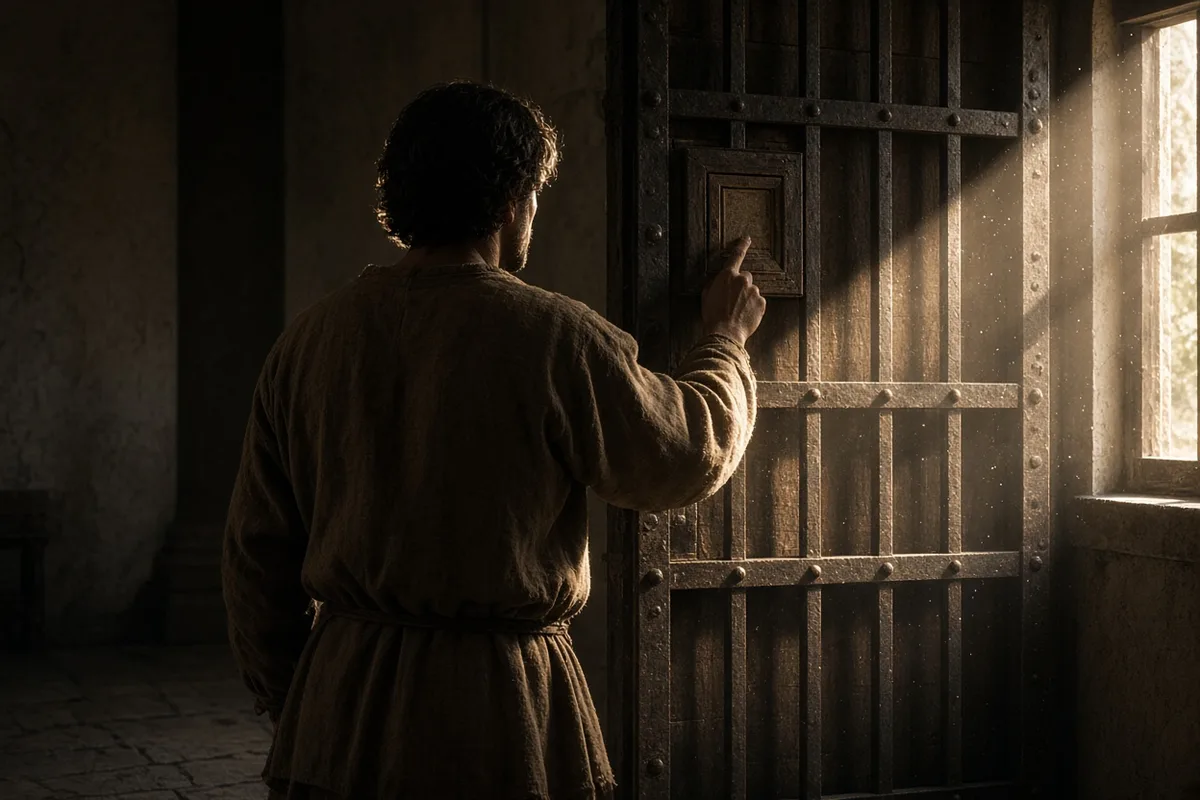
They moved him to the upper ward where the light came through a barred casement facing the Ouse, and there he remained until the spring of 1672 when the king’s Declaration of Indulgence reached Bedford. On the twelfth of May that year the clerk Paul Cobb entered his name in the register of releases alongside those of five other dissenters, noting only that Bunyan had given security for good behaviour. He walked out through the same door the gaoler had kicked shut twelve years earlier, carrying the copied sheets of Grace Abounding to the Chief of Sinners, which had already been printed in London the year before by George Larkin for sale at the Black Swan on Ludgate Hill. The edition ran to two hundred and thirty-two pages and sold for eighteen pence stitched; within a month the first impression of twelve hundred copies was exhausted.
His wife Elizabeth met him at the prison gate with their son Joseph, then aged nine, and they returned on foot to the house on St Cuthbert’s Street where the congregation had already begun to meet again in the orchard behind the building. On the following Sunday he preached from the text “I will walk at liberty, for I seek thy precepts,” the same words he had repeated nightly in the cell when the frost reached the floor. The Bedford church book records that on 21 January 1672 the members chose him as their pastor by the lifting of hands, and he accepted without salary beyond the free-will offerings that covered the rent of the meeting place.
The years that followed took him repeatedly along the roads between Bedford and London. In 1675 he was again briefly confined for three months in the gatehouse at Westminster after preaching without licence at a house in Petty France, yet the second edition of Grace Abounding appeared that same year with an additional section headed “A Relation of the Author’s Imprisonment.” By 1678 the first part of The Pilgrim’s Progress had been printed by Nathaniel Ponder at the Peacock in Chancery Lane; the title page carried the name John Bunyan and the date 1678, though the manuscript had been completed two years earlier during a period of renewed restriction. The book sold for one shilling and sixpence, and Ponder’s ledger shows that three thousand copies were struck before the end of the year.
Bunyan continued to travel, preaching at Hitchin in 1681 and at the house of John Fenn in Coventry the following spring. On 31 August 1688 he rode from Reading to London through heavy rain to reconcile a quarrel between a father and son; he reached the house of John Strudwick, a grocer in Snow Hill, already feverish. He died there ten days later on the morning of 31 August, aged fifty-nine, and was buried two days afterward in the ground at Bunhill Fields beside the grave of Thomas Goodwin. The parish register of St Botolph’s Aldersgate notes only the name and the cause given as “a violent fever.”
His daughter Sarah, who had married a Bedford man named John Gibbs, kept the manuscript of the second part of The Pilgrim’s Progress until it was printed in 1684. The congregation he had pastored erected a new meeting house on Mill Street in 1707, built of brick with a gallery on three sides and seating for three hundred persons; the original oak pulpit from the orchard meetings was moved into it and remained in use until 1790. In 1874 a bronze statue by Thomas Woolner was placed in the centre of St Peter’s Green, showing Bunyan holding a Bible in his left hand and a copy of The Pilgrim’s Progress in his right, with the inscription taken from the Bedford church book recording his call to the pastorate.
The cell where the pages had been dictated stood empty after the prison was rebuilt in 1801, its stones used for the new county gaol on the same site. A single iron bar from the original window was preserved by the county antiquarian society and is now fixed to the wall of the Bunyan Meeting Free Church, which occupies the ground where the orchard once stood. On the last day of each August a single candle is placed in the window of the vestry facing the street, left burning until dawn.
The vestry window faces due west across the street toward the river, and the candle is lit each year by the current pastor, the Reverend Christopher Damp, who enters the room at 9:17 p.m. on 31 August, the precise minute recorded in the 1688 burial entry at Bunhill Fields. Damp uses a single wax taper taken from the same batch ordered for the church’s 300th anniversary services in 2007, when the congregation numbered 142 members and the offertory for that Sunday totalled £187 4s. 6d. The taper is held to the wick of a brass candlestick dated 1724, inscribed on its base with the words “For the use of the Meeting in Mill Lane” in the hand of deacon Thomas Hawkins.
Across the green the bronze figure by Woolner receives its annual cleaning on the morning of 1 September, performed by staff from the Bedford Museum using a solution of 2 per cent citric acid followed by a coat of microcrystalline wax. The Bible in Bunyan’s left hand bears the impressed text “John 6:37” on the open page, while the copy of The Pilgrim’s Progress in his right hand shows the 1678 title-page lettering in raised relief. Local historian Margaret West recorded in her 1954 notebook that the sculptor had consulted the 1672 church-book entry “chosen by lifting of hands” before modelling the fingers.
Inside the church the original oak pulpit, moved from the orchard in 1707, stands against the north wall of the 1851 schoolroom extension. Its four panels still carry the 1790 iron brackets that once held the hourglass, and a brass plate added in 1928 states that the wood was felled in 1654 from the estate of Sir Thomas Snagge at Marston Moretaine. The Bunyan Meeting Free Church library holds the 1684 second-part edition of The Pilgrim’s Progress, bound in calf with the ownership inscription “Sarah Bunyan Gibbs, her book, given by her father in the year of his going to the City.”
Three miles west at Elstow the Moot Hall, built circa 1500, preserves the bench where Bunyan is said to have sat during his 1650s bell-ringing period. The parish register of St Mary and St Helena records his baptism on 30 November 1628 and the marriage of his parents Thomas and Margaret Bunyan on 23 May 1627. On the last Saturday in May the Elstow Moot Hall Museum stages a reading of Grace Abounding attended by an average of 87 visitors, each receiving a facsimile of the 1666 first edition printed by George Larkin.
In London the Bunhill Fields grave is marked by a Portland stone ledger installed in 1862 at the cost of £14 10s., paid by the Bunyan Memorial Committee chaired by Samuel Morley. The inscription quotes the final sentence of The Pilgrim’s Progress: “So he passed over, and all the trumpets sounded for him on the other side.” Adjacent plots contain the remains of John Owen, who died 24 August 1683, and of Daniel Defoe, buried 1731. The City of London Corporation’s annual inspection on 15 March 2023 noted that the ledger had settled 11 millimetres at the north-east corner.
The John Bunyan Museum on Mill Street, opened 1995 in the former Sunday-school building, displays the iron bar from the Bedford gaol window, accession number BM 1897.3. It also holds the 1675 second edition of Grace Abounding, printed by Francis Smith, together with the only surviving copy of the 1682 tract Of the Trinity and a Christian, priced at fourpence. The museum’s visitor book for August 2022 records 1,204 entries, one of them signed “descendant of John Gibbs, Bedford, 14th generation.”
Each evening the single candle in the vestry continues to burn until the automatic timer extinguishes it at 5:42 a.m., the recorded moment of sunrise on 1 September in the Bedford latitude. The flame is visible from the street until the timer clicks, after which the room returns to darkness except for the faint reflection of street-lamps on the polished surface of the 1724 candlestick.