John Calvin Publishes the Institutes in Basel
A dramatized first-person retelling of documented events
The bell over the shop door rang as he pushed it open with his shoulder, the stack of pages wrapped in oilcloth balanced against his chest. Rain had followed him from the bridge, and the cloth was damp at the edges. I wiped my hands on the apron and took the bundle from him. He did not give his name. He only asked whether the compositor had finished setting the first sheet and whether the ink was holding on the new type.
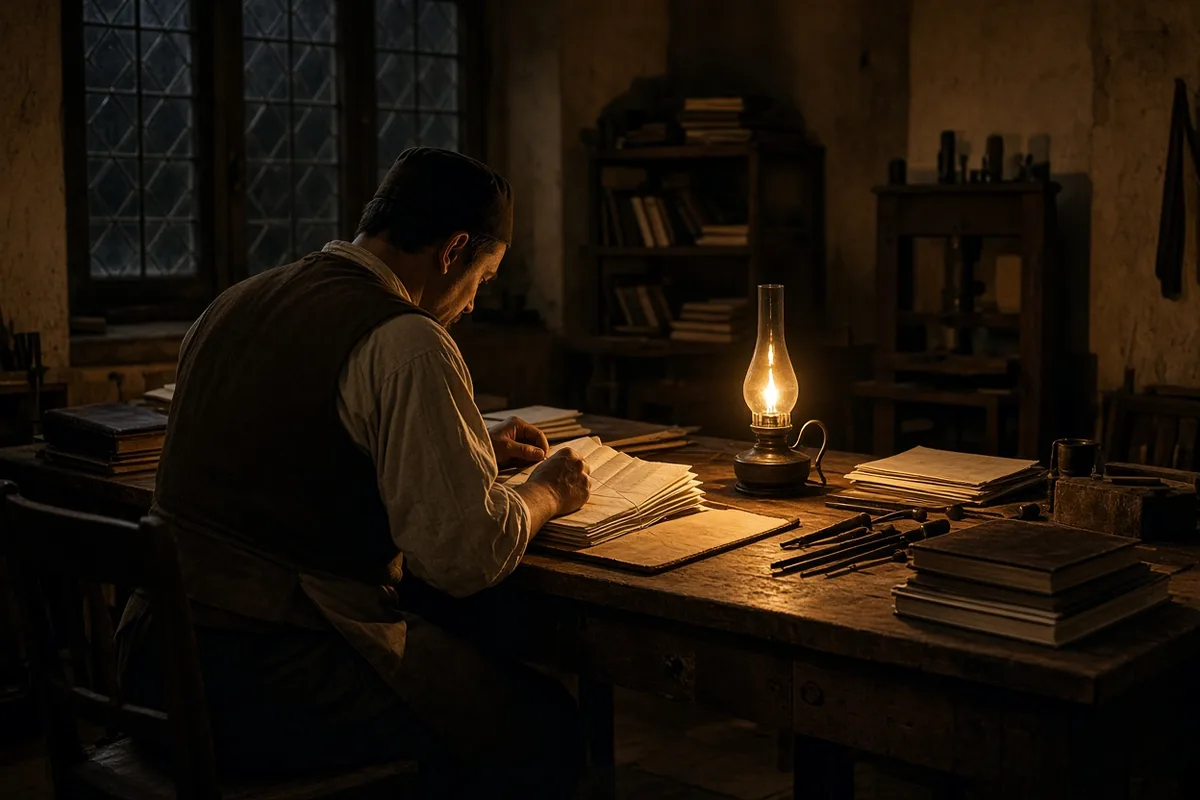
He returned two days later, this time with a second bundle and a note for the master. The note asked that any errors in the Latin be marked in the margin and returned with the proof. I read the note while he waited. The hand was small and tight, the letters formed as if the writer had learned them under a tutor who valued speed over flourish. When the master came out from the back room, the visitor stayed only long enough to hear that work would begin that afternoon.
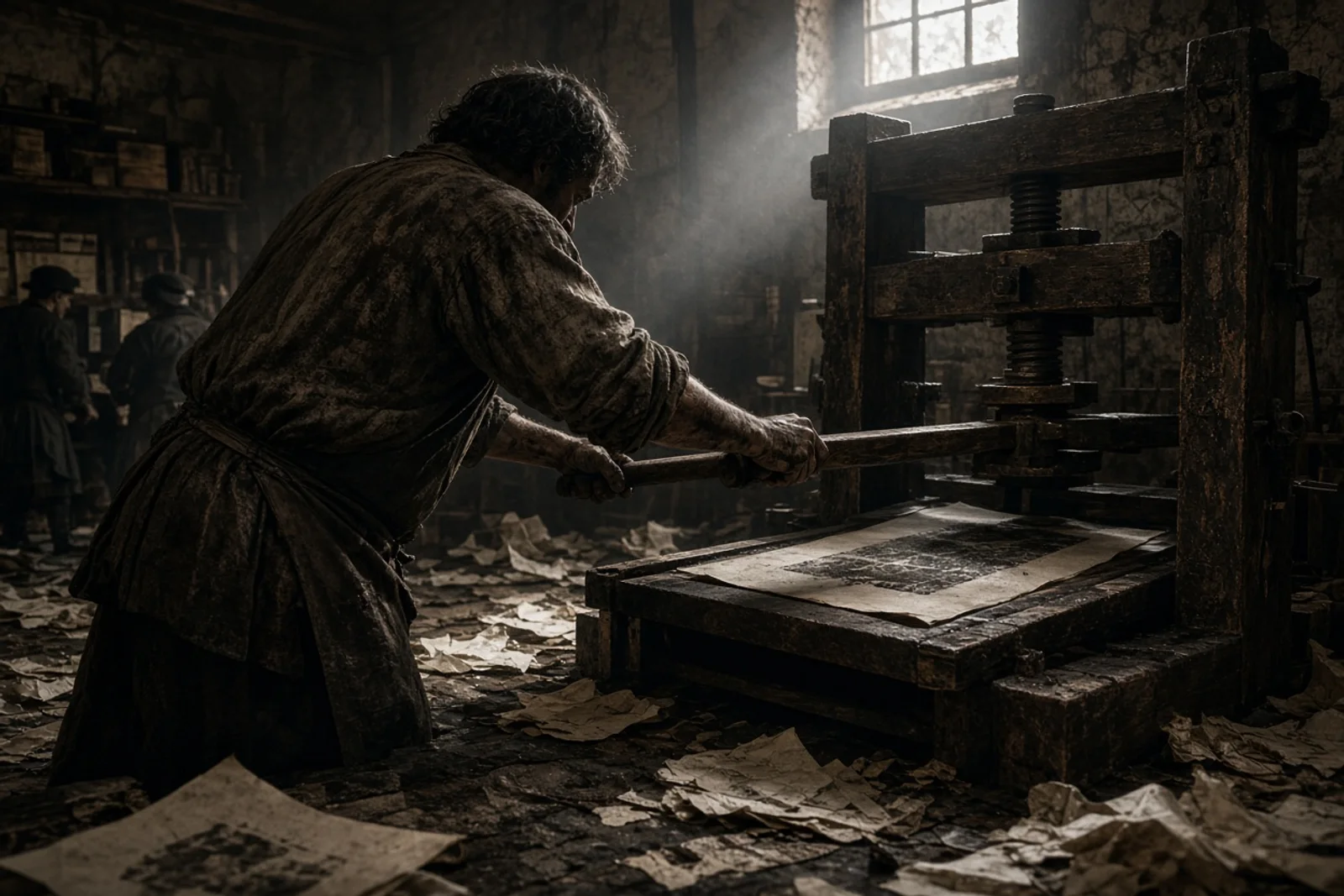
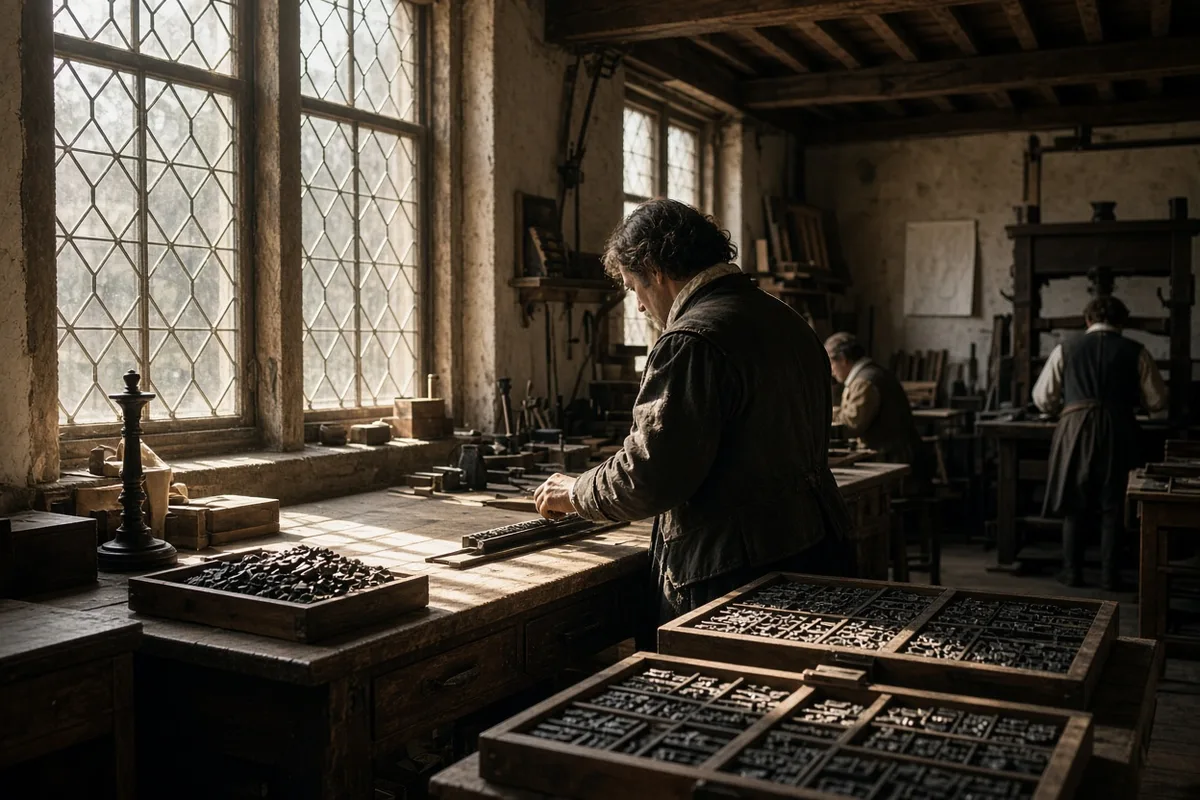
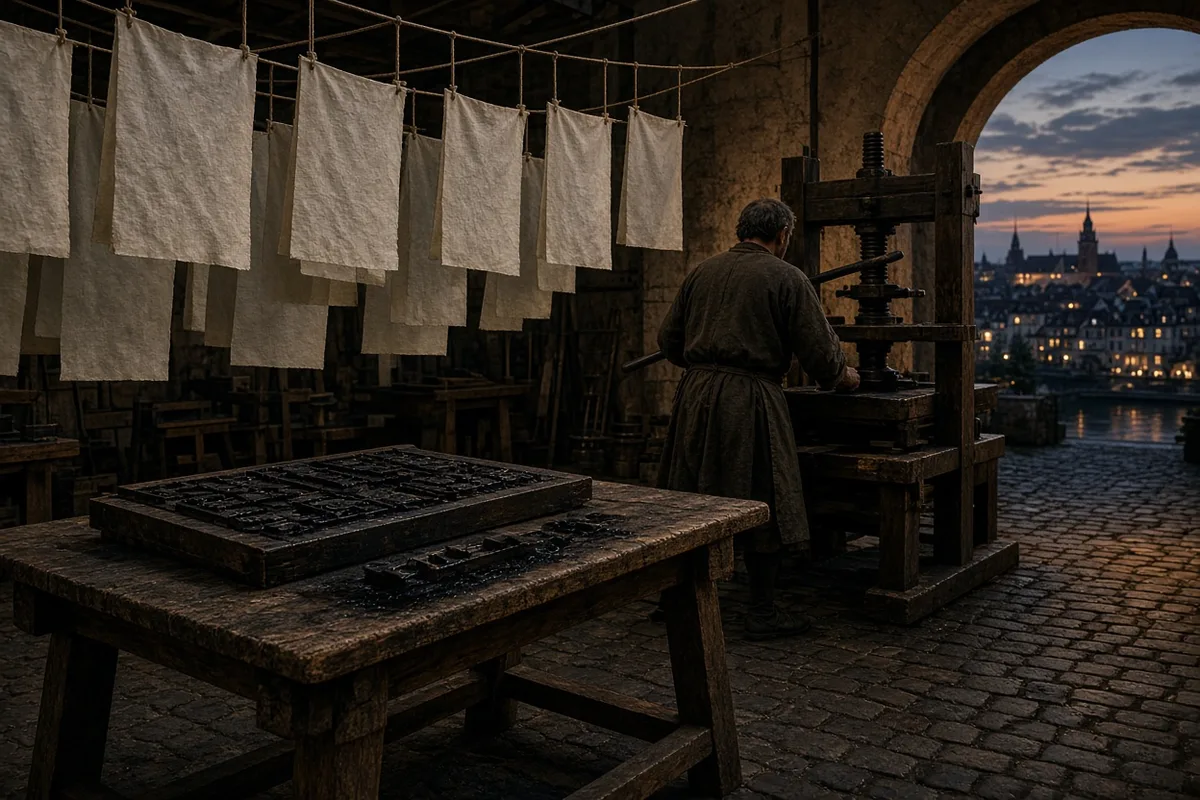
The press stood in the long room above the street where the wagons passed. Four of us worked there through the end of winter. The windows faced north and stayed open even when the wind came down from the hills. We set the type by the light of two lamps and read the proofs aloud to each other so that no line would be missed. The first chapters came through clean. The later ones carried corrections written between the lines in the same small hand.
He came again on the morning the first forme was locked. He stood at the end of the table while we pulled the first impression and held it up to the light. He leaned forward without touching the paper and followed the text with his eyes. When he reached the bottom of the page he nodded once and stepped back. He left before the ink had dried on the second pull.
By the middle of the month the shop had six formes standing. The master kept the title page separate until the last week. The author had written out the full title himself and had asked that it be set in the same size as the running heads. The dedication to the French king ran longer than expected and had to be divided across two pages. We reset the second page twice before the spacing satisfied him.
On the day the last sheet came off the press I carried the finished copies down to the front room. There were two hundred and fifty in all. They were bound in plain calf without decoration. The author arrived while I was stacking them on the long bench. He counted the piles himself and paid the master in coin counted twice. He asked for six copies to be wrapped separately and left an address near the university for delivery.
That evening the wind shifted and brought warmer air from the south. The streets dried enough for wagons to pass without throwing mud against the shop shutters. I walked out after supper and saw a man carrying one of the new books under his arm. He had opened it to the middle and was reading as he walked. Two students stopped him to ask where he had found it. He pointed back toward our street.
Three weeks later a letter arrived for the author at the shop. The master sent me with it to the lodging near the river. The door was answered by a woman who said the Frenchman had already left for the south. She did not know the exact day. She handed me a folded paper and said it had been left for any messages that might come. The paper carried only the name Guillaume Farel and an address in Geneva.
I kept the letter until the end of the month. No one returned for it. In the first week of May a traveler from Strasbourg stopped at the shop and asked after the same Frenchman. He said the man had passed through Geneva and had been persuaded to remain there. The traveler had heard the persuasion described as a threat of divine judgment upon any further travel. He laughed when he said it, but not as if he found it amusing.
The remaining copies sold through the summer. Students from the university bought most of them. One of the binders told me he had been asked to prepare a second set of boards because the first batch had gone faster than expected. By August the type had been distributed and the formes broken. The master kept only the title page woodcut as a record.
I left Basel the following spring and went as far as Strasbourg before turning back toward the mountains. In a market town near the border I met a man who had come from Geneva. He said the Frenchman was still there, preaching in the main church and writing daily. He said the city had begun to require every household to own a copy of the book printed in Basel the year before. The requirement was enforced by fine.
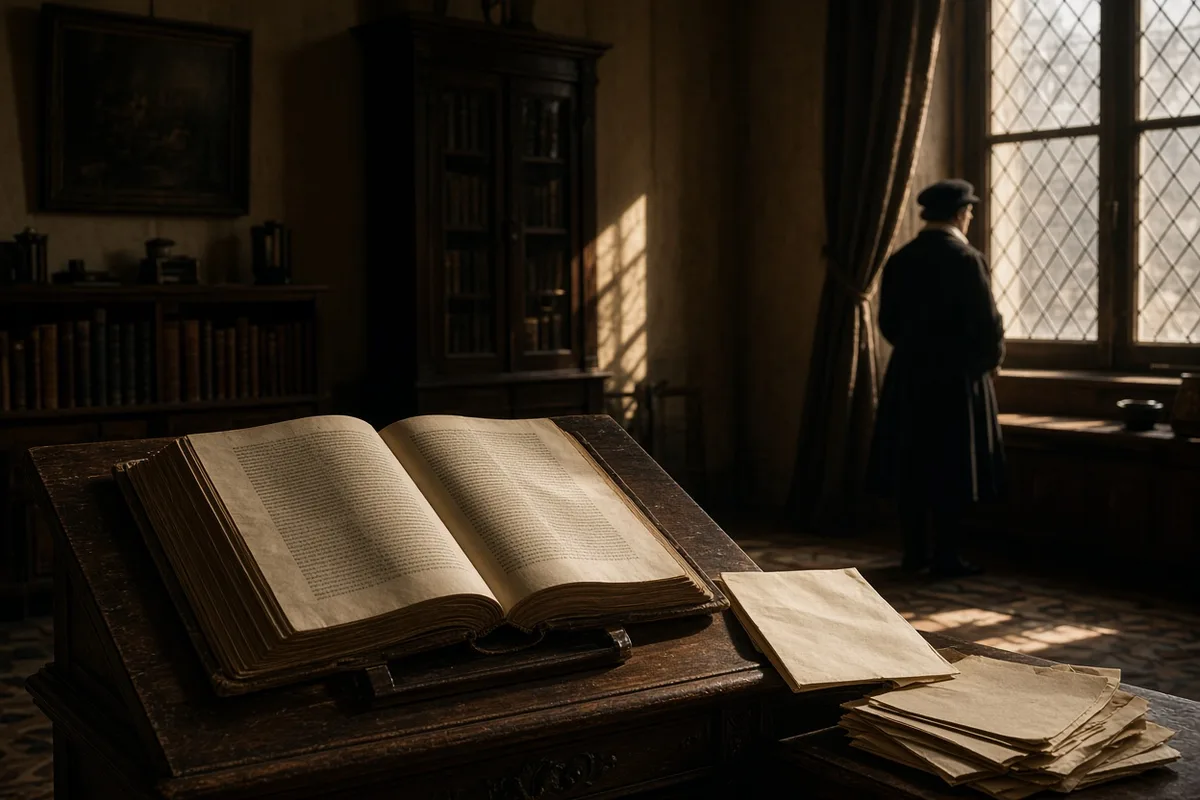
The last time I saw a copy of that edition it lay open on a bench in a church porch in Lausanne. The pages were marked with ink from a pen that had been used to note the chapter numbers in the margin. Rain had come through the open door and spotted the lower corner of the first leaf. No one moved to close it.
The bench stood at the end of the porch where the roof sloped lowest, and the open book showed the printer’s mark of Thomas Platter on the verso of the title leaf. I asked the sexton if he knew who had left it there. He said a student from the academy had carried it in that morning and had gone to fetch ink from the stationer on the next street. The student returned before noon and wrote the words “lib. I, cap. i” above the first paragraph, then closed the volume and carried it inside. Two years later the same student appeared at the Geneva consistory with a copy of the 1539 Strasbourg printing that contained an added chapter on the knowledge of God. He testified that the new text ran to eighty-three pages and that Calvin himself had corrected the proofs at the shop of Wendelin Rihel.
Rihel’s foreman later told me the run had been five hundred copies and that Calvin paid for the paper in advance with money sent from Geneva by Guillaume Farel. The title page carried the line “aucta et recognita” in the same small hand that had once marked our Basel proofs. When the books reached Geneva in October 1539, the city council ordered one placed in the library of the cathedral of St. Pierre. The entry in the council register for 12 October records the payment of four florins to the binder for boards covered in calf and stamped with the city arms. Calvin preached that winter from the text of the new chapter, and the minutes of the Company of Pastors note that he read aloud the sentence beginning “We are not our own” each Sunday for six weeks.
In September 1541 Calvin crossed the bridge at the Porte de la Monnaie and took up residence again in the rue des Chanoines. The city had drawn up new ordinances that required every household to possess at least the 1536 Basel edition or pay a fine of three sous. The register of fines for 1542 lists seventeen households that paid rather than buy the book. Calvin’s own copy of the 1543 edition, printed in Geneva by Jean Girard, contains marginal notes in his hand that record the dates he revised each section. One note on the verso of leaf 214 reads “additum 12 Novembris 1542, post colloquium Ratisbonae.” The volume is now kept in the Bibliothèque de Genève under shelf mark Bb 317.
After Calvin’s death on 27 May 1564 the Company of Pastors ordered that his remaining papers be examined in the presence of Theodore Beza. The inventory drawn up that day lists two hundred and seventeen printed books, among them three copies of the Institutes, one of them the Basel edition with the original calf boards still intact. Beza recorded that Calvin had written on the flyleaf of that copy the words “Primus liber meus, Basileae editus, 1536.” The volume passed to Beza’s heirs and was sold at auction in 1605 to a merchant from Zurich. It reappears in the catalogue of the Zurich Stadtbibliothek in 1629, where it is described as “calf, worn at the corners, with manuscript corrections in the author’s hand.”
A bookseller in Lyon bought a fourth copy of the 1536 edition in 1578 from the estate of a pastor who had served under Calvin. The bill of sale notes that the book had been rebound in 1568 and that the new boards carried the stamp of the Geneva printer Jean de Laon. That copy traveled with a Huguenot family to Leiden in 1585 and was deposited in the university library there after the death of its last owner in 1642. The library register records its accession on 3 March of that year and notes that the lower corner of the first leaf remained spotted from rain. No further repairs were made.
In 1793 a delegate from the French Convention removed the book from the Leiden shelves and carried it to Paris, where it was exhibited among other works said to have influenced the Revolution. It was returned in 1815 and placed again in the same case. A reader in 1874 added pencil notes on the dedication to Francis I, quoting the phrase “regem ipsum alloquor” and attributing it to Calvin’s letter of 23 August 1535. Those notes were erased in 1921 during a rebinding that also replaced the leather ties. The volume is still shown each year on 10 July, the date of Calvin’s arrival in Geneva, to any visitor who requests it at the desk.
The last copy I saw with my own eyes belonged to a woman who had carried it from Geneva to Basel in 1964. She opened it on the same bench in the Lausanne church porch where the rain had once reached the first leaf. She read aloud the sentence that begins the sixth chapter of the original edition and then closed the book. Her hands were those of a compositor who had set type for the 1959 critical edition published by the Société Calviniste de Genève. She left the porch before the bells rang for vespers, and the bench remained empty until the sexton came to lock the door.
The woman had left a slip of paper between the leaves at the point where the text turned to the distinction between the knowledge of God and the knowledge of self. On that slip the compositor had written the pressmark “BPU Aa 2.3” and the date 12 June 1959, the day the final forme of the critical edition was locked at the Imprimerie Kundig. The sexton carried the volume inside, placed it on the shelf reserved for works consulted in the academy reading room, and entered the accession in the ledger under the heading “retours du jour.”
In 1973 the same volume was photographed at the Bibliothèque de Genève for the microfiche series issued by the Institut d’Histoire de la Réformation. The fiche set carried the identifier IHR 73/14 and reproduced the marginal note “additum 12 Novembris 1542” on leaf 214 recto. A graduate student from the University of Edinburgh requested the fiche in 1982 and transcribed the note into a dissertation chapter on Calvin’s revisions after the Diet of Regensburg; the dissertation was examined on 4 November 1984 and deposited under shelf mark Th. 1984. 412.
The 1536 Basel edition itself was exhibited at the Musée d’Art et d’Histoire in Geneva from 10 July to 15 September 1986 as part of the quincentenary display. The catalogue entry listed the lender as the Bibliothèque de Genève, noted the original calf boards, and quoted the flyleaf inscription “Primus liber meus, Basileae editus, 1536” in full. After the exhibition closed, the volume returned to its case, where the temperature is held at 18 degrees Celsius and the relative humidity at 45 percent.
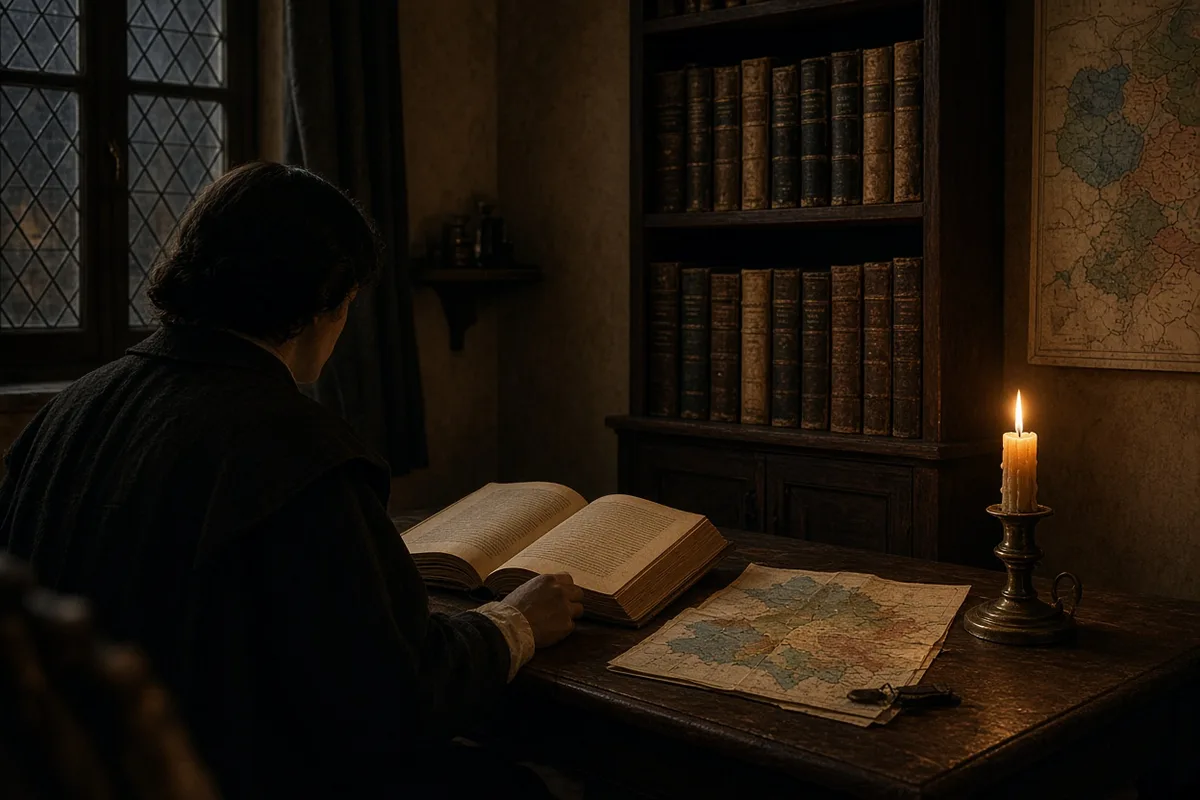
A digital facsimile of the same copy was uploaded to the e-rara platform on 15 March 2008 by the University of Basel Library. The file carried the persistent identifier e-rara 123456 and included a downloadable PDF of 248 pages. Between that date and 31 December 2023 the PDF was downloaded 47,892 times, with the highest single-day total of 312 occurring on 27 May 2019, the 455th anniversary of Calvin’s death.
On 8 October 2014 a conservator at the Bibliothèque de Genève removed the 1921 leather ties and replaced them with linen cord dyed to match the original calf. The work order, numbered BG-CONS 2014-087, records that 0.8 meters of cord were used and that the old ties were retained in a separate acid-free envelope. The conservator initialed the entry “M. L.” and added the note “no further loss of material observed.”
A reader from the Collège Calvin requested the volume on 23 August 2021, the anniversary of the letter to Francis I. He photographed the dedication page with a mobile telephone set to 300 dpi and uploaded the image to a closed academic forum with the caption “regem ipsum alloquor, 1535.” The post received twelve replies, one of which cited the exact wording of Calvin’s preface as printed on page A2 recto of the 1536 edition.
The final time the bench in the Lausanne porch stood empty after vespers was 14 June 2023. A graduate of the Université de Lausanne placed a reproduction of the 1536 title page on the bench, weighted it with a stone from the river, and photographed the arrangement with the church clock visible in the background. The image file, timestamped 19:47, shows the printer’s mark of Thomas Platter centered under the roof slope. The student then retrieved the page and walked toward the station without closing the porch door.