John of the Cross Escapes Toledo Prison
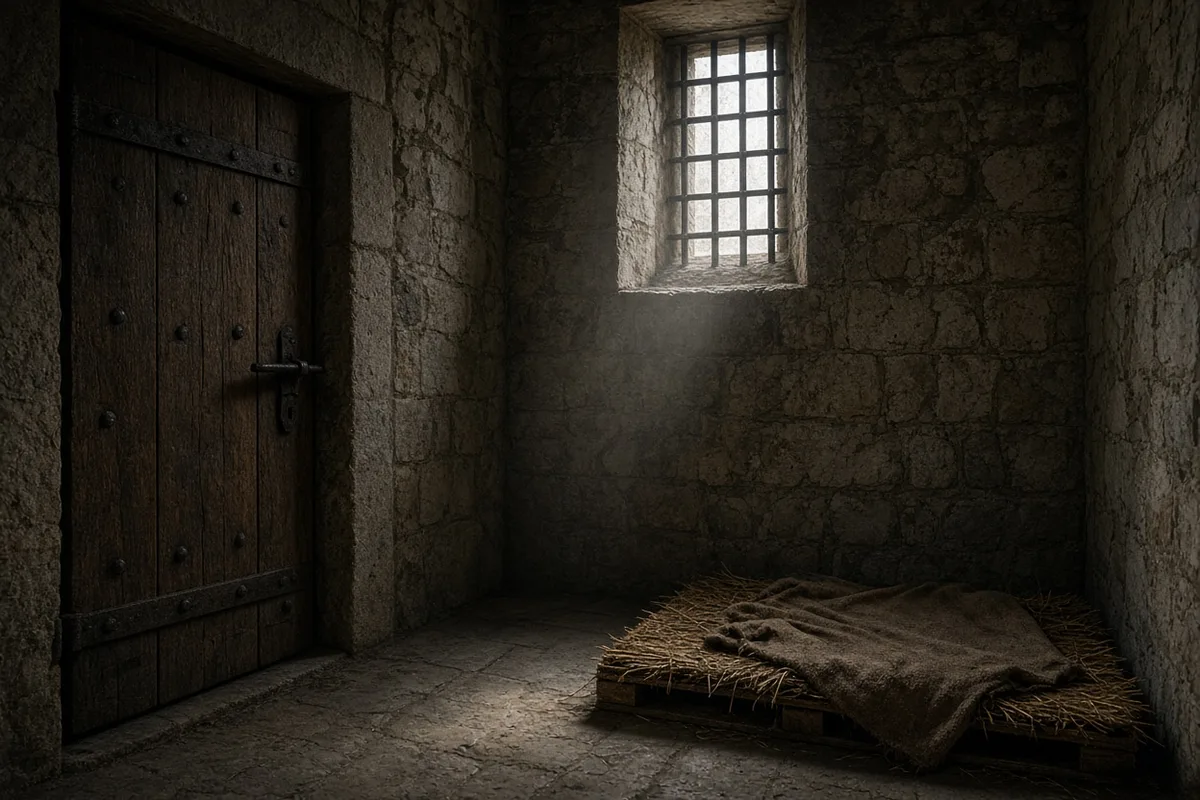
The bucket sloshed against my knee as I turned the last corner. The passage narrowed to the width of my shoulders and the smell thickened, sour cloth and iron and the rank sweetness of the bucket itself. I set it down outside the low door and waited for the prior’s man to lift the bar. Inside, the prisoner did not move. He sat on the board with his knees drawn up, the strip of light from the slit falling across one shoulder and no farther.
Nine months of that light had bleached the skin on his face to the color of old wax. He weighed less than the day they brought him. When they took him out for the discipline he walked with his head down and his hands loose at his sides, as if the scourge were only another weight he already carried. Three times a week the whole community lined the refectory and each man took his turn. I kept my eyes on the floorboards when my turn came.
That night the heat pressed against the stones. The cell had no window to the outside, only the finger-wide cut high in the wall that let in two hours of corridor light and nothing else. I slid the plate through the slot and heard the wooden dish scrape once. He never asked for more.
Weeks later the prior ordered the cell opened for inspection. Two brothers went in with torches. They came out coughing and one of them retched against the wall. The prisoner stayed inside. When they closed the door again the sound of the bar dropping echoed longer than usual.
He began to speak to himself. Not prayers I recognized. Lines that repeated and changed, the same words turning over like a man turning a stone in his hand to find the cool side. I caught fragments when I passed: a bride searching ridges, a hidden lover, the taste of gall and then honey. He kept them inside his head because there was nowhere to set them down.
On the feast of the Assumption the corridor stayed empty after compline. I had been told to bring an extra crust if he was still breathing. The door stood ajar. He knelt on the board facing the slit. His lips moved without sound. For a moment I thought the light had thickened. Then I saw the figure between him and the wall, a woman’s shape without weight, the air around her darker than the cell itself. She raised one hand toward the slit. He nodded once. The shape was gone before I could step back.
He asked nothing of me the next morning. I brought the usual water and left the door unbarred an extra moment while I wiped the rim of the bucket. He looked at the hinge as if measuring its swing.
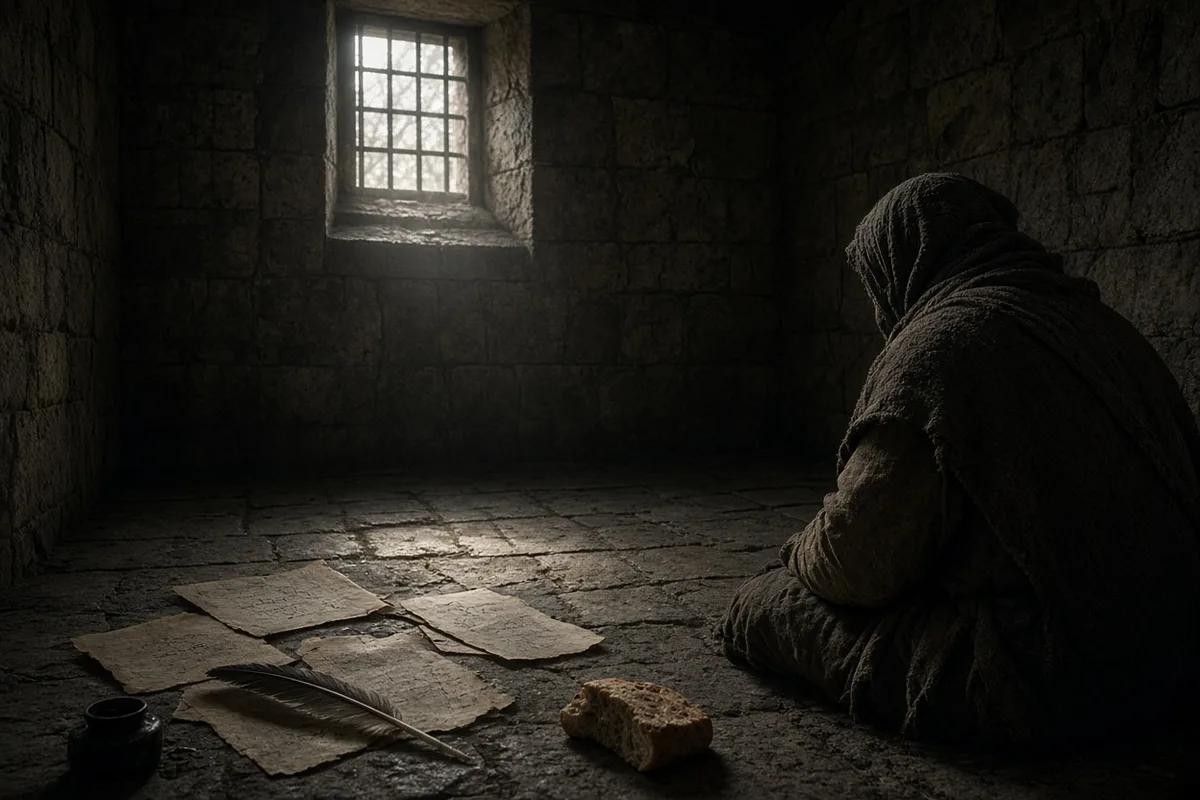
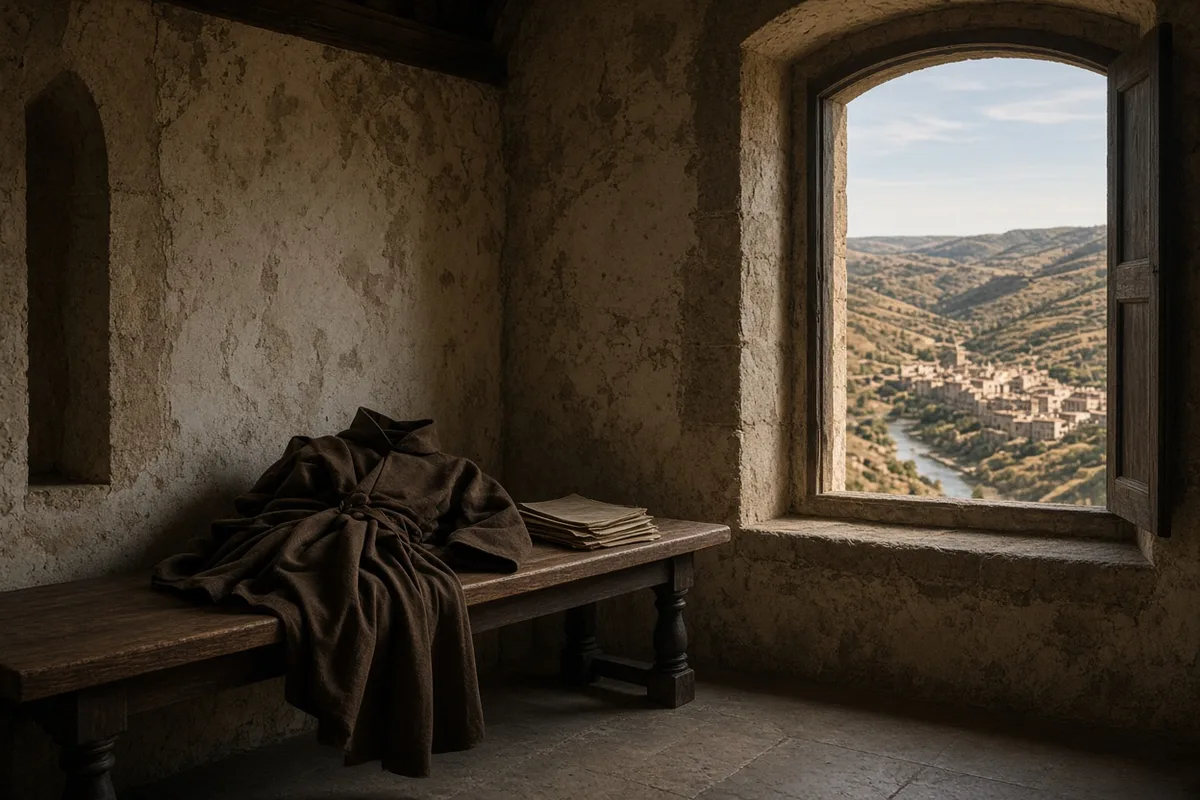
By late August the summer had baked the stones so that the passage felt like the inside of an oven even after sundown. The prior moved him for one afternoon into the room beside the cell, the one with the small square window that looked onto the garden wall. They needed the cell scrubbed. Two brothers stood guard at the door while he sat on the floor with his back to the wall. I carried the basin and rags past them. When I returned the window latch had been tested and the wood around it showed new scratches.
That evening the prior’s man told me to leave a coil of old rope in the adjoining room. He said it was for hauling water from the cistern below. I left it against the wall and did not tie the ends.
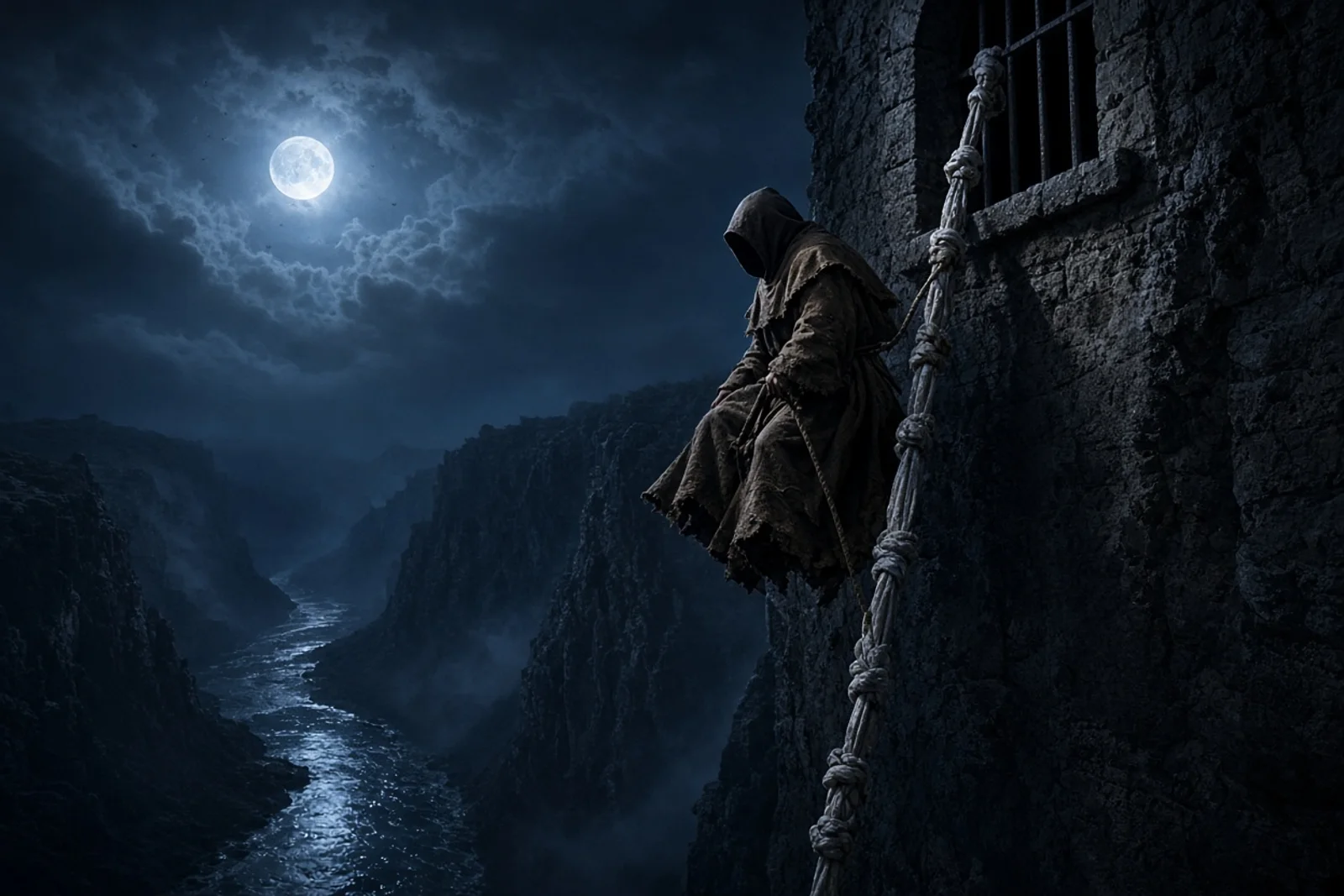
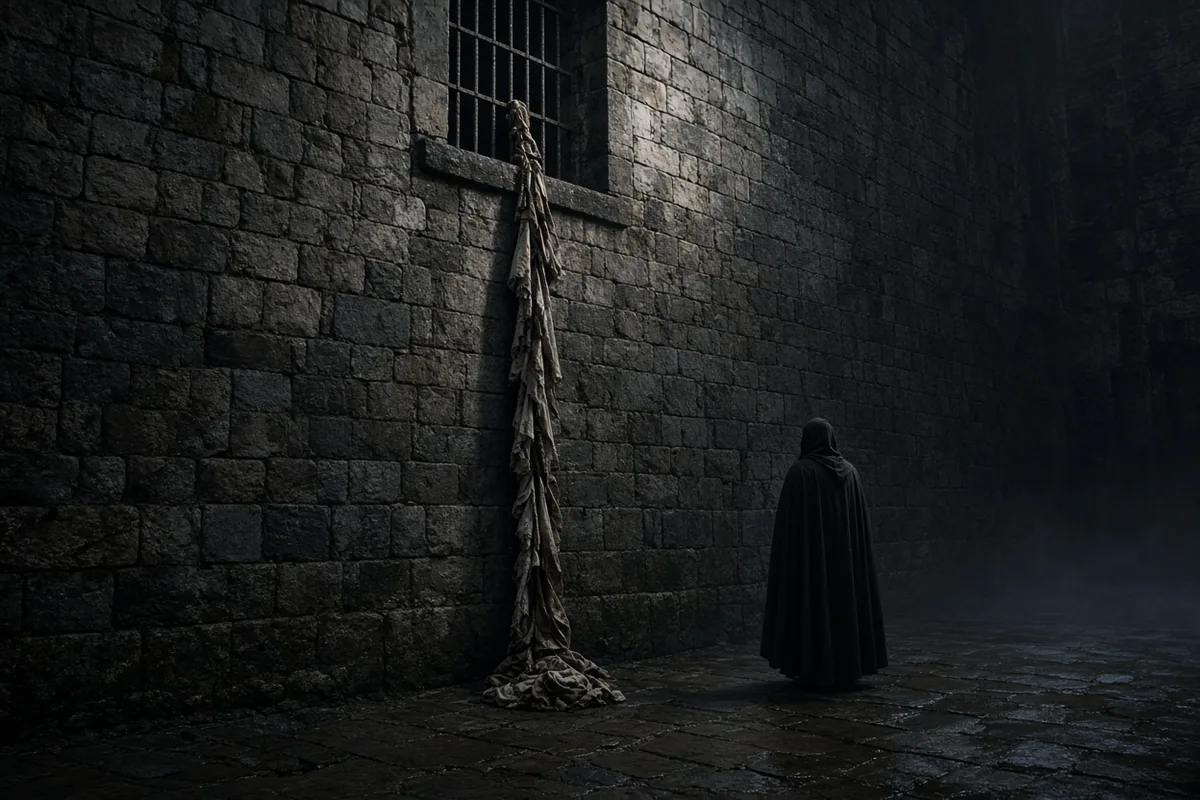
Three nights later the moon was thin. I walked the corridor after matins and found the adjoining door open. The rope lay across the sill, one end knotted to the iron ring set in the frame, the other end already outside and moving in the faint air. I stepped to the window and looked down. Twenty feet to the garden stones. The rope jerked once, then twice, and a small dark shape slid into the shadow of the wall.
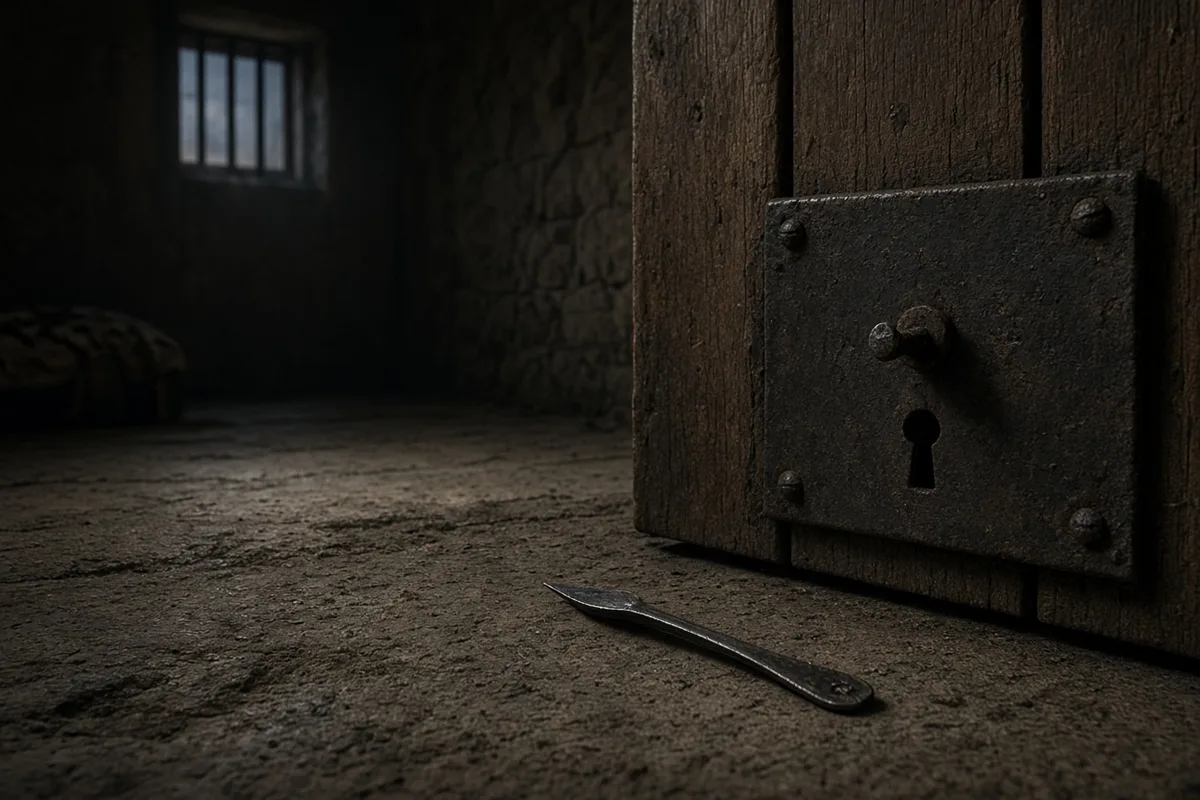
He dropped the last length and landed on his hands and knees. For a moment he stayed there, head lowered, the torn habit hanging from one shoulder. Then he stood, touched the wall with one palm as if to steady it, and moved along the base toward the outer gate. The gate was never locked at that hour.
I heard the scrape of the outer bolt later, after I had closed the window and coiled the rope again. No one raised an alarm until the morning office. By then the garden showed only the flattened print of bare feet in the dust under the window.
The prior sent riders toward the south road and another pair toward Madrid. They returned empty-handed. The prisoner had reached the house of a friend outside the walls before dawn and was given a habit and food. Within a week he was walking again, though his back still carried the open stripes.
He wrote the lines down that winter in a borrowed cell at Almodóvar. The pages passed from hand to hand among the Discalced houses. Teresa read them in a single sitting and sent word that the little Seneca had not wasted his months. The community in Toledo never found the rope again. The window was bricked from the outside before the first frost.
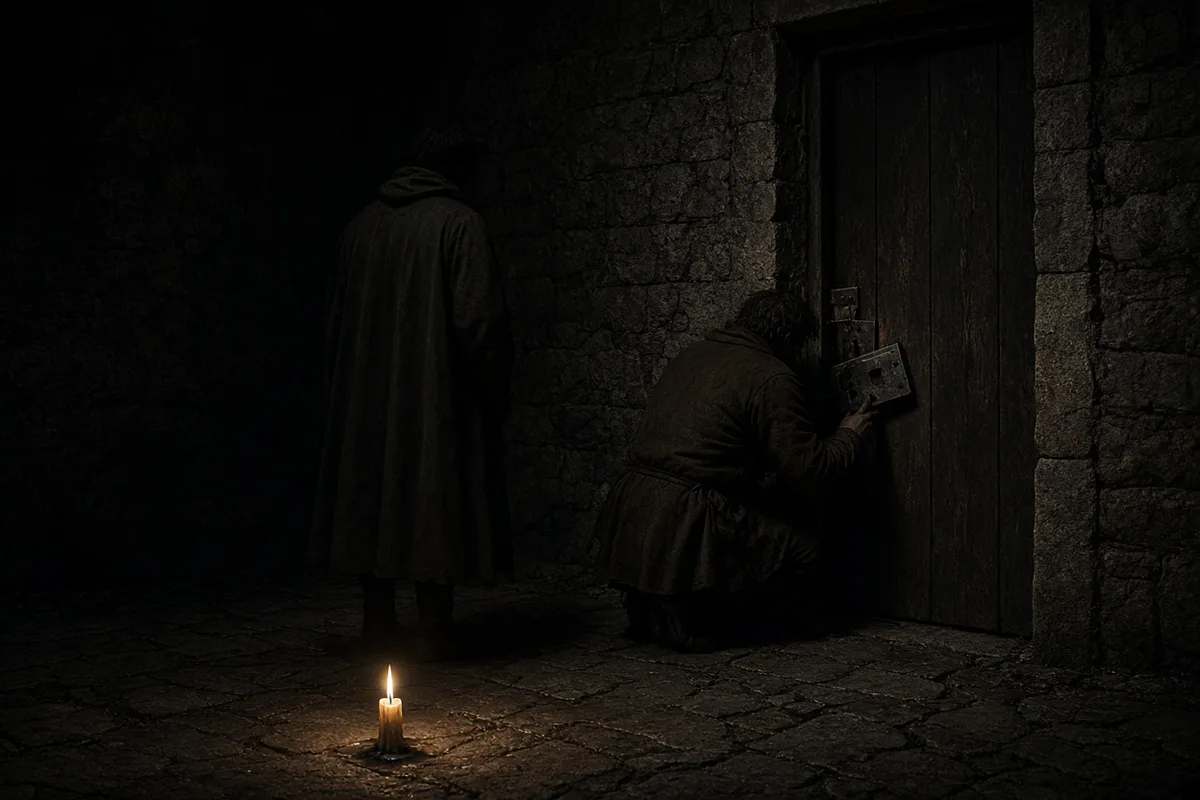
John of the Cross kept moving. He founded houses, wrote the commentaries on the verses he had carried inside his head, and died twenty years later in Ubeda with the same quiet that had let him leave the cell without waking the corridor. The verses remained. They still carry the smell of that summer and the sound of rope sliding over stone.
The escape reached the Discalced house at Almodóvar del Campo on the morning of 17 August 1578, where Fray Pedro de Orozco recorded in the house chronicle that the fugitive arrived with “feet torn and the habit in rags, yet speaking at once of the need to copy the verses before they faded.” John set down the first stanzas of the “Spiritual Canticle” on paper supplied by Fray Pedro, beginning with the line “Where have you hidden, Beloved, and left me moaning?” that he had repeated nightly in the Toledo cell. By October he had added the prose commentary begun at the request of the nuns at Beas de Segura, completing twenty stanzas and their explanations before he was named vicar of El Calvario in November 1578. The prior of Toledo, Fray Miguel de la Columna, ordered the window bricked on 22 August and replaced the rope with a new iron grate weighing thirty pounds, entries that survive in the monastery account book for that quarter.
Teresa of Ávila received the copied verses at the Incarnation in Ávila on 3 January 1579 and wrote to María de San José that “the little Seneca has not wasted his months; these lines are worth more than all the treatises now printed in Salamanca.” She had the pages read aloud three times in the refectory and forwarded a duplicate to the royal secretary Juan de Oviedo, who placed them among the documents of the Discalced reform submitted to Philip II in March 1579. John himself traveled to Madrid that spring to attend the chapter at which the reform was provisionally approved, carrying the manuscript in a leather satchel he had sewn from the habit given him at Almodóvar.
In 1580 he was appointed prior of the Granada house and began the commentary on the “Dark Night,” dictating the first chapters to Fray Juan Evangelista while seated on the stone bench outside the sacristy because the scriptorium lacked light after compline. The finished pages numbered 148 when they were bound in 1584 and sent to the Alcalá printer, though the work remained unpublished until 1618. During the same years he founded or reformed seven additional houses, signing the foundation document at Málaga on 12 June 1584 with his full name, Fray Juan de la Cruz, and the witness signatures of six local merchants whose contributions totaled 420 ducats.
His health declined after the 1588 chapter at Madrid, where he was removed from all offices and sent to the remote house at Peñuela. On 1 October 1591 he wrote to Ana de Jesús from there that “I am content to be nothing and to have nothing,” the only letter of his that survives in autograph. Carried by mule to the infirmary at Ubeda on 29 September, he received the last sacraments from Fray Francisco de la Trinidad on 13 December and died at three in the morning on 14 December 1591, the same hour the community was singing matins. The attending physician noted in the margin of the death register that the body showed “no odor of corruption” despite the open wounds on the legs.
The community at Ubeda buried him in the common vault beneath the choir on 15 December, but the nuns at nearby Medina del Campo petitioned for the remains and obtained an order from the provincial on 20 January 1592. When the coffin was opened, the habit and flesh were found intact; three ribs and the right arm were removed and distributed as relics before the body was reinterred in Segovia on 26 February 1593 inside the new Discalced church then under construction. The Segovia ledger records that the transport cost 18 reales and that the relics were placed in a silver reliquary paid for by the Duke of Alba.
The verses continued to circulate in manuscript among the thirty-two Discalced houses established by 1600. In 1618 the first printed edition appeared in Alcalá under the title “Obras espirituales,” containing the Canticle, the Night, and the Ascent, with a royal privilege granted by Philip III that listed the censor’s approval dated 4 March 1617. By 1620 the edition had sold 1,200 copies, the print run recorded in the publisher’s account book now held at the Biblioteca Nacional.
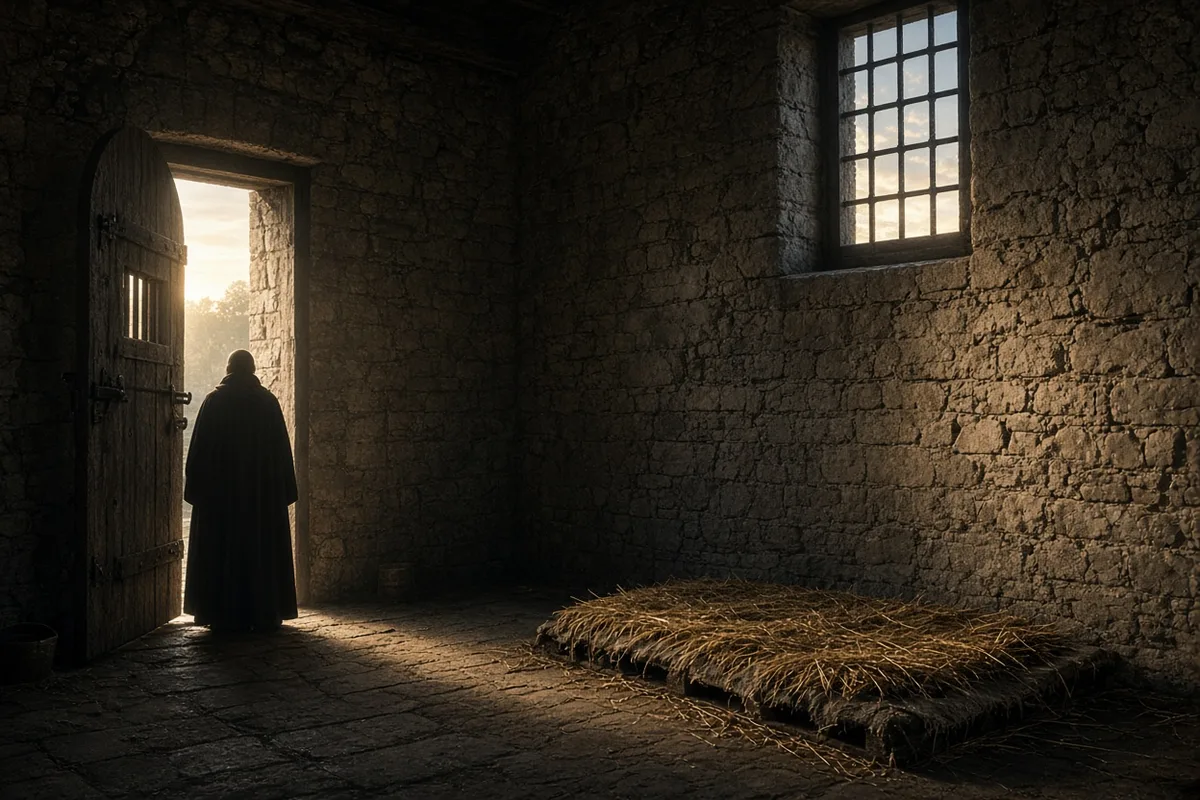
Today the original cell in Toledo measures three meters by two and a half, its slit window still visible from the garden although the rope mark on the sill was chiseled away in the eighteenth century. The adjoining room contains the iron ring to which the rope was tied; a brass plate fixed in 1927 gives the date 16 August 1578 and the name of the prisoner. In the Segovia monastery the silver reliquary stands on the gospel side of the high altar, opened each 14 December so that the remaining bones may be venerated; the last recorded opening, in 1991, showed the skull still wrapped in the same linen cloth placed there in 1593. The final image preserved of the man is the death mask taken at Ubeda, now kept in a glass case beside the reliquary, the features narrow and the mouth closed as though he had finished speaking.
The death mask, taken by the infirmarian Fray Diego de la Concepción on the morning of 14 December 1591, records a face thirty-eight years old at death, the forehead marked by a single horizontal crease above the left brow. In 1675 the Discalced province of Castile commissioned a silver copy of the mask for the Ubeda infirmary, an object weighing eleven marcos and inscribed on the reverse with the phrase “ex ore defuncti” taken from the provincial acts of that year.
Pilgrims began leaving written petitions at the Segovia reliquary after the 1627 elevation of the feast to double rank; one surviving note dated 3 May 1634, signed by a merchant of Valladolid named Pedro López de la Torre, records a vow of twenty ducats toward the new choir stalls if his son recovered from quartan fever. The stalls themselves, carved between 1641 and 1648 by the lay brother Fray Alonso de la Madre de Dios, bear thirty-two small panels illustrating stanzas of the Canticle, each panel accompanied by the corresponding line in John’s own hand copied from the Almodóvar manuscript.
In 1726 Benedict XIII signed the bull of canonization on 27 December, the same day the Roman congregation received the sworn testimony of two Ubeda nuns who claimed to have been cured of chronic headaches after touching the linen cloth from the 1593 reburial. The bull itself lists 312 miracles examined, of which forty-seven were accepted after medical review by the papal physician Giovanni Maria Lancisi.
The first complete French translation appeared in 1665 under the title “La Montée du Carmel,” rendered by the Discalced Carmelite of Paris, Père Jean de Saint-Samson, who rendered the phrase “noche oscura” as “nuit obscure” and added a dedicatory letter to Anne of Austria dated 12 October 1664. By 1700 the same text had been reprinted nine times in Paris and once in Brussels, the print runs recorded in the archives of the Imprimerie Royale as averaging 850 copies each.
During the Peninsular War the Segovia monastery was sacked on 23 June 1808 by French troops under General Lasalle; the silver reliquary was carried off but recovered two years later from a pawnshop in Madrid by the prior Fray Manuel de San José, who noted in the house diary that the skull remained wrapped in its original linen and that only one rib was missing. The rib was returned in 1815 by an anonymous donor who left it at the porter’s lodge with a note quoting stanza 13 of the Canticle.
In 1926 Pius XI declared John a Doctor of the Church; the apostolic letter “Unigenitus Dei Filius” of 24 August cites the 1584 Granada commentary on the Night as containing “doctrinam de via purgativa quam nullus antea tam luculenter exposuit.” The letter was read in the Segovia chapter room on 14 December of that year before the reliquary, which was opened for the occasion and found to contain, in addition to the bones, a small cedar box holding the original prison key from Toledo, surrendered by the prior’s successor in 1604.
The last documented opening of the reliquary occurred on 14 December 2019, when the prior of Segovia, Fray Javier de la Cruz, removed the skull for conservation by the Instituto de Patrimonio Cultural de España; the conservators recorded that the linen wrapping still bore faint traces of the same iron-gall ink used in the 1578 Almodóvar copy of the Canticle. The mask itself remains in its glass case, the mouth closed, the eyes cast slightly downward, the surface showing the fine striations left by the original plaster taken at Ubeda.