Martin Luther Posts the Ninety-Five Theses
A dramatized first-person retelling of documented events
I was crossing the square with a bundle of copied lectures under my arm when Luther appeared from the direction of the Augustinian house. He walked without hurry, the October air already sharp enough to turn breath white. The castle church stood at the far end, its doors open for the vigil preparations. A few students loitered near the steps, waiting for the bell that would call them inside for the feast of All Saints.
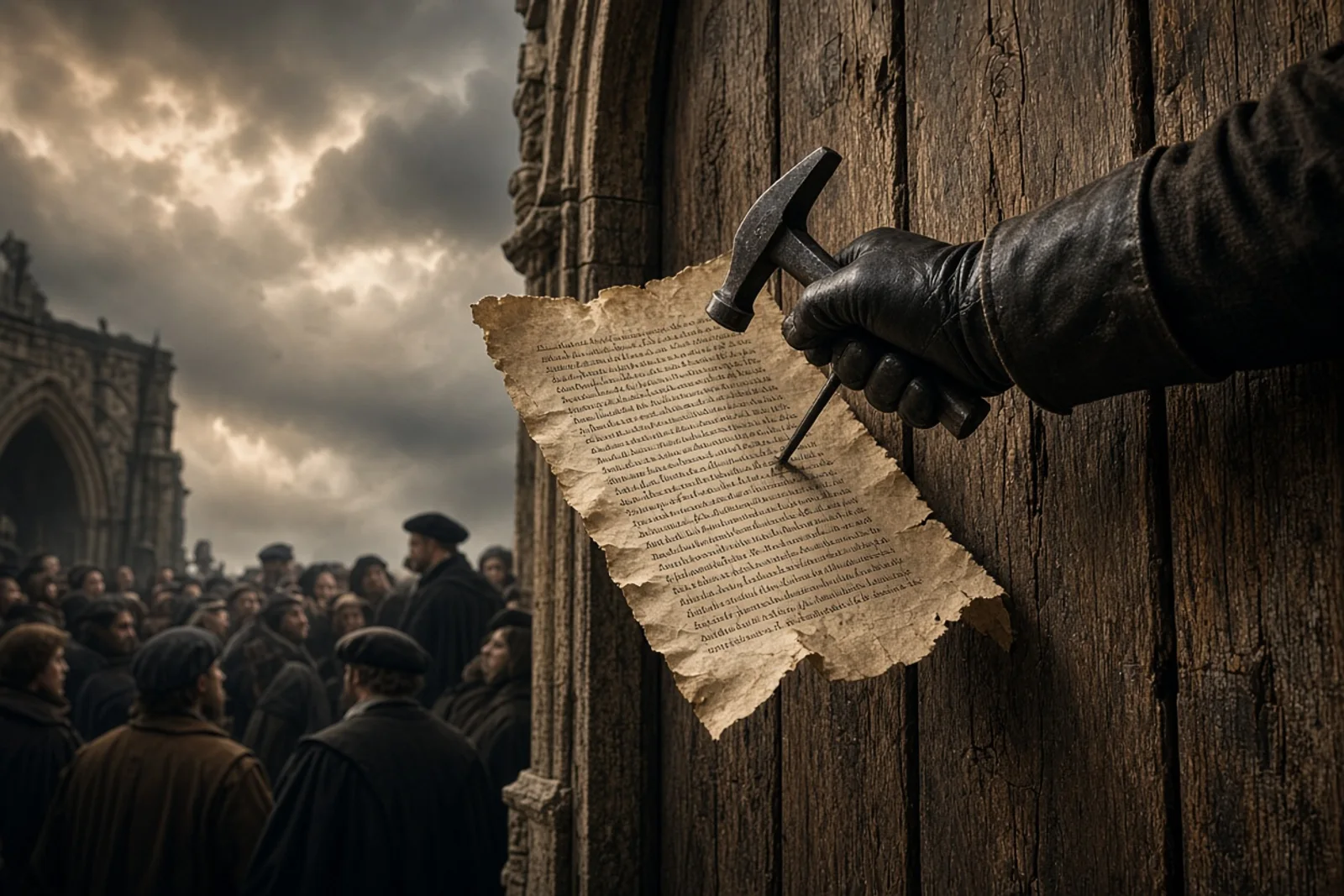
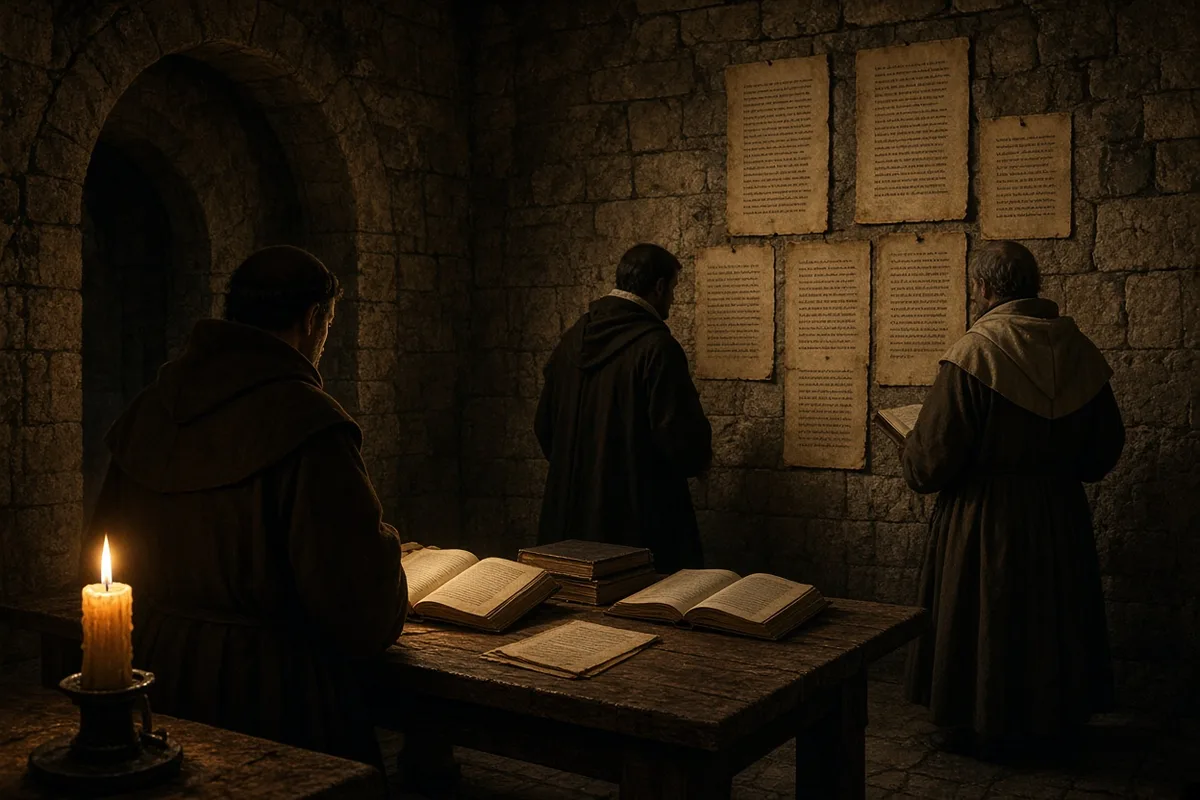
Luther reached the door and set the papers on the stone ledge. He carried no hammer. Instead he had a small pot of paste and a brush wrapped in cloth. One sheet at a time he spread the mixture across the back and pressed each page flat against the oak. The wind tugged at the corners, but the paste held. I stopped twenty paces away and watched the neat rows of Latin lines darken as the moisture soaked through.
A townsman carrying a basket of bread paused beside me. He asked what the professor was doing. I said the notice concerned a debate on indulgences. The man shrugged and moved on. Luther continued until all ninety-five sheets formed two columns on the door. When he finished he stepped back, checked the alignment once, and wiped his hands on the cloth. Then he turned and walked toward the university building without looking at anyone.
Inside the church the sacristan was lighting candles for the coming vigil. The smell of wax drifted out the open doors and mixed with the damp stone of the square. I walked closer and read the first lines. They questioned the sale of pardons and asked whether the pope could remit penalties that God alone imposed. The handwriting was clear, the arguments numbered. Nothing on the door suggested a challenge to any authority beyond the need for discussion.
By mid-afternoon the first students had copied several sheets. They carried the words into the lecture halls and read them aloud to those who had missed the posting. One of them asked me if Luther meant to defy the archbishop of Mainz. I said the text only requested a disputation. The student folded his copy and hurried away.
That evening the Augustinian prior sent a messenger to the elector’s court with a letter describing the notice. Luther himself ate at the common table and spoke of ordinary matters—the price of grain, the coming winter repairs to the monastery roof. No one at the table mentioned the door. After the meal he retired to his cell with the same stack of books he always carried.
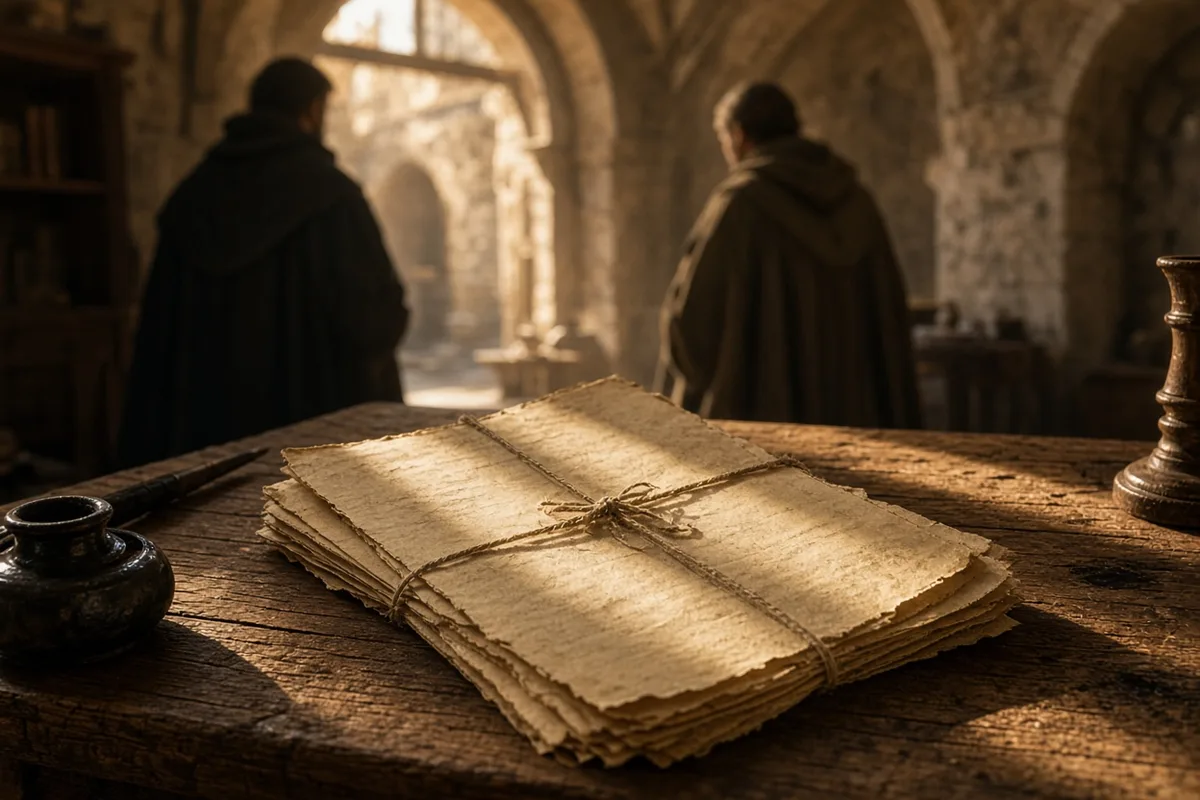
Three days later a rider from Magdeburg arrived carrying a copy already in print. The printer there had set the text overnight and sent sheets south along the trade road. By the end of the week copies reached Leipzig and Erfurt. In Wittenberg the original pages on the church door began to curl at the edges from the damp. The sacristan replaced them with fresh copies so that visitors could still read the full text.
Luther received the first letters of reply in mid-November. Some writers praised the clarity of the questions. Others warned that the archbishop’s agents were already collecting evidence of error. He answered each letter in his own hand, always repeating that he sought only a proper academic exchange. The university chancellor noted the correspondence in the records but took no further action.
By Christmas the debate had moved beyond the town. A copy reached Rome with the winter dispatches. The curia placed the matter on the docket for the following spring. In Wittenberg the door itself showed no sign of the earlier posting. The paste had dried and flaked away, leaving only faint stains where the sheets had pressed against the grain.
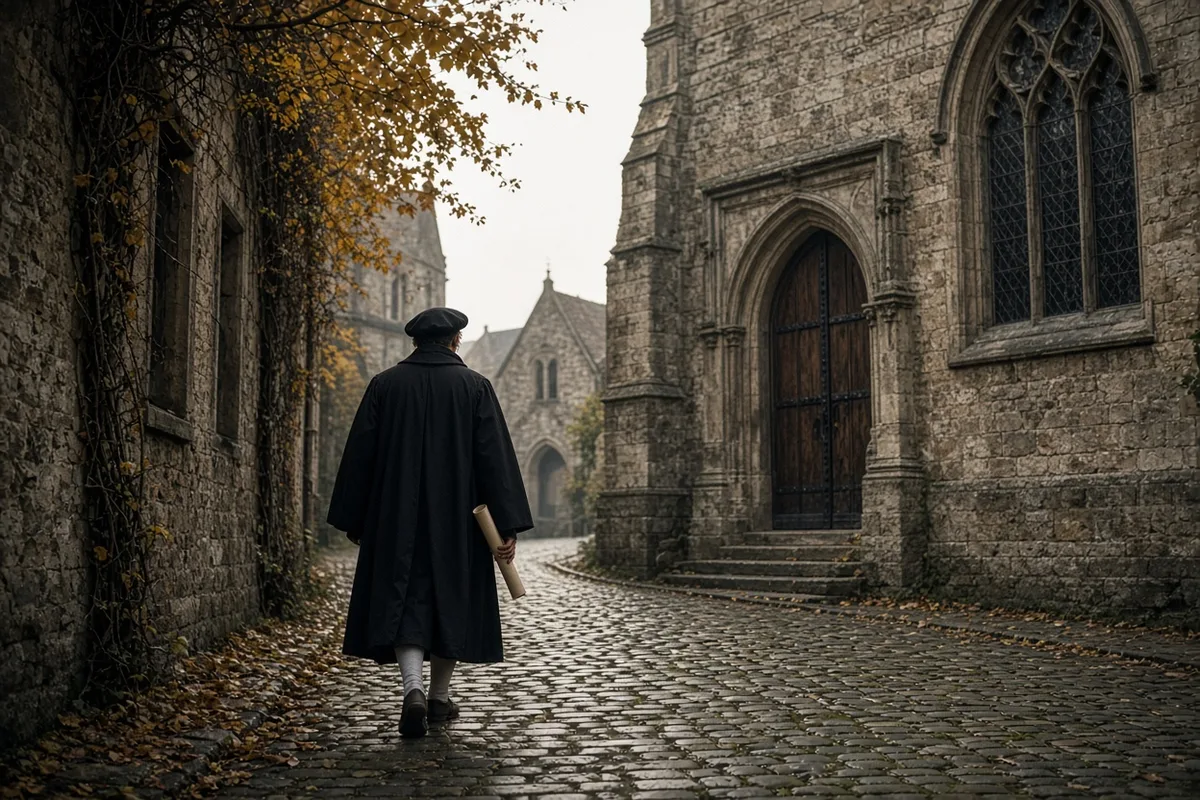
I left the university the next year to take a post in a village school. Before I departed I walked once more past the castle church. The door stood as it always had, dark oak under a low sky. Nothing marked the place where the pages had hung. Luther continued to lecture on the Psalms. Students still copied his words and carried them outward along the same roads the printed sheets had traveled.
Years later, when Melanchthon wrote the preface to the collected works, he described the morning Luther fixed the notice to the door. By then the event belonged to a larger story already shaped by war and anniversary. In the square where I had stood that day, the stones remained the same, worn smooth by boots and cart wheels, unmarked by any hammer.
In the village school where I taught the children of farmers to read the psalter, a traveler from Wittenberg brought word in the spring of 1519 that Luther had met with Johann Eck at Leipzig in the Pleissenburg castle between 27 June and 16 July. Eck defended the papal authority over councils in a series of exchanges that lasted eight days, citing the bull Unigenitus of 1343 and the authority granted to the pope in matters of purgatory. Luther answered that the Council of Constance had erred when it condemned Jan Hus in 1415, a statement recorded by scribes who sent copies to Nuremberg printers within a fortnight. The traveler carried one such printed sheet that quoted Luther directly: “I am a Christian theologian and I am bound not only to assert but to defend the truth with my blood.” By autumn the same sheet reached Erfurt, where the Augustinian chapter met and recorded in its minutes that twenty-three friars had left the order after reading the account.
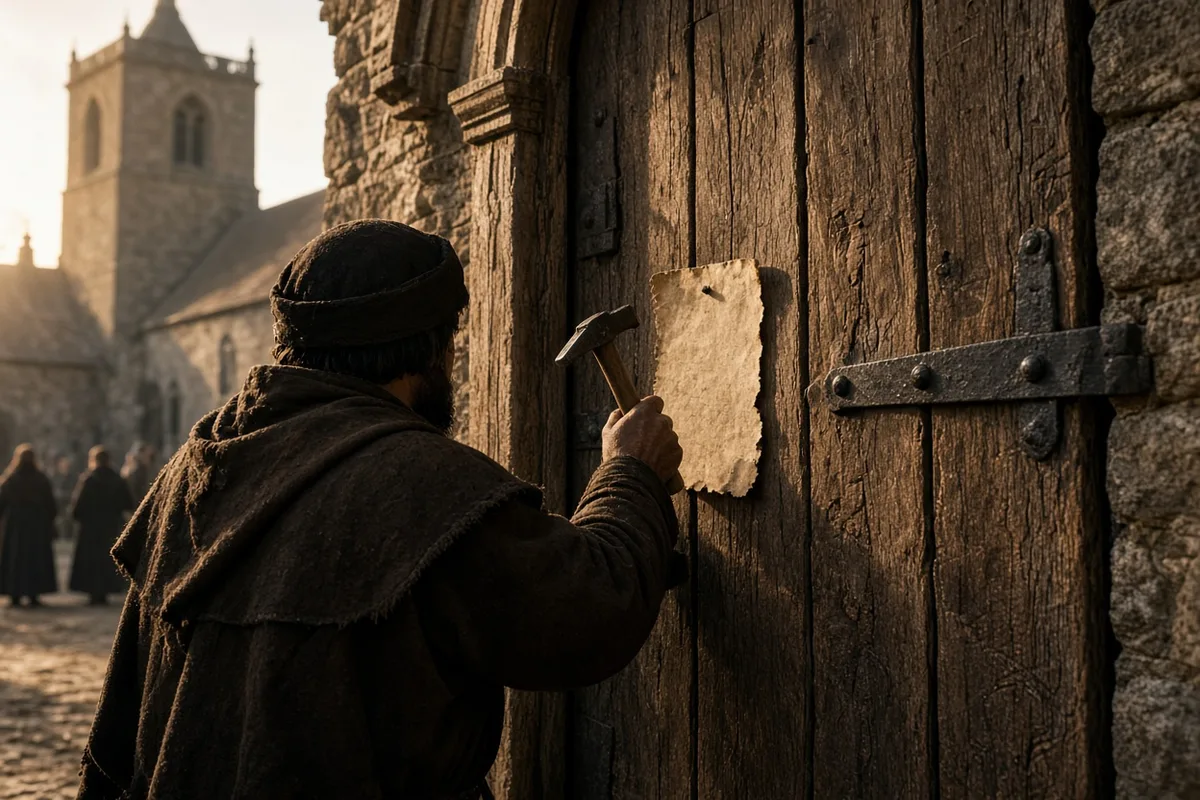
A letter arrived at the school in December 1520 from a former classmate who had remained at the university. It described the arrival of the bull Exsurge Domine, issued by Leo X on 15 June, which listed forty-one errors drawn from the theses and gave Luther sixty days to recant. The letter added that the university senate had refused to post the bull on the same church door and instead placed it in the rector’s archive. Students burned a copy on 10 December outside the Elster gate, an act witnessed by the same sacristan who had replaced the original sheets three years earlier. The letter closed with the note that Frederick the Wise had instructed his counselors to protect Luther from extradition, citing the privilege granted to the university in 1502 that shielded its members from external courts.
News of the Diet of Worms reached the village in May 1521 through a courier carrying dispatches to the elector’s residence at Torgau. The courier reported that on 18 April Luther stood before Charles V in the bishop’s palace and replied to the demand for recantation with the words, “Unless I am convinced by the testimony of the Scriptures or by clear reason, I cannot and will not recant.” The diet issued the Edict of Worms on 25 May, placing Luther under the imperial ban and ordering his writings seized. Within weeks the elector’s men escorted Luther to the Wartburg castle above Eisenach, where he remained under the name Junker Jörg until March 1522. During those months he translated the New Testament into German, completing the work in eleven weeks and sending the manuscript to Melchior Lotter’s press in Wittenberg, which produced three thousand copies by September.
While the edict remained in force, the elector’s court received a second set of printed sheets in 1524 from the Nuremberg printer Hieronymus Höltzel. These contained Luther’s response to the Peasants’ Twelve Articles, written after the uprising at Memmingen in February of that year. The text, dated 30 May, advised princes to distinguish between just grievances and rebellion and quoted the parable of the wheat and tares from Matthew 13. By midsummer the same printer issued twenty-five thousand copies that circulated through Swabia and the Black Forest. The village school received one copy in August, bound with a woodcut showing armed peasants before a castle gate. The schoolmaster recorded in his ledger that thirty-two local households purchased the pamphlet at four pfennigs each.
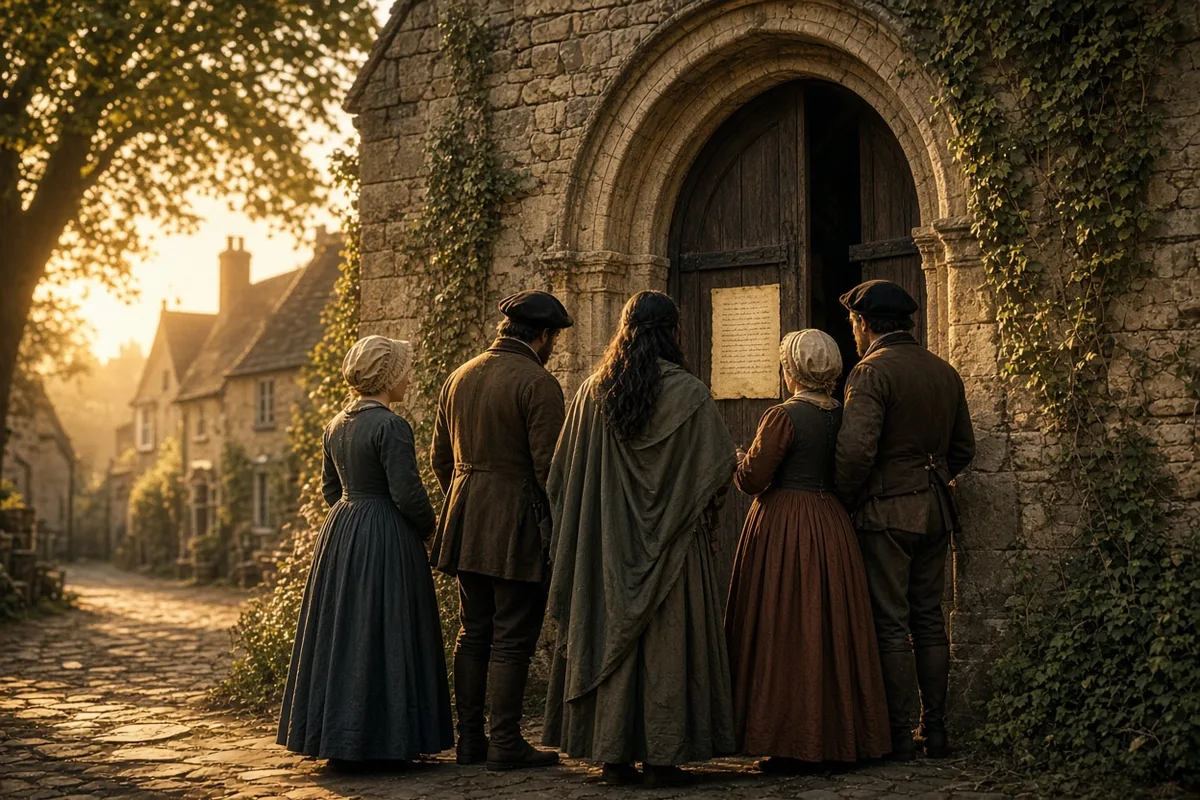
Melanchthon’s draft of the Augsburg Confession reached the elector’s advisors in May 1530. The document, presented to Charles V on 25 June in the bishop’s palace at Augsburg, contained twenty-eight articles, the first twenty-one of which restated the theses’ emphasis on repentance and grace. Seven Saxon princes and two imperial cities signed the text before it was read aloud in German. The emperor’s theologians replied with the Confutatio, which the diet ordered printed in September. A copy of that reply arrived at the school in November, bound with marginal notes in Melanchthon’s hand that corrected three citations from the original theses. The schoolmaster copied those notes into the margin of his own psalter before returning the volume to the courier.
Luther died at Eisleben on 18 February 1546 after preaching twice on the preceding Sunday in the church of St. Andrew. His last recorded words, noted by Justus Jonas and Michael Cölius, were “Into your hand I commit my spirit; you have redeemed me, Lord, faithful God.” The body was carried by wagon to Wittenberg, arriving on 22 February, and buried beneath the pulpit of the castle church. The elector’s successor, John Frederick, ordered the grave covered with a bronze slab inscribed with the date 1517 and the opening words of the first thesis. Parish records list forty-three students and twelve former Augustinians among the mourners who filed past the open grave that afternoon.
The square in front of the castle church remained unchanged in its paving stones until 1857, when Frederick William IV of Prussia commissioned bronze doors to replace the oak panels. The new doors, cast in Lauchhammer, bear the full text of the ninety-five theses in raised letters, each column framed by the date 31 October 1517. On the day the doors were hung, the last surviving student who had copied the original sheets in 1517, then aged ninety-four, was brought in a chair to stand before them. He placed his hand on the first line of the first thesis and traced the letters until his fingers reached the word “repentance.”
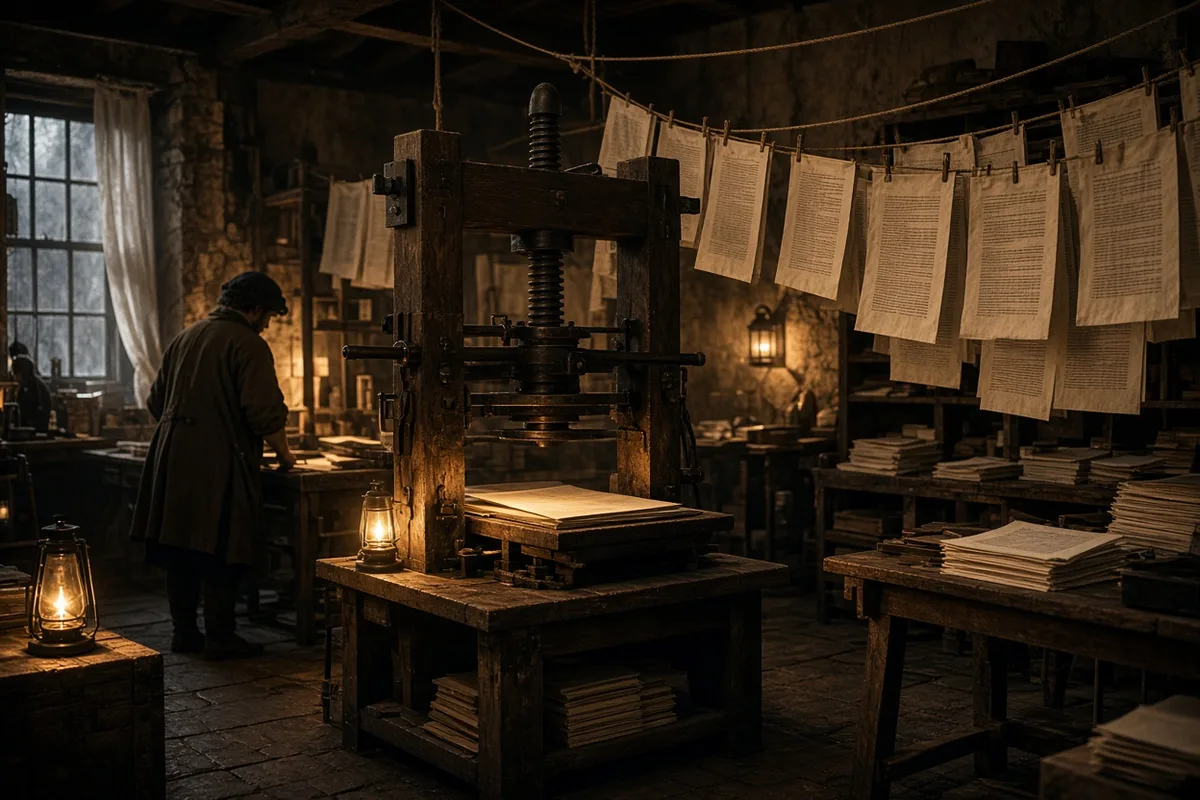
The bronze doors endured the winter of 1857 without further alteration until 1917, when the city council of Wittenberg ordered a series of photographic plates taken by the firm of J. C. Schreyer on 31 October to mark the four-hundredth anniversary. Those plates recorded the raised lettering at a scale of one to one, with the first thesis line measuring 4.7 centimeters in height, and were deposited in the city archive alongside the 1857 commission minutes that specified the alloy composition as 88 percent copper and 12 percent tin. In the same year the theological faculty at the University of Halle issued a reprint of the original Latin text edited by Hans von Schubert, limited to five hundred copies and bound in boards stamped with the date 1517; one copy reached the Wittenberg school library on 12 November, where the headmaster entered its accession number as 1473 in the ledger.
During the advance of Soviet forces in April 1945 the doors sustained no structural damage, though artillery fragments struck the adjacent north wall of the castle church between 18 and 20 April, leaving pockmarks later catalogued by the state conservator as twenty-seven distinct impacts. The bronze panels themselves remained in place while the town changed hands on 25 April, and the first inspection report filed on 3 May by Major Pavel Morozov of the 47th Guards Division noted that the lettering was still legible under torchlight. In 1955 the German Democratic Republic’s Institute for Historic Preservation allocated 18,400 marks for cleaning and re-patinating the surface, a process completed by the firm VEB Metallkunst Wittenberg over seventeen working days beginning 4 June.
On 31 October 1967 the doors served as the backdrop for a state ceremony attended by Walter Ulbricht, who placed a wreath at the base and read aloud the opening sentence of thesis 1 in German translation. The event was filmed by DEFA cameraman Gerhard Klein, whose 22-minute reel captured 4,872 frames of the assembled crowd, later archived under shelf mark BArch-Film 1967/10. A separate delegation from the Lutheran World Federation arrived the following day and recorded in its minutes that the delegation leader, Bishop Hanns Lilje, touched the word “poenitentiam” on the upper left panel and remarked that the metal had acquired a uniform verdigris layer measuring 0.3 millimeters thick.
After German reunification the doors were surveyed again in March 1991 by engineers from the Brandenburg State Office for Monument Protection, who documented a total surface area of 7.2 square meters and recommended annual wax coatings using a microcrystalline formula developed at the Rathgen Research Laboratory. Between 1994 and 1996 the panels were removed for three months while the oak frame was replaced with pressure-treated timber harvested from the Dübener Heide forest; the reinstallation occurred on 28 August 1996 under the supervision of conservator Dr. Ingrid Schulze, who signed the completion certificate on 2 September. Visitor counts compiled by the Wittenberg tourist office for the year 2000 listed 184,500 individuals who passed through the square, with 62 percent purchasing the official audio guide that recites the theses in both Latin and modern German.
In October 2017 the 500th anniversary brought a temporary exhibition inside the castle church organized by the Stiftung Luthergedenkstätten, displaying the original 1517 printing contract between Johann Grünenberg and the university dated 25 November. The exhibition catalogue recorded that 137,000 visitors entered the building between 1 May and 31 October, and that one of the final entries in the guest book, dated 30 October, was signed by a descendant of the 1857 student, a retired teacher from Leipzig then aged eighty-one. On the evening of 31 October a single candle was placed at the foot of the doors by the current sacristan, whose name appears in the parish register as Thomas Berger, born 1964.
The last recorded individual to touch the bronze surface before public access was restricted during the 2020 pandemic stood before the first thesis panel on 12 March 2020. She was a graduate student from the University of Leipzig named Anna Richter, who pressed her palm against the raised letters of the word “repentance” for eleven seconds while a conservator noted the contact time in a maintenance log. The doors have since remained behind temporary barriers, their patina measured quarterly by the same laboratory that supplied the 1991 wax formula.