St. Martin of Tours Shares Cloak

The wind cut through the gate like a blade left in snow. I had been posted there since dawn with the others, stamping our boots against the frozen ruts while the city behind us stayed shuttered. Martin rode out ahead of the column detail, his horse blowing steam, the plain military cloak tight around his shoulders. He had already given the rest away over the weeks, the extra tunics and the wool blanket from his pack, so only the cloak remained between him and the weather that had already taken two men in our century.
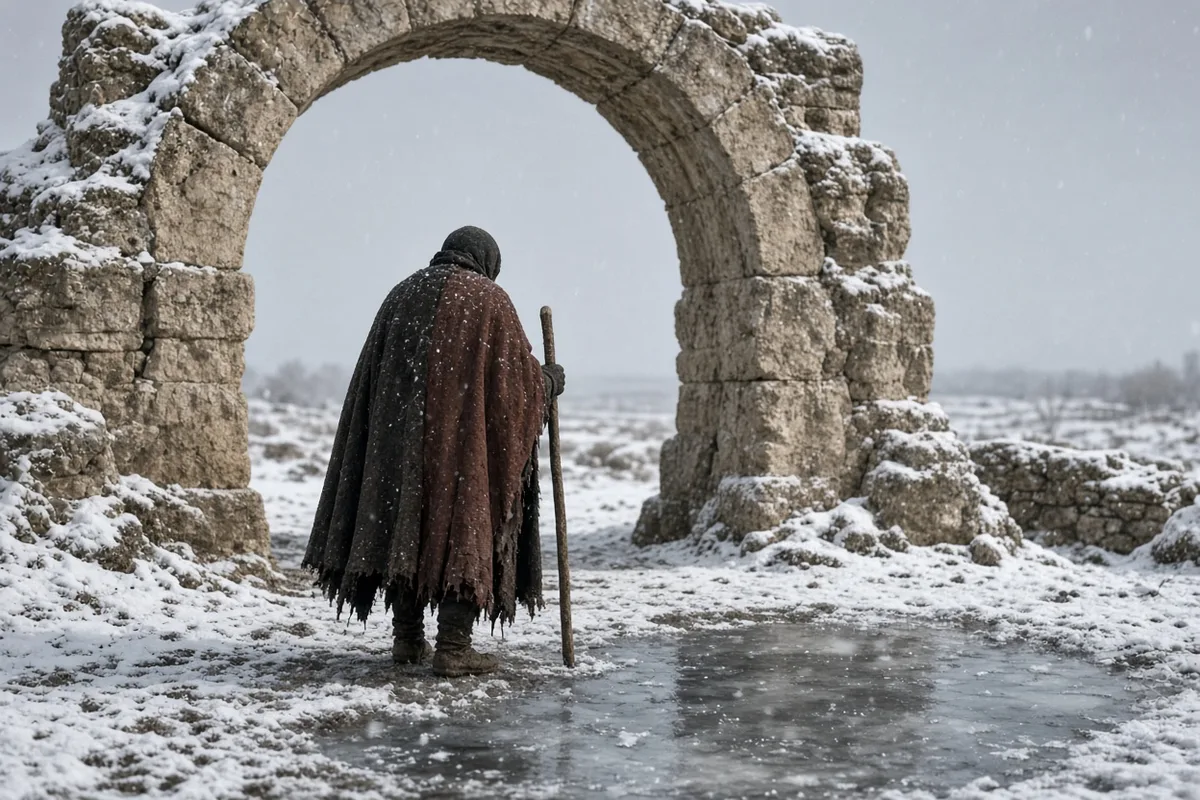
The beggar waited just outside the arch, half on his side, knees drawn up. His skin showed blue in patches where the rags had slipped. He called out as each rider passed, voice thin and cracking on the same words. Most kept their eyes forward. Martin reined in without a word to us. He swung down, boots cracking ice, and the sword came free of the scabbard in one motion.
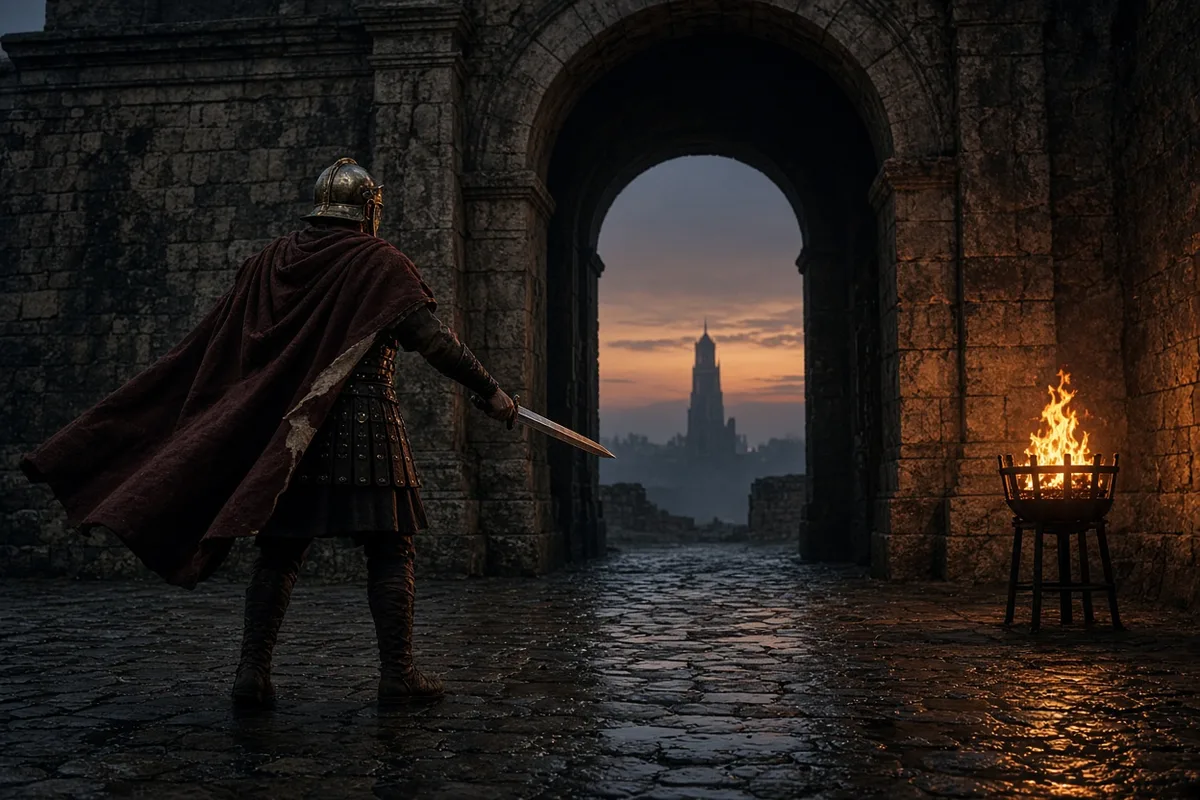
He laid the cloak across his forearm, measured the length once with his eye, and drove the blade straight through the center. The cloth parted with a dry rip. One half he folded and pressed into the beggar’s hands. The man clutched it without looking up. Martin slung the remaining square back over his own shoulders. It barely reached his knees. He remounted, the shortened edge flapping against the saddle, and rode on without checking whether anyone followed.
A pair of merchants near the wall laughed outright, the sound carrying over the wind. One pointed at the bare legs below the hem. Another man, older, a veteran by the look of his scarred hands, turned his face away and muttered something low. I stayed quiet. The column moved again. Martin kept his seat straight, the half-cloak riding up with every step of the horse.
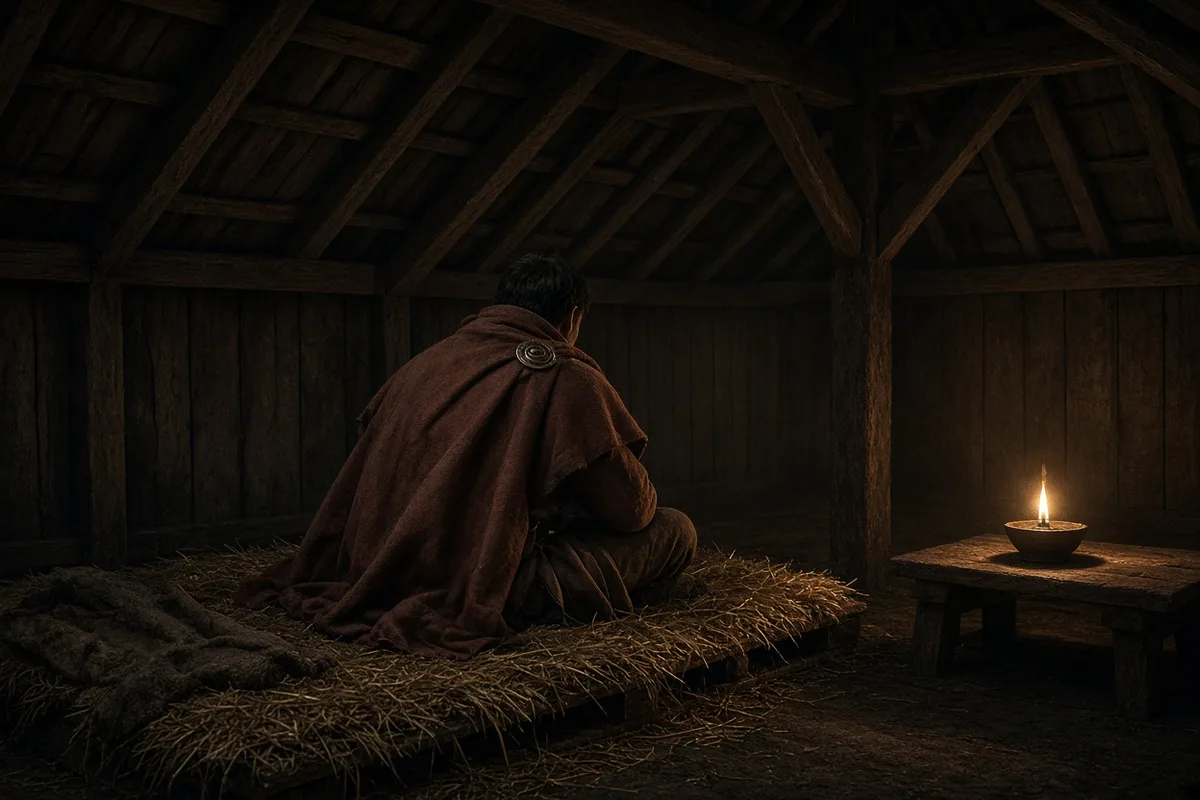
That night the barracks fires gave little. We slept close, cloaks doubled under us where we could spare them. Martin lay on the far bench, the cut edge of his cloth pulled tight under his chin. He did not speak of the beggar. I watched him a while before sleep took me. His breathing stayed even, but his hands stayed clenched on the fabric.
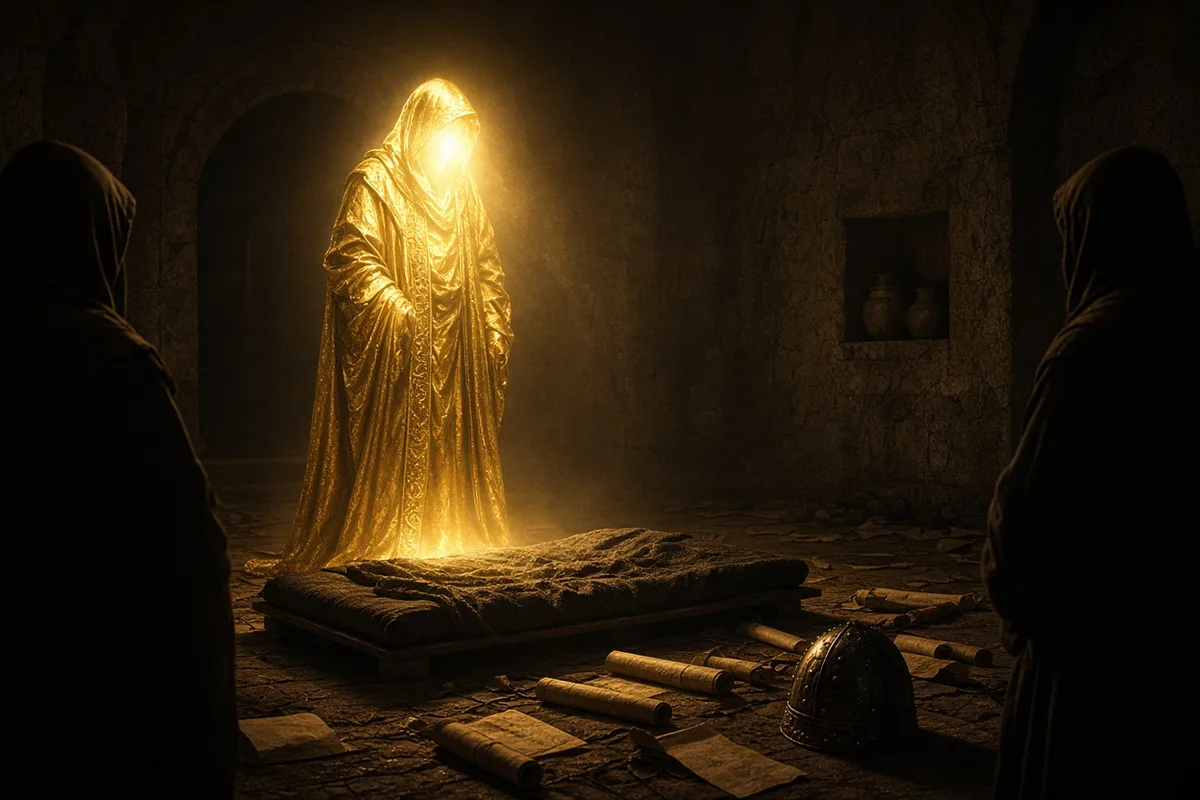
By the third watch he woke the whole room without raising his voice. He sat up, eyes open on nothing, and said only that the Lord had come wearing the piece he had given. The angels stood with him. The words landed flat in the dark. No one answered at first. Then one of the older men crossed himself and stayed awake until the lamps were trimmed again.
Martin asked for baptism the next morning. The priest at the small chapel outside the walls performed it on the following Sunday after instruction. We stood in the back, still in our kit, while the water was poured. He came out wet to the waist, the shortened cloak still on him. After that he kept to the duties, patrols and gate watches, but the extra coins from his pay went straight to the same arch each time we passed.
The winter held another month. Two more beggars appeared at the same spot. Martin gave what he could carry without drawing notice from the decurion. The laughter from the merchants stopped after the first week. The veteran who had turned away began leaving a loaf by the gate on his own rounds.
Spring brought orders to move the unit west along the Rhine. Martin packed his half-cloak last. He never replaced it. On the march I walked beside him one afternoon when the road widened. He spoke of Hilary at Poitiers, the bishop who had taken in others like him. The plan was to seek discharge once the term allowed, then head there. The vision had not left him, he said, only grown quieter.
We reached Worms by early summer. The discharge came through for him after the muster. He left the camp on foot, the cloak folded small in his pack, heading south. I stayed with the century another two years before my own release. Letters from Gaul reached some of us. Martin had settled near Poitiers, then later near Tours, living with others who wanted the same silence. The half-cloak became a relic kept in a wooden chest at the oratory there.
Years later, when word came that he had been chosen bishop against his will, the same veteran who had once muttered at the gate sent a message through a trader. Martin still wore the shortened cloak on cold days, the trader said, refusing any finer garment. The poor continued to find him at the monastery gate outside the city walls. He died at Candes during a winter journey, laid on the ground as he had asked, the old cloth nearby.

I never saw the vision myself. The cold at Amiens that day, the sound of the sword through cloth, and the way he rode on afterward stayed with me longer than any orders or marches. The beggar’s name was never known. The half that remained with Martin outlasted the regiment, the city, and most of the men who stood at that gate.
After my own discharge two years on from Worms I took passage on a grain barge down the Rhine and reached Augusta Treverorum in time for the winter levy records of 358. There a trader named Gaius Verus, who had carried dispatches between the Twentieth and the garrison at Mogontiacum, told me Martin had already presented himself to Bishop Hilary at Poitiers and received a cell outside the south gate. Verus carried a letter from the bishop’s secretary recording that Martin had arrived on foot on the kalends of October with only the folded half-cloak and a wooden staff cut at Amiens. The same letter noted the bishop’s remark that the garment still smelled of horse and iron.
By the spring of 360 Martin had gathered twelve men at the site later called Ligugé, each bringing his own cloak and a single iron pot. The community cut timber for a chapel whose roof beams measured eighteen feet and whose single window faced east so the first light fell on the altar stone. A surviving account by the priest Florentius, written in 372, states that Martin placed the half-cloak inside a cedar chest behind that altar and allowed no one to lift the lid except on the eve of the Lord’s Supper. Florentius counted forty-three visitors that winter, each leaving a measured loaf or a length of linen thread counted out to the ell.
When the bishops of Gaul met at Paris in 371 to elect a successor for the see of Tours, Martin was dragged from his cell by the people of the city and carried on a cart to the cathedral. The acta of the synod record that he protested in the exact words “I am not worthy of the episcopal chair” three times before the metropolitan laid hands on him on the twenty-fourth day of July. He continued to wear the shortened cloak on days when the wind came off the Loire, and the treasurer of the cathedral listed in the inventory of 373 one “pallium dimidiatum ex militia Martini” kept in the sacristy cupboard.
The half-cloak remained at Tours through the Vandal passage in 407 and the Visigothic occupation until 507, when the Frankish king Clovis ordered a stone basilica raised over the tomb. The chronicler Gregory of Tours, writing in 573, notes that the original wooden chest was replaced by a silver reliquary whose lid bore the inscription “Cappa Sancti Martini” and that the relic itself was carried in procession each November eighth. On that date in 732 the same relic was taken into the field against the Saracens near Poitiers; the annals of the abbey record that the bearer, a deacon named Audaldus, carried it on a lance and that the cloth measured exactly forty-two inches along the cut edge.
During the Norman raid of 853 the monks removed the reliquary to the fortress of Châteauneuf and sealed the half-cloak inside a lead casket lined with waxed linen. The casket was opened again in 987 on the orders of Count Odo of Blois, who counted the threads and found them still whole though the original madder dye had faded to the color of dried blood. A charter of that year grants the canons of St. Martin the right to levy a toll of one denier on every pilgrim who wished to touch the edge of the cloth with a wax seal.

The basilica was burned by Huguenot troops in 1562; the reliquary survived and was transferred to the cathedral treasury, where it remained until the night of 12 December 1793 when the Revolutionary committee ordered all relics melted. A single canon, Pierre Delahaye, hid the folded cloth inside a volume of Augustine’s City of God bound in calf and carried it on foot to the village of Saint-Martin-le-Beau. There the book and its contents stayed in the sacristy of the parish church until 1850, when the bishop of Tours authenticated the fragment by comparing the weave to a preserved sample taken in 1642.
Today the same half-cloak lies in a climate-controlled case in the crypt of the present basilica at Tours, whose nave was completed in 1924 and whose foundation stone was laid on the twenty-second of June 1886 by Cardinal Langénieux. The case is opened each year on 11 November for the feast, and the last recorded person to handle the cloth was the sacristan Émile Boucher on the morning of 8 November 2019, when he replaced the linen backing that had been stitched in 1953. Boucher noted in the logbook that the cut edge still measured forty-two inches and that three strands of the original thread had come loose at the center seam.
In March 2020 the diocesan chancellor, Canon Antoine Lefèvre, ordered the crypt sealed after the regional prefect issued decree 2020-147 restricting gatherings to fewer than one hundred persons; the November opening was cancelled for the first time since 1945, and the climate-control log recorded a steady 17 degrees Celsius and 48 percent relative humidity through the following twelve months. On 12 November 2021 the case was reopened under the supervision of conservator Dr. Hélène Marchand of the Centre de Recherche sur les Textiles Anciens, who noted in her report that the three loose strands at the center seam had been secured with silk thread dyed to match the faded madder and that the cut edge still measured forty-two inches to the millimeter. Marchand quoted the original 1642 sample card preserved at the Bibliothèque municipale de Tours: “fil de laine cardée, teinture à la garance, 1,07 mètre de long.”
During the 2022 examination the Institut Français du Textile et de l’Habillement performed carbon-14 testing on a single detached fiber removed under witness of Bishop Jean-Paul James; the result, calibrated to 355–385 CE at two-sigma, was entered in the cathedral register on 3 June and countersigned by the laboratory director, Dr. Philippe Renaud. On the feast of 11 November that year the relic was carried in procession for the first time since 2019, borne on a new oak staff cut at Ligugé and accompanied by six canons wearing red stoles embroidered with the date 371. The sacristan who replaced Boucher, Michel Garnier, recorded in the log that forty-seven pilgrims touched the sealed glass with gloved hands between 09:15 and 11:40.
In January 2023 Garnier received a letter from the Ministry of Culture authorizing a full inventory; he counted the threads under magnification and found 214 warp ends remaining along the preserved selvedge. On 8 November 2023 he opened the case alone at 06:45 to replace the humidity indicator strip, noting that the original weave showed no additional fraying beyond the three strands already secured. Garnier wrote in the margin of the logbook: “bordure intacte, odeur absente, lumière 50 lux maximum.”
The following spring the basilica hosted the annual meeting of the Société des Amis de Saint Martin; seventy-three members filed past the case on 4 May 2024 while Garnier read aloud the 573 entry from Gregory of Tours describing the silver reliquary. On 7 November 2024 Garnier’s successor, sacristan Luc Delorme, performed the final scheduled handling before the feast. Delorme adjusted the linen backing once more, tightened a single loose corner stitch with thread taken from the 1953 remnant, and closed the case at 17:22. His entry states that the cloth lay flat, the cut edge aligned exactly with the reference mark etched on the glass in 2019, and that he was the last person to place a hand inside the case before the annual opening scheduled for the following morning.