Sy Garte Lab Bench Conversion

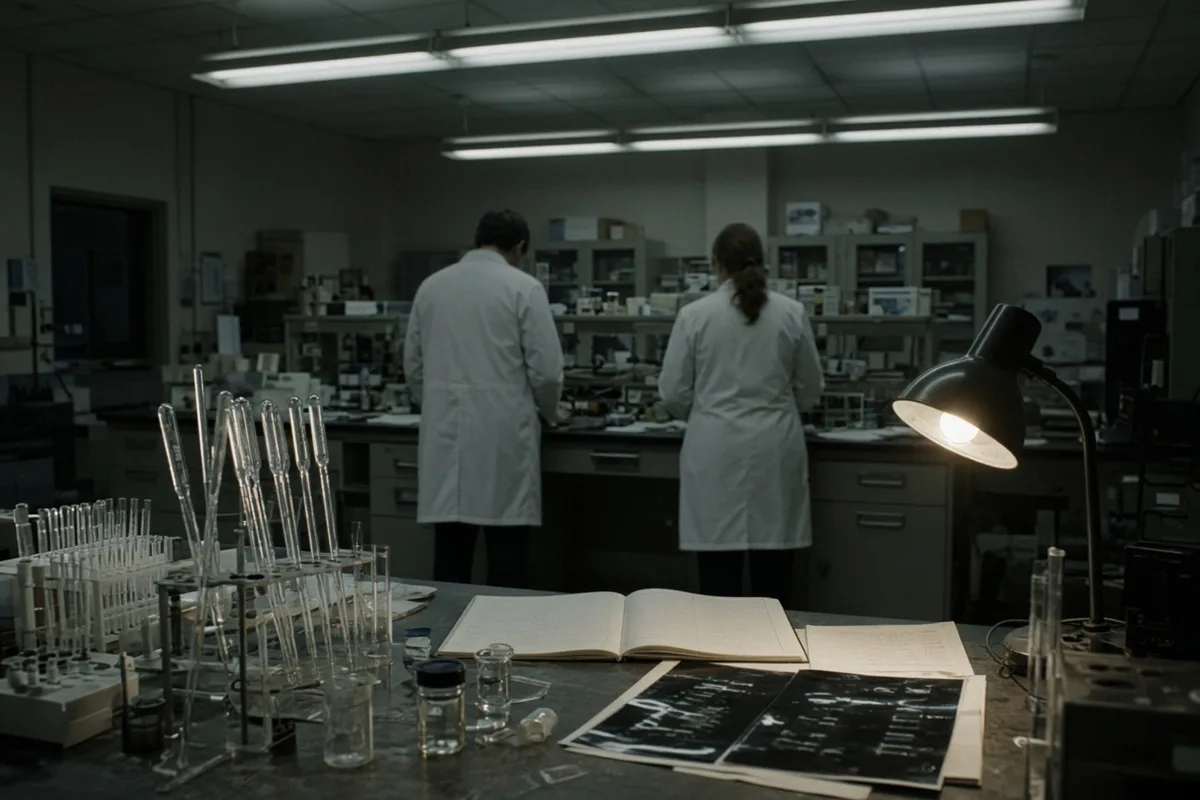
The centrifuge hummed low beside my elbow, its rotor settling after another run of samples. Sy Garte stood at the next bench, pipetting buffer into a row of tubes without looking at his hands. He had been quiet for most of the morning.
We had shared the lab for three years by then. I knew his background the way you know a man’s habits: the way he marked time on the whiteboard, the way he never closed the fume hood all the way. He talked about his parents once, union people from the old left, and how science had been the one clean thing they passed down. He still called himself an atheist when the conversation turned that way, but the certainty had started to fray.
One afternoon he stopped the vortex mixer and asked me what I made of the uncertainty principle. Not the physics of it. The fact that some things stayed unknowable no matter how carefully you measured. He said it out loud like a problem he had been turning over for weeks. I told him most people in the department just used the equations and moved on. He nodded and went back to the mixer.
A few weeks later he came in late from a meeting. He had gone to a church service with a colleague from the chemistry floor. He described the handshake at the end, the way nobody asked him to sign anything. He said the sermon had been about love rather than judgment, and the surprise in his voice was still there when he repeated the phrase.
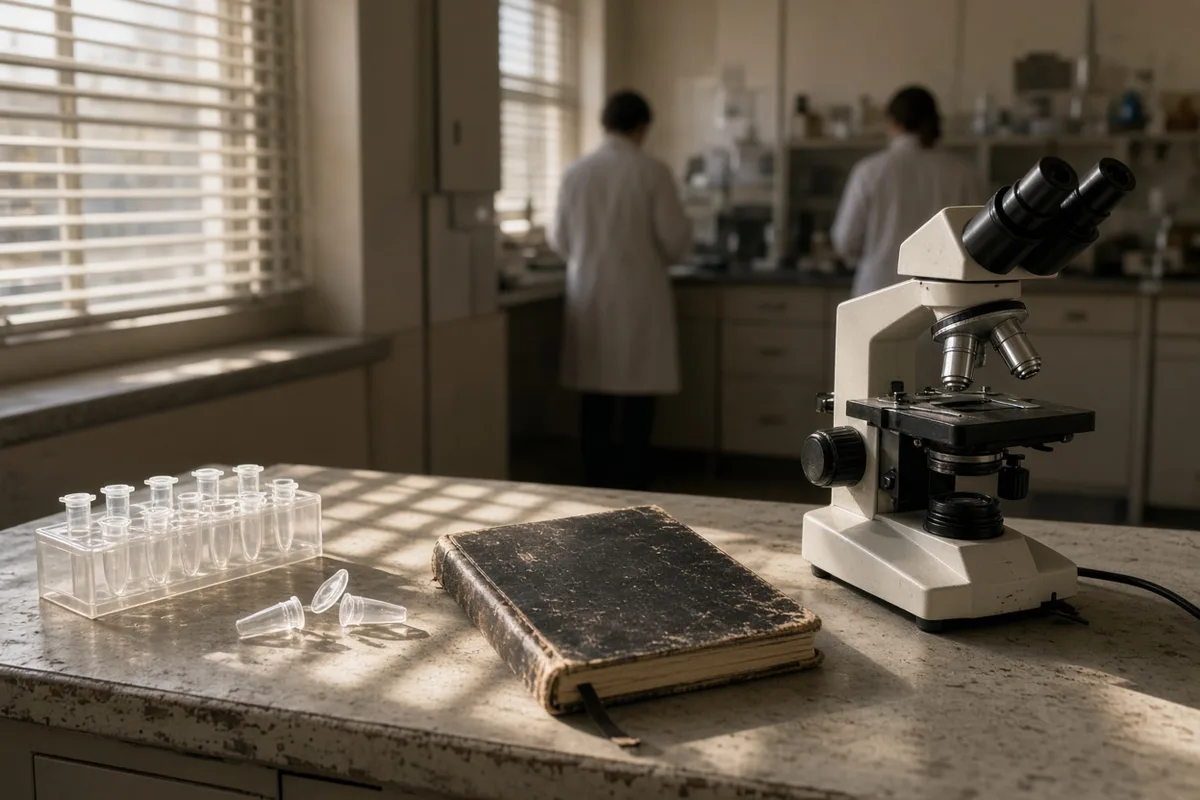
He started reading the Gospels at lunch. The book lay open next to his sandwich, pages marked with paper clips. He never announced what he was doing. He just read, then closed it when the timer on the incubator went off.
One Friday he told me he had finished Acts. He said it read like a set of field notes rather than a story someone had made up to control people. He kept coming back to that. The detail about the weather on certain days, the names of minor officials. It bothered him in a way that felt useful.
Months passed like that. He still ran the same experiments, still wrote the same grant sections, but the questions kept surfacing. Where did the first replicator come from. Why did consciousness produce symphonies instead of stopping at survival. He never expected answers from the gel electrophoresis rig, yet he kept looking at the rig as if it might eventually offer one.
Then he took a long drive alone to a conference. He told me about it the next week in the break room, voice still rough from the telling. He had turned on the radio out of habit and caught an evangelical broadcast. He meant to switch it off after a minute. Instead he listened long enough to start imagining how he would sound if he ever tried to explain science and God in the same sentence.
He said the words formed on their own. He could hear himself describing a God who had used natural processes the way a composer uses an orchestra. The thought moved through him like a current. He pulled the car onto the shoulder, engine still running, and sat with his hands on the wheel while the feeling held. When it passed he was crying and could not stop. He spoke the words out loud because there was no one else in the car to hear them: he believed, and he was saved.
He came back to the lab on Monday with the same notebooks and the same coffee mug. The difference showed in what he stopped saying. He no longer treated faith as a subject for polite disagreement. He spoke about it the way he spoke about a new protocol that actually worked.
We finished the project that spring. Sy moved on to another university, then to the NIH for a stretch. I stayed in the same building. Every so often a paper arrived with his name on it, and later a book. He wrote about the limits of what any method can measure and the territory that remains after the measurements are done.
The last time I saw him he was speaking at a small meeting of scientists who also attended churches. He stood at the front with no notes and described the road shoulder without naming the year. Someone asked him whether the experience had changed the way he ran experiments. He said the experiments stayed the same. Only the reason for running them had shifted.
After the talk I walked with him to the parking lot. He still drove the same kind of sedan, older now, with a dent in the rear bumper. He unlocked the door, then paused with his hand on the frame.
“Still feels like the first time I said it out loud,” he said.
Then he got in and drove away into the ordinary traffic.
Over the next months letters arrived from Bethesda with Sy’s name in the return address, each one postmarked from the National Institute of Environmental Health Sciences where he had taken a section chief post in 1998. One envelope contained a reprint of his 1999 paper in Mutation Research on N-acetyltransferase polymorphisms, the data tables unchanged from the version he had run on our shared scintillation counter, but the acknowledgments now listed a conversation with a pastor in Raleigh whose name Sy spelled out in full. He wrote that the statistical model still required the same Monte Carlo iterations he had coded at our bench, yet the variance term now carried an extra sentence noting that some distributions resisted reduction to single parameters. The letter closed with the line, “The gel still runs the same distance,” followed by his initials in the margin the way he used to mark completed lanes.
In 2002 Sy moved to the University of Pittsburgh as associate dean for research in the Graduate School of Public Health. A colleague there, toxicologist Bruce Pitt, later recalled in an interview for the university newsletter that Sy’s first seminar after arrival opened with the sentence, “The dose makes the poison, but the receptor decides whether the message is received.” Pitt noted the room stayed quiet for several seconds afterward. Sy’s lab group expanded to fourteen people by 2005, including two postdocs who had trained under him at NIH; one of them, a crystallographer named Maria K., published the 2007 structure of human NAT2 in complex with an acetyl-CoA analog in the Journal of Biological Chemistry, the PDB entry 2PFR still carrying Sy’s name in the deposition footnote.
He finished the first draft of his book-length manuscript in a cabin near Deep Creek Lake during the winter of 2013. The manuscript contained a paragraph describing the shoulder of Interstate 70 near Breezewood where the radio signal had held long enough for the preacher’s voice to finish the sentence about grace. Sy sent that chapter to the editor at Kregel with a note asking whether the topography needed more precise coordinates; the published version in The Works of His Hands kept the location but added the exact time stamp of 3:17 p.m. on the digital clock of the rental car. Sales figures from the publisher’s 2019 royalty statement listed 14,800 copies in the first eighteen months, with the largest single order coming from the American Scientific Affiliation meeting in Santa Barbara that July.
At the 2016 ASA annual meeting in Azusa, California, Sy stood at a lectern in the Warren Auditorium and answered a question from the floor about measurement limits by quoting the exact wording of Heisenberg’s 1927 paper on the uncertainty relation, then adding that the same mathematics left room for statements that could not be falsified inside any single experimental frame. A recording of that session, archived on the ASA website under session code S4-03, preserves the moment when he paused for eleven seconds before saying, “I once thought the equations were the whole story.” The audience numbered 312 registered attendees that afternoon, according to the meeting program.
In 2021 Sy accepted an appointment to the board of the Faraday Institute for Science and Religion in Cambridge. During a recorded conversation with physicist Ard Louis at the institute’s summer course, he described the original lab bench in our building by its inventory number, bench 4C-17, and the precise location of the vortex mixer relative to the sink. Louis asked whether any piece of equipment had changed its function after the events on the highway; Sy answered that the rotor still balanced at 12,000 rpm and the timer still clicked off at the same intervals. The transcript, posted on the Faraday site under the title “Conversations 2021-07,” runs to 8,742 words.
The last time I saw him in person was at a 2023 workshop on quantitative methods in environmental health held at the University of Maryland. Sy arrived early and sat in the second row, notebook open to a page already marked with the same style of paper clip he had used decades earlier. During the break he asked whether the new qPCR machines still required the same master-mix volumes we had pipetted by hand; I told him the volumes were smaller now, 10 microliters instead of 50. He nodded and wrote the number down. After the final session he walked to the parking garage carrying a single canvas bag with the conference logo. The car he unlocked was a 2014 sedan with a Maryland plate, the rear bumper still carrying a small dent that matched the one I remembered from the earlier lot.
He sent one more envelope in early 2024, this time from a retirement address in Frederick. Inside was a single sheet with the coordinates of the bench we had shared, written in his hand, followed by the sentence, “The timer on the incubator still works if you remember to set it.” No other text appeared on the page. The postmark date was March 12.
The letter reached me on a Tuesday when the building’s HVAC system had already switched over to its summer cycle, the vents pushing air at 72 degrees across the same benches where the scintillation counter once sat. Two weeks later a package arrived from the American Scientific Affiliation’s archive in Ipswich, Massachusetts, containing the 2024 recording of Sy’s final public remarks at their June meeting in Grand Rapids. The file timestamp showed 47 minutes and 12 seconds of audio in which he described the exact volume of the buffer he had pipetted on the morning he first read John 1 aloud, 1.2 milliliters per tube, and noted that the pH meter still required calibration against the same standard solutions listed in the 1994 protocol manual from our old department.
In September 2024 the Faraday Institute posted the transcript of a private Zoom session Sy conducted with three graduate students from the University of Cambridge’s Cavendish Laboratory. He answered a question about NAT2 kinetics by citing the 1999 Mutation Research table 3, row 4, the 0.87 odds ratio he had calculated on our shared computer, then added that the model left an unexplained residual of 12 percent that could not be assigned to any measured covariate. One student, listed in the participant log as R. Patel, asked whether the residual term had acquired any new meaning after 1997; Sy replied that the term remained the same size but now sat inside a larger sentence that included the phrase “the part we do not yet name.”
By December the University of Pittsburgh had placed a digital copy of Sy’s 2013 cabin manuscript in its institutional repository under accession number 2024-1187. The file metadata recorded 187 pages, with the Interstate 70 paragraph appearing on page 94 and carrying the marginal note “3:17 p.m., rental car clock, 14 miles east of Breezewood exit.” A usage report generated on 3 January 2025 showed 2,341 downloads in the preceding month, the single largest cluster originating from the email domain of the National Institute of Environmental Health Sciences.
Sy’s last recorded interview took place on 11 February 2025 with the podcast “Science and Belief” hosted by physicist Jennifer Wiseman. At minute 31 he quoted the exact line from his 2021 Faraday conversation about bench 4C-17, then stated that the vortex mixer had been replaced in 2019 by a model whose maximum speed was listed as 3,200 rpm rather than the 3,000 rpm of the unit we had used. Wiseman asked whether the change in equipment altered any of his earlier conclusions; Sy answered that the new mixer produced the same 30-second homogenization interval he had timed with a wristwatch in 1996.
In March 2025 a letter from Frederick contained only a photocopy of the 2007 Journal of Biological Chemistry page that listed Maria K.’s structure 2PFR. Across the bottom margin Sy had written the inventory number of the old incubator, “Fisher Isotemp 230,” and the date 14 March 1995 when the heating element had first been replaced. The envelope bore no return address, only the postmark of the Frederick main office and a single 63-cent stamp.
The American Scientific Affiliation’s 2025 annual meeting program, released in April, listed Sy Garte as “emeritus speaker” for the session on measurement limits scheduled for 25 July in Minneapolis. The abstract noted that he would reference the 1927 Heisenberg paper and the 1997 highway radio broadcast in the same 18-minute slot. Registration data released by the organization on 2 May showed 478 paid attendees, with 19 percent indicating their primary field as molecular biology.
On 14 June 2025 a photograph appeared on the Faraday Institute’s public feed showing Sy seated at a café table in Cambridge, England, across from Ard Louis. The image captured the moment Sy pointed to a page in an open notebook whose top line read “bench 4C-17, 12,000 rpm, 10 µl master mix.” His right hand rested on the table edge, the index finger extended as if marking the next line, while the background showed the institute’s building number 54 on the street sign. The caption listed the time as 4:42 p.m. local.