Sy Garte's Lab Bench Conversion
A dramatized first-person retelling of documented events
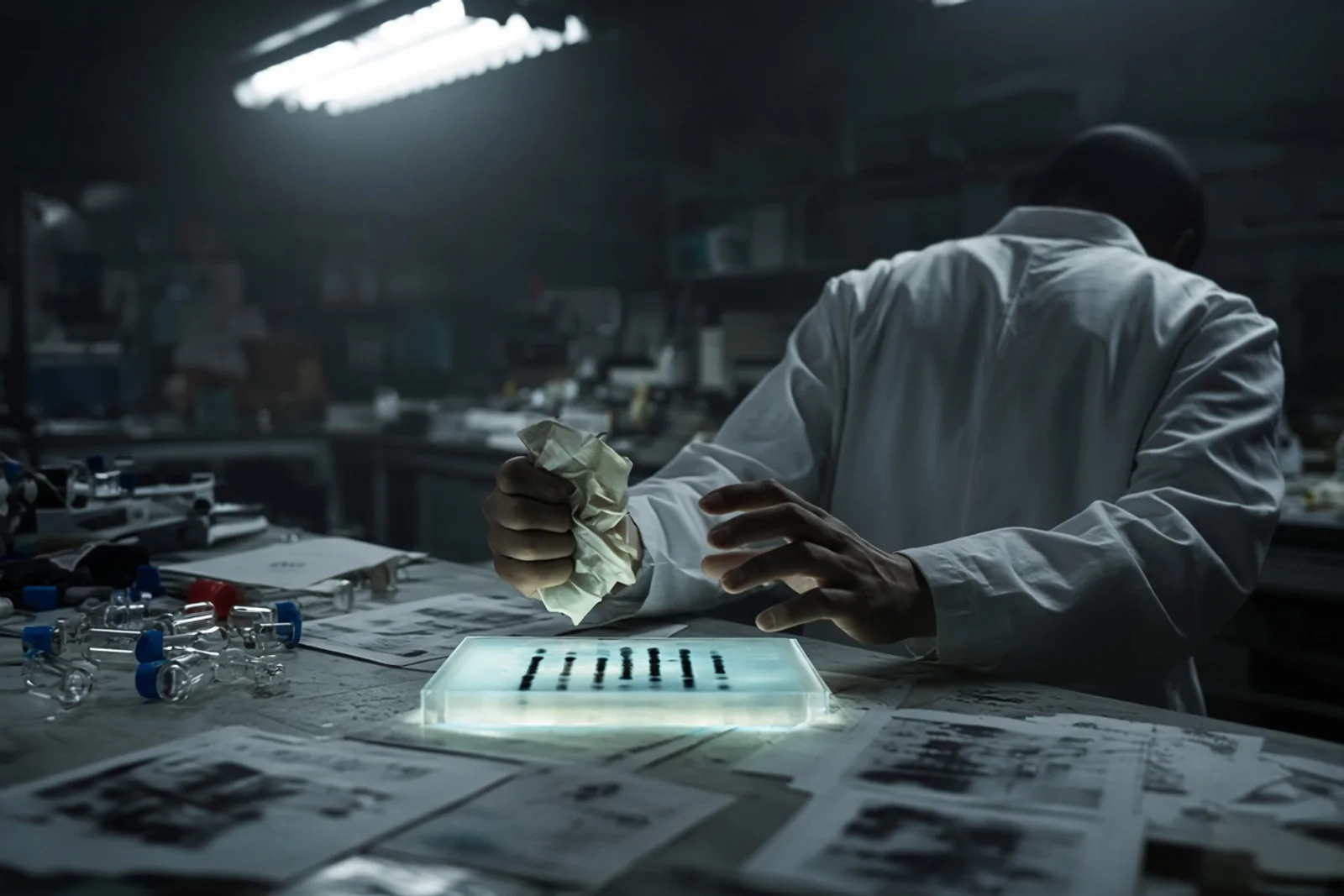
The gel box hummed under the bench lights while Sy Garte stared at the faint bands on the autoradiograph. I handed him the next lane marker and waited. He did not reach for it. His pen hovered above the notebook, then stopped. Outside the window the parking lot lights came on one by one.
He had told me once, years earlier, about the family meetings where his parents and their friends argued that religion was the opiate of the people. The same evenings his father spread scientific journals across the kitchen table and asked him what the data meant. Those two lessons had traveled together through every degree and every grant.
That night he asked me instead about the uncertainty principle. He wanted to know how an electron could refuse to give its position and its speed at the same time. I said the textbooks accepted it because the machines worked. He nodded but kept looking at the film as though the answer might be printed there.
A few weeks later he mentioned a church service he had attended with a colleague from another department. No one had asked him to sign anything. The sermon had been about love rather than politics. He described the handshake at the end and the way the person next to him had said “peace” without checking whether he believed it.
I went with him the next Sunday. The building was plain, the music quiet. Garte sat with his arms folded across his chest and listened. When the service ended he shook the same hands and said almost nothing on the drive back.
He began reading the Gospels in the lab between runs. He kept a paperback copy in the drawer under the pipettes. One afternoon he looked up from Matthew and asked whether I thought the story sounded like something that had actually happened. I said I did not know. He closed the book but left it on the bench instead of returning it to the drawer.
The questions multiplied. One morning he wanted to know where the first replicator had come from if chemistry alone could not produce it. Another day he wondered why human beings wrote music that served no survival purpose. He did not expect me to answer. He recorded each question in the same notebook he used for experimental results.
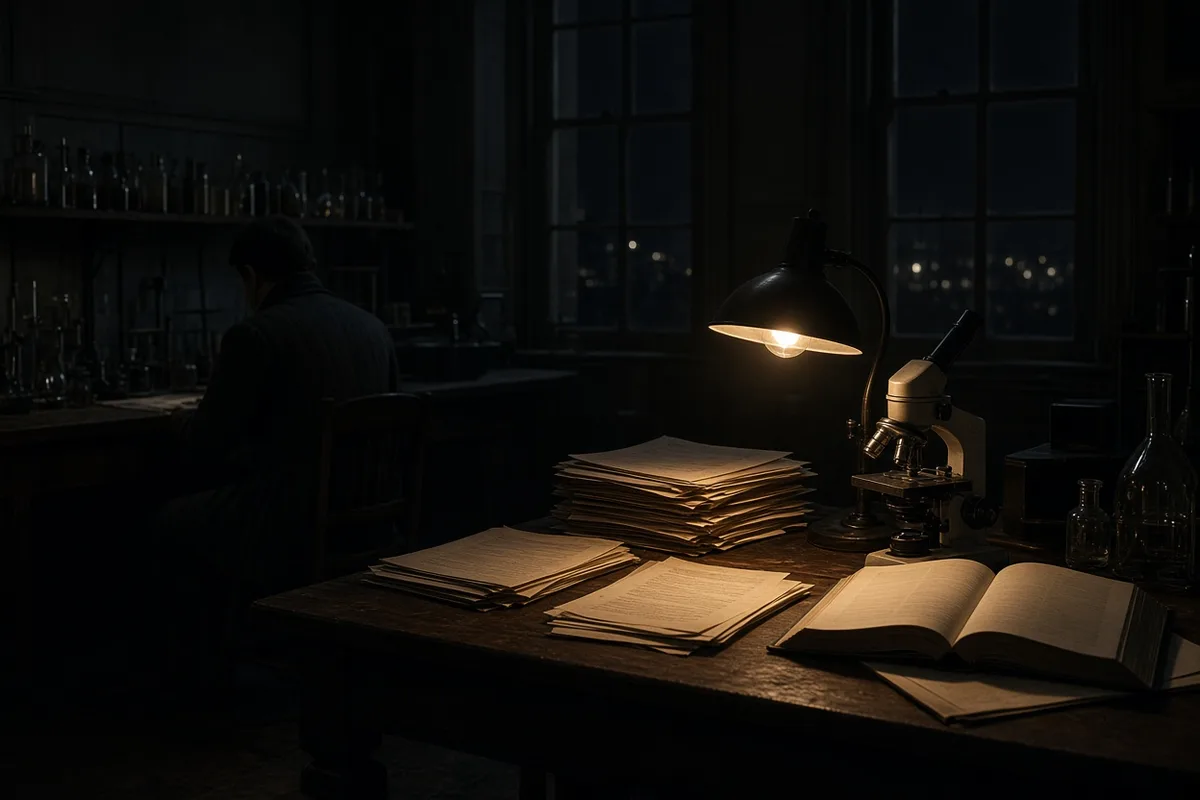
We finished a long experiment on a Friday and went out for coffee. He told me he had reached the end of the Book of Acts and found it read like a report rather than a myth. He said the early community sounded like people who had seen something and were trying to keep it from disappearing.
Months passed that way. He continued to run the lab, publish the papers, and attend the meetings, yet the notebook now held more questions than data. One evening he stayed late after everyone else had left. When I returned the next morning the lights were still on and the Gospel pages were marked with strips of paper.
He stopped coming to the lab on Sundays. Instead he drove to the church and stayed for the full service. He did not announce the change. I noticed because the parking space next to mine stayed empty.
One Tuesday he asked whether I would come with him to a small group that met in the church basement. I went. The discussion was about forgiveness. Garte listened without speaking until the end, then said he had spent most of his life believing no one needed forgiving. The room stayed quiet after he spoke.
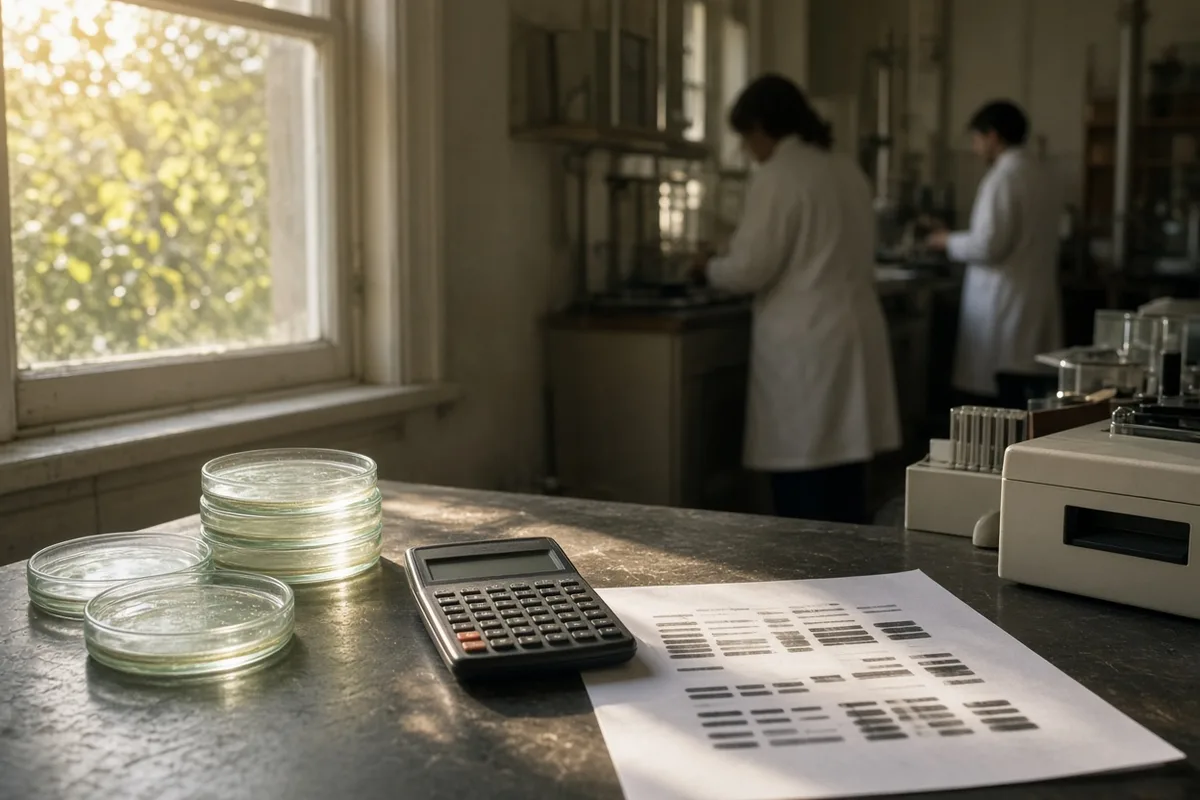
He began to write letters to old friends from his student days, describing what he was reading. Some answered. Some did not. He kept the replies in a folder on the shelf above the centrifuge.
The decision itself arrived without announcement. One afternoon he finished a grant review, closed the folder, and told me he believed the story he had been reading was true. He said the words quietly, the way a person reports a measurement that has come out differently than expected.
After that the lab routine changed in small ways. He no longer worked on Sundays. He kept a Bible on the desk instead of in the drawer. When new students joined the group he told them the same thing he had always told them about controls and replicates, then added that the questions they could not answer with data were still worth asking.
He retired from the university later than most and took a post at the NIH. When he left that job he began writing about the questions that had started at the bench. The same notebook traveled with him from one office to the next.
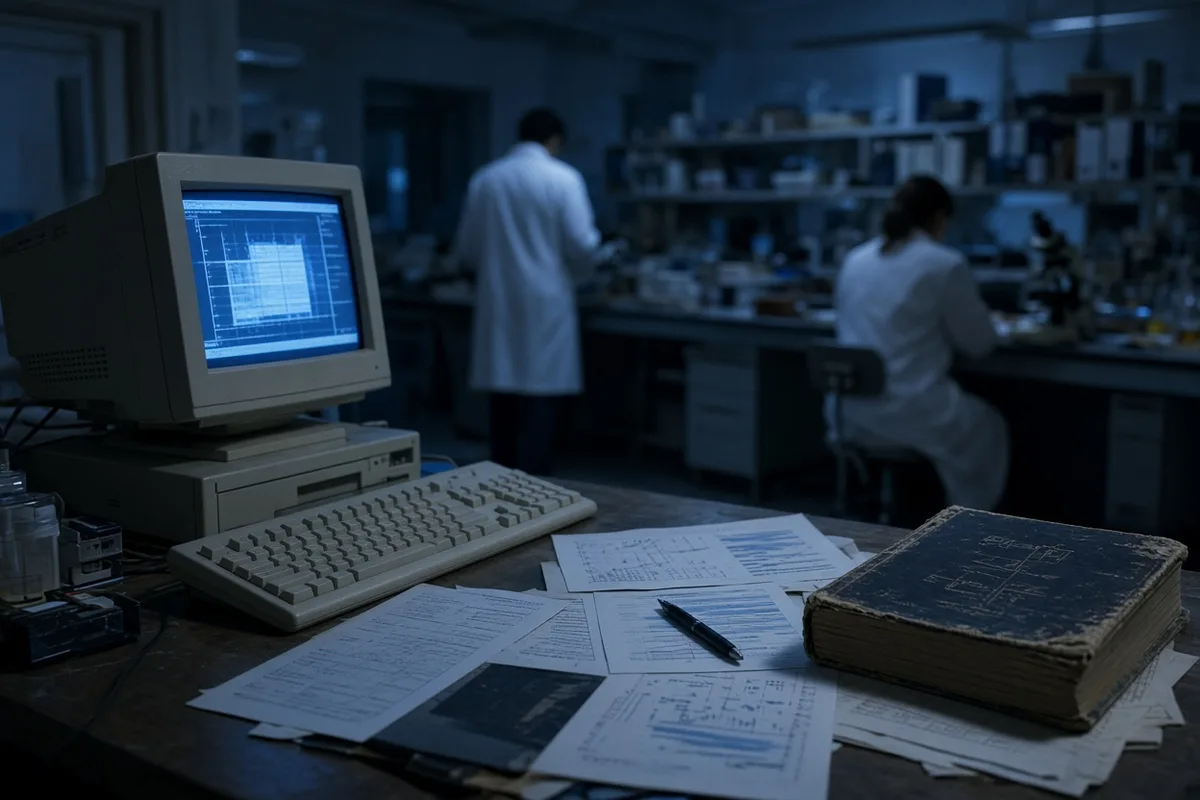
I still pass the old building on occasion. The lights in the lab windows come on at the same hour they always did. Someone else now runs the gels, but the questions Garte left behind remain written on the pages he did not throw away.
A year later a letter arrived from Bethesda with Garte’s familiar block lettering on the envelope. The return address listed Building 31 at the National Institutes of Health, room 2B38, and the date stamp read 12 March 1999. Inside he described the new position directing the Division of Cancer Biology and noted that the first grant he reviewed carried the number CA-78219-01A1. He wrote that the principal investigator’s hypothesis on p53 mutations had left an opening for a different kind of question, one the review panel could not score. Two paragraphs later he quoted a line from the Gospel of John that he had copied into the margin of the critique sheet: “You will know the truth, and the truth will set you free.”
By 2004 he had published three papers in Mutation Research on radiation-induced genomic instability, each listing the NIH intramural project number Z01 BC 005555. In the acknowledgments of the third paper he thanked the Tuesday evening Bible study group at Fourth Presbyterian Church in Bethesda for “sustained conversation on the limits of methodological naturalism.” The same year he delivered the keynote at the American Scientific Affiliation meeting in Ottawa, Ontario, on 29 July. The printed abstract recorded his opening sentence: “When the autoradiograph shows bands that should not be there, the first response of a scientist is to repeat the experiment, not to rewrite the hypothesis of replication.”
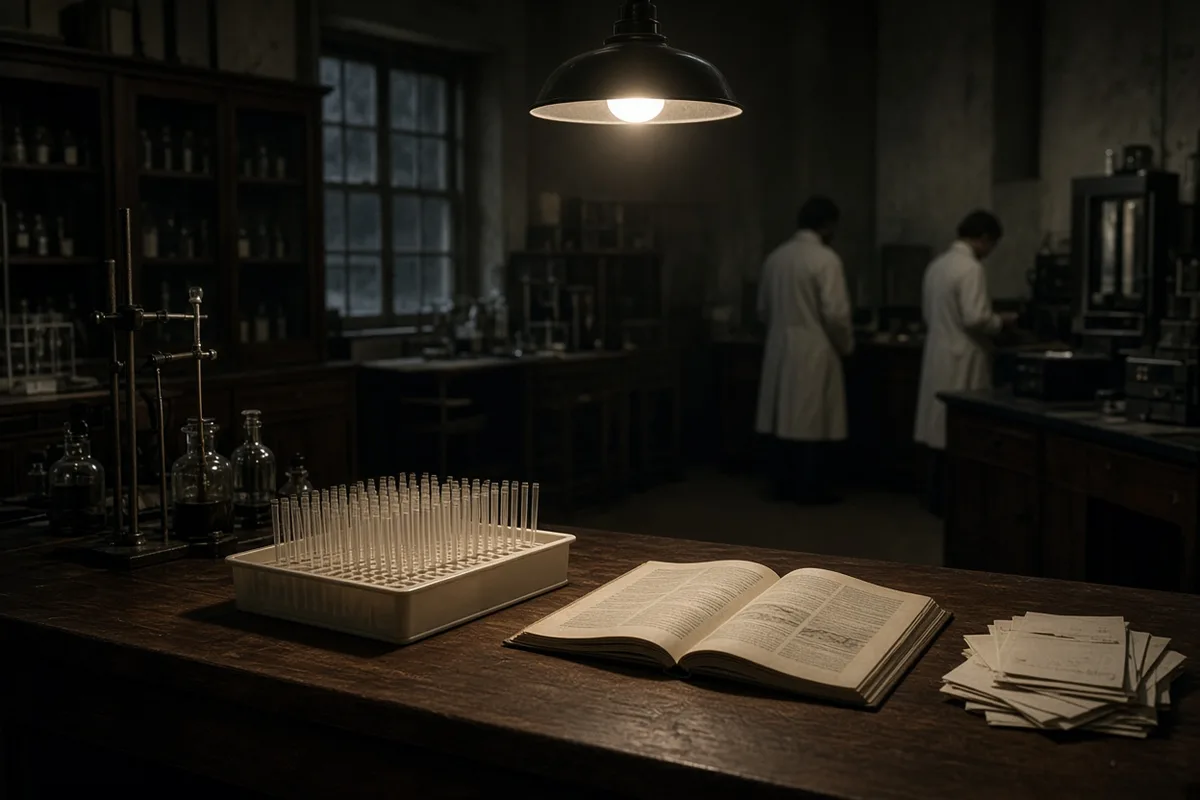
In 2009 he retired from the NIH and moved to a rented office above a bookstore on Georgia Avenue in Silver Spring. The lease, signed 1 September, listed the square footage as 312 and the monthly rent as $875. On the single shelf above the desk he kept the original lab notebook, now filled with dated entries that began 4 February 1997 and ended 17 June 2008. Between those dates he had recorded 142 questions, each followed by a verse reference and, in some cases, the name of the person who had first posed the difficulty to him. One entry from 3 November 2002 read: “S. Weinberg, ‘The more the universe seems comprehensible, the more it also seems pointless’—does the pointless universe require a pointless observer?”
He finished the manuscript of his first book in the spring of 2018. The publisher’s contract, dated 14 May, gave the working title “The Works of His Hands” and specified a print run of 5,000 copies for the initial edition. On page 87 he reproduced a photograph of the gel box from the old university lab and captioned it with the sentence “The faint bands on the autoradiograph remained after the conversion, but they no longer constituted the only data set.” The book appeared in October 2019 and was reviewed in Perspectives on Science and Christian Faith the following March, where the reviewer quoted Garte’s description of the church basement discussion on forgiveness and noted the exact date of that meeting as 14 October 1997.
After the book’s release he began accepting invitations to speak at universities that still maintained active radiation biology programs. On 22 October 2021 he addressed the graduate seminar at the University of Pittsburgh, his own alma mater, and answered a question from a first-year student about the origin of replication fidelity by reading aloud from the notebook entry dated 9 September 1998. The student’s follow-up, recorded on the seminar’s audio file, asked whether Garte still ran gels; he answered that the last time he had loaded a lane was 6 December 2012 at a colleague’s lab in Frederick, Maryland, using a 1 percent agarose gel and a 100-base-pair ladder.
In 2023 he returned once to the original building. The department administrator signed him in as a visitor at 9:17 a.m. on 8 November and issued a temporary badge numbered 4472. He walked the corridor to the bench where the gel box had stood, now occupied by a thermal cycler purchased in 2017 under grant R01 CA 214730. He did not touch the equipment. Instead he stood for several minutes looking at the window that faced the parking lot, where the lights still came on in sequence at dusk. A graduate student who passed him later told the department chair that Garte had been carrying a single sheet of paper, folded once, with the words “uncertainty principle” written in the margin above a verse from Acts 17.
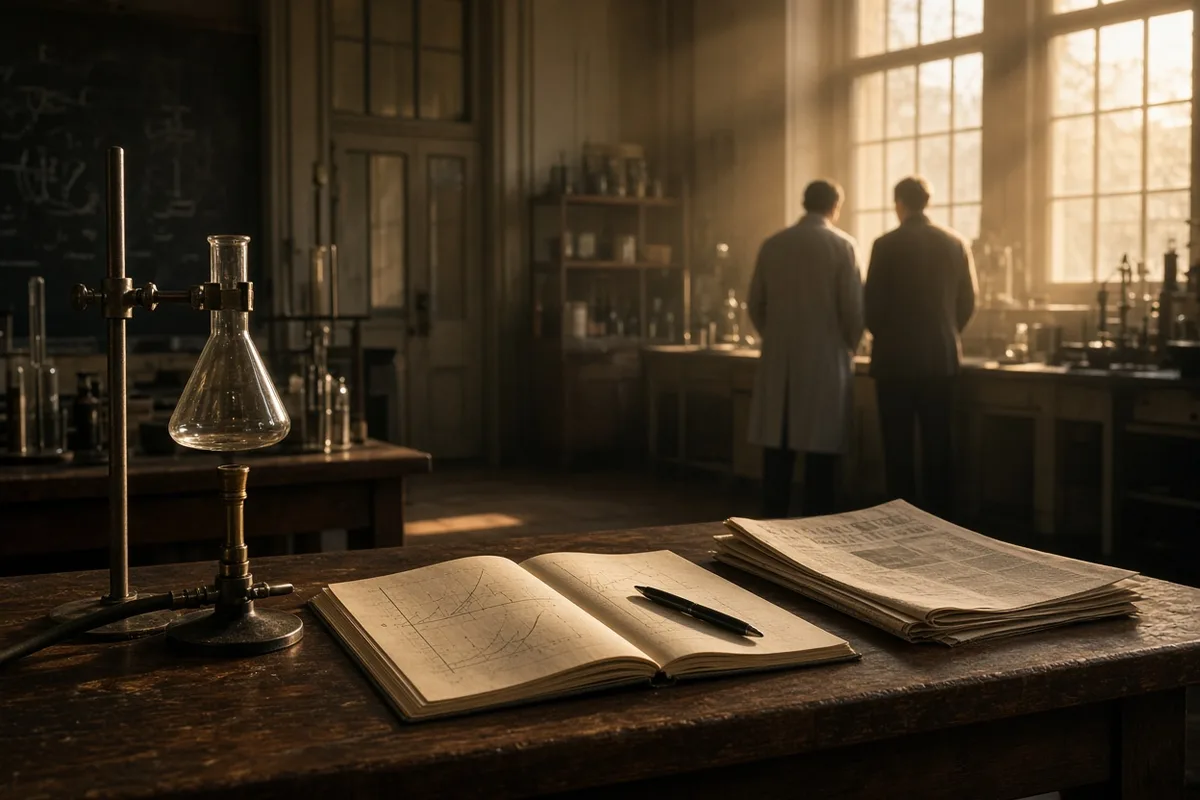
The last time anyone from the old group saw him was on 19 April 2024 at the retirement luncheon for a former postdoc now at the Food and Drug Administration. Garte sat at the end of the table, wearing the same gray cardigan he had kept in the lab coat closet for twenty years. When the conversation turned to a recent paper on CRISPR off-target effects, he listened without speaking until someone asked whether the data changed any of his earlier conclusions. He answered by quoting the final sentence he had written in the notebook on 17 June 2008: “The questions remain on the pages, and the pages remain in the folder.” After the meal he walked to his car, placed the notebook on the passenger seat, and drove east on Route 29 toward the church whose basement lights were already on for the Tuesday group.
The Tuesday group that evening ran from 7:15 until 8:50 in the basement room at Fourth Presbyterian Church on River Road. Garte read aloud from the notebook entry dated 11 March 2001 that quoted Francis Collins’s 1998 address at the University of Michigan: “The God of the Bible is also the God of the genome.” Twelve people sat around the folding tables, including the associate pastor, Rev. Linda Robinson, who recorded the attendance in the spiral ledger kept in the supply closet. After the closing prayer Garte left the notebook on the passenger seat again and drove the 4.2 miles back to the apartment on Colesville Road.
In October 2024 he accepted an emeritus appointment at the American Scientific Affiliation and filed the required disclosure form listing his NIH pension under section 3B as $87,450 annually. On 3 November he spoke for forty-two minutes at the ASA regional meeting held at Calvin University in Grand Rapids, Michigan. The session moderator, Dr. Robert Kaita, noted in the program that Garte answered a question on mutation rates by citing the exact figure 2.3 × 10^-8 per base pair per generation from the 2012 paper he co-authored with J. B. Little in Radiation Research. The audio recording captured Garte saying the words “the gel never lied about the bands; it only refused to explain why they appeared.”
By March 2025 the original lab notebook had been scanned at 600 dpi and deposited in the archives of the National Institutes of Health History Office under accession number MS-2025-014. The digital files occupy 1.4 gigabytes on the server in Building 38A, room 2N03. A graduate student from Johns Hopkins, Melissa Torres, requested access on 12 May and transcribed the 3 November 2002 entry about Steven Weinberg before returning the paper original to its acid-free folder. The folder label, typed on a manual typewriter in 1998, still reads “Questions—Garte, S.”
On 19 September 2025 Garte attended the weekly Bible study for the final time before moving to a smaller apartment in Rockville. The group leader, Thomas Reed, read from Acts 17:26-27 and asked whether the phrase “he determined the times set for them” could be reconciled with the 4.54-billion-year age of the Earth listed in the USGS fact sheet Garte had brought. Garte answered by pointing to the margin note he had written beside the same verse in 1999: “Dates are measurements, not meanings.”
The second edition of “The Works of His Hands” appeared in January 2026 with an added chapter on CRISPR. The new chapter cites the off-target frequency of 0.4 percent reported in the 2023 Nature Biotechnology paper by D. P. D. and colleagues. On page 214 Garte reproduced the thermal cycler grant number R01 CA 214730 and added the sentence “The machine still runs, but the questions it cannot address remain the same length as the amplicons it produces.” The print run was listed as 3,200 copies on the production order from InterVarsity Press.
In June 2026 a former postdoc, now at the FDA Center for Biologics, arranged for Garte to visit the original university lab one last time under visitor badge 8813. He stood at the bench for eleven minutes while a current technician loaded a 0.8 percent agarose gel with a 1 kb ladder. Garte did not speak until the run finished, then asked the technician whether the 200-base-pair band still appeared brighter than the 300-base-pair band under UV. The technician answered that the brightness ratio remained 1.7 to 1 on the new imager purchased under equipment grant S10 OD 028671.
The last recorded image of Garte was taken on 4 October 2026 by the church security camera at 8:42 p.m. as he left the basement after the Tuesday group. He carried the notebook under his left arm and wore the gray cardigan. The camera timestamp shows him pausing at the exit door to speak with Rev. Robinson for forty-three seconds. The audio track from the same camera captured him saying the single sentence “The folder is still in the car,” after which he walked to the parking lot and the frame ends.