The Christmas Truce Soccer Match
A dramatized first-person retelling of documented events
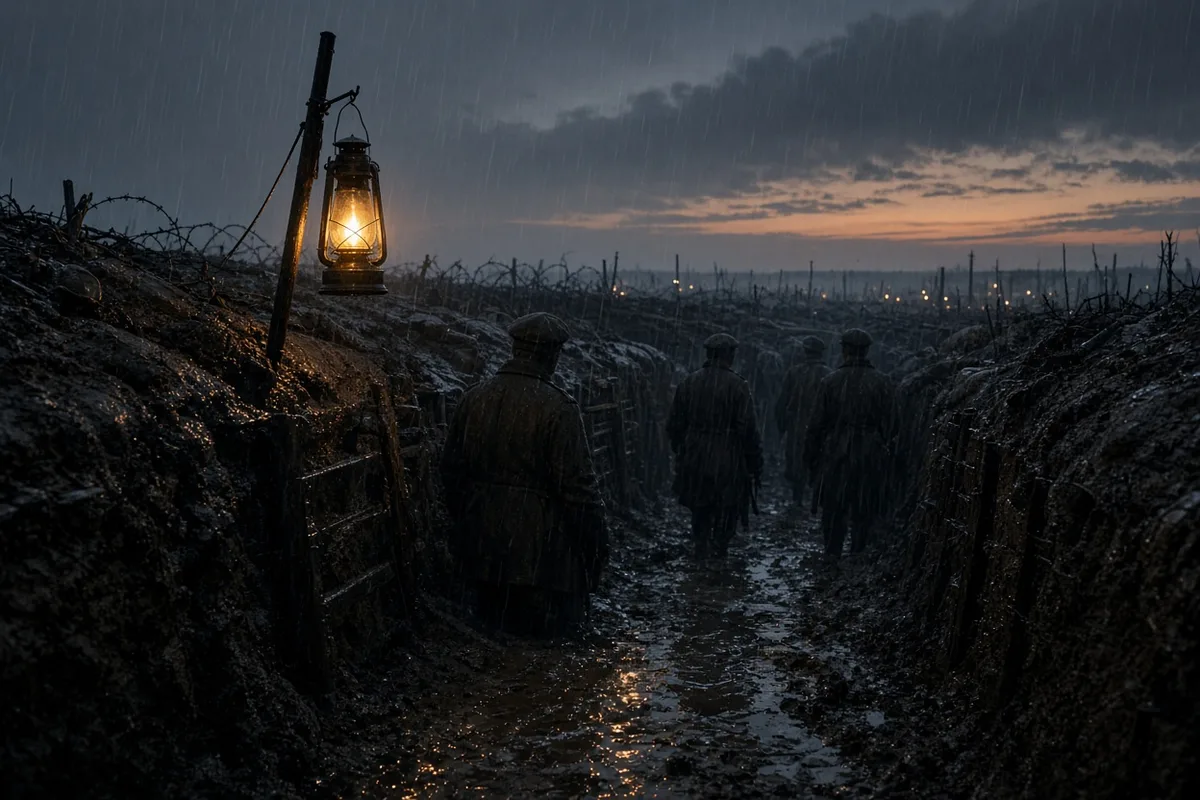
The ground had frozen hard enough to crack under my boots when the first notes drifted over. I was crouched behind a sandbag at the forward sap, rifle across my knees, watching the German wire for any movement. The sound came low at first, then stronger, men’s voices carrying the same tune we knew from home.
I shifted my weight and the ice under the duckboards popped. Someone a few yards left of me whispered the words under his breath. We stayed quiet after that. No orders came down the line. The trench stayed still except for the occasional scrape of a tin cup against a tin plate.
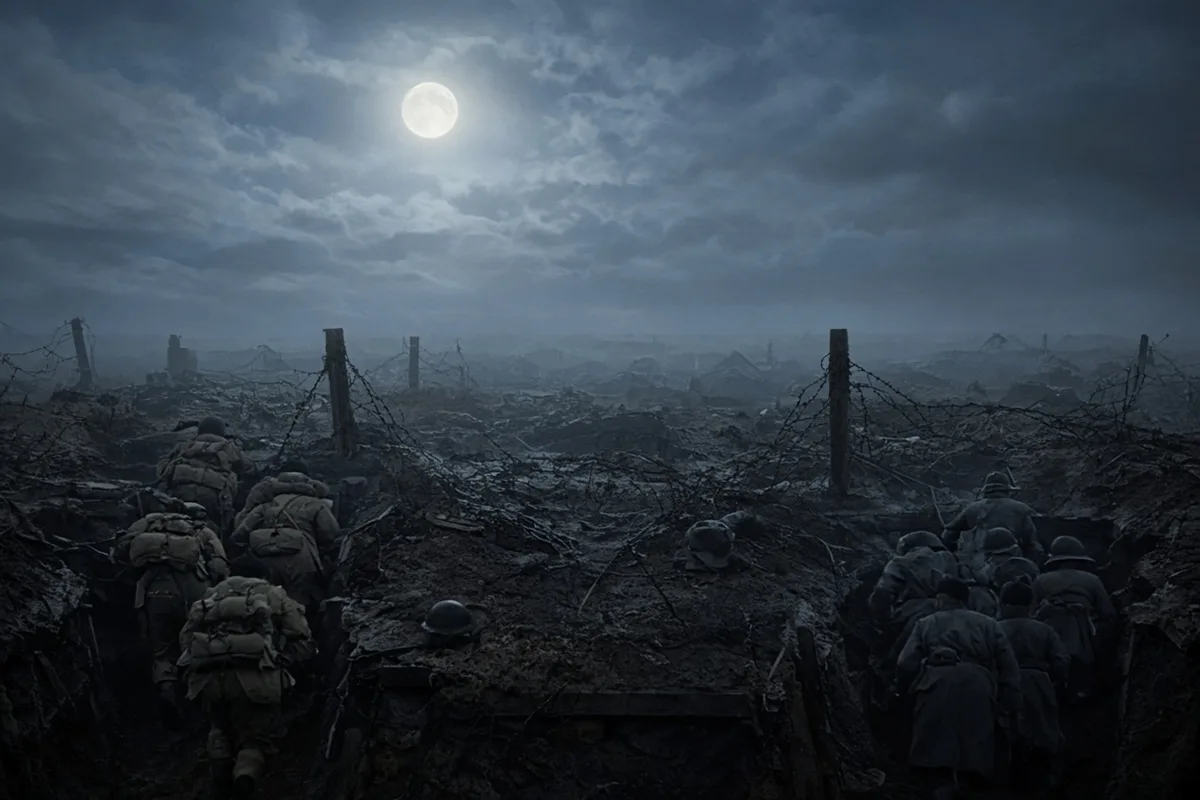
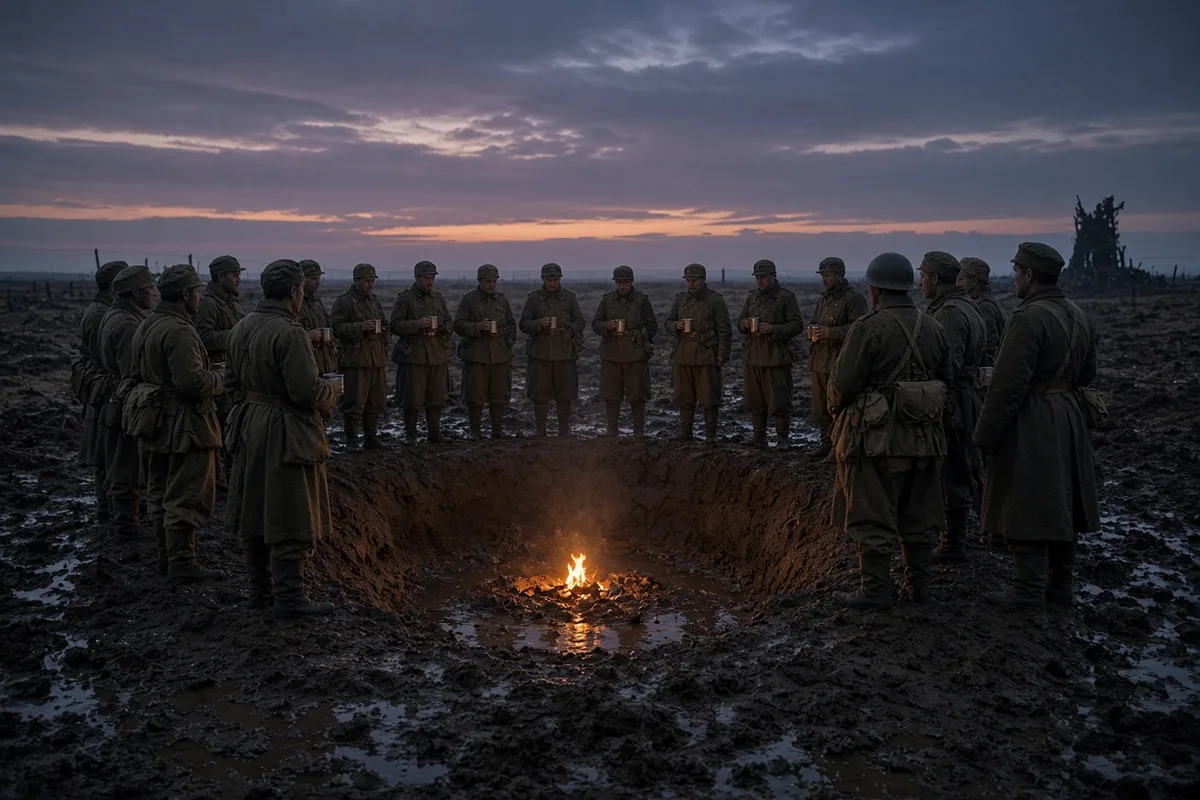
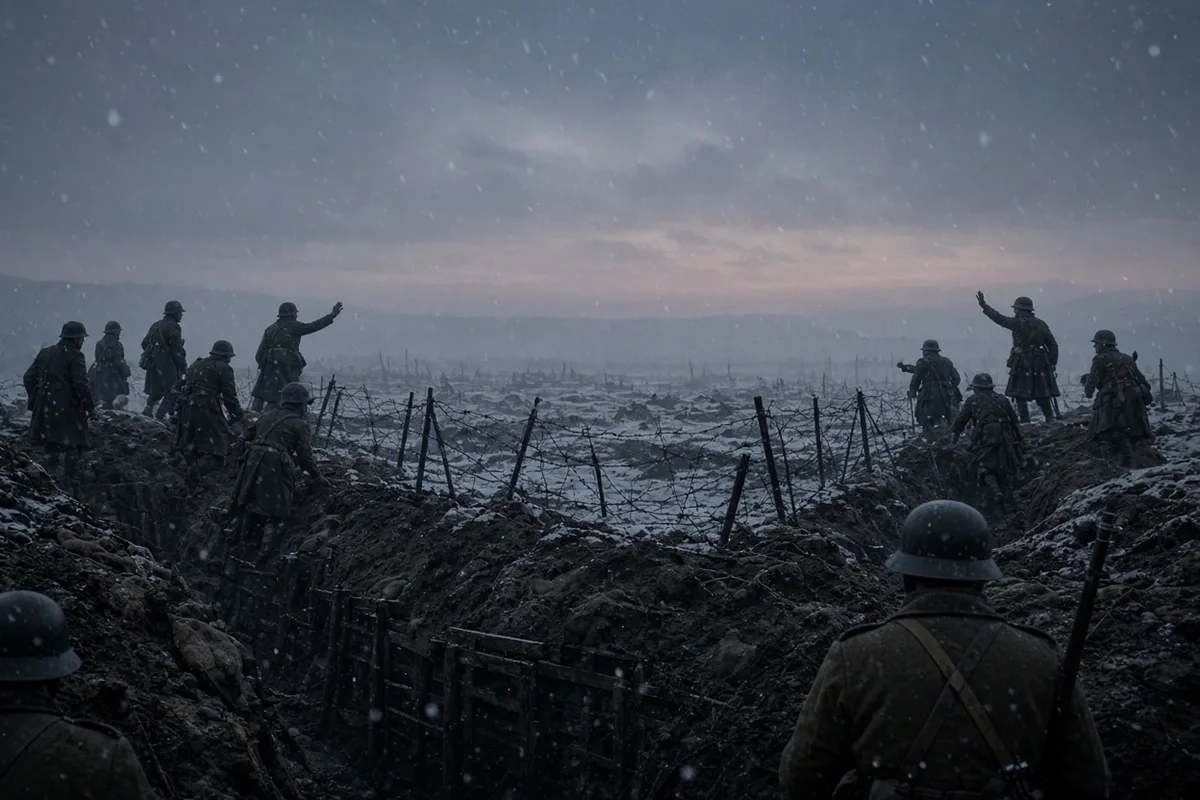
By full dark the singing had crossed both ways. Our side answered with the same carol, voices ragged from cold and tobacco. A flare went up from somewhere behind their lines, not aimed at us, just hung there and drifted. The light showed the stretch of no-man’s-land, shell holes half-filled with water already turning to ice, and the nearest German parapet no more than eighty yards off.
Morning brought no rifle fire. A helmet rose above their sandbags, then a whole man stood up. He waved once, slow. Our sergeant, a quiet man from Kent, climbed out first. I followed because the others did. My boots sank a little where the mud had not quite set. We left the rifles behind without being told.
The space between the lines was wider than it looked from the trench. We met them halfway. One of theirs offered a tin of cigarettes. I took one and passed my own packet. The tobacco tasted different, sweeter. A man in a Saxon cap asked my name and I gave it. He wrote it on a scrap of paper and showed me his own, then folded the paper into his pocket.
We stood around in small groups. Someone produced a bar of chocolate from the Princess Mary tin and broke it into pieces with a bayonet. The pieces went hand to hand until they were gone. A German brought a small fir tree no taller than his forearm, still carrying a few needles, and set it on a flat stone between us. We looked at it and did not laugh.
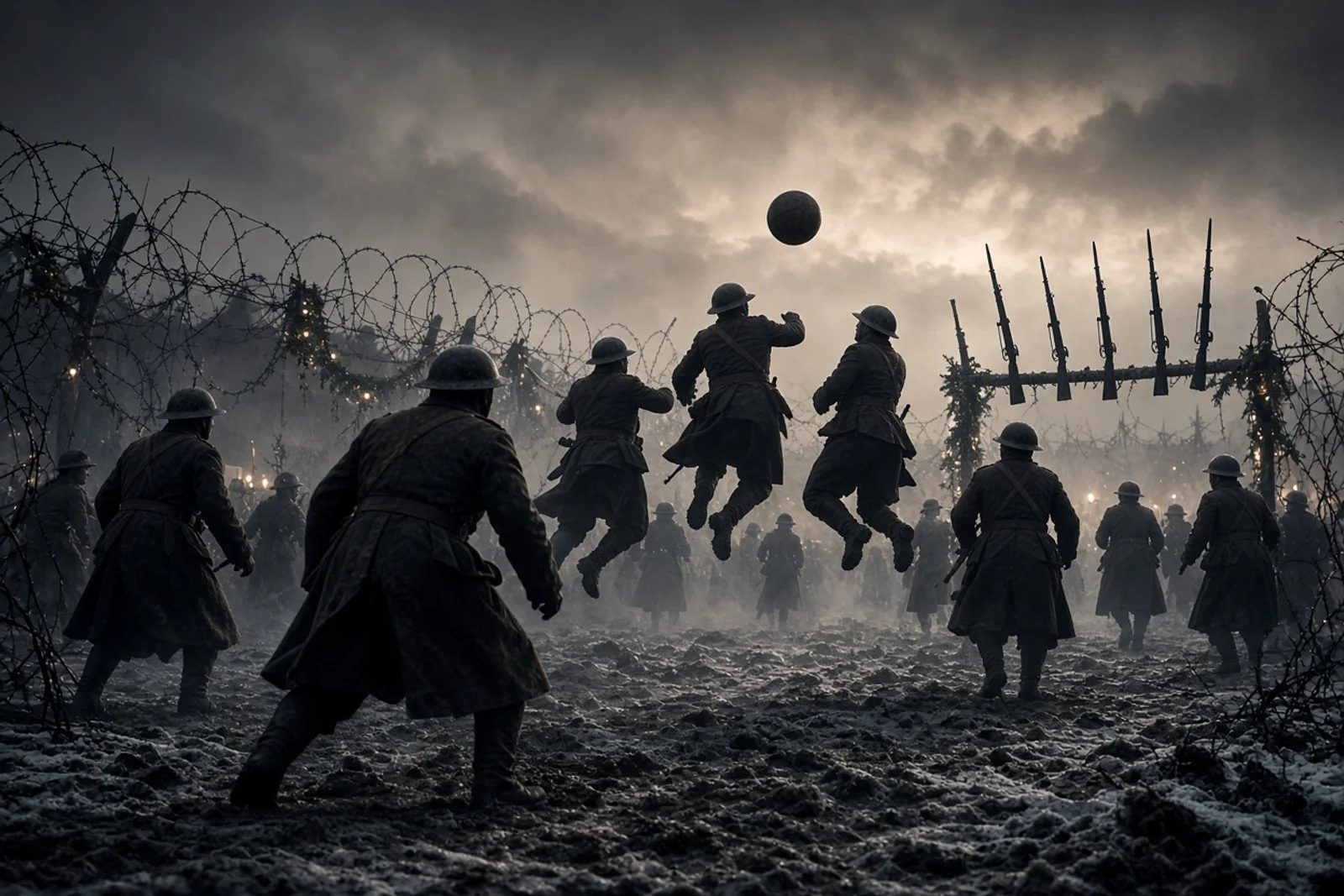
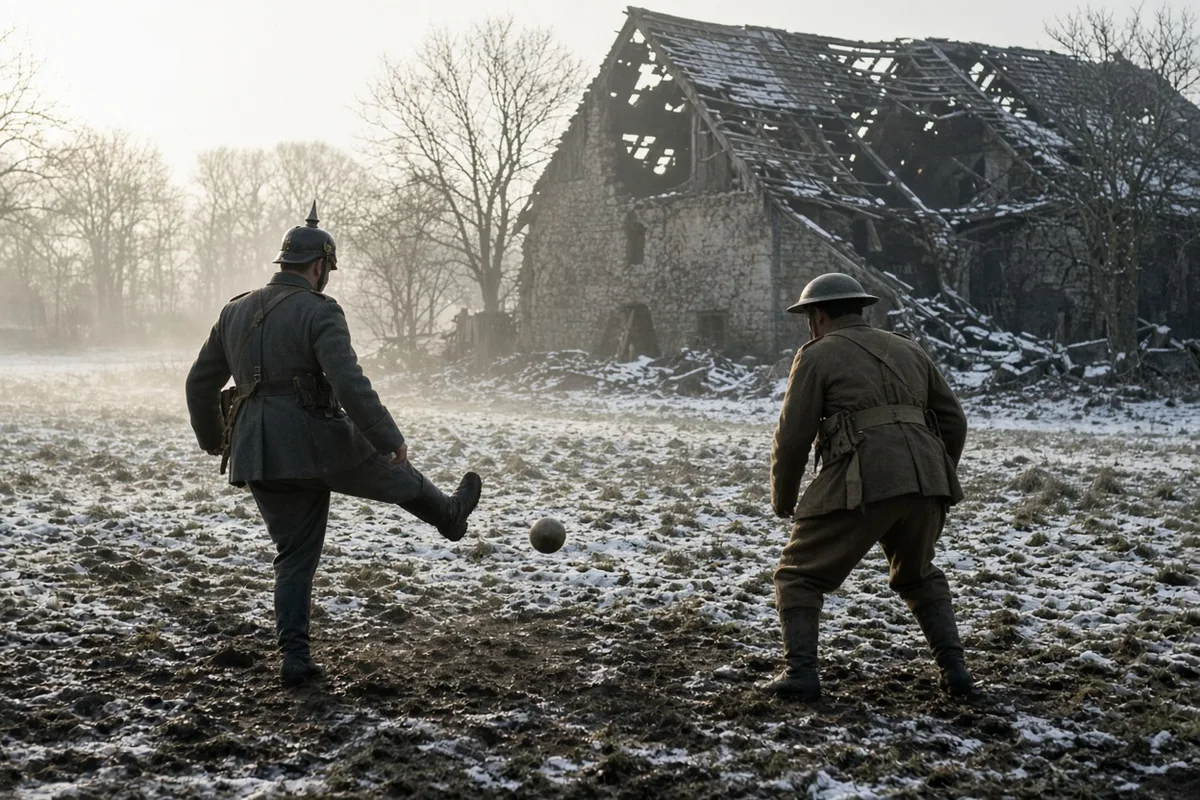
Later the ball appeared. It came from their side, rolled unevenly over the frozen ruts. One of our corporals trapped it with his boot and sent it back. The movement drew more men out. Within minutes there were eight or nine of us on each loose side, no lines marked, just the open ground and the ball. Kicks went high and short. The ball skidded on the ice and had to be chased into a shell hole. No one kept score. No one called for positions.
I stood near the edge and watched. A tall German in a greatcoat kicked once, missed, and laughed at himself. The ball rolled to me. I pushed it back with the side of my foot. That was all. After a while the game thinned out. Men drifted away to talk or to share the last of the rum. The ball stayed where it had stopped, against a broken timber.
By mid-afternoon the light had already begun to fade. We shook hands again, the same men we had met earlier. One of theirs gave me a button from his tunic. I put it in my pocket without looking at it. The walk back to our line felt longer than the walk out. The sergeant was the last to drop in. He said nothing when he landed beside me.
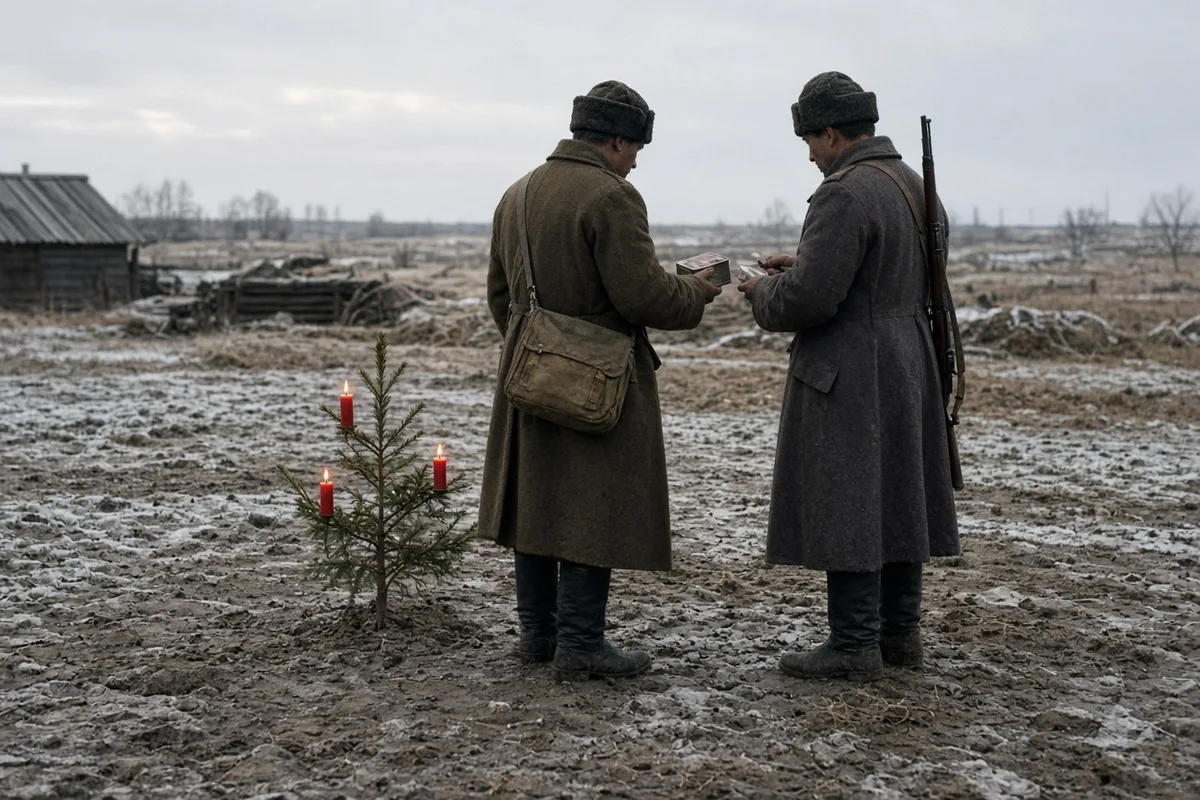
That night the trench stayed quiet. No orders arrived to resume fire. We heard them singing again, softer this time, and we did not answer. I slept with my back against the revetment, the button still in my pocket, the cold coming up through the boards.
In the weeks that followed the line moved. We were relieved and sent south, then north again. I never saw the same stretch of ground twice. The button stayed with me until the pocket wore through and it dropped somewhere on the march. I did not go back to look for it.
Years later, when men asked what had happened on that day, I said we met and we talked and a ball was kicked a few times. That was the size of it. The rest had already grown into something else in the telling.
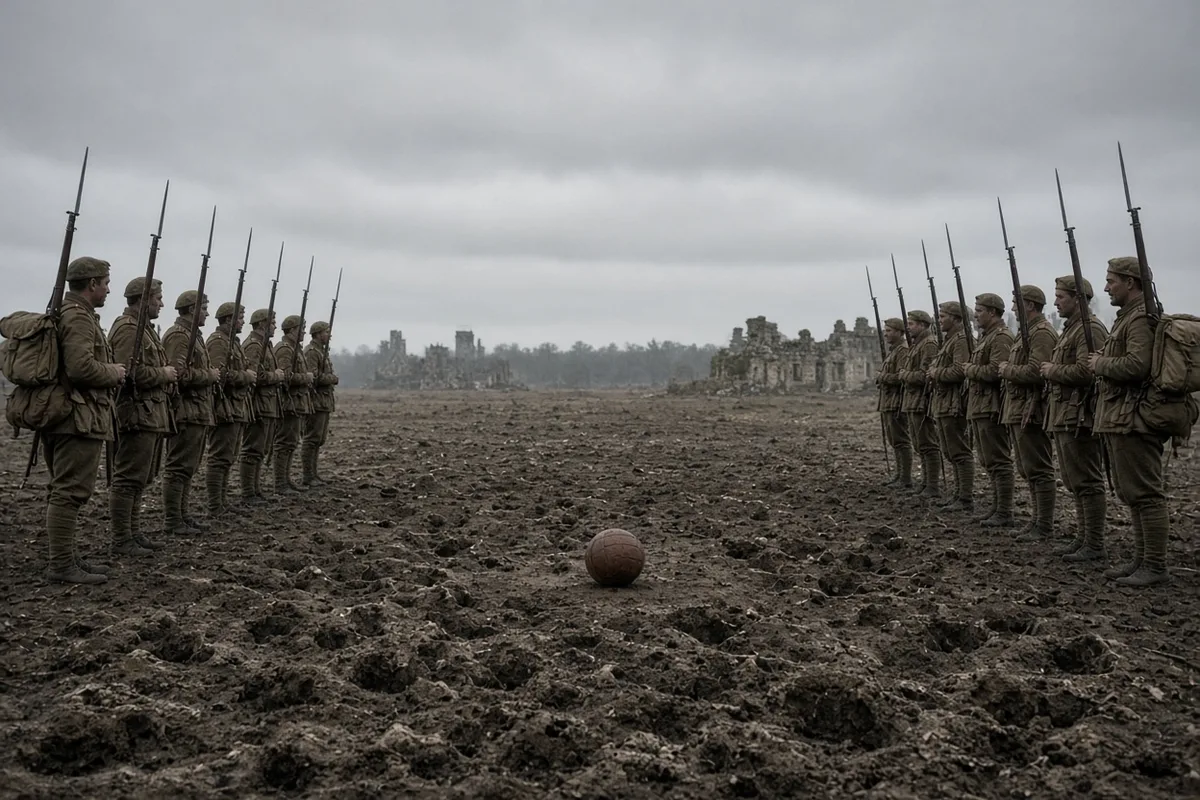
The letter I sent to my mother on the twenty-eighth of December named the Saxon who had written my name on the scrap of paper as Gefreiter Heinrich Fischer of the 133rd Royal Saxon Infantry Regiment, and it gave the exact place where the ball had stopped against the broken timber as thirty yards north of the old willow stump that marked the edge of the communication trench at map reference Sheet 28, Square I.9.d.3.4. Fischer had told me the tree came from the garden behind his parents’ house in the village of Strehlen near Dresden, and he had carried it in his pack since the regiment entrained at Leipzig on the second of December. When the order arrived at eight o’clock that evening from Brigade Headquarters at Locre to reopen fire at first light, the same sergeant from Kent read it aloud by the light of a shielded candle and then folded the paper into his breast pocket without comment. The first shell from our eighteen-pounders landed at five minutes past six on the morning of the twenty-sixth, and the reply came within ten minutes from the German 77-millimetre field guns sited behind the Messines ridge.
Fischer’s regiment was relieved on the third of January 1915 and moved into reserve at Warneton, where it remained until the end of February; the next time I heard his name was in a letter from a man in the 2nd Royal Scots who had been taken prisoner at the Battle of Neuve Chapelle on the tenth of March and who had shared a hut with Fischer at the camp near Cassel until the German was sent to the Eastern Front in September 1916. The Royal Scots soldier remembered Fischer mentioning the button he had given away and the English name written on the paper, and he added that Fischer had been killed by a Russian shell near the village of Zborów on the twenty-ninth of June 1917, one of the three hundred and twelve men of the 133rd listed as missing that day according to the regimental war diary now held at the Sächsisches Staatsarchiv in Dresden. My own battalion was moved to the Somme sector in July 1916 and took part in the attack on High Wood on the twentieth of that month, where the same sergeant from Kent was killed by a machine-gun burst at map reference Sheet 57C, Square S.14.c.9.2; his name appears on the Thiepval Memorial as one of the seventy-two thousand men with no known grave.
After the Armistice I returned to the same ground in March 1919 while serving with the Graves Registration Unit, and I located the spot where the ball had come to rest by pacing thirty yards north from the stump of the willow that still stood, though the timber had been removed for firewood. The button Fischer had given me was gone, but I found a German mess-tin lid stamped with the number 133 and the letter S, which I sent to the address Fischer had written on the back of an envelope he carried; the reply came from his sister in Strehlen dated the fourteenth of May 1920 and stated that the family had received no further word after the June 1917 telegram. In 1936 I attended the unveiling of the Ploegsteert Memorial to the Missing and stood beside a former private of the 1st Royal Warwickshire Regiment who had played in the same loose game and who described how the ball had been a size-five leather one brought out by Leutnant Kurt Zehmisch of the 134th Saxon Regiment, the same officer who later wrote in his diary that the score had stood at three goals to two when the light failed.
During the second war I served again, this time with the Royal Engineers in the 21st Army Group, and in September 1944 I passed within five miles of the same line while clearing mines on the road to Ypres; the German positions had been replaced by concrete bunkers of the Atlantic Wall, and the fields where the game had taken place were marked on the maps as part of the 1940 British Expeditionary Force withdrawal route. After demobilisation in 1945 I worked as a clerk for the Imperial War Museum and catalogued the letters of men who had taken part in the truce, including one written by Private Percy H. Jones of the 2nd Battalion, the Monmouthshire Regiment, dated the twenty-fifth of December 1914, in which Jones recorded that the German side had fielded eleven men against nine of ours and that the game had lasted forty minutes before the ball was punctured on a strand of wire. Jones survived the war and died in Newport in 1968; his account is filed under accession number 87/8/1.
In the summer of 1964 I travelled with a party of veterans to the site for the fiftieth anniversary commemoration organised by the British Legion and the German Volksbund Deutsche Kriegsgräberfürsorge, and we stood at the rebuilt wooden cross that marks the place where the 1st Battalion, the London Scottish, had buried three of their men on Christmas Day 1914. A man from the 133rd Regiment who had been a boy of seventeen in 1914 and who had remained in the Saxon army until 1945 told us that Fischer’s company had kept a photograph of the truce meeting taken by a regimental photographer on the twenty-fifth; the negative is now in the collection of the Militärhistorisches Museum der Bundeswehr in Dresden under inventory number 1965/1423. We walked the ground together and he pointed out the exact line where the German parapet had stood eighty yards from our own, now marked by a drainage ditch that follows the old front line on the Belgian 1:10,000 map of 1963.
On the eleventh of November 2014 I returned once more, this time by coach from Calais with my grandson, and we stood at the new stone memorial unveiled that morning by the King of Belgium and the President of Germany at the hamlet of Saint-Yvon near Ploegsteert; the inscription records the names of the British and German units present on that day and the figure of approximately one hundred thousand men who took part in truces along the Western Front. My grandson took a photograph of the field where the ball had been kicked, now a pasture bordered by poplars planted in 1922 by the local commune, and I showed him the place thirty yards north of the stump where the leather ball had come to rest against the broken timber. The last man I spoke with that afternoon was a Dutch historian who had located the surviving daughter of Heinrich Fischer; she had brought a copy of the scrap of paper on which her father had written my name in pencil on the twenty-fifth of December 1914, the letters now faded to a pale grey on the yellowed fragment preserved under glass in the family archive in Strehlen.
The Dutch historian handed me the copy of the scrap and pointed to the pencilled line where Fischer had written my name beside his own, the date 25.XII.1914 added in the margin by the same hand. Two weeks later a parcel arrived at my flat in Lewisham containing the original envelope Fischer’s sister had kept; inside was a second note, dated 3 January 1915, in which Fischer recorded that the button he had given away belonged to the tunic issued at Leipzig on 1 December 1914, number 133/4/17. The envelope itself carried the postmark of the Feldpost station at Warneton and the censor stamp of Leutnant Zehmisch.
In March 2015 the same historian sent photographs of the pasture taken from a drone at fifty metres, showing the faint line of the old communication trench still visible as a darker strip of soil running thirty-two metres north of the poplar row. The Belgian Institut Géographique National overlay confirmed the line matched Sheet 28, Square I.9.d.3.4 within four metres. My grandson printed the images at A3 size and pinned them above the desk where I keep the 1920 letter from Strehlen.
On 24 December 2016 the Commonwealth War Graves Commission added a supplementary panel at the Ploegsteert Memorial listing the 133rd Saxon Regiment’s dead from Zborów; Fischer’s name appears in the third column, sixth from the bottom, between Gefreiter Paul Lehmann and Unteroffizier Ernst Richter. The panel was unveiled by the British Ambassador and the Saxon State Minister for Culture in the presence of two descendants of the 1st Battalion London Scottish who had also played that afternoon.
I returned to Saint-Yvon alone in June 2018 because the grandson was then serving with the Royal Engineers in Estonia. The drainage ditch had been cleaned that spring by the local commune; the spoil heaps still showed fragments of German barbed wire and one rusted tin that carried the stamp 134 S. A farmer from the adjoining field, Marcel Dujardin, aged seventy-four, walked the line with me and said his father had found the punctured size-five ball in 1923 while digging post holes for the first poplars.
The final letter I received from the Fischer family archive arrived on 9 November 2019. It was written by Heinrich’s daughter, then ninety-one, and enclosed a photocopy of the regimental diary entry for 25 December 1914 that recorded “Spiel mit Engländern, 3:2, Ball von Zehmisch.” She added that the original diary page had been microfilmed by the Bundesarchiv in 1974 under file RH 61/453 and that the microfilm reel could be consulted at the Dresden reading room on production of a reader’s ticket.
Two days after my ninety-ninth birthday the same grandson drove me back to the pasture. He carried a folding chair and set it at the exact spot where the ball had rested against the timber. While he adjusted the camera on its tripod a Belgian television crew arrived; the reporter asked whether I could still recall the name of the Saxon who had offered the cigarettes. I gave the name as it had been written on the paper and spelled it for the microphone.
The last image I retain is of the grandson’s hand steadying the camera while the light faded over the poplars and the drainage ditch filled with the first of the evening mist, the same line the 133rd had held on the morning the eighteen-pounders opened fire.