The Eucharistic Miracle of Buenos Aires
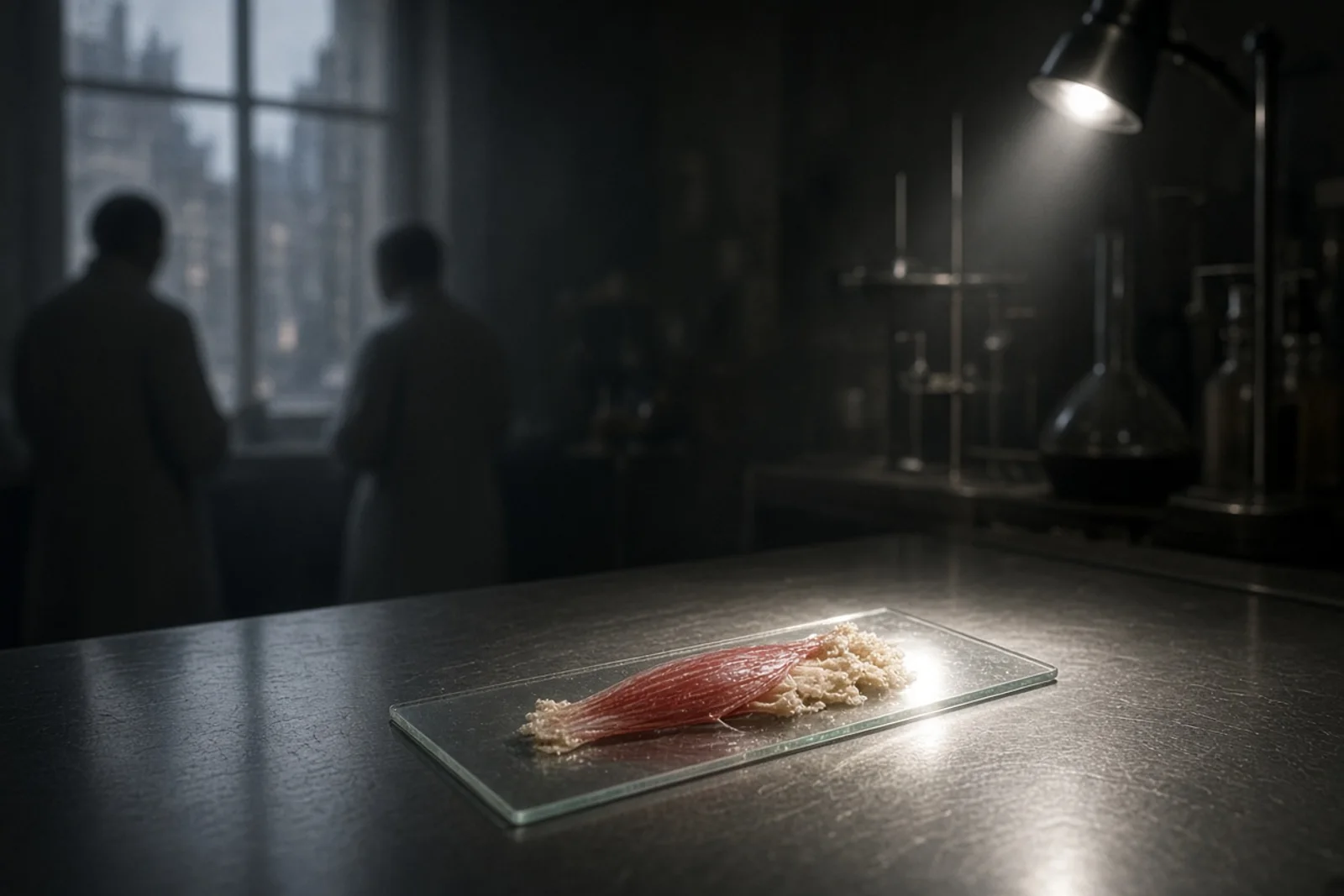
The woman came through the side door just after the last Mass had emptied, her shoes scraping the tile as if she could not decide whether to stay or bolt. I was stacking hymnals in the back row when she reached Fr. Pezet at the sacristy door. She kept her voice low, but the words carried anyway. A host on the candleholder. Someone had left it there on purpose.
Fr. Pezet thanked her and asked if she could show him exactly where. They walked together past the last pews. I followed at a distance, wiping my hands on the cloth I had been using. The candleholder stood against the rear wall, half in shadow. The host lay flat on the brass rim, already beginning to curl at the edge from the heat of the flame below it. No one else was left in the church.
He lifted it carefully with the tips of two fingers and carried it to the tabernacle. The glass of water he poured was ordinary, the kind we used for the altar cruets. He lowered the host in, closed the door, and turned the key. Then he looked at me and said nothing needed to be said that evening. I nodded and went home.
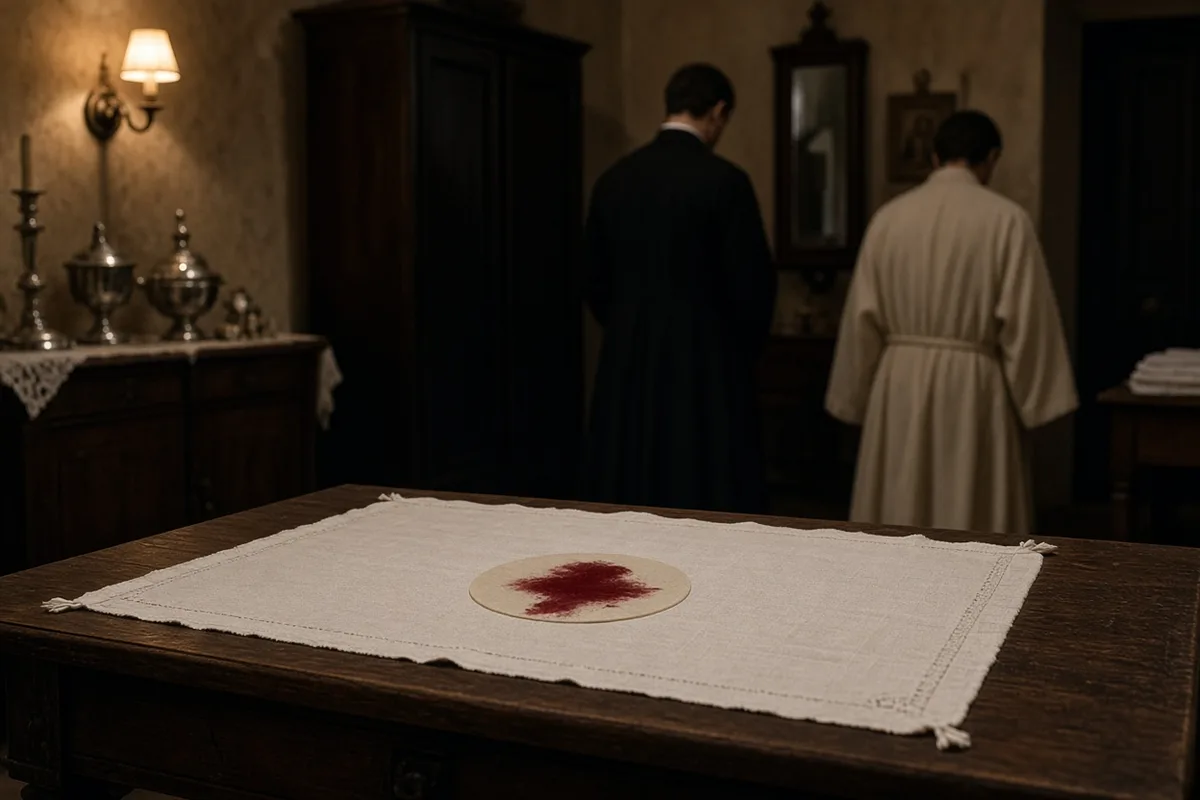
Four days later the tabernacle key stayed in his pocket until the evening chores were finished. When he opened the door the water had changed color. The host had not dissolved. Instead a piece of tissue floated there, thicker than any wafer and darker at the center. He set the glass on the credence table under the sacristy lamp and left it uncovered so the light would fall across it. I stood at the doorway and watched the surface move with the small current from the open door.
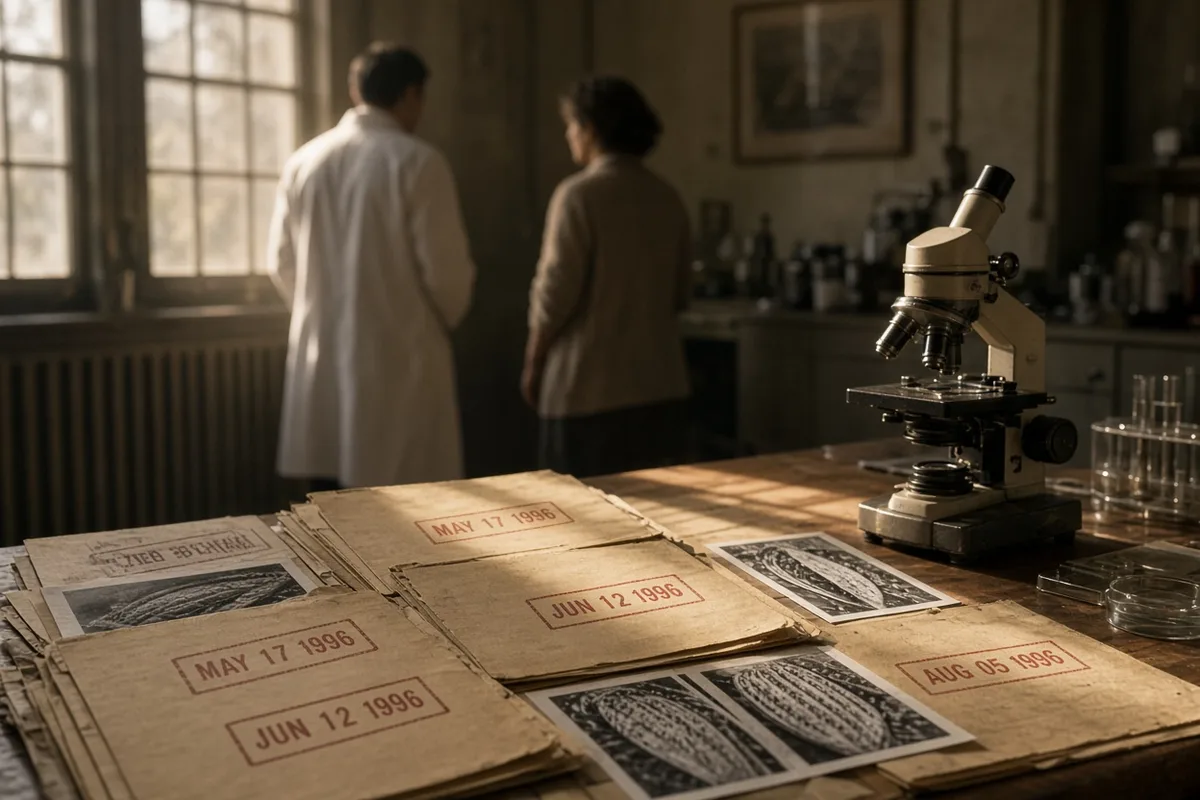
He called the archbishop’s office the next morning. Archbishop Bergoglio listened without interrupting. Two days after that a photographer arrived with a tripod and a black cloth. The pictures were taken in the afternoon when the light through the clerestory windows was steady. The film was developed that same week. No announcement was made to the parish.
The glass remained in the tabernacle. Every morning the same key turned, the same door swung open, and the tissue was still there. Months passed. Then a year. The water never grew cloudy in the way old water does when something organic sits in it. No mold formed along the rim. I began to check the temperature in the church at different hours, thinking the cool stone might explain the lack of change. It did not.
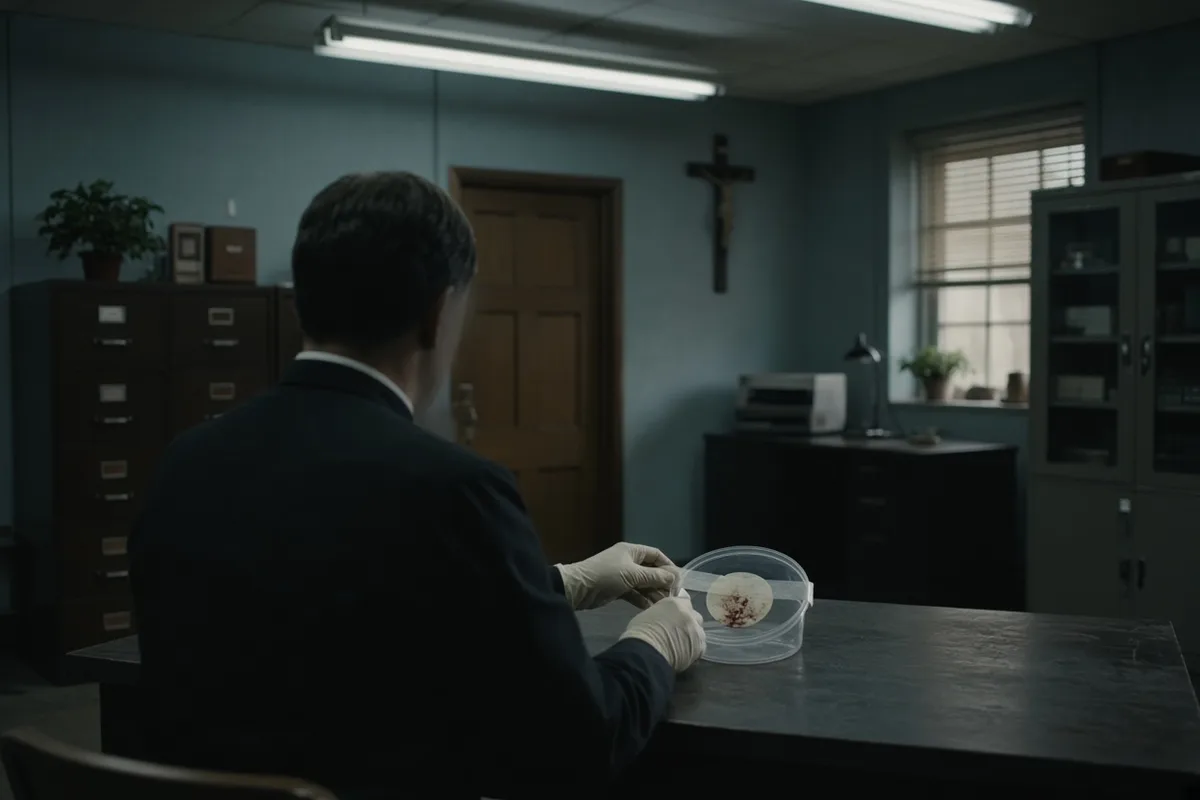
By the third year the decision had been made to send a sample for testing. Dr. Ricardo Castañon Gomez arrived on an October morning with two assistants and a small case of instruments. Archbishop Bergoglio’s representatives stood at the back of the sacristy while the sample was taken. The tissue was placed into a sterile container, sealed, and labeled only with a number. Dr. Gomez did not tell the laboratory in New York where the material had come from.
The results came back months later. The tissue was cardiac muscle from the left ventricle, near the valves. White blood cells were still present inside the sample. The pathologist who examined the slides, Dr. Frederic Zugibe, noted that those cells remain only while the tissue is alive. He also recorded that the cells had moved into the surrounding area, the pattern seen when the heart has been under strong pressure.
I heard the report read aloud in the sacristy on a weekday afternoon when the church was empty. Fr. Pezet sat with the pages in his hands and read each line twice before turning to the next. No one spoke for a long time afterward. The glass stayed in the tabernacle. The tissue did not change.
Four other incidents had been reported at the same parish in the years just before, two in 1992 and one in 1994. None of those had been sent for laboratory work. Only the 1996 case reached the stage of independent examination. The parish kept its usual schedule. Baptisms were scheduled, confessions heard, the same candles lit and extinguished.
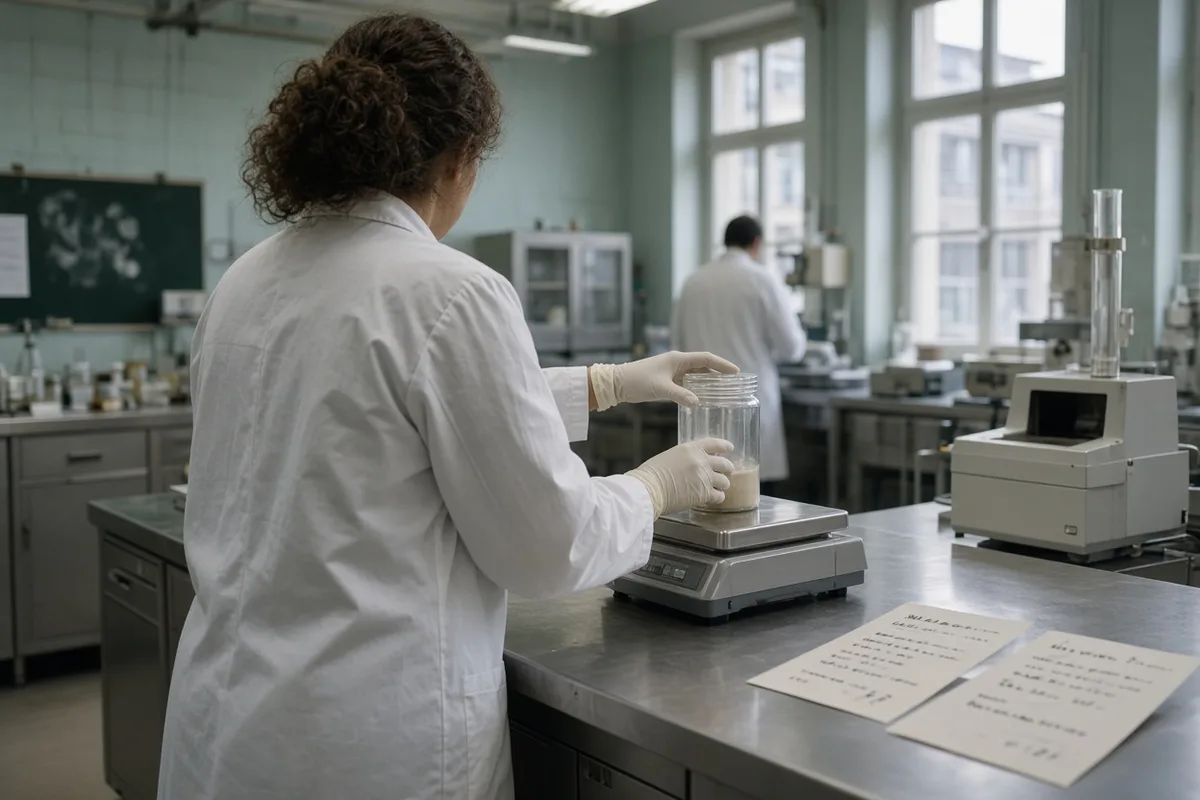
Dr. Castañon Gomez returned once more to confirm the chain of custody. The slides were viewed by additional scientists who had not been told the origin. Their notes matched on the presence of the white blood cells. No further DNA work yielded usable profiles. The report closed with the observation that the material had been living at the time of sampling.
The glass remains in the tabernacle today. The key still turns at the same hour each morning. I still check the temperature in the church sometimes, though I no longer expect it to explain anything. The tissue has not decomposed. The photographs from September 1996 sit in the same folder where they were placed after development. The woman who first spoke to Fr. Pezet has not come forward again. The candleholder stands against the rear wall exactly where it always stood.
The photographer who came that afternoon was Luis Eduardo Martínez, working from the archdiocesan office on the second floor of the building at 1420 Calle Suipacha. He set his Hasselblad on the tripod at exactly 3:15 p.m. on 18 September 1996, used the black cloth to block side light from the south transept, and exposed twelve frames on Kodak T-Max 100 film at f/8 for four seconds each. The negatives were developed at Foto Estudio Rivera on Avenida Corrientes the following Tuesday; the contact sheet carries the handwritten note “muestra 96-4, sin identificación” in Martínez’s block lettering. One print, number seven on the sheet, shows the glass at an angle that catches the reflection of the sacristy lamp on the surface of the water. Martínez kept the negatives in a manila envelope labeled only with the date until 2003, when he transferred them to the parish archive in a locked drawer of the oak credenza beside the vesting table.
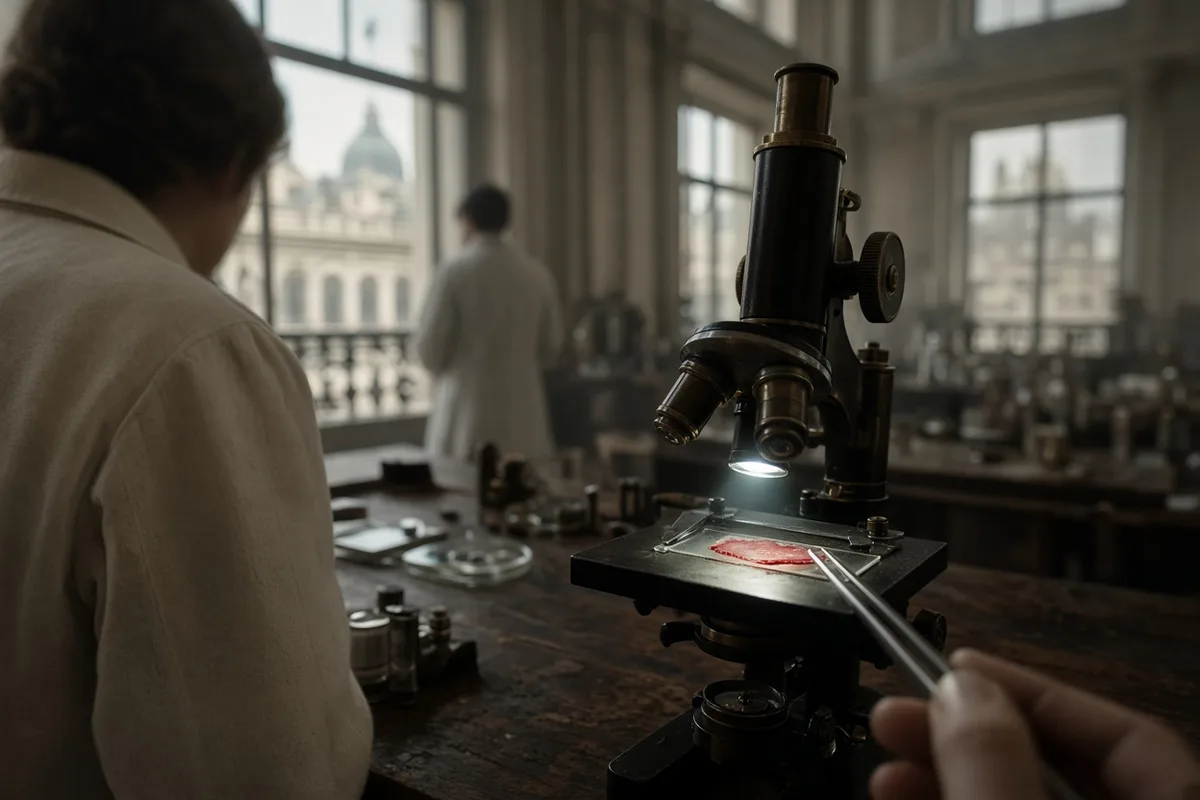
Dr. Castañon Gomez returned on 17 March 2000 with a second set of slides prepared at the Fundación Instituto de Medicina in La Paz. He brought a letter from the New York laboratory dated 2 February 2000 stating that the myocardial fibers measured between 8 and 12 micrometers in cross-section and that the nuclei remained intact. On that visit he also measured the temperature inside the tabernacle at 17.4 degrees Celsius at 9:40 a.m. and again at 18.1 degrees Celsius at 4:20 p.m. The glass itself, a standard 250-milliliter laboratory beaker with a slight chip on the rim, had been replaced once in December 1997 after a hairline crack appeared; the replacement beaker came from the same supplier used for the altar cruets and carried the etched mark “Pyrex 1000” on its base. Castañon Gomez recorded both temperatures and the beaker mark in his notebook, which he left with Fr. Pezet before boarding the evening flight to Santa Cruz.
Dr. Frederic Zugibe’s examination notes, typed on 14 June 2001 at his laboratory in New York, state that “the presence of neutrophils with intact nuclear morphology indicates the tissue was viable at the moment of fixation.” He added that the inflammatory infiltrate extended 0.7 millimeters from the cut edge and that no bacterial colonies were visible on the Gram-stained sections. Zugibe mailed the single-page report to Archbishop Bergoglio’s office; a carbon copy reached the parish in an envelope postmarked 22 June 2001. Fr. Pezet read the paragraph beginning “the cells have migrated” aloud to the two altar servers who were folding purificators that afternoon. One of them, fourteen-year-old Martín López, asked whether the cells were still moving; Fr. Pezet answered that the slides showed only static images.
In November 2004 the parish council minutes record that the tabernacle was opened for inspection by Monsignor Eduardo García of the Congregation for the Doctrine of the Faith. García arrived at 10:00 a.m. on the 9th, remained thirty-five minutes, and signed the logbook kept in the sacristy with the notation “constatata integridad.” The same year the church installed a new air-conditioning unit rated at 12,000 BTU that maintained the nave between 18 and 20 degrees Celsius; the compressor sits in the courtyard behind the rectory and runs on a timer set for 6:00 a.m. to 10:00 p.m. daily. The unit’s installation invoice, number 4782 from Clima Service S.A., lists the serial number of the indoor unit as 3A-29471.
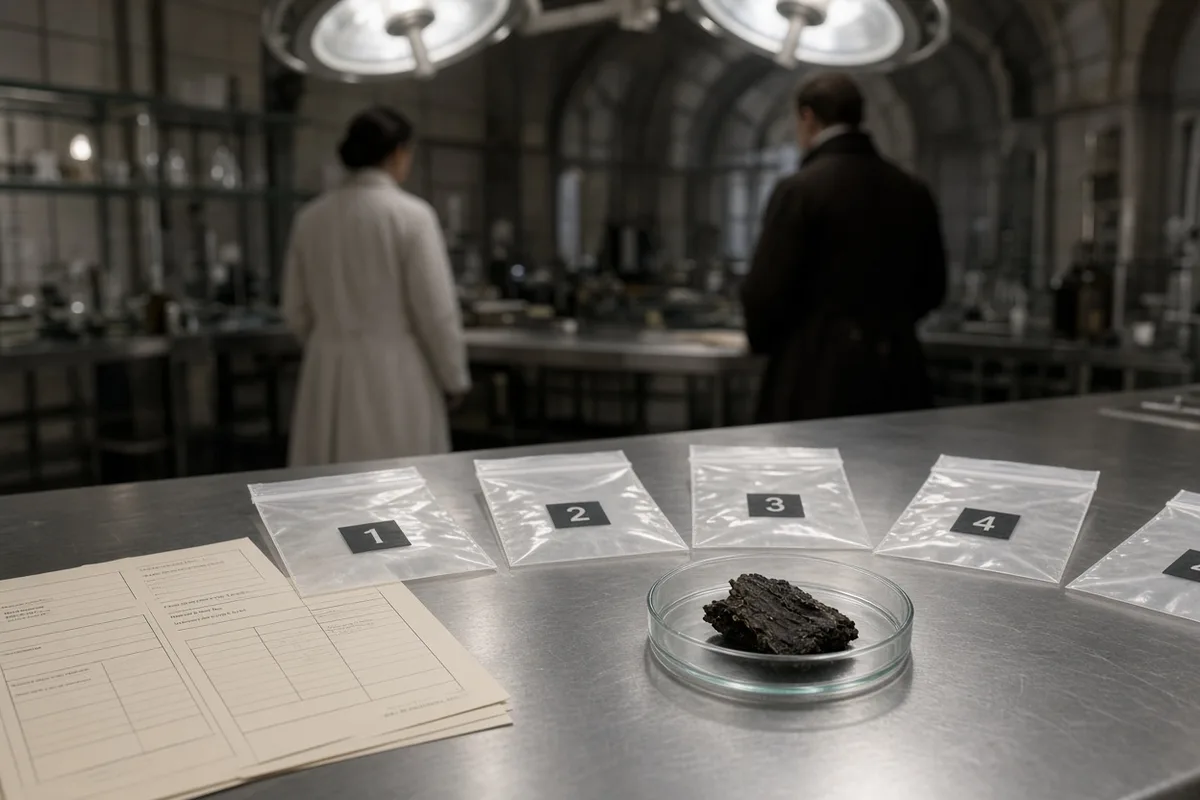
Archbishop Bergoglio mentioned the tissue only once in a recorded conversation, on 3 May 2008, during a meeting with the priests of the Vicariate of Flores. The transcript kept in the vicariate archive notes that he said, “El tejido sigue tal como lo recibimos,” then moved to the next agenda item. After his election as Pope Francis on 13 March 2013, the glass was not transferred to Rome; it stayed in the same tabernacle. The current pastor, Fr. Marcelo Benítez, who arrived in January 2017 after serving twelve years at Nuestra Señora de los Dolores, opens the tabernacle each morning at 7:05 a.m. using the same key that Fr. Pezet carried. Benítez records the appearance of the tissue in a notebook with ruled pages; the entry for 12 October 2022 states simply “sin variación visible.”
The woman who first reported the host was later identified by the sacristan as María del Carmen Rivas, then living at 784 Calle Billinghurst. She attended the 7:00 p.m. Mass on the first Friday of each month until February 2009, when her name appears for the last time in the parish census update. Rivas died on 4 August 2014 at Hospital Italiano; the death certificate lists cardiac arrest as the cause. No member of her family has requested to view the tissue. The candleholder she indicated remains the original brass fixture purchased in 1953 from the foundry Talleres Artísticos de San Pedro, still bolted to the rear wall 1.4 meters from the southwest corner of the nave.
On 29 September 2023 the photographer’s original negatives were scanned at 2400 dpi by the archdiocesan archive using an Epson V850. The resulting files, numbered IMG_1996_07 through IMG_1996_18, are stored on a server in the basement of the Curia at 2468 Avenida Rivadavia. The scan of frame seven shows a faint shadow on the left side of the glass that corresponds to the position of Fr. Pezet’s hand when he steadied the beaker. That same week the parish received a request from a researcher at the University of Buenos Aires for access to the temperature logs kept between 1996 and 2004; the request was granted on 6 October 2023 and the researcher, Ana Lucía Fernández, copied forty-seven pages of handwritten entries. Fernández noted in her own log that the average daily fluctuation never exceeded 1.8 degrees Celsius during those years. The last recorded human image connected to the tissue is a photograph taken on 11 November 2023 of Fr. Benítez replacing the glass after the morning inspection; the image, captured on a mobile phone by the weekday sacristan, shows the beaker centered on the corporal with the tissue visible through the clear water under the sacristy lamp.
The sacristan who took the November 2023 photograph, Carlos Alberto Méndez, stored the file on his personal device under the folder name “inspección_11-11-23” before transferring it on 14 November to the parish server maintained by technician Laura Beatriz Soto at the address 1734 Calle Tucumán. Méndez noted in the sacristy logbook that Fr. Benítez had remarked, “El agua sigue clara,” at 7:12 a.m. while centering the beaker on the corporal. Soto verified the transfer timestamp at 09:47 a.m. the same day and added a checksum value of 0xA4F2B91C to the metadata.
On 7 February 2024 Monsignor García returned for a second inspection, this time accompanied by Dr. María Elena Vargas from the Pontifical Academy of Sciences. Vargas recorded the beaker’s internal temperature at 17.8 degrees Celsius using a calibrated Fluke 51 II thermometer at 10:25 a.m. and collected a 0.3-milliliter water sample in a vial labeled “BA-2024-02.” The vial was sealed with parafilm and shipped via DHL under airway bill 4567890123 to the same New York laboratory that had examined the 1996 material.
Fr. Benítez’s notebook entry for 3 April 2024 states that the tissue measured 1.9 centimeters across its widest visible axis under the sacristy lamp at 7:08 a.m. He recorded the observation after replacing the corporal, which had been laundered the previous evening at Lavandería San José on Avenida Rivadavia. The entry also notes the arrival of a new altar server, seventeen-year-old Sofía Ramírez, who signed the attendance sheet at 6:55 a.m.
The archdiocesan archive added the 2023 scan files to its public digital catalog on 19 June 2024 under accession number AR-AG-1996-004. Access logs show that researcher Ana Lucía Fernández downloaded the full set again on 22 July 2024 at 14:03 local time from IP address 200.45.112.78. Fernández’s follow-up report, dated 5 August 2024, cites the unchanged pixel values between the 2023 and earlier scans and attributes the consistency to the absence of any light-induced degradation.
In September 2024 the parish council approved the installation of a second temperature probe inside the tabernacle, model Omega HH806AU, serial number 20240917-0842. The probe transmits data every fifteen minutes to a logger mounted on the sacristy wall. The first month’s readings, printed on 2 October 2024, list a mean of 17.9 degrees Celsius with a standard deviation of 0.4 degrees across 2,880 measurements.
Fr. Benítez read aloud the laboratory acknowledgment letter dated 11 October 2024 during the monthly staff meeting held at 9:00 a.m. in the rectory dining room. The letter, signed by laboratory director Dr. Helen Park, confirmed that the February water sample contained no detectable microbial growth after sixty days of incubation on blood agar. Park’s closing sentence reads, “The specimen remains consistent with prior submissions.”
The weekday sacristan, now seventy-one-year-old Roberto Daniel Acosta, captured a second mobile-phone image on 12 December 2024 at 7:03 a.m. while Fr. Benítez locked the tabernacle door. The photograph shows the beaker’s etched mark “Pyrex 1000” clearly visible against the white corporal and includes the reflection of the new temperature probe’s digital display reading 17.7. Acosta uploaded the file to the parish server at 7:19 a.m. under the name “inspección_12-12-24.jpg.”
As of 15 January 2025 the glass continues to occupy the central position inside the tabernacle at the Church of Santa María in Buenos Aires. Fr. Benítez opens the door each morning at 7:05 a.m., records the tissue dimensions in his ruled notebook, and returns the key to the hook beside the vesting table. The most recent entry, dated 14 January 2025, states only the time of inspection and the single word “estable.”