The Eucharistic Miracle of Lanciano
A dramatized first-person retelling of documented events
In the dim light of the sacristy the other monk's hands shook as he folded the linen cloth. He had spoken of his trouble only once, in the refectory after Compline, and then only to say the words of consecration no longer felt like they reached anywhere. I set the cruets on the tray and said nothing. The bell rope hung slack against the wall. Outside, the winter air over Anxanum carried the smell of wet stone from the street that climbed toward the monastery gate.
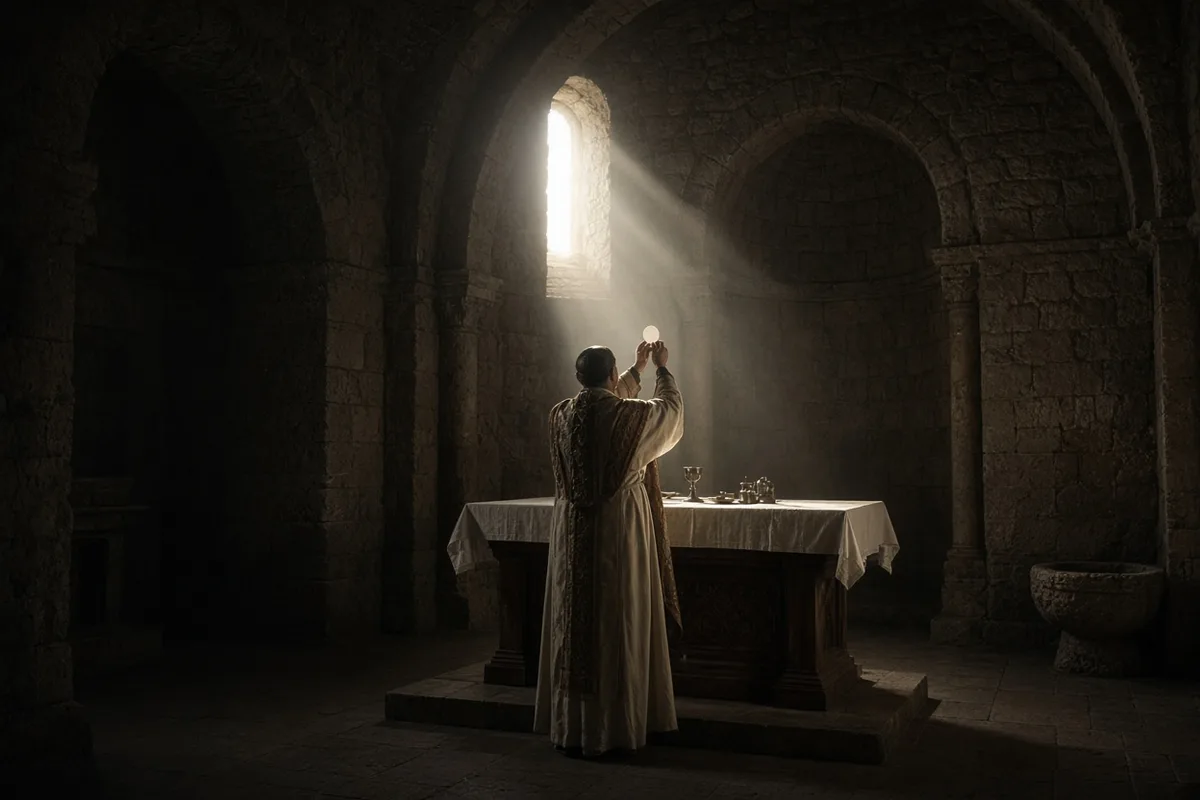
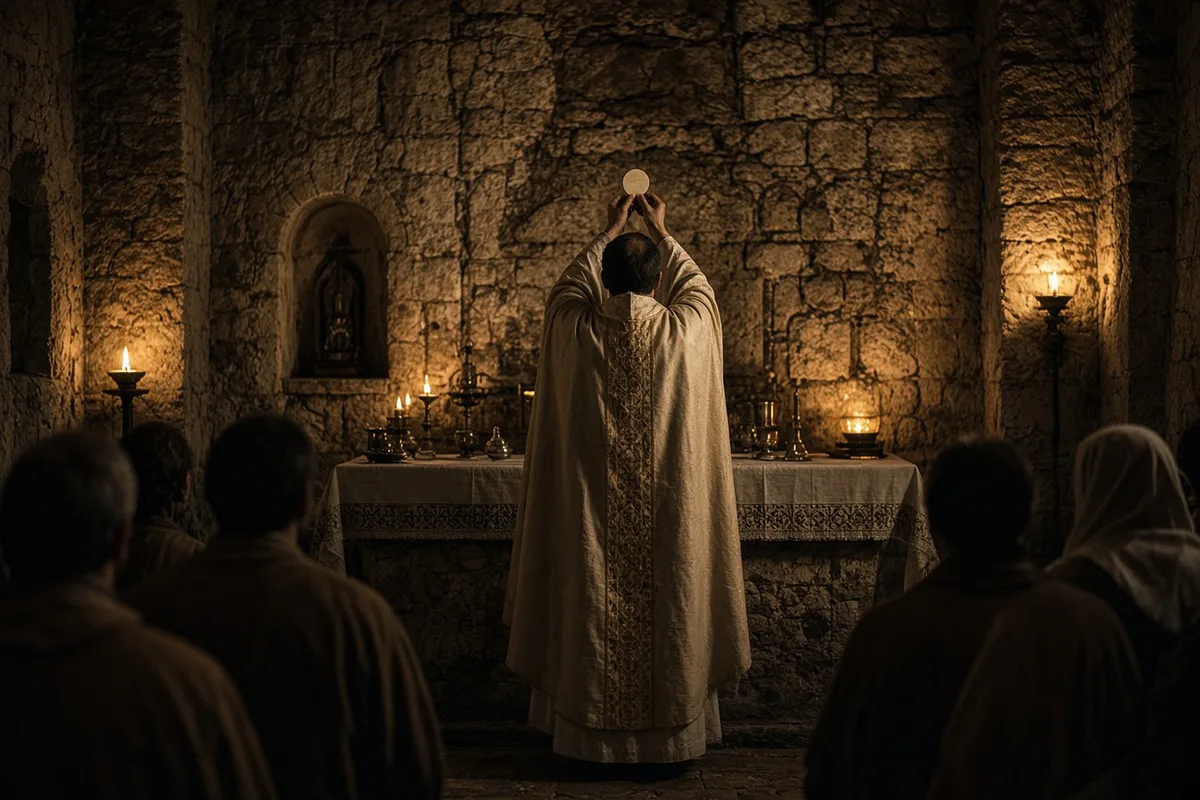
He walked to the altar without looking at any of us. The small congregation knelt on the worn flags. I stood to the side with the server, close enough to see the unleavened disk on the paten. His voice was steady until the moment the formula reached its center. Then it thinned, as if the air had grown thinner around the words.
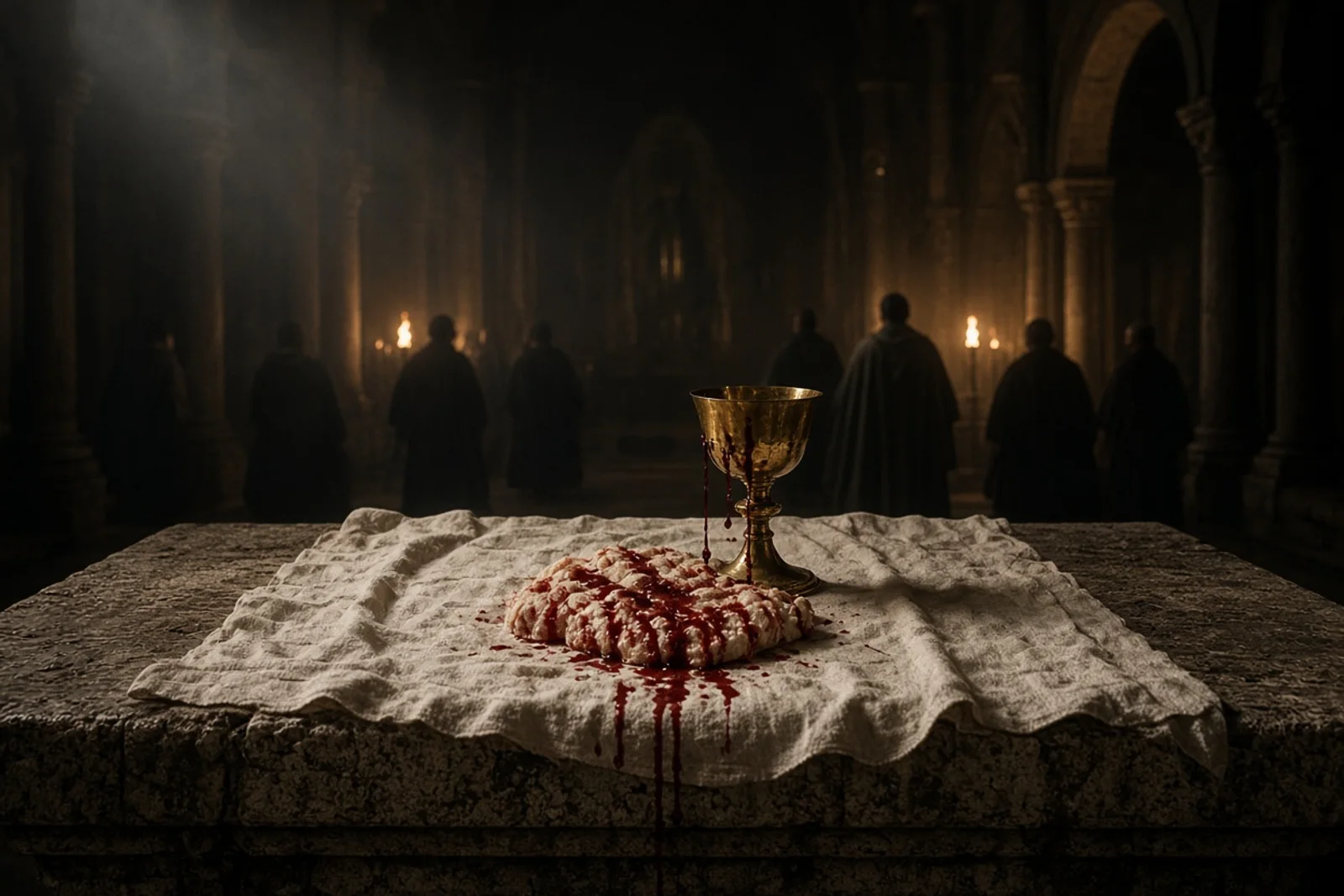
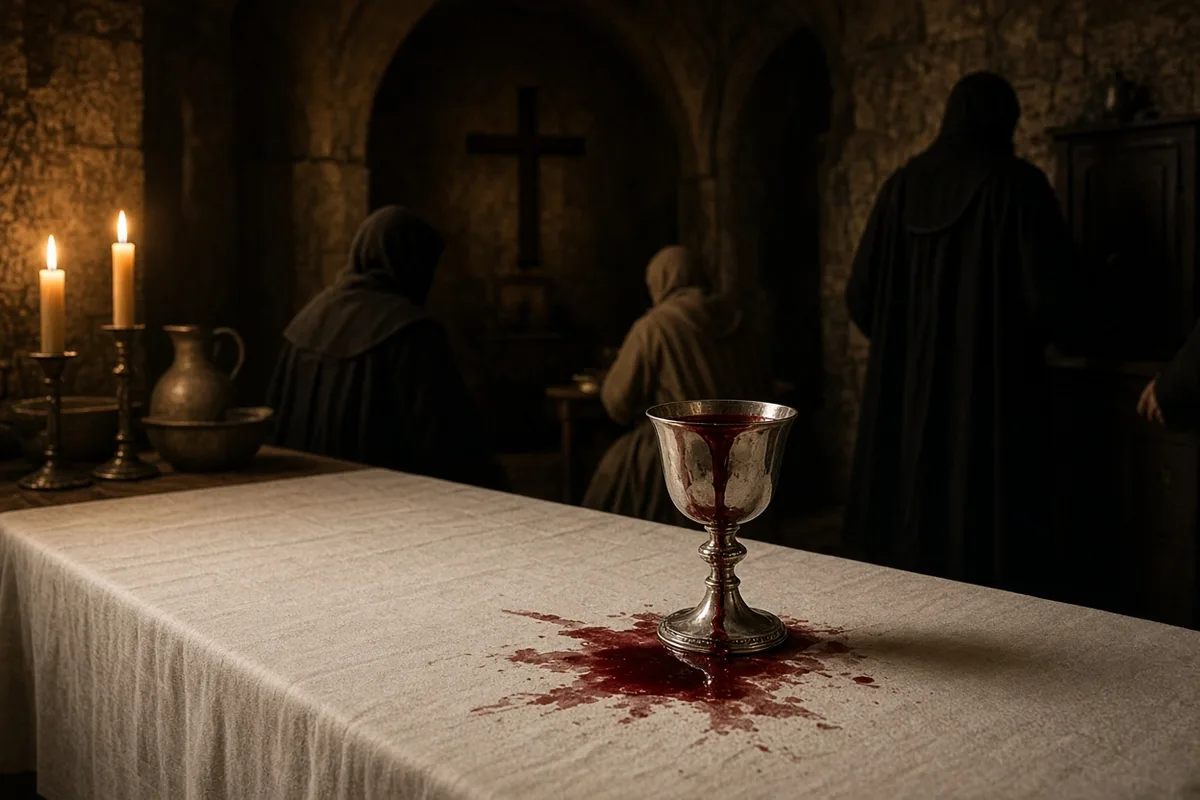
The change was not loud. The bread darkened at the edge and thickened, rounding into a membrane that glistened once and then settled. The wine in the chalice darkened at the same instant, rising into five separate beads that held their shape as the liquid beneath them cleared. He stepped back half a pace. The server made a small sound in his throat.
He turned toward the few who had come that morning. His face was wet. He told them to come closer and look. Some rose at once. Others stayed on their knees. The five beads of what had been wine sat separate on the base of the chalice, each a different width and height, yet the surface they rested on showed no tilt or spill.
We carried the vessels to the side chapel and set them on the stone shelf. No one touched them again that day. The monk who had celebrated remained on the step below the altar until the light through the high window moved past noon. When he finally stood, he asked that the relics be left where the people could see them without entering the sanctuary. The prior agreed.
The Basilian brothers kept the same vessels in that chapel through the following decades. When the community thinned under the pressure of the imperial edicts from the east, the remaining monks moved the membrane and the five beads into a plain ivory box lined with silk. They recorded nothing beyond the fact that the objects remained unchanged. In 1175 the last of them left for another house. The Benedictines who took possession the next year placed the box in the treasury behind the main altar and added a note of its weight.
By the middle of the thirteenth century the church itself had been given to the Franciscans. They built a larger structure on the same ground and moved the relics to a niche in the new apse. The ivory box was replaced in 1636 with one of wood and silver. In 1713 a Neapolitan silversmith fitted the present monstrance and chalice of rock crystal so that both could be seen without being handled.
Archbishop Rodriguez came in 1574. He brought a balance and witnesses. Each bead was placed on the scale alone, then with one other, then with three. The reading stayed the same no matter which combination was used. The archbishop had the result inscribed on a plaque that was later set into the wall of the chapel. The plaque survived the later rearrangements of the church.
In November 1970 the Franciscan guardians requested a new examination. Two professors from Arezzo and Siena were allowed to take small samples under the eye of the archbishop. The membrane proved to be striated cardiac muscle. The beads were human blood that had dried into a uniform hardened mass. No further permission for testing has been granted since.
Some have noted that no written account exists before the sixteenth century. Others point out that the same absence surrounds most objects kept in churches through those centuries of upheaval. The relics themselves have remained in the same church under the same order for more than seven hundred years.
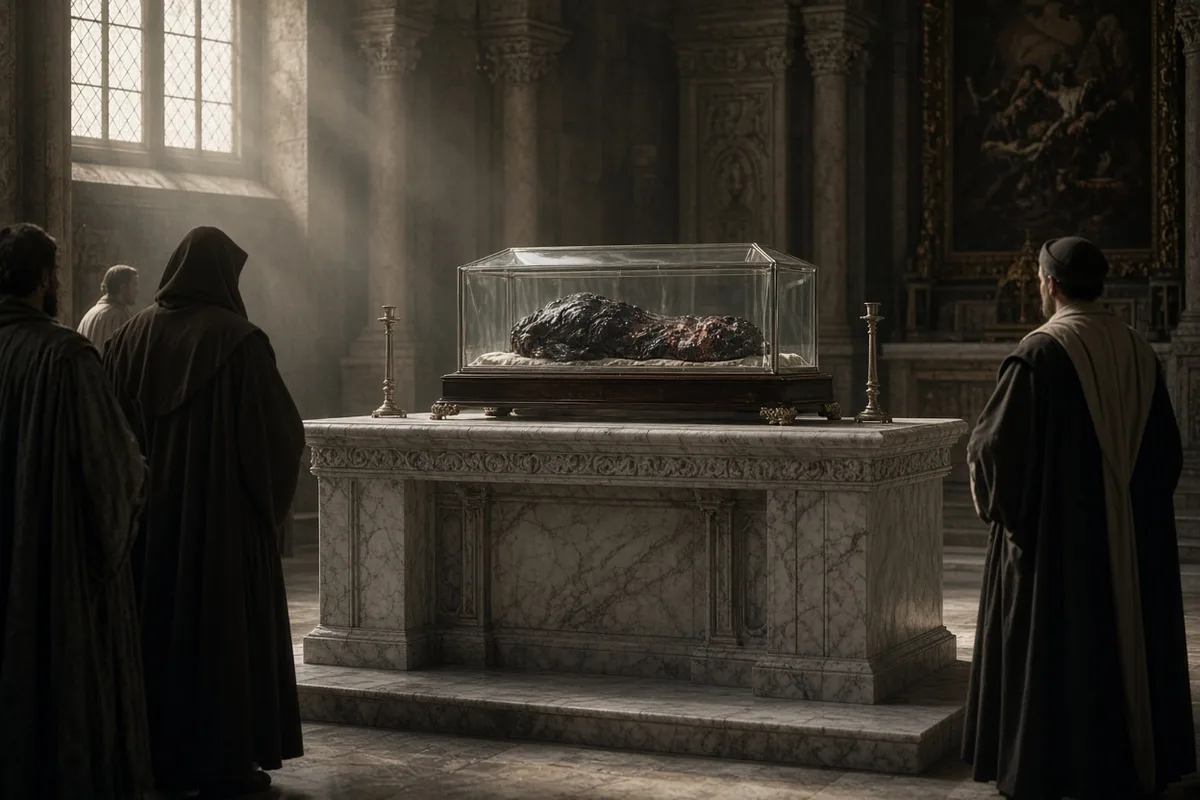
The present reliquary stands on the main altar behind a marble screen. From the side stair one can see the membrane through the glass, darker at the center where it thins, and the five beads resting in the crystal cup below it. The light from the clerestory windows moves across them once each afternoon and then passes on.
The sacristan Brother Anselmo opened the iron gate at the foot of the side stair each morning at half past six and closed it again after the last afternoon Mass. On 4 March 1971 he stood beside the marble screen while Professor Odoardo Linoli of Arezzo Hospital removed a sliver no larger than a grain of rice from the lower margin of the membrane and placed it in a sterile vial labeled “Campione A – 4.III.71.” Professor Ruggero Bertelli of the University of Siena recorded the time in his notebook and noted the temperature of the chapel at 14 degrees Celsius. The two men worked under the direct observation of Archbishop Pacifico Maria Luigi Perantoni and two notaries from the diocesan curia. Linoli later wrote in the published report that the tissue displayed “the characteristic cross-striations of cardiac muscle” and that the blood, typed as AB, showed “no trace of any preservative substance.”
The same report recorded that the five beads, when sectioned, proved to be a single homogeneous clot rather than separate coagula. Linoli weighed the entire cardiac fragment at 2.8 grams after drying and measured its thickness at the center as 0.4 millimeters. He placed a control sample of fresh myocardium beside it under the microscope and dictated the observation that the ancient specimen retained the same birefringence under polarized light. The Franciscans of the Convent of San Francesco entered the date of the examination in the Liber Chronicorum and noted that the relics were returned to the crystal monstrance the following day without any visible alteration.
Pilgrims continued to arrive by the train that stopped at the Lanciano station on the Adriatic line. In 1982 the Italian State Railways added a special coach on the feast of Corpus Domini for groups from Pescara and Chieti; the parish register for that year lists 47,312 signatures in the visitors’ book kept in the sacristy. Father Giuseppe Trinchieri, guardian of the convent from 1979 to 1988, recorded in his annual report to the provincial minister that the reliquary was carried in procession through the streets of the old town on the second Sunday after Easter, accompanied by the Confraternity of the Most Holy Sacrament founded in 1563. The route passed the site of the former Basilian monastery, now occupied by a municipal primary school whose courtyard still contains the original well head dated 1124.
In 2002 the crystal cup containing the five beads was fitted with a new silver collar stamped by the assay office of Naples with the mark “AG 925” and the date letter for that year. The work was carried out by the firm of Giuseppe Del Vecchio on Via Tribunali, whose invoice, preserved in the convent archive, itemizes 184 grams of silver and twelve hours of engraving. The monstrance itself received a new oak base reinforced with steel rods after an earthquake of magnitude 4.2 on 31 October 2002 caused a hairline crack in the original marble shelf. The crack was documented in photographs taken by the regional superintendency for cultural heritage on 12 November of the same year.
Archbishop Carlo Ghidelli visited the church on 8 December 2004 and celebrated Mass at the main altar. In his homily he quoted the phrase from the 1574 plaque—“Pondera aequalia inventa sunt”—and instructed that a new bronze plaque bearing the same Latin sentence be affixed beside the 1971 laboratory report, which had been framed and hung in the chapel. The text of the report, printed by the diocesan press in Chieti, runs to forty-three pages and includes twelve photomicrographs. Copies are sold at the bookstall near the entrance for three euros each.
The last Franciscan friar to live in the convent full time was Father Serafino Di Lullo, who died on 19 February 2019 at the age of ninety-one. Until the week before his death he continued to open the iron gate each morning and to dust the marble screen with a linen cloth kept in a drawer of the sacristy cupboard. On 17 February he asked the parish secretary to note in the ledger that the light from the clerestory windows still reached the crystal cup at approximately four forty-five in the afternoon during the month of February. The secretary recorded the observation in blue ink on the line dated that day. After Father Di Lullo’s funeral the provincial minister assigned the daily care of the relics to two diocesan priests who reside in a house two streets away and come to the church only for scheduled liturgies. The iron gate is now opened by an electronic timer set to six thirty and locked again at seven in the evening.
In June 2021 the diocesan office in Chieti installed a closed-circuit camera above the crystal monstrance after a visitor attempted to photograph the membrane with a flash unit on 14 May. The camera, model Hikvision DS-2CD2143G2-I, records at 4K resolution and stores footage for thirty days on a server located in the sacristy cupboard that once held Father Di Lullo’s linen cloths. The provincial minister approved the installation on the condition that the feed remain accessible only to the two resident priests and to the Carabinieri station on Via del Popolo. A notice posted beside the marble screen states that “images are retained solely for security purposes” and carries the signature of Monsignor Luciano Di Marcantonio dated 2 June 2021.
During the renovation of the adjacent cloister in October 2022, workers uncovered a fragment of the original Basilian well head dated 1124 beneath the new concrete floor of the municipal school. The fragment, measuring 18 centimeters by 9 centimeters and bearing the incised letters “ANNO MCLXXIV,” was transferred to the convent archive and catalogued under inventory number 2022/47. The same works revealed a layer of 13th-century fresco plaster still adhering to the north wall of the former refectory; conservators from the Soprintendenza di Chieti removed three samples for pigment analysis and returned the wall to its sealed state within forty-eight hours.
On 12 September 2023 the crystal cup was removed for the first time since 2002 so that the silver collar could be inspected for corrosion. The collar, stamped AG 925 and the Naples date letter “C,” showed no measurable loss of thickness when tested with a micrometer at six points by silversmith Giuseppe Del Vecchio’s grandson, Marco Del Vecchio. The cup itself, after cleaning with distilled water and a soft goat-hair brush, was weighed at 187.4 grams and returned to the monstrance the same afternoon. The entire operation was witnessed by the vicar general, Don Michele Colalella, who recorded the start time as 09:17 and the completion time as 14:52 in the convent ledger.
The electronic timer controlling the iron gate was recalibrated on 3 January 2024 after complaints that the gate remained unlocked until 19:40 on several December evenings. A technician from the firm Elettra Service of Pescara adjusted the internal clock to account for the transition to Central European Time and installed a backup battery rated for seventy-two hours. The revised schedule now opens the gate at 06:25 and locks it at 19:05 from 1 April to 30 September, with printed notices to that effect affixed to both sides of the gate on 5 January.
In the parish register for 2023 the sacristan noted 38,764 signatures, a decline of 8,548 from the 2019 total. The largest single group recorded was a pilgrimage of 214 members of the Confraternity of the Most Holy Sacrament from the parish of San Pietro in Vincoli, Rome, who arrived by chartered bus on 16 October and were admitted for private veneration between 10:00 and 10:45. Their names occupy four consecutive pages of the visitors’ book, each entry written in the same blue ballpoint pen supplied at the bookstall.
The 1971 laboratory report, framed beneath glass since 2004, was examined by a paper conservator on 22 March 2024 after a small brown stain appeared in the lower right margin. The conservator, Dr. Elena Rossi of the University of Urbino, identified the stain as iron-gall ink transferred from an earlier annotation and removed it with a 0.5 percent solution of calcium phytate applied under magnification. The treatment lasted four hours and left no visible residue; a new protective sheet of 100 percent cotton museum board was inserted before the frame was resealed.
On weekday afternoons the two diocesan priests now alternate the duty of checking the monstrance seal. Father Antonio De Carolis, assigned to the church since 2020, enters the chapel at 16:40 each Tuesday and Thursday, opens the small access door with a brass key numbered 7, and confirms that the wax seal stamped with the diocesan arms remains intact. Father Paolo Mastroianni performs the same inspection on Mondays, Wednesdays, and Fridays. Both men initial a logbook kept on the sacristy shelf; the most recent entry, dated 11 April 2024, reads “seal verified, light incidence normal,” followed by the initials “A.D.C.”
At 16:47 on 9 May 2024 a woman in a dark coat climbed the side stair alone and stood before the marble screen for eleven minutes. She carried no camera or phone and did not sign the visitors’ book. When the clerestory light reached the crystal cup she leaned forward until her forehead nearly touched the glass, then straightened, turned, and descended the stair without speaking. The security camera recorded her departure through the west door at 16:58; the footage shows only her back and the empty chapel behind her.