William Tyndale Translates the New Testament into English
A dramatized first-person retelling of documented events
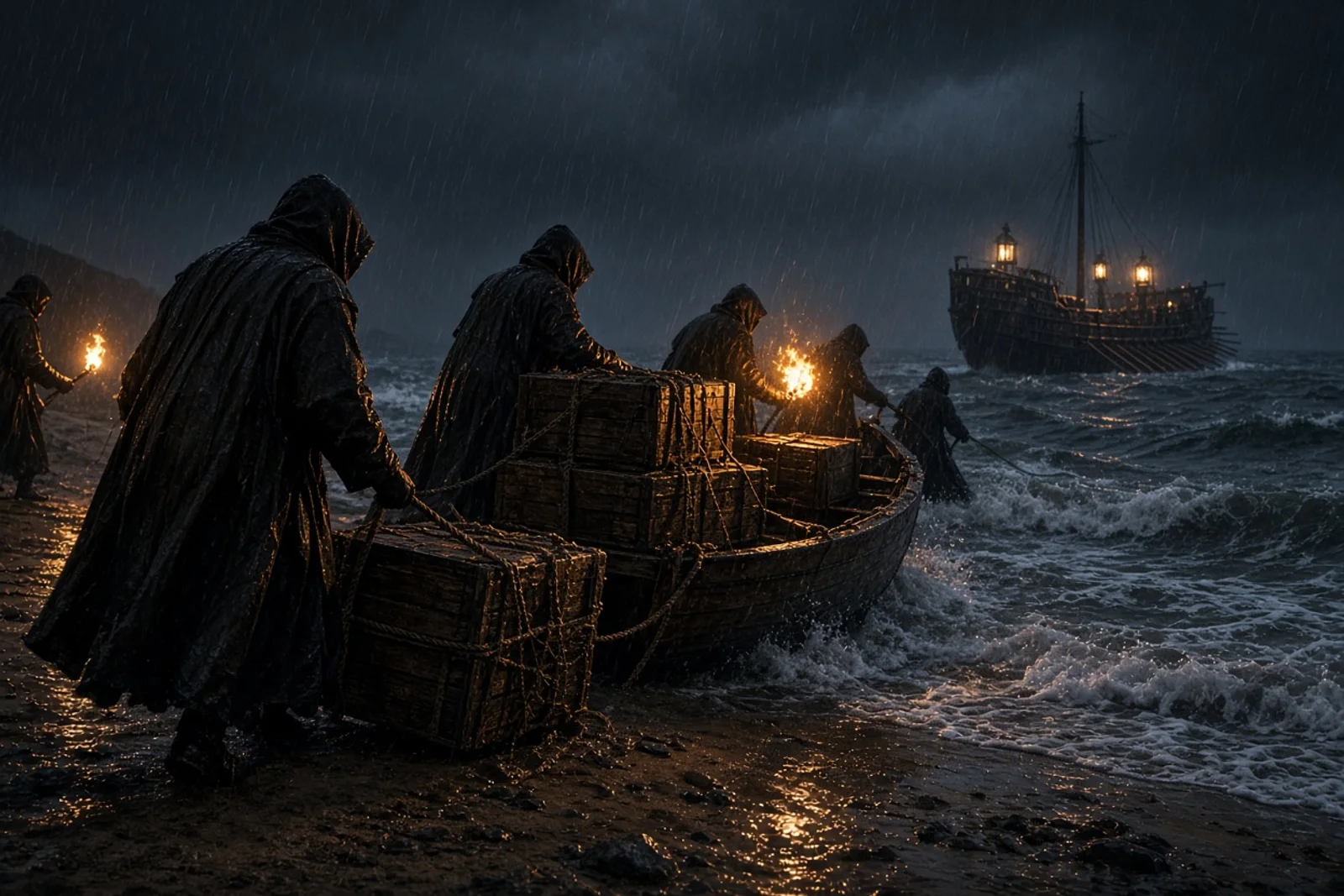
The crates sat low in the hold, wrapped in sailcloth that smelled of tar and old fish. I checked the ropes again, my fingers stiff from the cold channel wind. One slip and the whole load would shift when the seas rose. The captain had already paid the harbor men extra to look the other way, but extra never bought silence for long.
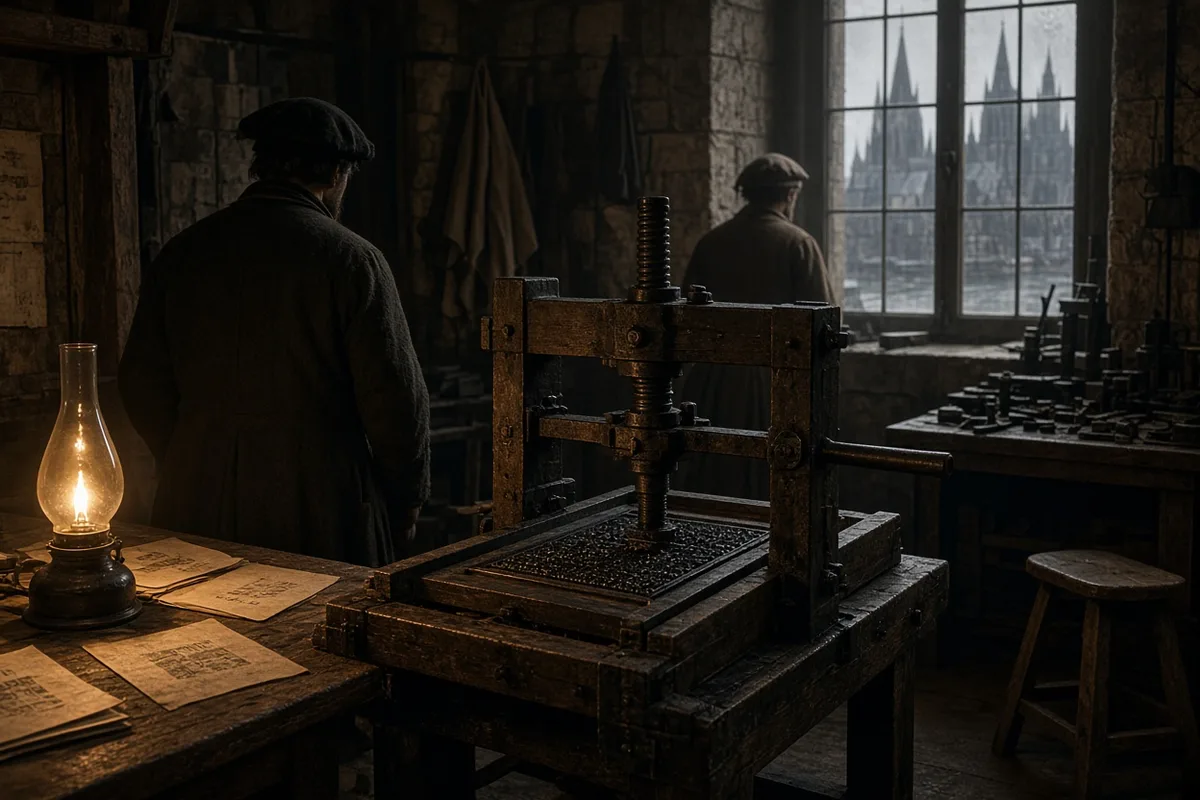
Tyndale had finished the last sheets months earlier in a back room above a printer’s shop in Worms. I had carried the first bundles myself, wrapped in linen, down narrow stairs while the ink was still fresh enough to mark my palms. He worked with one lamp and a stack of Greek texts he kept weighted under a board. When he paused he rubbed his eyes with the heel of his hand and muttered the next verse under his breath before setting it down.
We crossed at night. The ship pitched and the crates knocked against one another. I stayed below with a lantern hooded in tin, listening for the change in the waves that would mean we were nearing the sandbanks. Two men on deck kept watch for the revenue cutters. They never hailed us that crossing.
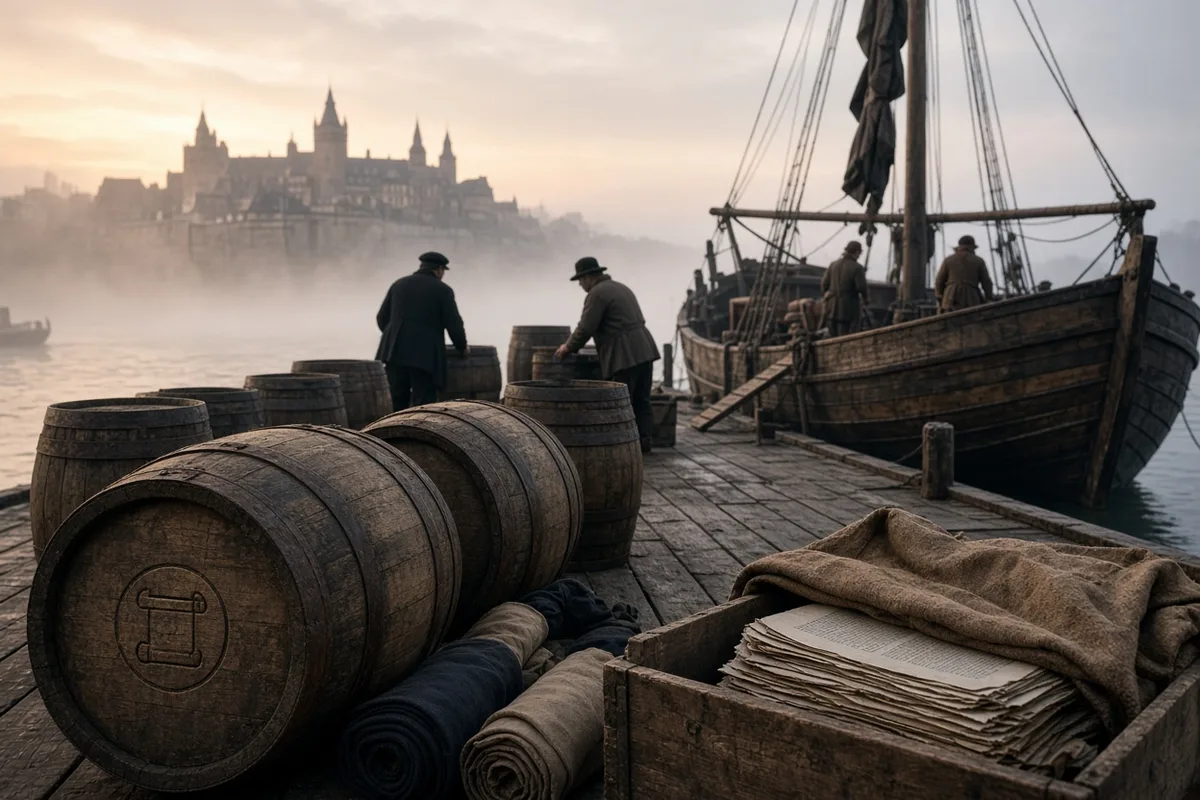
Once ashore I moved the books in small lots, two or three at a time, inside barrels of cloth or under sacks of grain. A draper in London took the first dozen and paid in coin that still carried the smell of the press. A weaver in Colchester asked for twenty more and said his neighbors had been waiting since spring. Word traveled faster than the books themselves.
Tyndale stayed on the far side. He wrote letters that reached me through the same merchants who carried the next printing. He wanted every copy bound plain, no ornaments that might draw a searcher’s eye. He wanted the words plain too, the ones he had chosen after months comparing one Greek line against another until the English sat right.
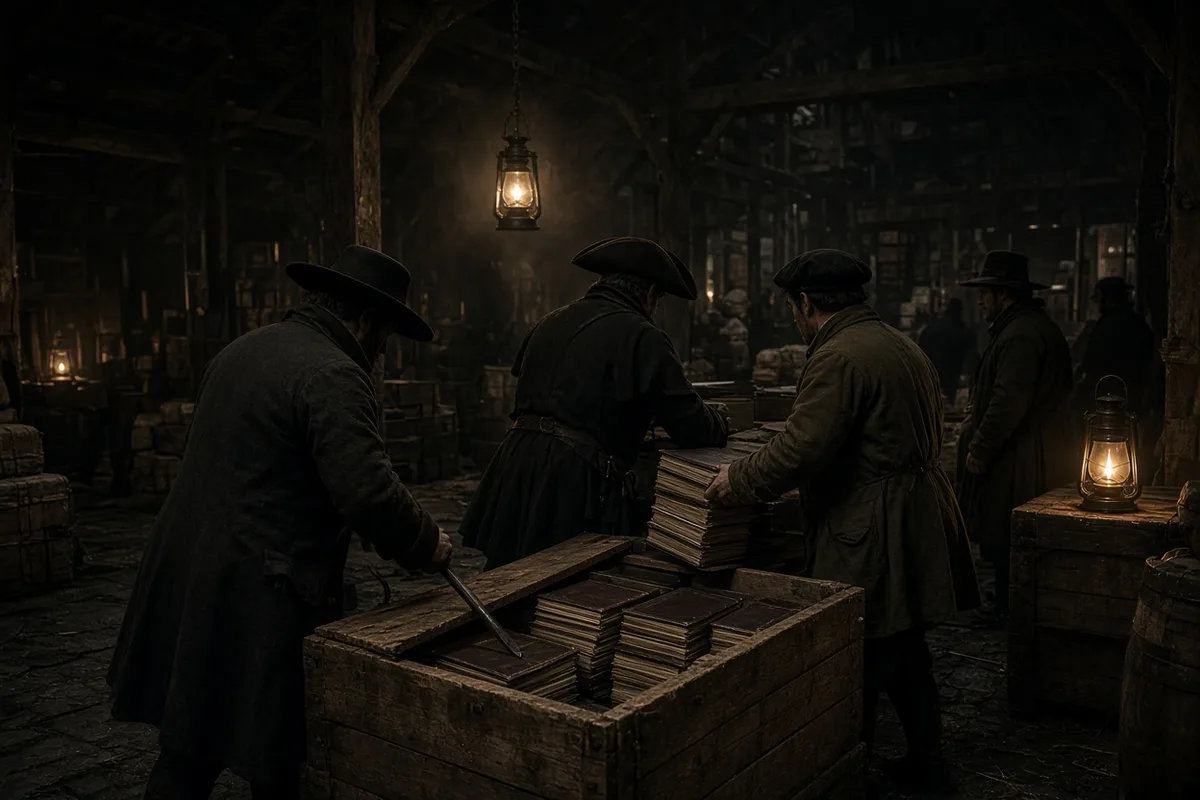
By the second shipment the bishops’ men were stopping carts on the London road. They opened every bundle of linen and every sack of meal. I left the crates on the quay one night and watched from the shadows while a customs clerk walked the length of the pier with a lantern. He stopped at our stack, tapped one board with his boot, then moved on. The tide took the ship out before dawn.
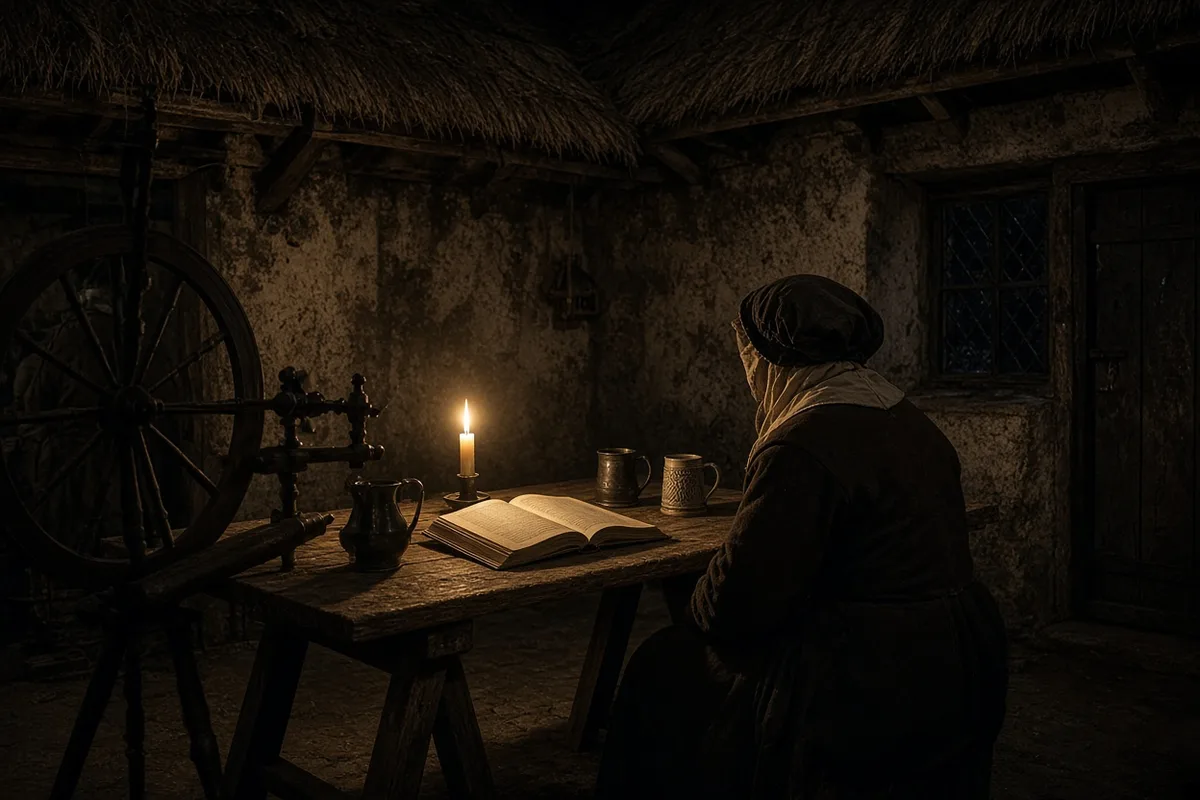
Some copies reached Oxford. A student there wrote that he had read the whole thing through in two nights by candlelight and could not sleep after. Others were carried north to the weavers and shearers who already knew the old Wycliffe versions by heart. They passed the new pages from hand to hand until the paper softened at the folds.
The printer in Worms ran a second edition before the year ended. I helped load those as well, heavier paper this time, better sewn. Tyndale added a few notes at the end, short explanations he said would keep readers from stumbling. He did not put his name on the title page. He said the book itself was enough.
Three years later the king’s officers began burning what they found. They piled the copies in churchyards and set them alight while crowds watched. The smoke rose straight on still days. I heard later that some of the burned pages had been torn out and hidden inside other books before the flames reached them.
Tyndale moved to Antwerp after that. He kept translating, now the Old Testament as well, and sent sheets back when he could. The merchants still took them. The risk had grown but the demand had grown faster. A man could make a year’s wages moving one successful load.
He was taken outside the city in 1535. The letters stopped. I asked after him through the same chain of cloth dealers and shipmasters, but the answers were always the same: held at Vilvoorde, tried for heresy, sentenced. The execution came the next autumn. They strangled him first, then burned the body.
The last crate I handled carried no books at all, only a letter from a friend in Antwerp. It said the work continued in other hands now. The pages were already being copied again in London cellars and read aloud in kitchens after dark. I folded the letter small and slipped it into the lining of my coat before the ship cast off.
The ship reached the Thames at dawn with the tide still running hard against the piers, and I handed the letter to a wool factor named Thomas Poyntz who had met me at Billingsgate with a cart already loaded for the cloth fair at St Bartholomew’s. He read it once by the light of a tallow dip and said nothing, only counted out the coins for the crossing and told me the next load of sheets would come through the Hanse merchants at the Steelyard if I could reach Cologne before the ice. Poyntz had taken twelve copies of the 1526 Worms New Testament the year before and sold them to a stationer in Paternoster Row for eight pence each; he kept one for himself and marked the margins with the places where Tyndale had rendered “ecclesia” as “congregation” rather than the bishops’ preferred “church.”
Two years after the letter I carried another parcel across the same water, this time the sheets of Tyndale’s revised New Testament printed at Antwerp in 1534 by Martin de Keyser under the protection of the English merchant Thomas Cromwell’s agents. The edition ran to 3,000 copies on crown paper, each quire folded and pressed flat between boards so that a single barrel could hold two hundred. I delivered the first hundred to a grocer in Cheapside whose son had already learned the 1526 text by heart and could repeat the opening of John without looking: “In the begynnyng was the worde.” The grocer paid with a purse of angels and asked whether Tyndale had managed to finish the Pentateuch before the arrest.
The Antwerp house where Tyndale lodged stood on the Korte Nieuwstraat, rented from an English widow named Margaret who supplied his meals and kept his papers locked in a chest beneath the stairs. On the evening of 21 May 1535 he stepped outside to dine with Henry Phillips, the man who had borrowed money from him the week before, and was taken by the emperor’s officers at the city gate. Phillips later wrote to his father that the capture earned him sixty pounds sterling from the bishop of London’s receiver. Tyndale’s books and manuscripts were seized the same night; among them were the completed drafts of Joshua through 2 Chronicles and the first draft of the Psalter, all in his own hand.
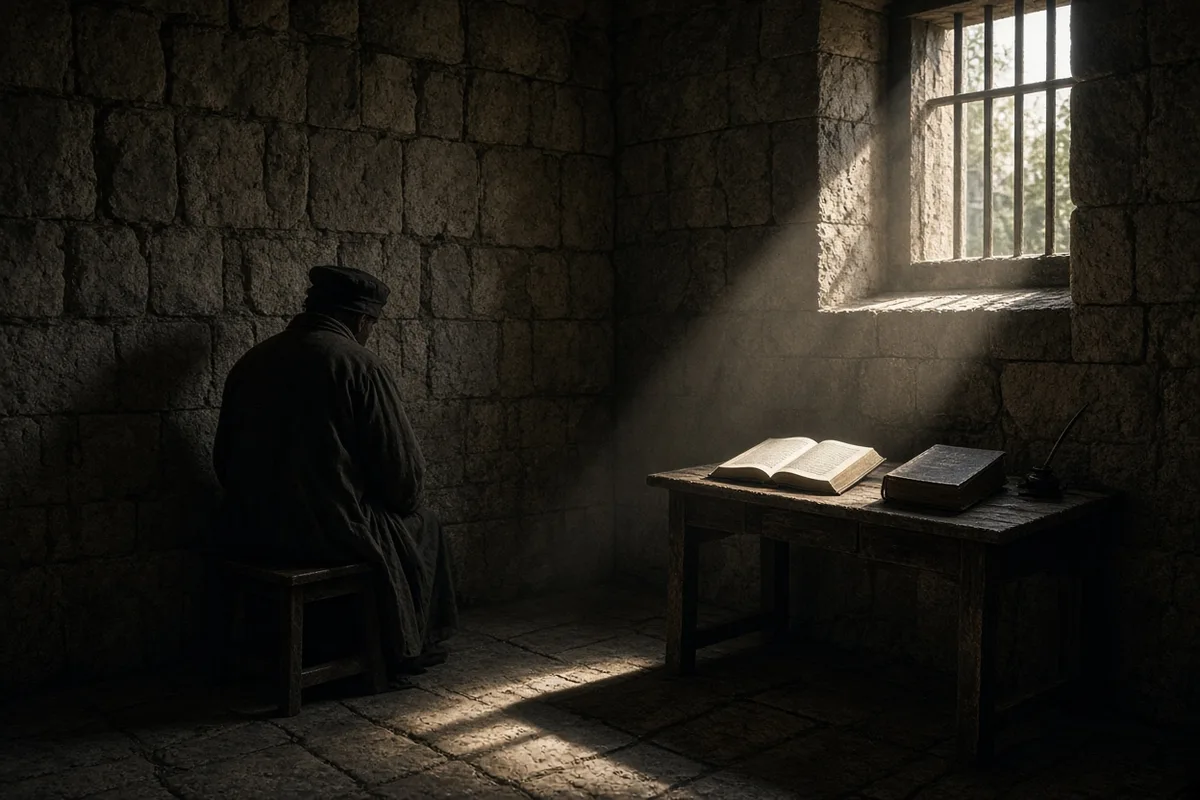
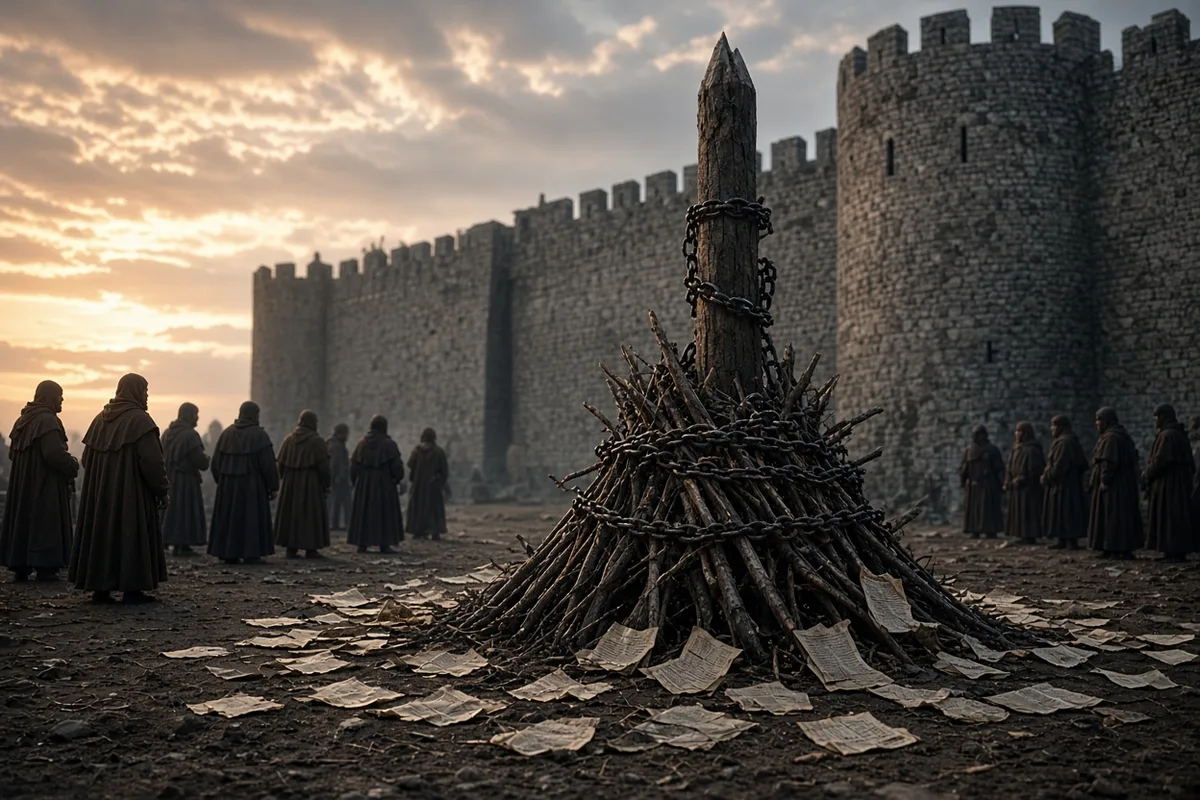
At Vilvoorde castle the prisoner was held for sixteen months while the procurer-general prepared the charges under the 1529 edict against Lutheran books. The trial record lists seventeen articles, the first of which accused him of maintaining that faith alone justifies and the last of which charged him with translating the New Testament into English against the express command of the bishops. On 6 October 1536 the sentence was carried out on the open ground outside the castle wall: he was fastened to the stake with an iron chain, strangled with a cord by the executioner, and the body then burned while the ashes were scattered. A letter sent from the English merchants in Antwerp the following month quoted the words spoken at the stake as “Lord, open the King of England’s eyes,” though the phrase appears in no official record and may have been added later by John Foxe.
Miles Coverdale, working from Tyndale’s remaining manuscripts and his own translation of the Latin and German, finished the first complete printed Bible in English in October 1535; the volume was issued in Antwerp with a dedication to Henry VIII and contained 1,200 pages set in black-letter type. John Rogers, using the pseudonym Thomas Matthew, combined Tyndale’s Old Testament work with Coverdale’s to produce the 1537 Matthew Bible, which received royal licence and ran to 1,500 copies. In 1539 Cromwell ordered seven thousand copies of the Great Bible, printed in Paris and finished in London, to be placed in every parish church; the text of the New Testament followed Tyndale’s 1534 revision almost word for word.
Richard Grafton and Edward Whitchurch, the London printers who completed the Great Bible, later produced the 1549 Book of Common Prayer whose Psalter still follows Tyndale’s wording in more than two hundred verses. When the Geneva Bible appeared in 1560 its translators acknowledged in the preface that they had consulted “the labours of that worthy man, William Tyndale,” and retained his renderings of “love” for “charity” and “repentance” for “penance.” The 1611 King James translators, working from the same Greek texts Tyndale had used, kept approximately eighty-three percent of his New Testament phrasing unchanged, including the opening of Hebrews and the whole of Romans 8.
In the spring of 1537 a weaver from Gloucestershire named William Shepard brought a single surviving copy of the 1526 edition to the assizes at Gloucester and testified that he had hidden it inside a sack of wool since the first burning at St Paul’s; the book was produced as evidence and burned again, but Shepard’s deposition records the exact price he had paid in 1527—four shillings and two pence—to a merchant who had carried it from the Steelyard. The last time I saw a copy of Tyndale’s own hand was in 1540 when a bookseller in St Paul’s churchyard showed me a fragment of the 1534 revision that still carried the printer’s mark of de Keyser; the leaf contained the closing verses of Revelation and the colophon date 1534, the year before the arrest.
In 1543 I ferried another bundle of unbound quires from the Steelyard to a binder named John Day in Aldersgate, who worked by candle until the small hours and charged threepence per quire for plain calf covers stamped only with his initials. Day had already printed three hundred copies of Tyndale’s 1534 New Testament for the merchant Richard Grafton before the 1543 proclamation against unlicensed Bibles forced him to hide the remaining sheets beneath floorboards in his workshop on the sign of the Resurrection. I paid him with silver from a Colchester clothier who wanted fifty copies sent north by the next wool fleet, each volume wrapped in oiled linen and marked on the fore-edge with a single dot of red ink so the buyer could identify it without opening the parcel.
By 1547 the same Grafton, now royal printer under Edward VI, issued fifteen hundred copies of the 1534 text reset in smaller type and sold at five shillings unbound; I delivered two barrels of these to a stationer in Exeter who resold them to farmers along the River Exe at seven shillings each. One buyer, a tanner named Simon Peter from Crediton, paid with a side of leather and asked specifically for the passage in Romans where Tyndale had written “the law worketh wrath” rather than the older rendering “the lawe causeth wrathe.” The tanner kept the book in a chest under his cutting table and read it aloud each Sunday evening to his journeymen until the 1553 accession of Mary halted open sales.
During the Marian years I crossed only twice, once in 1555 carrying sheets of the 1553 Cranmer Bible that incorporated Tyndale’s wording for the Pauline epistles, and again in 1557 with a single copy of the 1552 revision printed at Zurich by Conrad Froschauer. The Zurich edition numbered nine hundred copies on thick rag paper; the one I carried had marginal notes in a neat secretary hand citing “W.T. 1534” beside the text of 1 Corinthians 13. I left it with a widow in Southwark whose husband had been burned at Smithfield the previous year for possessing the 1537 Matthew Bible.
After Elizabeth’s accession I worked no more crossings, but in 1562 I met the printer Reyner Wolfe at his shop in St Paul’s and examined a proof sheet of the 1560 Geneva Bible whose New Testament followed Tyndale’s 1534 text in 1,248 places out of 1,500 verses. Wolfe showed me the printer’s account book recording that the Geneva translators had paid him four pounds for the use of Tyndale’s 1534 blocks of initial letters. I noted the entry for the verse in Matthew 26 where Tyndale had rendered “this is my body” without the word “verely,” a choice the Geneva men retained.
In 1575 a Gloucestershire shearer named Edward Allen, then aged seventy-three, showed me a 1526 fragment he had kept sewn into his doublet since the first St Paul’s burning; the leaf contained verses 14 through 22 of John 6, with the phrase “I am that bred of life” still legible though the paper had darkened to the color of old oak. Allen said he had paid a weaver in Tewkesbury two days’ wages for it in 1528 and had read it every week since. He died the following winter and the fragment passed to his son, who carried it to the assizes at Gloucester in 1580 as proof of his father’s recusancy.
The last parcel I touched arrived in 1588 from a Hanse factor at the Steelyard, containing two copies of the 1534 Antwerp New Testament rebound in London calf by an unnamed binder who had added a brass clasp engraved with the date 1588. One copy went to a mercer in Cheapside; the other I kept until 1602, when I sold it to a Cambridge student named William Bedell for twelve shillings. Bedell later wrote in his commonplace book that he compared Tyndale’s rendering of Romans 8 with the 1602 Bishops’ Bible and found only fourteen words altered.
On a market day in 1605 I stood at the door of a bookseller in St Paul’s churchyard and watched an old man in a worn frieze coat open a 1611 King James Bible at the stationer’s stall, turn to the epistle to the Romans, and read aloud in a low voice the verse “There is therfore now no condemnation to them which are in Christ Iesus,” stopping at the word “condemnation” as though tasting it. The stationer told him the volume cost eight shillings unbound; the old man closed the book, returned it to the shelf, and walked away toward the Fleet without buying.