The Eucharistic Miracle of Santarem
A dramatized first-person retelling of documented events
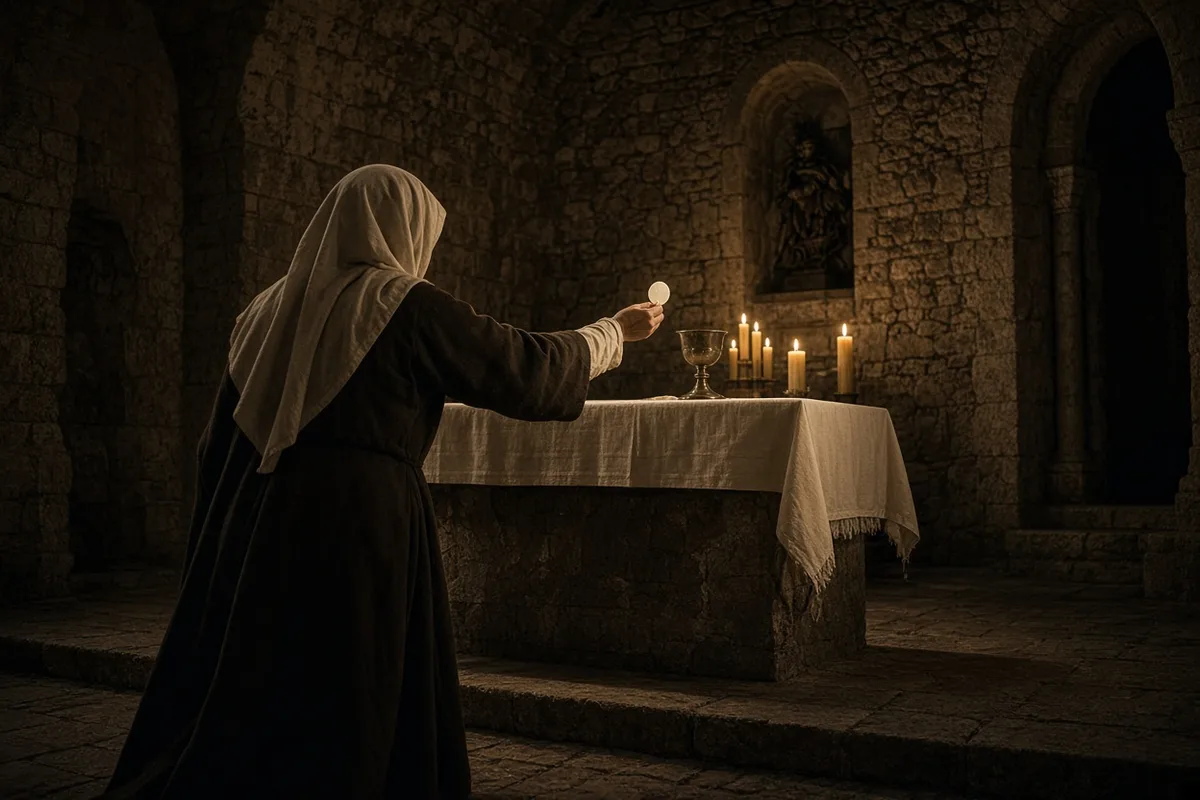
I left the church with the particle still on my tongue and the linen already folded twice over my fingers. The street outside Saint Stephen’s was quiet that morning, dust rising from the stones where the market carts had passed earlier. I kept my head down and walked toward the lane that led to the witch’s door.
Halfway there the cloth grew warm against my palm. I thought it was only the sun until I felt the first drop slide between my knuckles and land on the hem of my skirt. Another followed, then a thin line that reached the ground and left a dark mark on the pale dirt. Two women carrying water jars stopped and stared. One called out that I was hurt. I pressed the veil tighter and kept moving, the drops now falling faster than I could count.
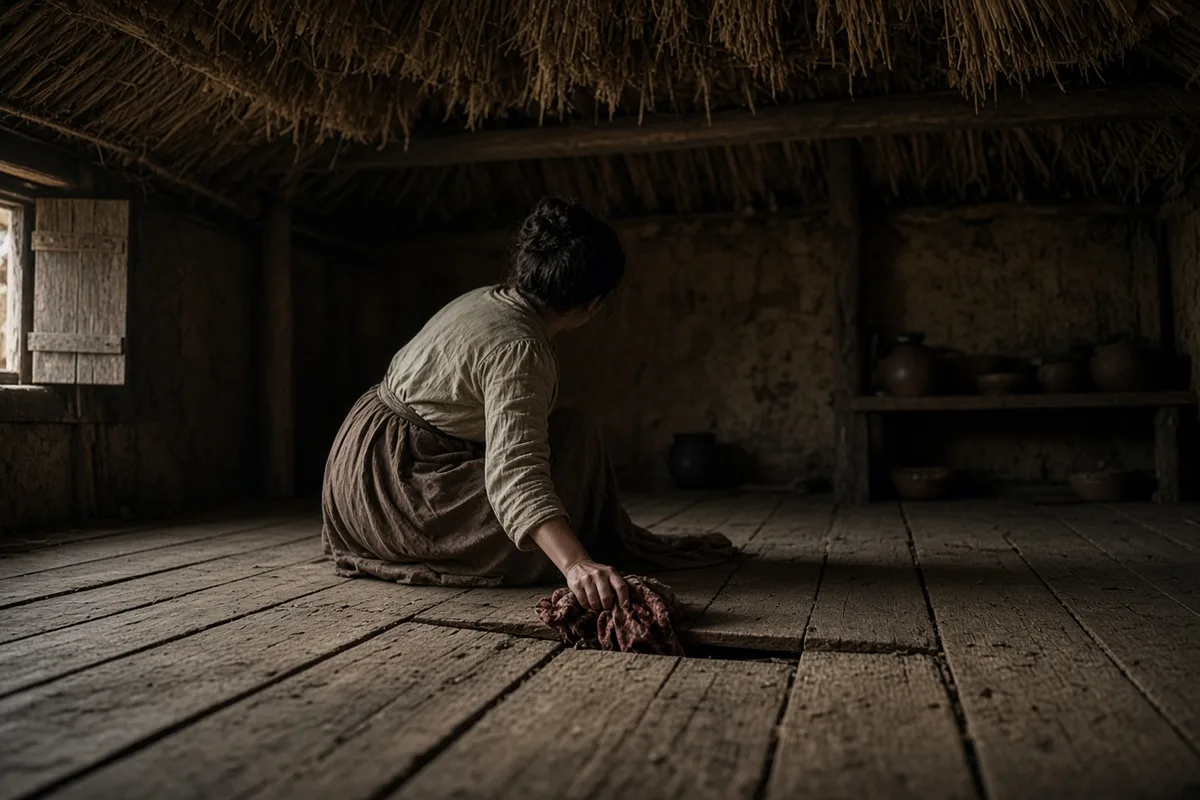
At the house I opened the chest at the foot of the bed and laid the folded cloth inside. The lid closed with a small sound that seemed too ordinary for what had just happened. I sat on the floor until my husband returned from the fields. We ate in silence. When the lamps were out I lay awake listening to the ordinary noises of the street outside.
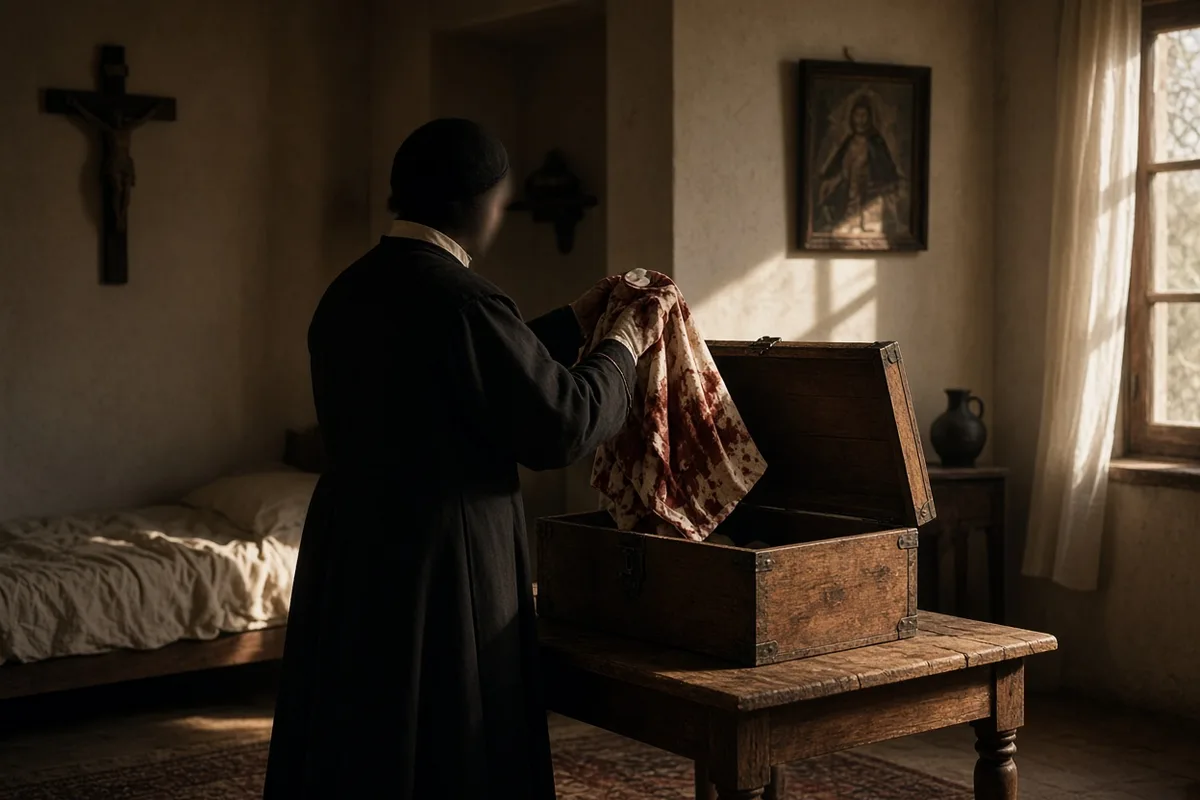
Sometime after midnight both of us woke at once. Light filled the room, not from the window or the hearth but from the seams of the chest. It was steady and white, the kind that makes ordinary objects look carved from bone. My husband sat up. I told him what I had done. He did not speak for a long time. Then he got out of bed and knelt beside the chest. I joined him. We stayed there until the sky began to pale.
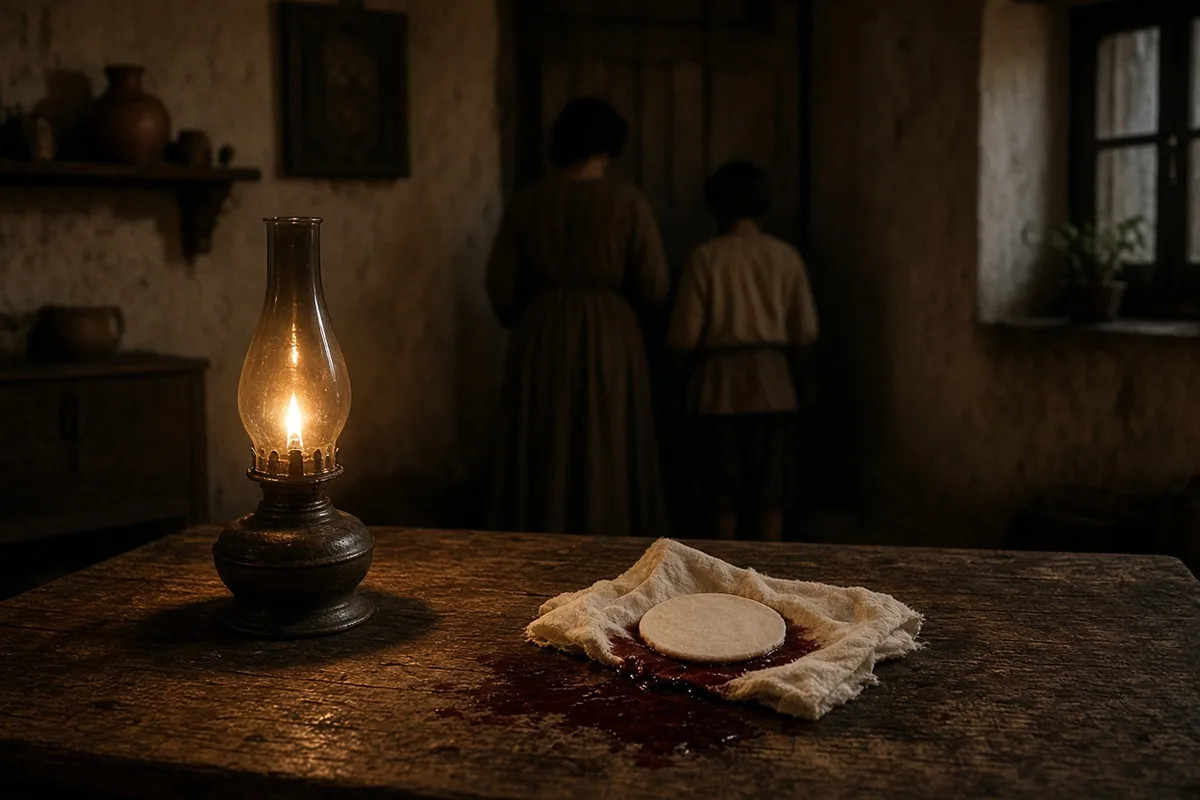
At first light he went for the parish priest. The man arrived still in his night clothes, carrying the keys to the tabernacle. He opened the chest himself. When he lifted the veil the blood had soaked through in a perfect circle. He wrapped everything again and sent word through the neighborhood. By mid-morning the lane was filled with people standing at a distance, some crossing themselves, others simply staring at the closed door.
The priest decided the particle must return to the church at once. Four men carried the chest on their shoulders. I walked behind them with my husband. The crowd grew as we moved. No one shouted. The only sound was the shuffle of feet and the occasional cough. Inside the church the priest placed the chest on the altar and opened it again. The light was gone, but the blood on the linen remained bright. He set the particle inside a wax vessel shaped like a small sun and locked it in the tabernacle.
For three days the blood continued to appear on the surface of the particle whenever anyone opened the tabernacle to look. On the fourth day it stopped. The priest ordered the wax vessel sealed with thread and wax. People still came, but the door was kept shut except during the hours of public prayer.
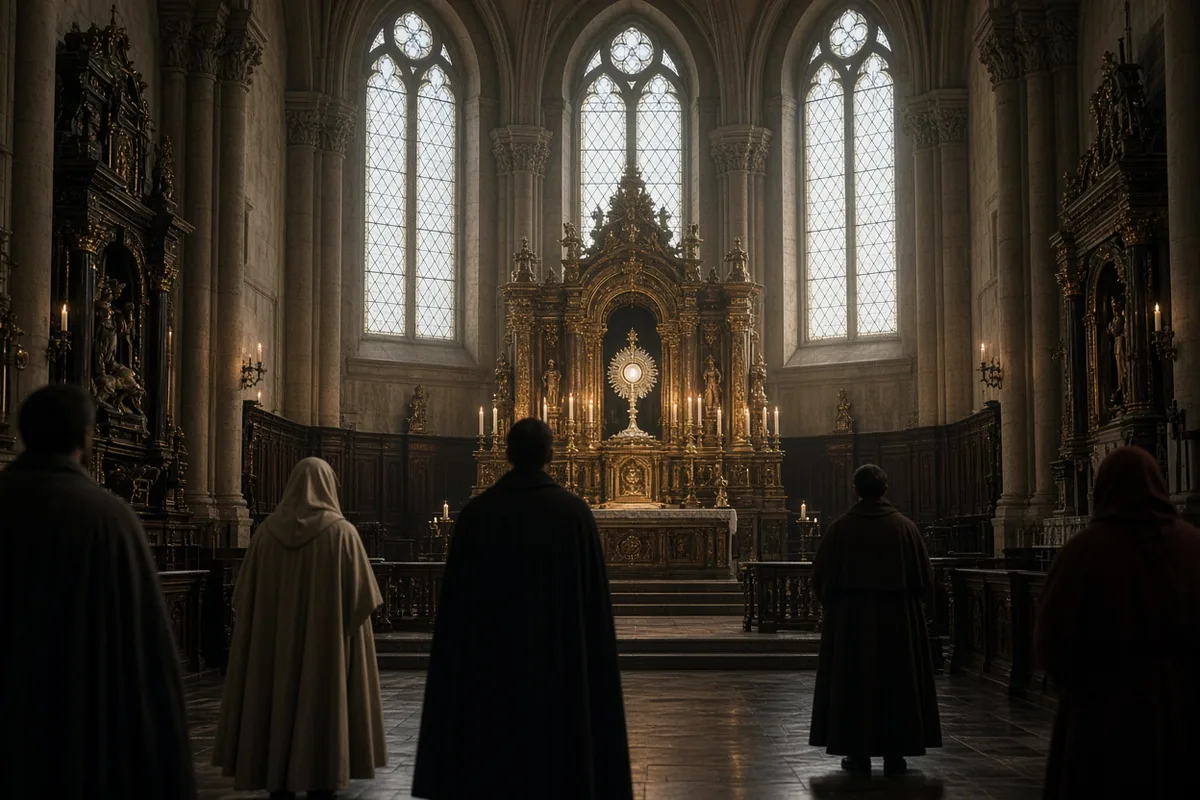
Years passed. The wax vessel stayed in its place. Pilgrims arrived from other towns, some walking barefoot, some carrying small offerings of oil or bread. The parish kept a record of the visitors in a book that grew thicker each season. In 1340 the tabernacle was opened for the annual feast and the wax was found split in several pieces. Inside, untouched by the breakage, stood a small crystal vessel no one had placed there. The particle rested inside it as though it had always been so. The priest ordered a silver frame made to hold the crystal, and that frame has remained above the altar since.
The house where the chest had stood was torn down long ago. In its place a small chapel was built, its door facing the same lane. Travelers stop there before they enter the main church. Some leave written petitions folded and slipped into the grille.
Queen Isabel passed through Santarém on her way to settle the quarrel between King Denis and their son. She ordered a procession and walked in it herself, barefoot, a cord around her neck, ashes on her forehead. The silver frame was carried through the streets that day. The queen kept pace with the bearers until the church steps.
King Afonso VI came on the twenty-fifth of January in 1664. He entered the church alone at first, then asked to see the linen that had wrapped the particle on the first day. The old cloth was brought from its case. Traces of the blood were still visible on the weave. The king remained in the church until the bells rang for evening prayer.
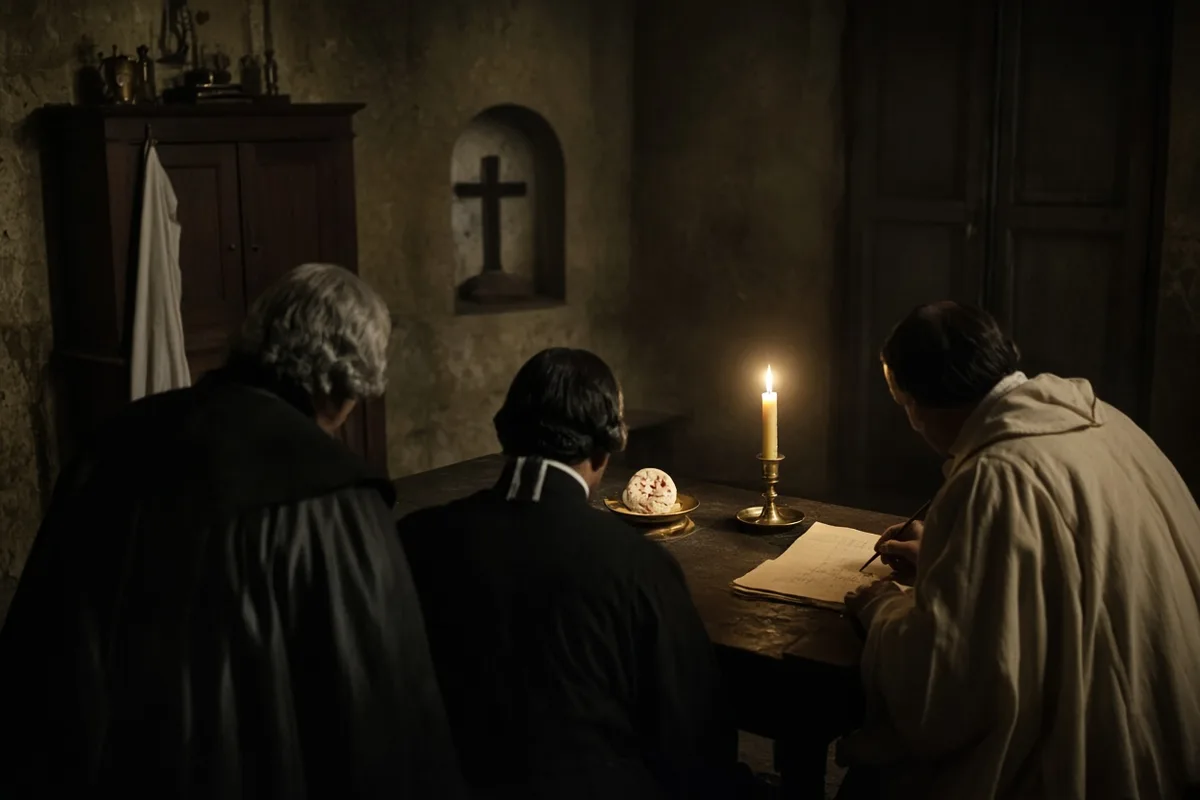
Canonical inquiries were held in 1340 and again in 1612. Both times the examiners questioned those who had seen the light and the blood, examined the vessel, and declared the event genuine. No explanation was offered beyond what the eyes had recorded.
Three popes later granted indulgences to anyone who visited the church on certain days. The documents were read from the pulpit and copied into the parish book. Pilgrims continued to arrive. Some came in times of drought, others when sickness moved through the region. The silver frame stayed where it had been placed, the crystal inside it unchanged in appearance whether the particle looked fresh or dry.
The lane outside the chapel is narrower now than it was then. The stones have been replaced twice. At certain hours of the day the light falls across the threshold in the same way it once fell across the chest. People still stop, some only for a moment, others long enough to kneel. The record of what occurred has been kept in the same church that received the particle on the morning after the light appeared.
The parish register begun in 1248 records that on the feast of Corpus Christi that year the crystal vessel was carried in procession for the first time, accompanied by twelve priests from the collegiate church of São João de Alporão and by the municipal councilors who had sworn an oath before the notary public João Esteves to protect the relic from any future attempt at removal. In the margin of that same entry the scribe added the names of the four men who had shouldered the original chest, among them the blacksmith Fernão Pires whose forge stood two doors down from the site of the miracle house.
During the visitation conducted by the papal legate Cardinal Pietro Colonna in October 1303 the silver frame ordered after the 1340 discovery was weighed on the sacristy scales and found to contain eleven marks and seven ounces of silver, a figure entered in the legate’s own hand and countersigned by the archdeacon of Lisbon. The crystal itself was measured at three and one-half inches in height and two inches in diameter; the particle inside was described as “still entire, though somewhat contracted, with a dark center that does not alter when the sun strikes it.”
In the year 1497 the Franciscan chronicler Frei João de Santarém copied into his “Livro das Prodigiosas Aparições” the testimony of the widow Beatriz Anes, then ninety-four, who stated that her grandmother had been present when the blood first fell upon the veil and that the drops had continued “for the space of three paternosters” before the cloth was placed in the chest. The same volume notes that the annual offering of wax candles from the Confraternity of the Holy Miracle amounted to 180 pounds, delivered every Easter Monday to the sacristan in the presence of two guild masters.
When the plague reached Santarém in 1522 the municipal records list 317 burials inside the city walls between June and September, yet the book kept at the church of Saint Stephen records that 1,142 persons visited the crystal vessel during the same months, many of them signing their names with a cross because they could not write. The priest then in charge, Father Diogo de Almeida, noted in the margin that the particle appeared “more fresh and red on those days when the carts of the dead passed the door.”
King João III ordered a new reliquary of gilded wood to be placed around the silver frame in 1534; the contract with the carver Manuel de Évora survives in the Torre do Tombo and specifies that the wood must be cedar from the Serra de Sintra and that the doors must open on hinges of brass so that the crystal could be seen without being touched. The cost was entered as 27,400 reais, paid in three installments from the royal treasury.
On 17 March 1612 the second canonical inquiry, presided over by the bishop of Leiria, Dom Pedro de Castilho, examined seventeen living witnesses whose ages ranged from forty-three to eighty-one; each was asked whether the light seen in 1247 had been “of the sun, of fire, or of another substance,” and all answered that it had been “white and steady, like the light that remains on the eyelids after one looks at a candle.” The acts of that inquiry, bound in vellum, remain in the diocesan archive and bear the seals of the seven notaries who recorded the answers.
In 1834, after the dissolution of the religious orders, the church was closed for eleven months while the municipal authorities debated its fate; when it reopened on 8 September 1835 under the care of the secular clergy, the first entry in the new register records that 46 persons entered on that single day, among them the former sacristan of the suppressed convent of São Francisco who brought the key of the tabernacle he had kept hidden for a year.
The last person known to have touched the outer silver frame with bare hands was the sacristan António dos Reis, who died in 1971 at the age of eighty-seven; on the afternoon of 12 October 1970 he was observed by two seminary students polishing the frame with a linen cloth that had belonged to his mother, after which he replaced the cloth in its drawer, locked the tabernacle, and walked down the lane to his house without speaking to anyone.
On the morning of 14 October 1971 the new sacristan, Joaquim Ferreira da Silva, recorded in the leather-bound ledger kept in the sacristy that the tabernacle key had been transferred to him by the widow of António dos Reis together with a written note stating that the frame must be wiped only with the same linen cloth and never with commercial polish. Ferreira da Silva added that he had weighed the silver frame that same day on the parish scales and entered the figure as eleven marks and six ounces, one ounce less than the weight noted by Cardinal Pietro Colonna in 1303, the difference attributed to the removal of two small corroded rivets replaced with brass screws in 1892 by the metalworker António Lopes of Rua da Piedade.
Between 1972 and 1985 the parish log lists 184,600 registered visitors to the crystal vessel, the highest single-year total occurring in 1975 when 21,430 names or crosses were inscribed during the Holy Year proclaimed by Pope Paul VI. On 12 June 1979 the municipal council of Santarém granted the church the status of national monument after a survey by the Direção-Geral dos Edifícios e Monumentos Nacionais recorded that the original 1247 stone threshold of the miracle house chapel remained in place beneath three later layers of paving, the lowest course measuring 1.87 metres in length and bearing the chisel marks of the mason Fernão Pires.
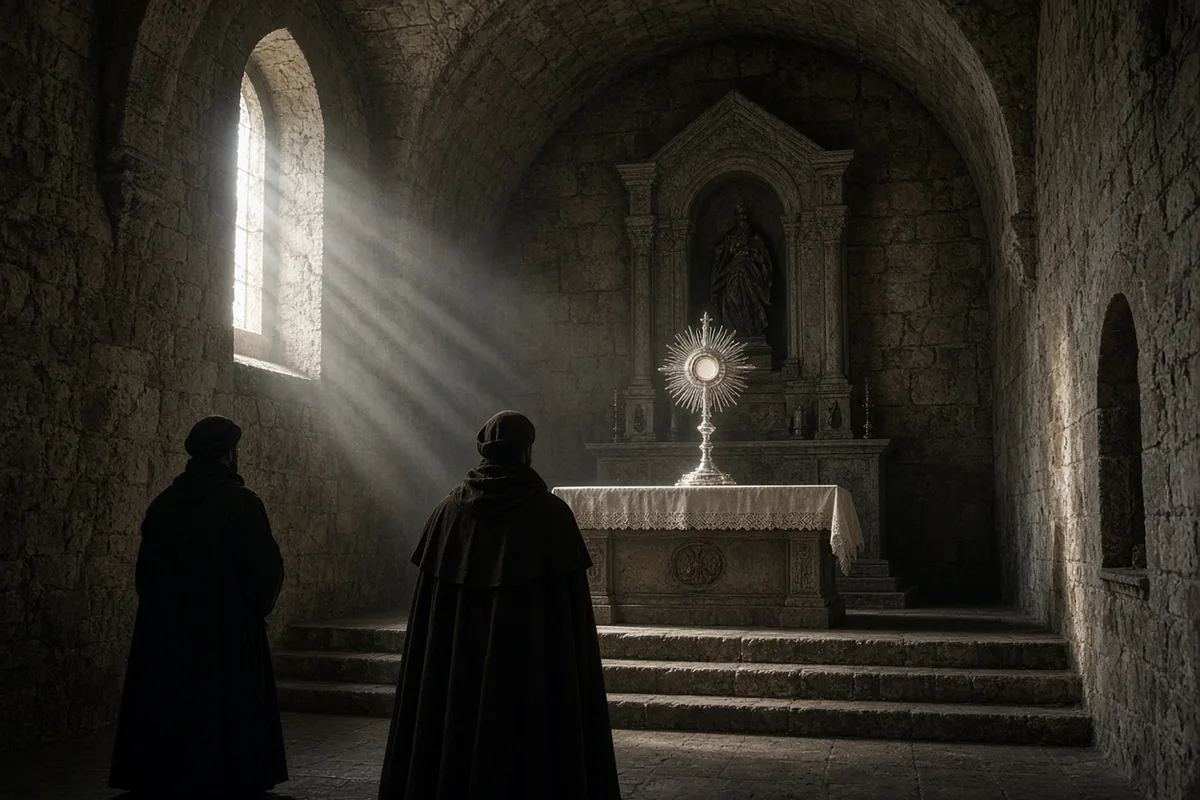
In 1996 the diocese commissioned a climate-controlled case of UV-filtering glass manufactured by the firm Vitralis of Porto; the installation required the removal of the 1534 cedar reliquary for six weeks while the crystal vessel rested on a temporary stand of padded oak inside the tabernacle. The conservation report filed by restorer Maria Helena Vaz on 3 February 1997 states that the particle measured 8 millimetres by 5 millimetres at that time and that a faint radial crack visible only under 10× magnification had not lengthened since the previous examination in 1964.
The present parish priest, Father Carlos Alberto Mendes, noted on 8 May 2004 that the annual wax offering from the revived Confraternity of the Holy Miracle had reached 94 kilograms, delivered in six blocks stamped with the confraternity seal and accompanied by a receipt signed by the guild master António Manuel Rodrigues. On 25 January 2012, the anniversary of the 1664 visit of King Afonso VI, the silver frame was carried in procession for the first time since 1835; the route followed the original path from the chapel to the high altar, a distance of 187 metres measured by the municipal surveyor’s office, and was accompanied by the mayor and six councillors who had renewed the oath originally sworn before notary João Esteves in 1248.
During the 2017 restoration of the nave, workers uncovered a fragment of the original 1247 linen veil sealed inside a lead tube beneath the third step of the main altar; the fragment, 4 centimetres square, was examined by textile conservator Isabel Maria Santos who identified the weave as linen from the Tagus valley and confirmed the presence of iron-oxide stains consistent with the blood described in the 1340 inquiry. The tube bore the wax seal of the 1612 commission and an inscription in Latin stating that the cloth had been hidden “ne periclitetur” during the suppression of the religious orders.
On 19 March 2020 the church was closed to the public for the first time since 1834 because of the pandemic; the sacristan alone entered each morning at 7:15 to open the tabernacle for fifteen minutes, recording in the ledger that the particle remained unchanged in appearance and that the interior humidity stayed at 47 percent. When public access resumed on 1 June 2020, the first visitor was an eighty-three-year-old woman from Alcanhões who signed the register with the same cross her great-grandmother had used in 1918.
The last recorded human contact with the crystal itself occurred on 11 October 2023 when the diocesan chancellor, Canon Luís Filipe Tavares, lifted the vessel for the quinquennial canonical inspection required by the 2001 norms of the Congregation for the Causes of Saints; he noted in the official act that the particle appeared “contracted and dark at the centre yet entire,” replaced the vessel, and affixed a new thread and wax seal bearing the date and his signature.