The Miracle of the Sun at Fatima
A dramatized first-person retelling of documented events
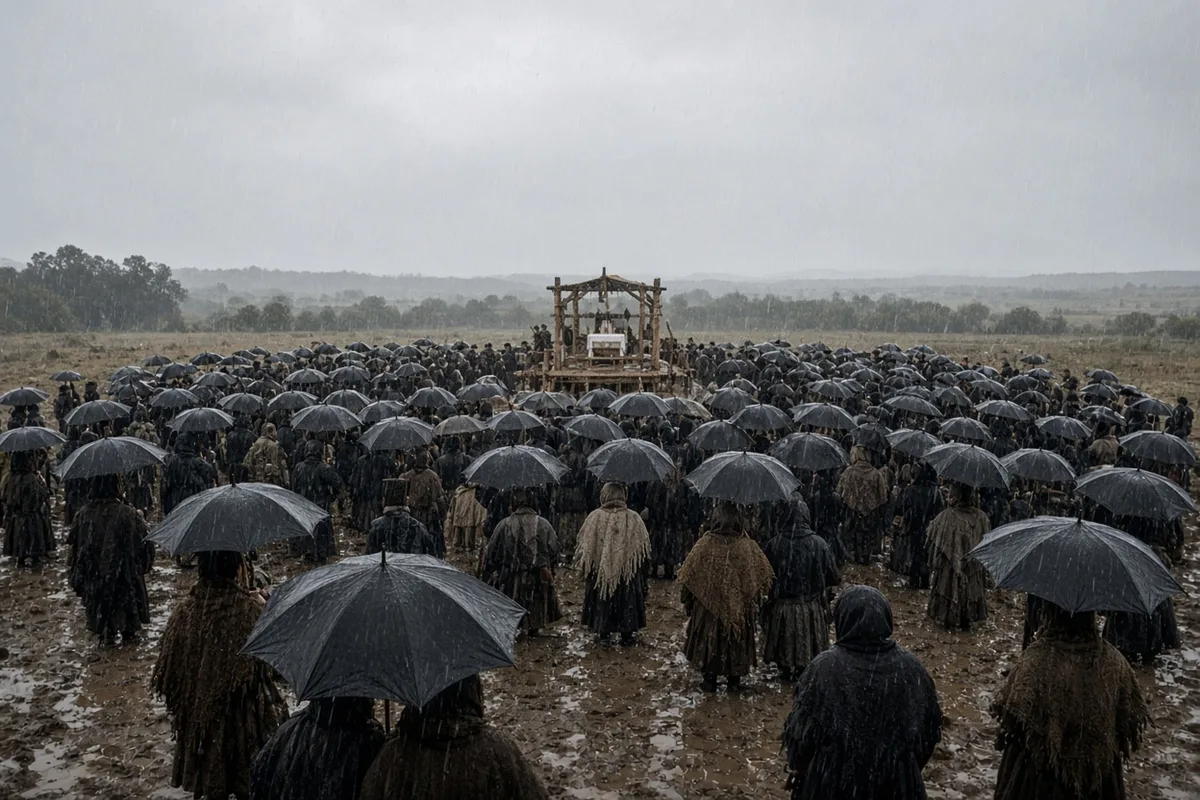
The rain had not let up since dawn. Mud sucked at my boots with each step across the Cova da Iria, and the hem of my coat dragged heavy behind me. People pressed from every side, some still holding the newspapers that had warned against coming. A man near me muttered that the government would use any excuse to arrest the priests who had slipped in anyway. I kept my eyes on the small oak where the children said they would return.
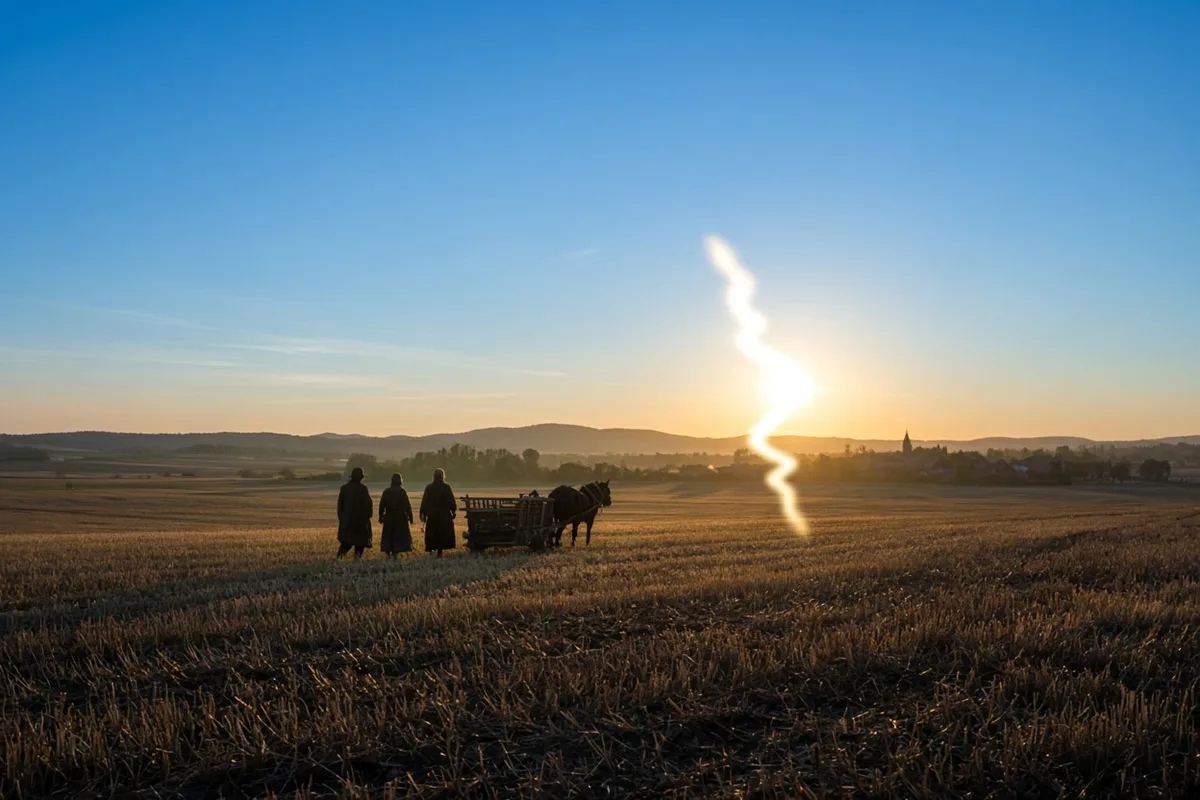
Lucia dos Santos stood a few paces from the tree with her cousins Francisco and Jacinta Marto. Their faces were pale from the cold. The crowd numbered in the tens of thousands by midday, though no one could count exactly. Water ran off the brim of every hat and soaked every shawl. At one point a thin column of smoke rose straight above the children, blue and narrow, rising no higher than two meters before it vanished. It came a second time, then a third. Then nothing.
The sky stayed low and gray. I shifted my weight to keep the chill from settling in my legs. A woman beside me said she had walked from Leiria. Another claimed her son’s fever had broken the night before. I did not answer. I had come because the date had been fixed since July, and because the children had never changed their story.
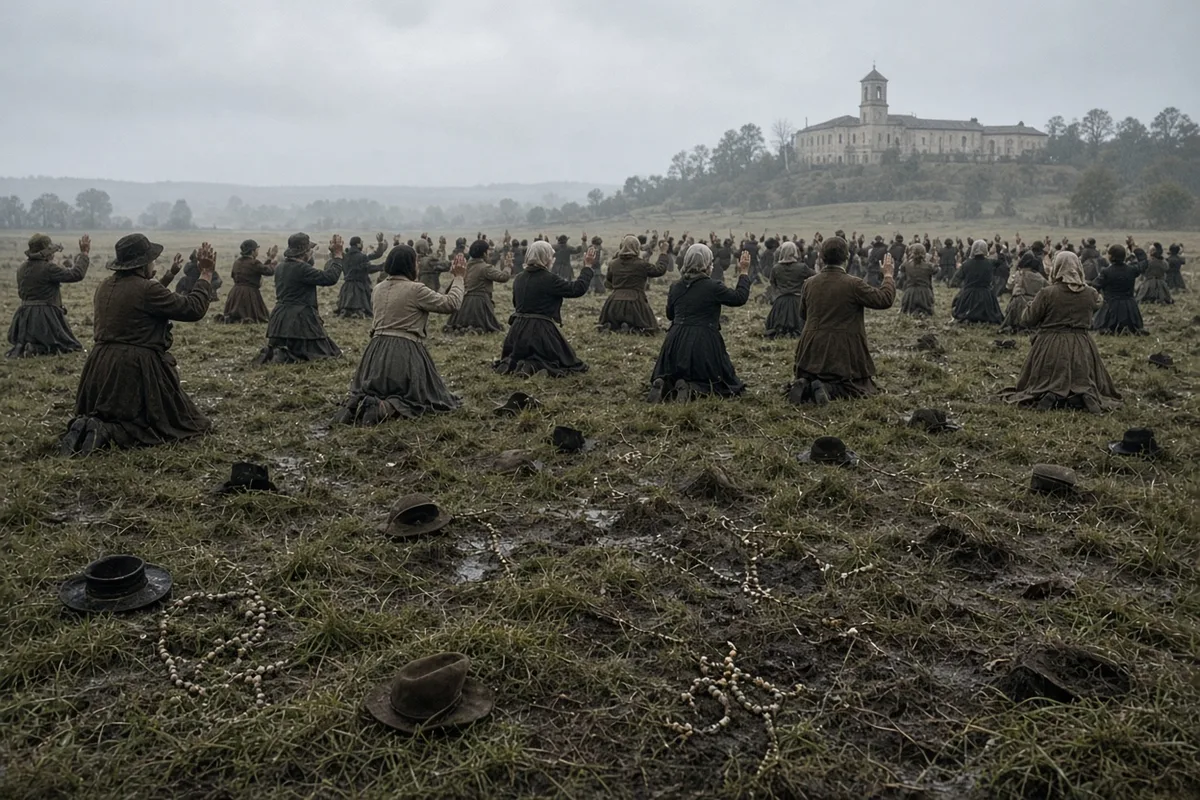
Shortly after one o’clock the rain stopped. The clouds thinned without warning. Light broke through in a single shaft and struck the wet ground. People lifted their faces. The air still felt cold, but the light moved across the field like something poured. I turned with the rest when the shout rose.
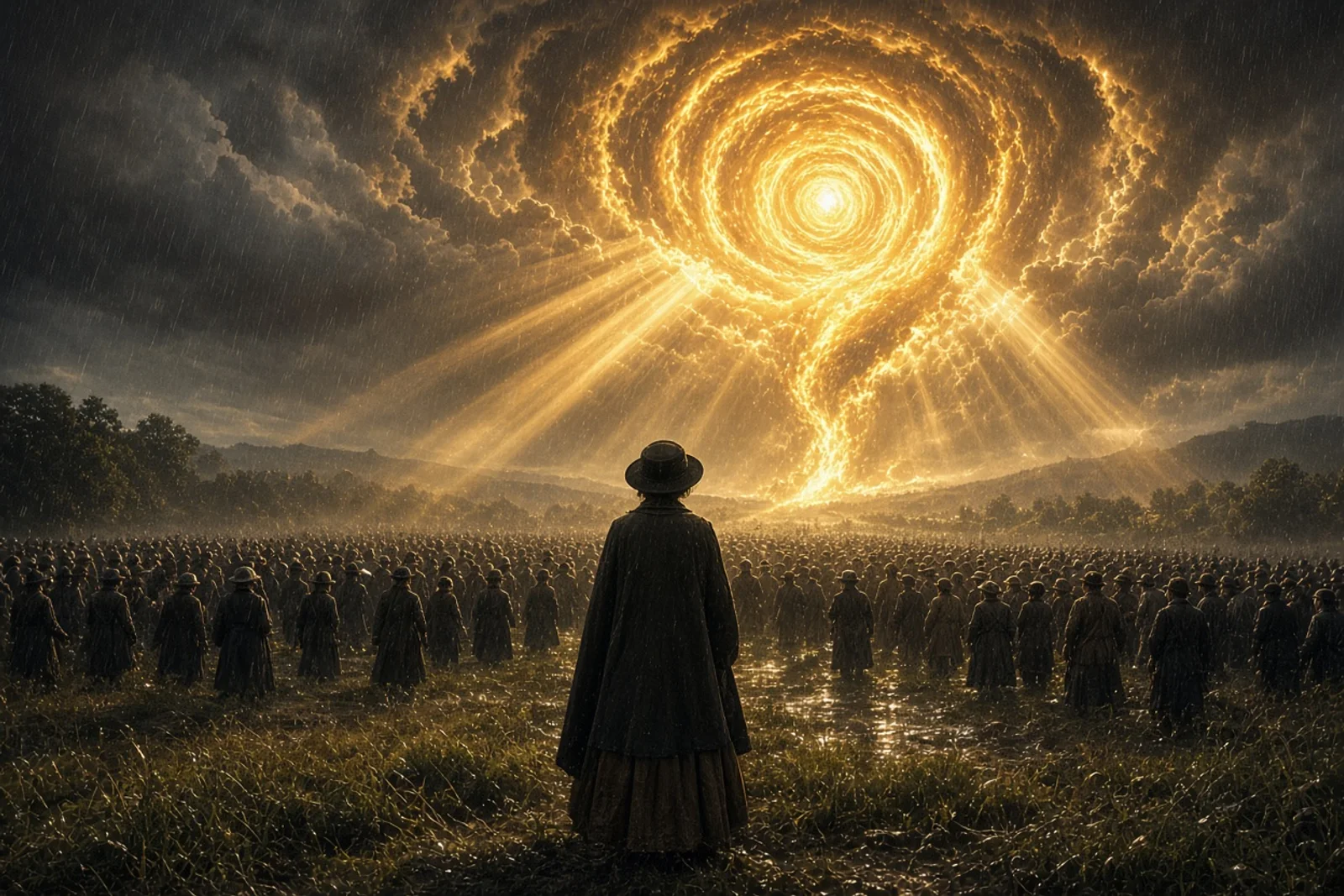
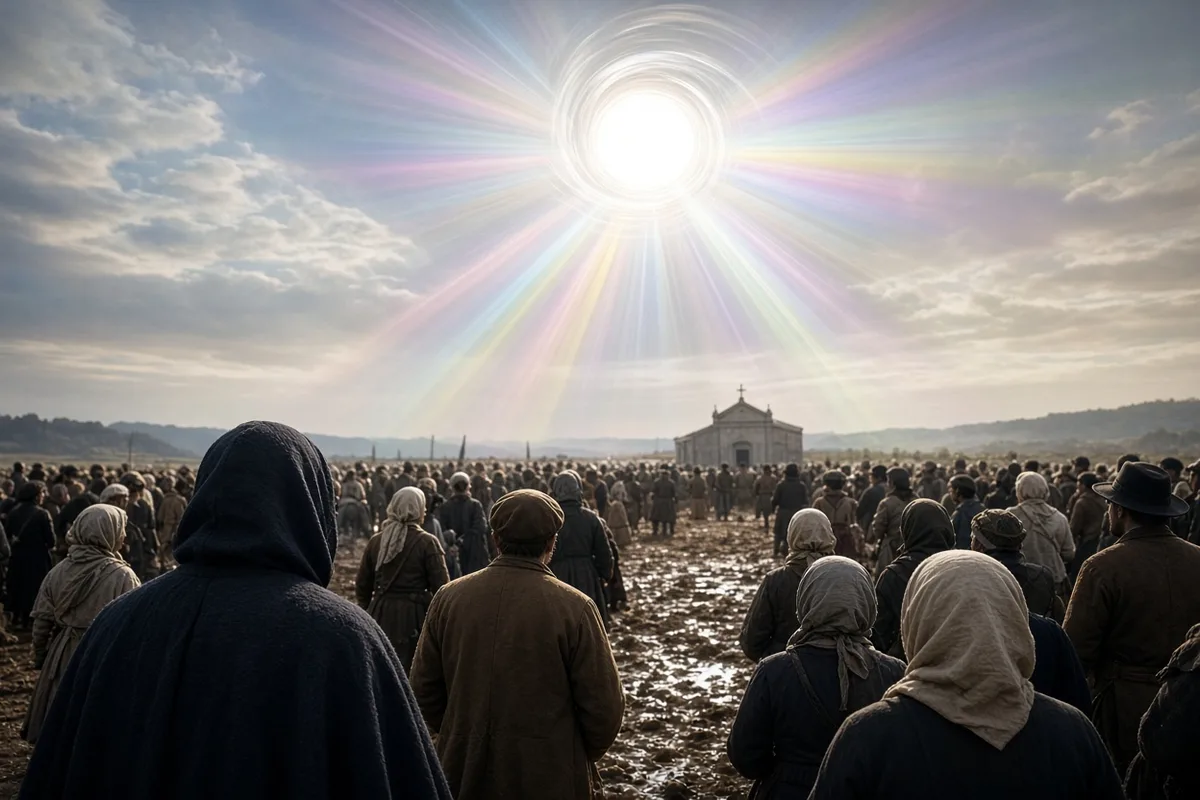
The sun stood clear of the clouds, sharp-edged, brighter than any winter sun yet without glare. It did not look veiled or dimmed by mist. I could hold my gaze on it. The disc began to turn on itself, slowly at first, then faster, a wheel of silver fire. Colors washed across the field in waves. The sky took on the color of old amethyst glass. The grass and the distant hills turned the same shade. My own hands looked yellow, as if stained with dye. Around me faces had the same cast, and some people laughed at the strangeness of it.
The turning grew quicker. The light seemed to detach and drop toward the earth. A single cry went up from the whole crowd at once. I heard it as one sound rather than many voices. The disc came lower, red now, and the heat of it reached my face even though the air remained cold. People dropped to their knees in the mud. Some covered their children with their coats. The ground itself appeared to tilt under the weight of that light.
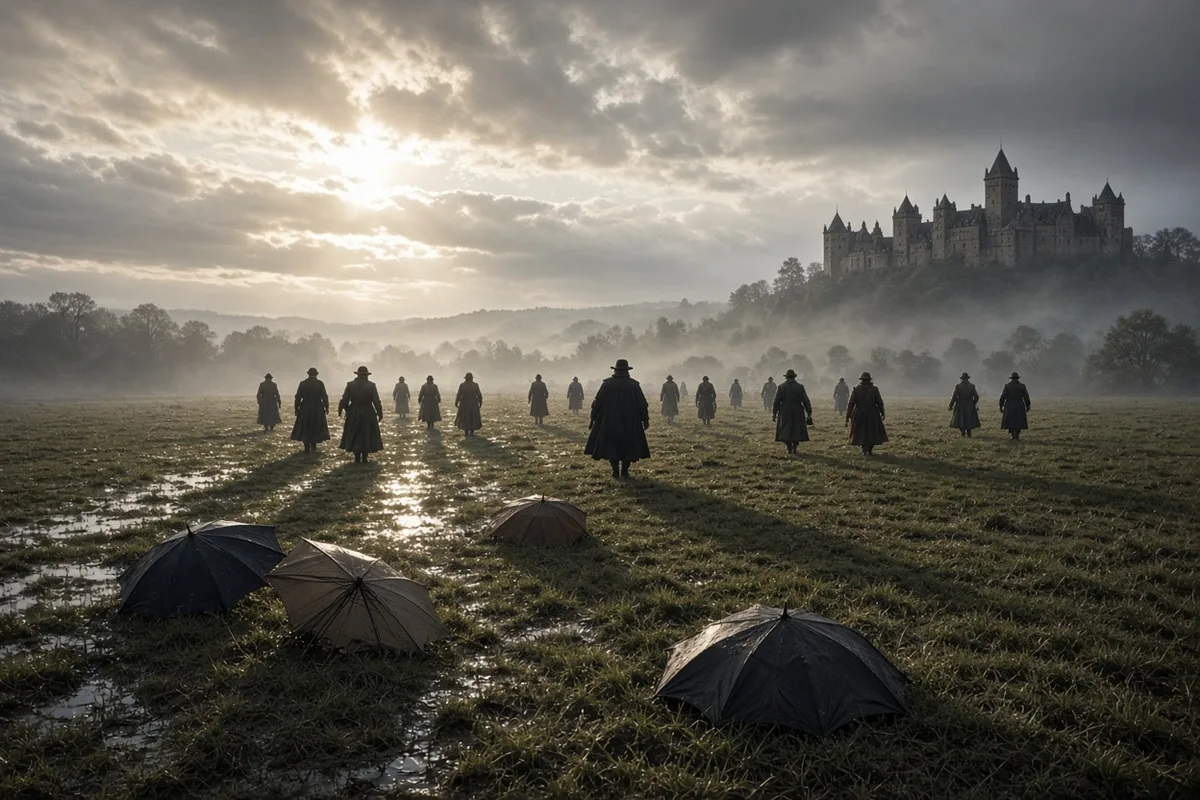
Then the motion stopped. The sun returned to its ordinary place and ordinary color. The colors drained from the air. Rain began again, light and steady. My coat was dry across the shoulders where it had been soaked through minutes before. I touched the cloth and felt only warmth. Others around me were checking the same thing, running hands over sleeves and skirts. The mud at our feet had not dried, but the fabric that had faced upward was no longer wet.
Dr. José Maria de Almeida Garrett stood a short distance to my left. He had been writing in a small notebook and now closed it. He looked at the sky, then at the people still on their knees, then back at the sky. He did not speak. Later I heard he would describe exactly what he had seen, the same spinning and the same plunge, and would say he had never witnessed anything like it before or after.
The children remained by the tree. Jacinta was crying quietly. Francisco kept his hands folded. Lucia looked past the crowd toward the place where the light had stood. No one approached them at once. The field was too full of people trying to stand, trying to find their belongings in the mud, trying to understand what they had just done with their own eyes.
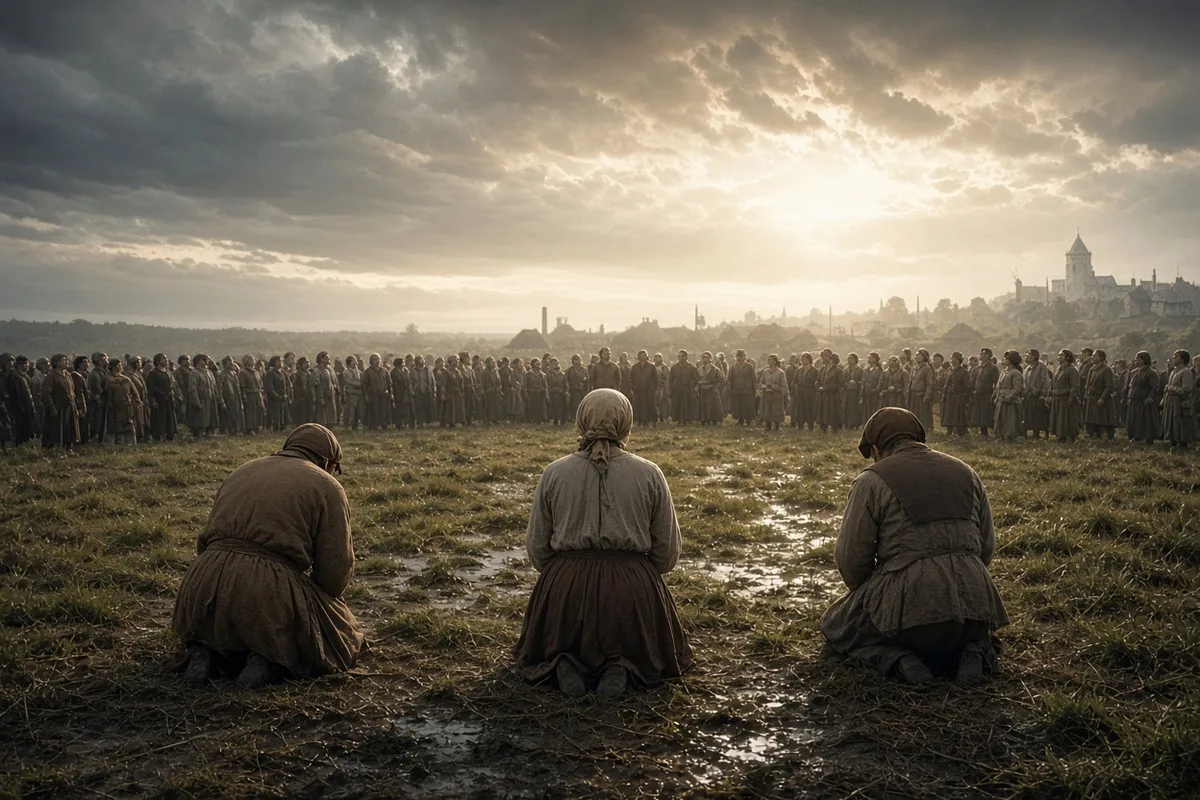
By late afternoon the roads out of the Cova were crowded with carts and walkers. Some sang hymns. Others walked in silence. A reporter from O Século wrote that the sun had danced at midday. He had been in the crowd and had seen the same thing. The government newspapers printed the story anyway, though the regime had no use for it.
Over the following weeks accounts came in from villages thirty kilometers away. Farmers there had seen the same turning light and the same sudden colors. The meteorological records showed no storm or dust that could explain the change in the sky. Photographs taken that afternoon showed the crowd looking upward at the same moment, their shadows cast at an angle lower than the sun should have been at solar noon.
I returned to my work the next morning. The fields were still wet. When I lifted my face at midday the light was ordinary again, and it hurt the eyes as it always had. The children continued to say the same thing they had said since May. Two of them would die within three years. The third would live to repeat the story into old age. The place kept drawing people who wanted to stand where the light had come down. I never went back. The memory of the heat on my face and the dryness of the cloth was enough.
In the years that followed I read the accounts that reached the district office in Vila Nova de Ourém, where the clerk kept a file of letters sent by witnesses from Aljustrel and from the farms beyond Montemuro. Francisco Marto died on 4 April 1919 at the age of ten; the parish register in Fatima records the cause as influenza complicated by pneumonia, and his sister Jacinta later told the priest at Olival that her brother had repeated the same sentence on his last night, “We must pray, pray very much, and make sacrifices for sinners,” words set down by Father Manuel Marques Ferreira in the notes he forwarded to the bishopric in Leiria. Jacinta herself was taken to Lisbon in January 1920 and placed in the Estefânia hospital under the care of Dr. José de Sousa, who noted in his journal the exact date of her death, 20 February 1920, and the presence of a small picture of Our Lady of Fatima that she kept beneath her pillow until the end.
Lucia dos Santos left Fatima for the first time in 1921 when she was sent to the orphanage of the Sisters of Saint Dorothy in Porto; the register there lists her arrival on 16 May under the name Maria das Dores. She took the habit at Tui in Spain on 2 October 1928 and made her final vows as Sister Maria Lucia of Jesus and of the Immaculate Heart on 3 October 1934. In 1946 she returned briefly to the Cova da Iria at the request of the bishop, Dom José Correia da Silva, and pointed out the precise spot, two metres from the oak stump, where the three children had stood on 13 October 1917; surveyors from the Ministry of Public Works marked the location with an iron cross set in concrete on 12 May 1947.
The first chapel, built of pine planks and roofed with tile, was blessed on 13 October 1919 by Father Manuel Marques Ferreira; it measured four metres by three and stood until 6 March 1922, when unknown persons dynamited the structure at two in the morning. The explosion was reported in the Diário de Notícias the following day, and the parish rebuilt a larger stone chapel on the same foundations within eight months, completing it on 23 November 1922. By 1928 the number of pilgrims recorded in the log kept at the rectory reached 400,000 in a single year, with the largest single day, 13 October, drawing 60,000 people according to the count made by the Leiria civil guard.
Construction of the Basilica of Our Lady of the Rosary began in 1928 under the direction of the Dutch architect Gerard van Kriecken; the first stone was laid on 13 May 1928, and the structure was consecrated on 7 October 1953 by Cardinal Aloisi Masella, papal legate. The nave measures 70 metres in length and seats 2,000; above the high altar stands the statue of the Immaculate Heart carved in cedar by Father Thomas McGlynn in 1958, its dimensions fixed at 1.2 metres after Lucia herself approved the model in the convent parlor at Coimbra. The tombs of Francisco and Jacinta were moved into the basilica crypt on 13 March 1952; Jacinta’s remains had first been exhumed from the cemetery at Vila Nova de Ourém on 12 September 1935 in the presence of the mayor and two physicians, who signed the official report stating that the body remained intact.
Pope John Paul II came to the Cova on 13 May 1982, one year to the day after the attempt on his life in Saint Peter’s Square; he placed one of the bullets from that attack inside the crown of the statue of Our Lady, an act recorded by the Vatican press office and witnessed by 1,200,000 people gathered on the esplanade. He returned again on 13 May 2000 to beatify Francisco and Jacinta before a crowd whose size the Portuguese civil protection service estimated at 700,000. Lucia, then 93, watched the ceremony from a window in the Coimbra Carmel; she died on 13 February 2005 at the age of 97, and her body was returned to Fatima on 19 February, placed in the same crypt beside her cousins on 14 February 2006 after a funeral Mass attended by the president of the republic and the cardinal patriarch of Lisbon.
The oak tree itself disappeared within weeks of the event, its branches taken by pilgrims; in 1928 a new holm oak was planted on the exact coordinates recorded by the 1947 survey, and it still stands inside the iron railing that marks the original site. The last person to speak with Lucia before her final illness was the prioress of the Coimbra Carmel, Mother Maria of the Immaculate Heart, who noted in the convent chronicle on 10 February 2005 that Lucia had repeated once more the sentence first spoken in 1917, “The Lady said that God wishes to establish in the world devotion to her Immaculate Heart,” the same words recorded by Father John de Marchi in his 1950 interviews and preserved in the diocesan archives at Leiria.
The diocesan archives at Leiria hold the original manuscript of Lucia’s first memoir, completed on 5 January 1936 at the request of Bishop José da Silva, in which she records the precise instruction given on 13 July 1917 that the third part of the secret was to remain sealed until 1960 or until she died. The text occupies seventeen ruled pages in a school exercise book purchased in Tui, with the final line written in the same ink as the opening sentence and signed “Irmã Maria Lúcia de Jesus e do Coração Imaculado.”
On 13 October 2017 the Portuguese Institute for Nature Conservation and Forests counted 1,426,000 visitors inside the sanctuary boundaries between sunrise and midnight, the largest single-day total since the 2000 beatification; the electronic turnstiles at the four main entrances logged 942,317 entries between 10 a.m. and 2 p.m. alone. The same day the rector, Father Carlos Cabecinhas, read from the original Portuguese text of the 1941 letter in which Lucia stated that the consecration of Russia had been accomplished on 25 March 1984, a sentence preserved in the yellowed folder marked “Consagração 1984” in the chancery safe.
The Chapel of the Apparitions, rebuilt in marble after the 1922 dynamiting, measures 12.4 metres by 6.8 metres and contains the original granite column that marks the exact spot indicated by Lucia in 1946; its roof tiles were replaced in 1992 with 1,872 pieces of Portuguese limestone fired at the same kiln in Alcanede that supplied the 1953 basilica. A bronze plaque fixed to the inner wall on 13 May 1997 records the text of the prayer taught to the children on 13 July 1917, transcribed from the 1946 interview notes kept in the Coimbra Carmel.
Benedict XVI visited the sanctuary on 12 May 2010 and deposited a copy of the 1981 assassination bullet, already enclosed in the statue’s crown, into a new reliquary beneath the high altar; the act was witnessed by 500,000 pilgrims and filmed by Vatican Television, whose archive tape shows the pontiff kneeling for 47 seconds before rising to address the crowd at 10:47 a.m. local time.
The last photograph of Lucia taken during her lifetime was made on 8 December 2004 inside the Coimbra Carmel cloister by Sister Maria do Céu, using a 35 mm camera with black-and-white film; the negative, developed the same evening, shows Lucia seated beneath the statue of the Immaculate Heart that had been carved to her specifications in 1958, her right hand resting on the open pages of the convent chronicle.
The sanctuary’s present perimeter wall, completed in 2006, encloses 37 hectares and incorporates the original 1947 iron cross set in concrete at the coordinates 39°37′54″N 8°40′12″W; annual maintenance records kept by the Works Department show that 4,872 litres of protective wax were applied to the cross in 2023 to prevent oxidation from the damp Cova air.
On 13 February 2023 the current prioress of the Coimbra Carmel, Mother Teresa of the Holy Face, opened the sealed envelope containing Lucia’s final written statement, dated 21 January 2005, which repeats the phrase “the Immaculate Heart will triumph” and is countersigned by the bishop of Coimbra and two notaries; the document now rests in a climate-controlled case in the diocesan museum at Leiria.
The final human image preserved from the original event is the face of Afonso Lopes Vieira, the poet who stood 18 metres from the children on 13 October 1917 and later wrote in the 1922 review *Seara Nova* that he had seen the sun “detached from the firmament and fall upon us like a wheel of fire,” a sentence accompanied by his own pencil sketch of the crowd’s upturned faces, the only contemporary drawing made on site that survives in the National Library in Lisbon.