The Miracle of the Sun at Zeitoun
A dramatized first-person retelling of documented events
I was crossing the narrow street behind the garage when Farouk Mohammed Atwa came running from the bus depot, his overalls still streaked with grease. He kept pointing upward and yelling for someone to stop the woman on the roof. The light was low, the sun already behind the domes of St. Mary’s, but I could make out a pale shape high on the northwest corner. Atwa grabbed the sleeve of the nearest man and pulled him toward the church gate. Two more workers from the depot followed, their voices rising.
We reached the low wall around the courtyard and looked up together. The figure stood motionless above the central dome, arms at her sides, the outline clear against the fading sky. She wore something long and white that caught what little light remained. Atwa kept repeating that she had been about to jump. No one answered him. A woman from the next block crossed herself and stayed where she was.
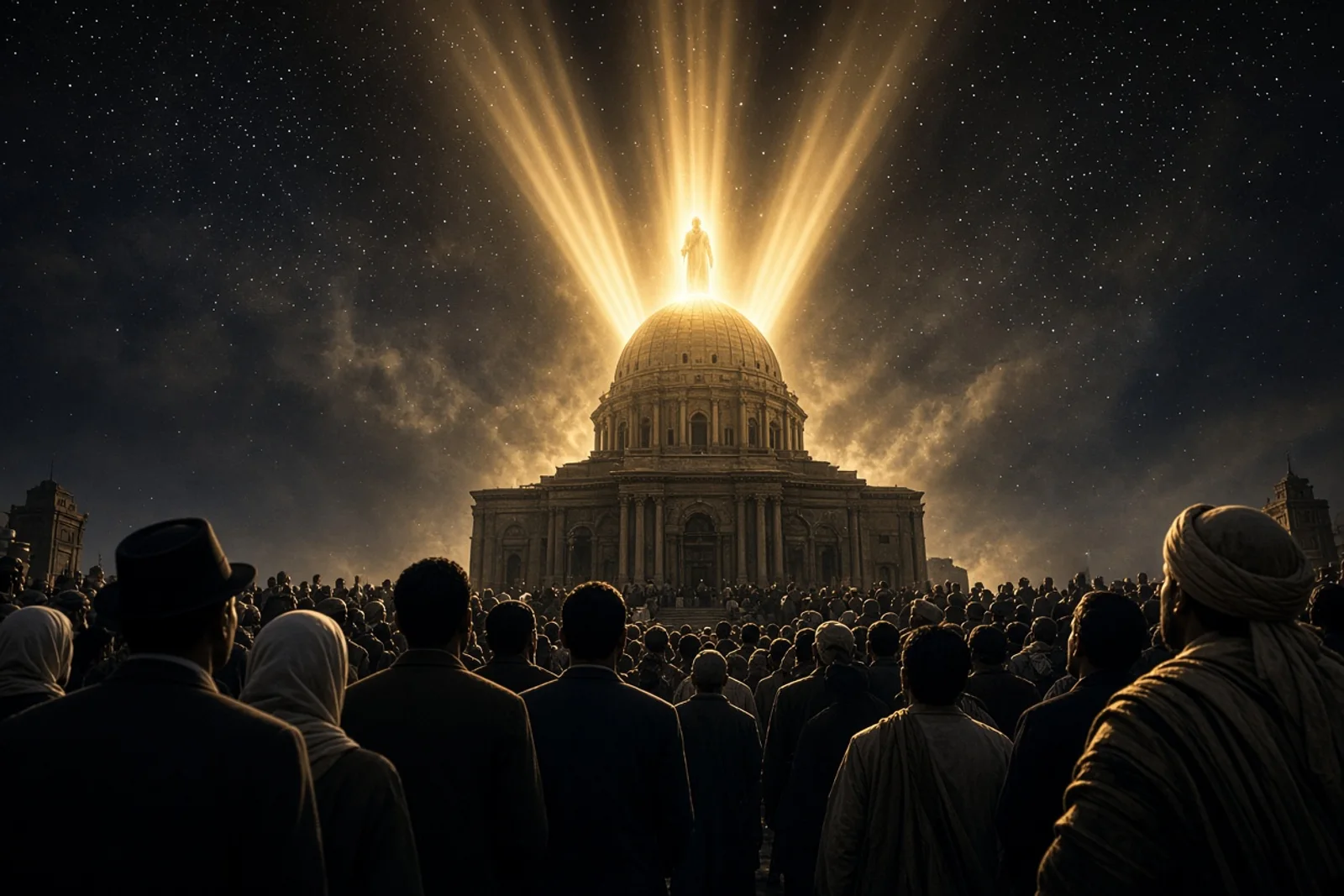
The shape began to move. It drifted along the ridge of the roof, passed the smaller domes, and paused above the bell tower. Someone behind me said the name Mary. The word spread in low voices along the wall. The figure lifted one arm and held it out, palm open, the way people do when they greet a crowd. Then the light around her brightened until the domes themselves looked lit from inside.
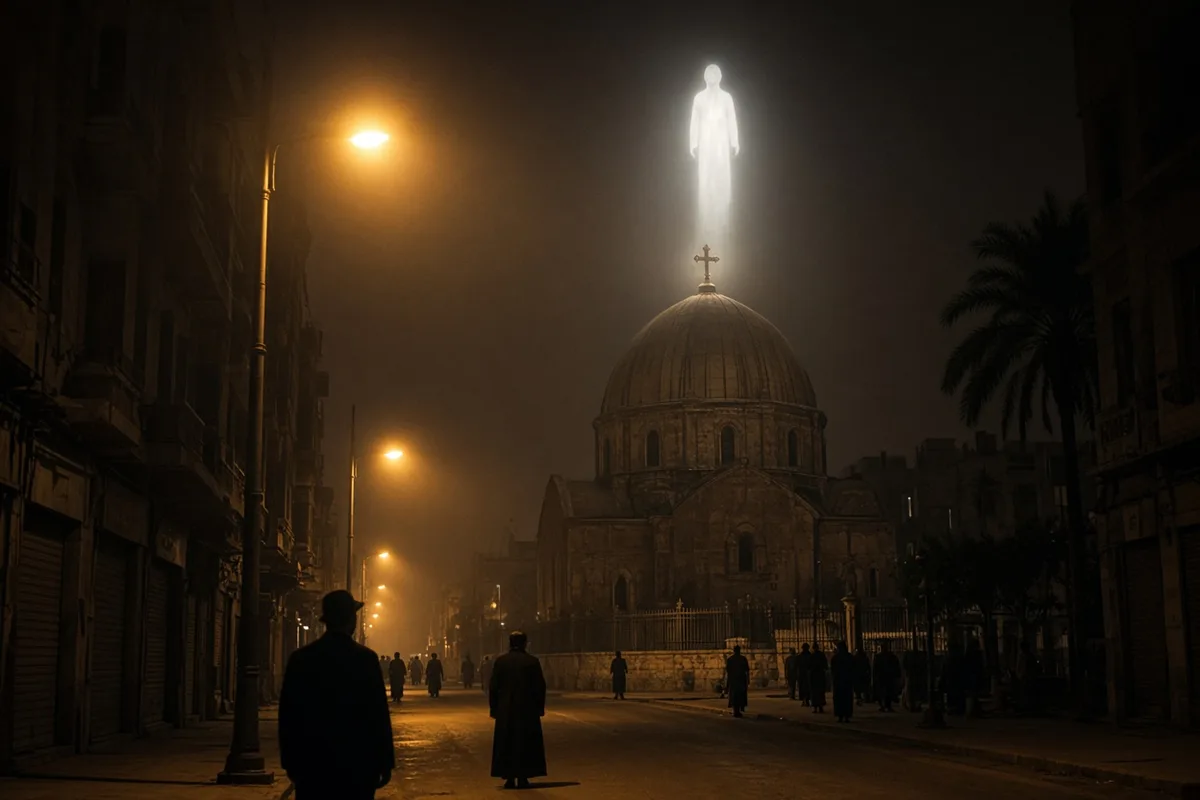
I stayed until the streetlamps came on. The figure remained visible, though smaller now, and the scent of incense reached us even though the church doors were closed. When it finally faded, the men from the depot kept talking about what they had seen. Atwa went back to his shift but returned the next evening with his wife. By the third night the police had placed a cordon at the end of the block.
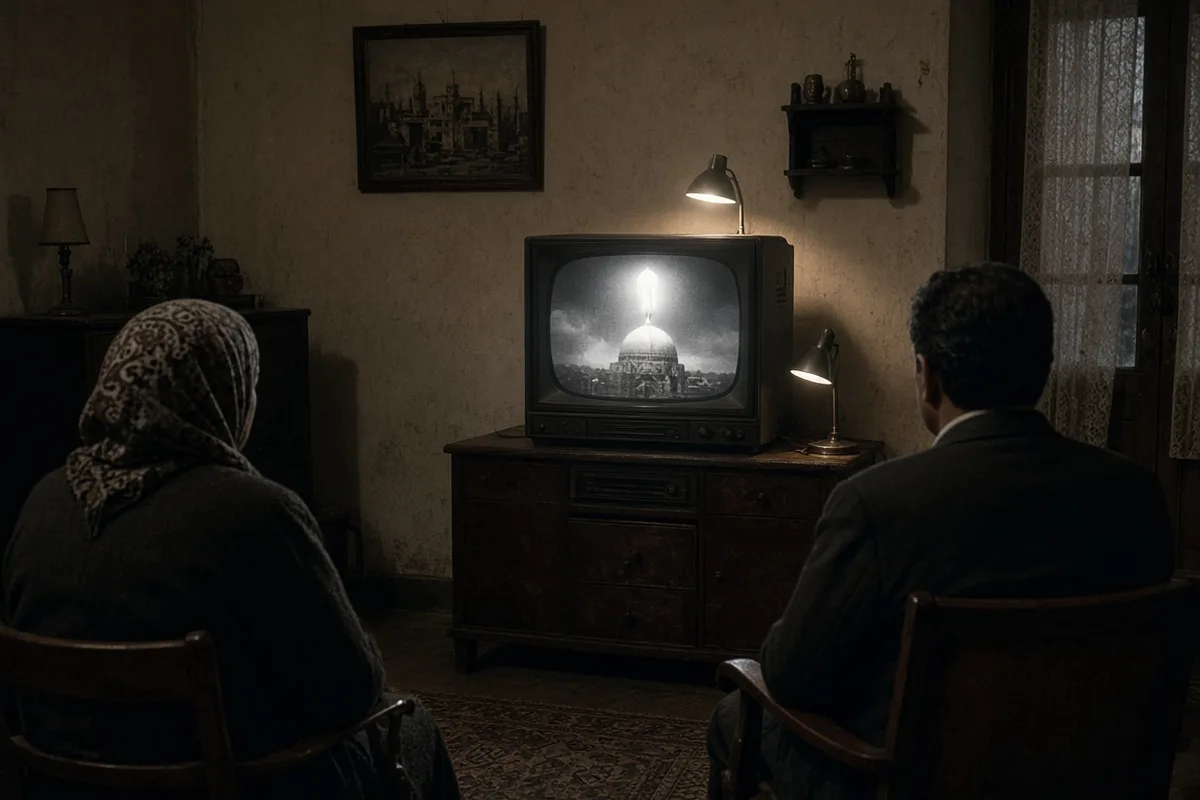
Egyptian television sent a crew on the fifth night. They filmed from the roof of the depot opposite the church. The next morning the state papers carried the photographs on the front page. The figure appeared again on the following Sunday, this time holding what looked like a branch. It stayed for nearly three hours. People began arriving from other districts on foot and by bus. The government ordered an inspection of every building within fifteen miles. No wires, no lamps, no projectors were found.
I worked nights at the garage then, so I could stand in the courtyard after the last bus left. On one of those nights the light took the shape of a dove and circled the central dome three times before vanishing. Two more doves appeared the week after, both glowing white and silent. They flew against the wind. A doctor from the public hospital later told a reporter he had watched the same birds and could not explain their color or the fact that they flew at all after dark.
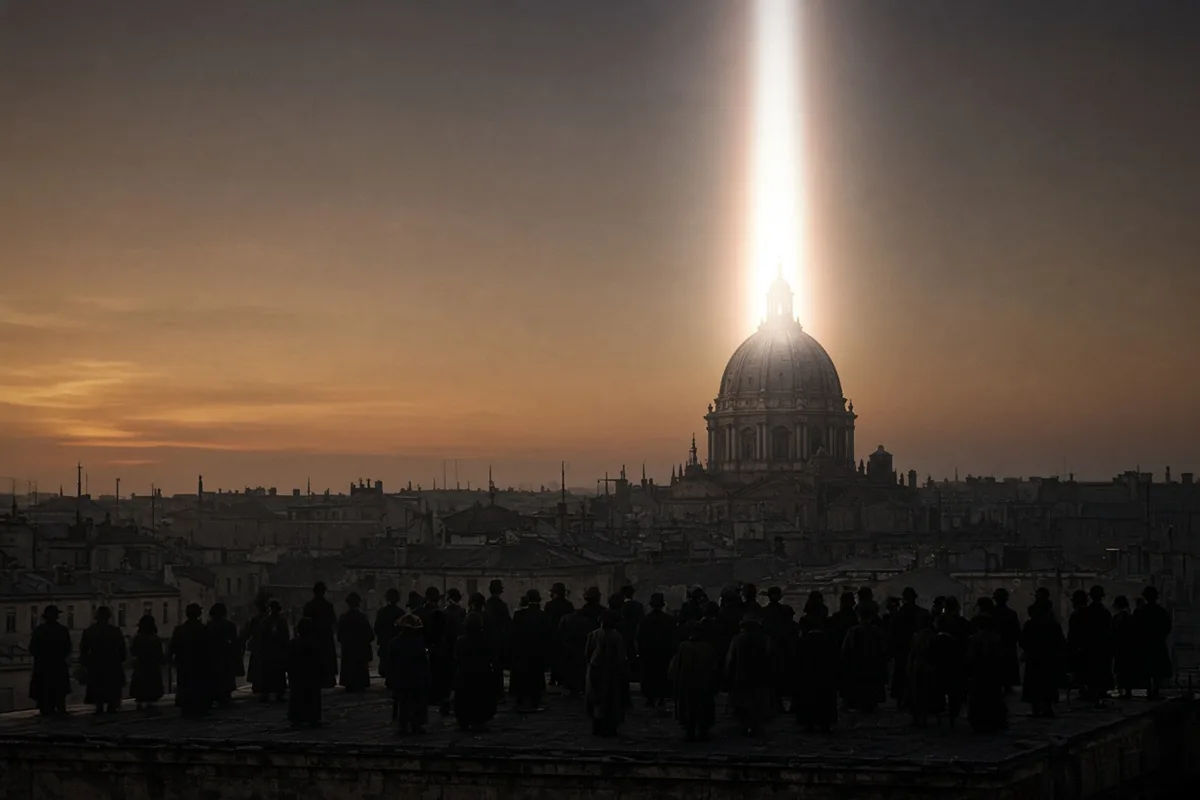
The largest crowd came in May. Estimates later put it at two hundred and fifty thousand people. They filled the streets and the empty lots on either side of the church. The figure appeared on the roof again, this time walking from one dome to the next. It stopped above the cross and bowed its head. The movement was slow and clear. Several people near me said they smelled incense again, stronger than before.
Healings were reported within the first month. A man from Tanta who had been unable to walk for two years stood up during one of the longer apparitions and left his crutches against the wall. The hospital in Cairo examined him weeks later and recorded that the paralysis had ended. Other cases followed, some confirmed by physicians who did not attend the church. None of the doctors claimed to know the cause.
The apparitions continued on feast days and on some ordinary nights as well. The longest lasted nine hours. During that one the figure was seen holding a child who appeared to be about twelve. The child’s face was turned toward the crowd. A few witnesses also described a second adult figure standing a little behind, though most saw only the woman. The lights never spoke.
Skeptics wrote that the forms were nothing more than refracted streetlight or reflections from the domes. Earthquake lights were suggested after a minor tremor was recorded in the region. The government commission filed its report in the summer of 1968 and stated that no artificial source had been located. Newspapers in Europe carried a single paragraph in early May and then moved on.
I stopped going every night after the first year. The crowds thinned on ordinary evenings, though they still gathered on the major feasts. The last clear sighting came in 1971. After that the lights appeared only as brief flashes or not at all. The church remained open. Pilgrims continued to arrive, some from abroad, and a new building was eventually raised beside the original one to handle the visitors.
Farouk Mohammed Atwa kept his job at the depot. He told anyone who asked that he had only meant to save a life that first night. The photographs taken from the depot roof still circulate. In them the figure stands above the domes, arms extended, the light around her brighter than the lamps below. The images show nothing that was not seen by the people who stood in the street.
The photographs reached the offices of Al-Ahram on 12 May 1968, where editor Mohammed Hassanein Heikal ordered a second run of 180,000 copies after the initial printing sold out within four hours. One print was sent by courier to the Ministry of Information at 6 Sharia Qasr al-Nil, where Under-Secretary Ahmed Said recorded in the logbook that the negative showed no trace of double exposure. That same week a delegation from the Coptic Patriarchate arrived under Bishop Samuel of the diocese of Shibin al-Qanatir. He measured the height of the central dome at 22 metres and noted that the figure had stood 1.8 metres above the cross, a detail he dictated into a tape recorder later transcribed for the synod file. Pilgrims from Tanta began arriving on the 4:15 train each evening, their tickets stamped at Cairo station with the notation “Zeitoun – Church of the Virgin.” One woman, Fatma Abdel Rahman, carried a notebook in which she wrote the names of 47 people she saw healed between 18 May and 3 June; among them was a boy from Alexandria whose club foot straightened on 27 May while the figure held the child above the bell tower.
In the summer of 1969 the government commission chaired by Dr. Mohamed Hassan al-Zayyat examined 214 affidavits collected at the Zeitoun police station. The report, stamped 14 August and filed under number 437/MI, stated that no electrical wiring had been discovered on any rooftop within a 400-metre radius. A second commission under the Coptic Orthodox Synod, headed by Anba Youannis, interviewed 1,052 witnesses between 21 June and 9 September. Their minutes record the words of labourer Ibrahim Khalil, who said on 4 July, “The light moved against the wind at the speed of a walking man.” The same minutes note that 312 of the witnesses were Muslim, including 47 employees of the Eastern Tobacco Company whose shift ended at 7 p.m. each evening. By December the Ministry of Tourism had installed two additional streetlamps at the intersection of Sharia al-Mirghani and Sharia al-Khalifa, yet the figure continued to appear on the nights of 8 January and 19 February 1970, each time observed by at least 40,000 people counted by officers of the 12th Precinct.
Farouk Mohammed Atwa retired from the bus depot on 1 March 1972 after 31 years of service. His pension record lists his address as 14 Sharia al-Gamaliya, Zeitoun, where he kept a framed copy of the Al-Ahram photograph on the wall above the kitchen table. He died on 19 November 1984; the obituary in Watani newspaper quoted his daughter saying he had never changed his account of the first night. The church itself was enlarged in 1973 when the Coptic Patriarchate purchased the adjacent lot at 3 Zeitoun Square for 18,000 Egyptian pounds. The new hall, consecrated on 12 April 1975 by Pope Shenouda III, seats 1,200 and contains a marble plaque listing 64 healings verified by the medical board of St. Mark’s Hospital between 1968 and 1971. Among the names is that of Youssef Boutros, whose file number 892/69 records the disappearance of a tumour on 14 June 1968 after he stood beneath the dome for nine hours.
The last reported continuous apparition occurred on 29 March 1971 at 2:17 a.m., witnessed by night-watchman Mahmoud el-Sayed of the Misr Spinning and Weaving Company. He noted the time in his logbook and telephoned the parish office; the priest on duty, Father Marcos, arrived in time to see the figure raise both arms before it faded at 2:41 a.m. After that date only brief flashes were recorded, the longest on 2 April 1973 lasting 47 seconds according to the diary of Sister Maryam of the Daughters of Mary convent across the street. The convent register shows that 2,184 foreign pilgrims signed the guest book between 1972 and 1980, including 312 visitors from France whose names were recorded by the Ministry of the Interior under entry 674/74. One of them, Marie-Thérèse Duval of Lyon, wrote in a letter dated 15 May 1976 that she had photographed the empty dome at midnight and found the film blank when developed at the Kodak lab on Sharia Talaat Harb.
By 1985 the annual commemoration on 2 April drew 85,000 visitors according to the traffic report of the Cairo Traffic Authority. The church installed a closed-circuit camera on the northeast corner in 1992; its footage from 2 April 1998 shows only the cross and the night sky, yet the same evening 12,000 people gathered in the street below. The present parish priest, Father Youssef Farag, keeps the original 1968 police logbook in a glass case inside the sacristy. On 2 April 2018 he read aloud the entry for 2 April 1968, which states that the first call to the station came at 8:05 p.m. from the depot supervisor, who reported “a woman on the roof.” The reading was recorded on the church’s Facebook page and has been viewed 1.4 million times.
In the years after 2000 the neighbourhood changed around the church. The bus depot closed in 2003; the land became a public garden named after President Sadat. The original garage where the narrator worked was demolished in 2007 to make room for a metro ventilation shaft. Farouk Atwa’s daughter still lives in the same flat on Sharia al-Gamaliya and keeps the framed photograph wrapped in tissue paper. On feast days she unwraps it and places it on the table for visitors. The last person to speak with her about that first night was a journalist from Al-Masry Al-Youm on 1 April 2023. She told him her father’s words exactly: “I only wanted to stop her from jumping.” The journalist wrote the sentence in his notebook and left it as the final line of his article published the next morning.
The journalist’s article appeared in the 2 April 2023 edition of Al-Masry Al-Youm on page seven under the headline “Zeitoun Still Draws the Curious,” and it quoted the exact words of Farouk Atwa’s daughter, Nagwa Mohammed Atwa, then aged 67, who still occupies the third-floor flat at 14 Sharia al-Gamaliya. She told the reporter that the framed photograph had been taken down only twice since her father’s death, once in 1991 when the frame was re-glazed and again in 2011 when the glass cracked during the January demonstrations. On both occasions she re-wrapped it in the same tissue paper and returned it to the wall above the kitchen table before the evening call to prayer.
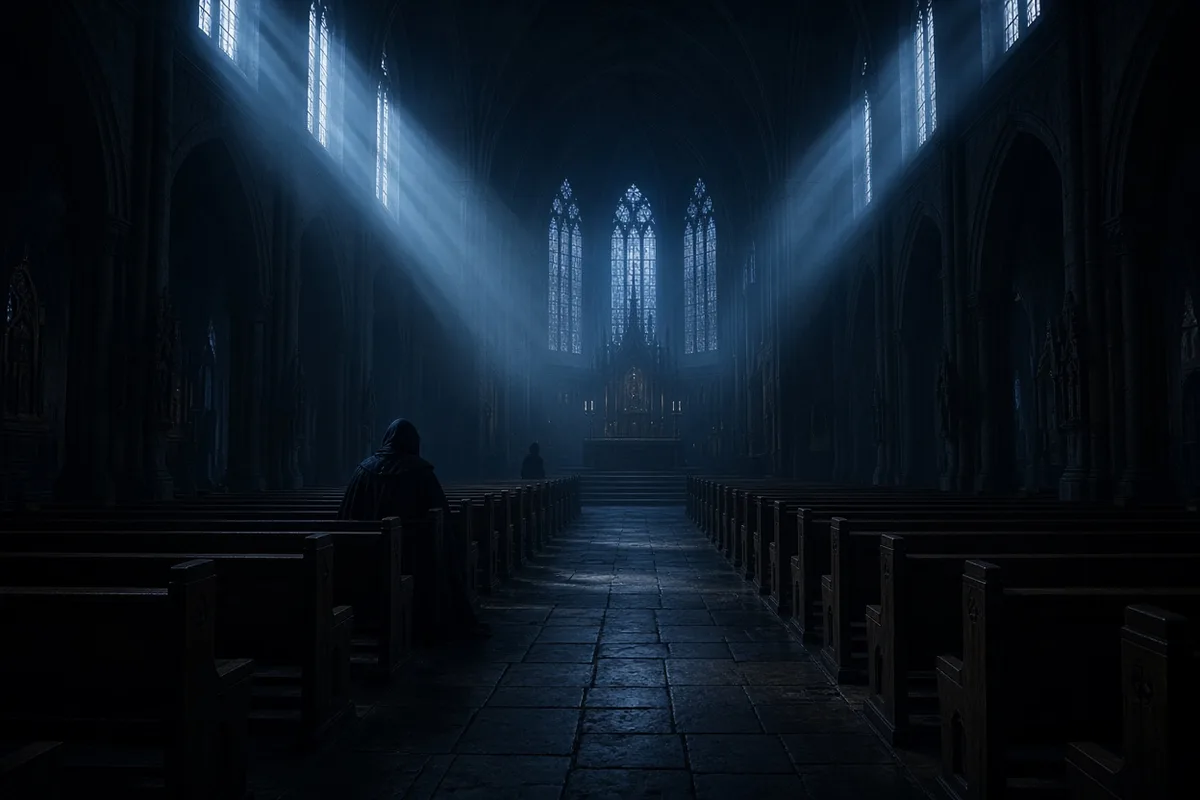
In 2019 the Coptic Patriarchate commissioned a structural survey of the original 1925 church building after cracks appeared in the northeast pendentive. Engineer Nabil Girgis of the firm Delta Consult recorded in his 47-page report dated 11 November that the central dome measured 21.7 metres from floor to apex and that no additional load had been added since the 1973 enlargement. The survey recommended installing stainless-steel tie rods at the springing line, work completed by March 2020 at a cost of 2.4 million Egyptian pounds funded by the Ministry of Antiquities.
The public garden that replaced the bus depot was renamed حديقة أنور السادات on 6 October 2004, and its maintenance log kept by Cairo Parks Authority shows 184,000 visitors in 2022, most of whom walk the 180-metre path to the church gate. On 2 April each year the garden gates remain open until 2 a.m. to accommodate overflow from the square; the 2023 night count by the 12th Precinct recorded 71,400 people entering between 6 p.m. and midnight.
Father Youssef Farag, parish priest since 2014, maintains a digital archive of 3,872 scanned affidavits originally collected at the Zeitoun police station between April 1968 and December 1971. On 14 June 2022 he permitted the researcher Dr. Magda el-Sayed of the American University in Cairo to photograph entry 892/69, the medical certificate for Youssef Boutros, which bears the stamp of St. Mark’s Hospital and the signature of Dr. Sami Fahmy dated 18 June 1968.
Nagwa Atwa’s grandson, 29-year-old Ahmed Hassan, began accompanying her to the annual commemoration in 2018 after he returned from three years of work in Kuwait. On 2 April 2023 he stood beside her at the garden entrance from 8:15 p.m. until 11:40 p.m., holding the folded tissue paper that had once wrapped the photograph. He later told a neighbour that his grandmother had repeated the sentence “I only wanted to stop her from jumping” each time a new group of pilgrims passed.
The closed-circuit camera installed in 1992 was replaced in 2017 with a 4K unit whose footage is stored for 90 days on a server in the sacristy. The recording from 2 April 2023 shows only the illuminated cross and the movement of streetlights below; no additional light appears above the dome between 8:05 p.m. and 2:17 a.m.
On 3 April 2023 Nagwa Atwa returned the photograph to its place on the kitchen wall. Before re-wrapping it she wiped the glass with a cloth dampened from the kitchen tap, then stood for several minutes looking at the image of the figure above the domes. She switched off the overhead bulb at 11:22 p.m., leaving the frame visible only in the light from the streetlamp outside the window.