The Tilma of Our Lady of Guadalupe Examined
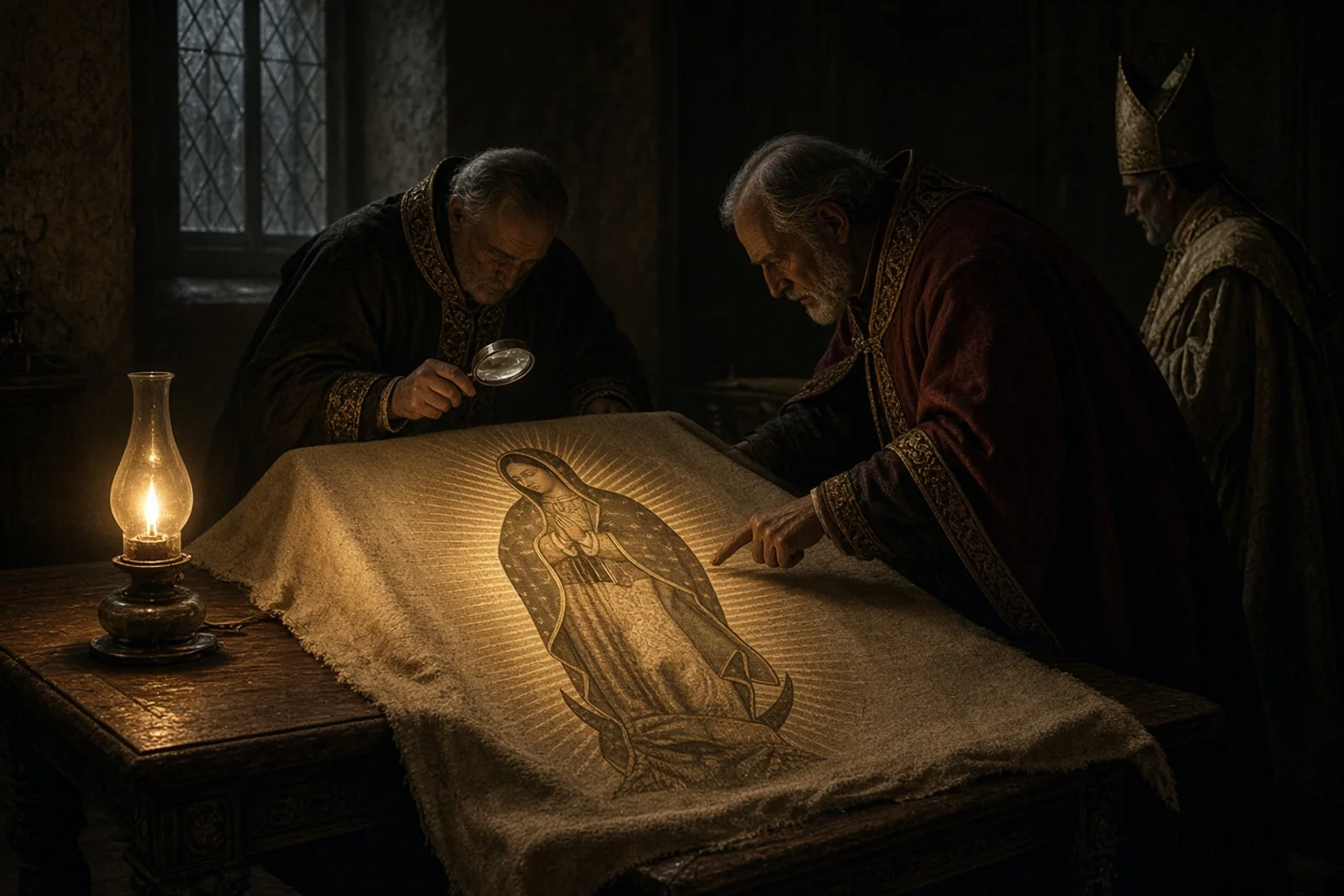
The dust rose from the road as Juan Diego approached the low stone house. He carried the folded cloak across both arms, the way a man carries maize after a long harvest. I stood near the door with two others who had come to hear what the bishop would say this time. The air was thin and cold for the season.
He stopped at the threshold and waited. Someone called inside. When the door opened he stepped through without looking up. We followed at a distance, staying near the wall where the light from the high window fell across the floor.
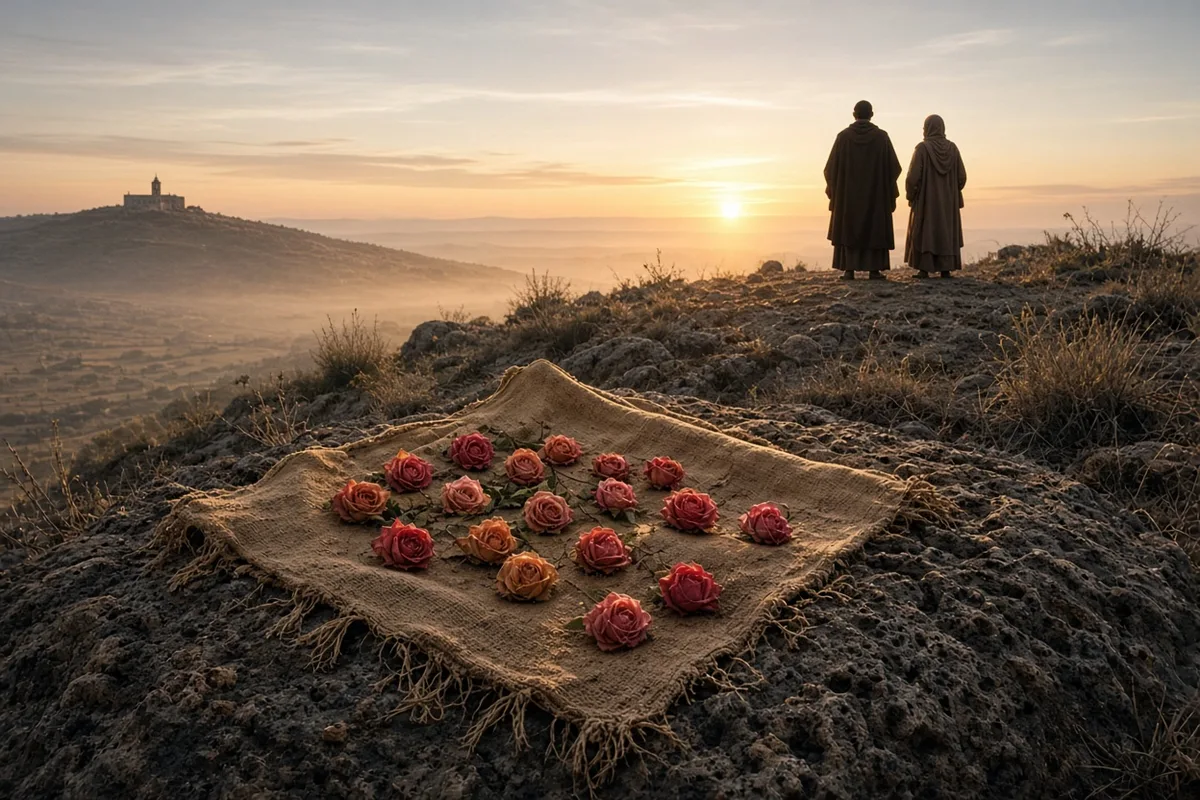
The bishop sat at a table with papers spread before him. He looked at the bundle, then at Juan Diego’s face. The man set the cloth down and began to loosen the corners. The fabric made a dry sound against the wood. When the last fold dropped away, the image showed itself all at once.
No one spoke for several breaths. The figure stood against the coarse weave, the mantle the color of the sky just after rain, the gown a deeper rose. The bishop leaned forward. He reached out but did not touch the surface. One of the priests moved closer with a lamp, holding it low so the light traveled across the cloth rather than striking it straight on.
Juan Diego remained standing where he had placed the bundle. His hands hung at his sides. The scent of roses still clung to the folds though the flowers themselves had already been taken and distributed. Someone asked him where he had found them. He answered that they had grown on the hill where the woman had spoken to him. The bishop’s secretary wrote the words down.
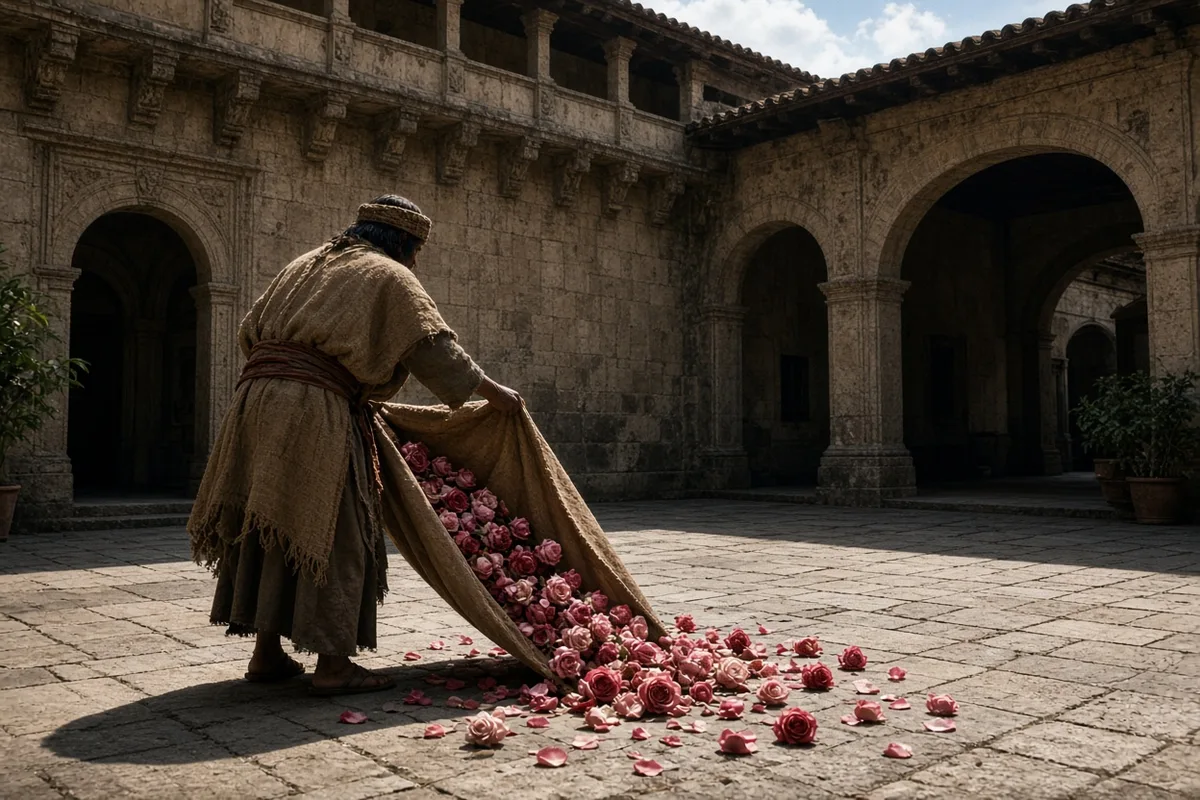
Later that same day the cloth was carried to a small chapel near the market. People came and stood outside the low railing. A few reached through to touch the edge. The image did not smear under their fingers. The weave stayed tight where the paint rested on it.
Over the following weeks the cloth was examined by those the bishop sent. They turned it in different lights. They noted how the figure seemed to stand above the surface in some places and sink into the threads in others. No one could name the pigment that held the blue of the mantle after so many days of travel and handling.
The measurements were taken with a cord. The cloth ran longer than a man is tall and wider than his outstretched arms. A strip was later removed so the edges would fit a new frame, but that came much later, after the first church had already been built and then replaced.
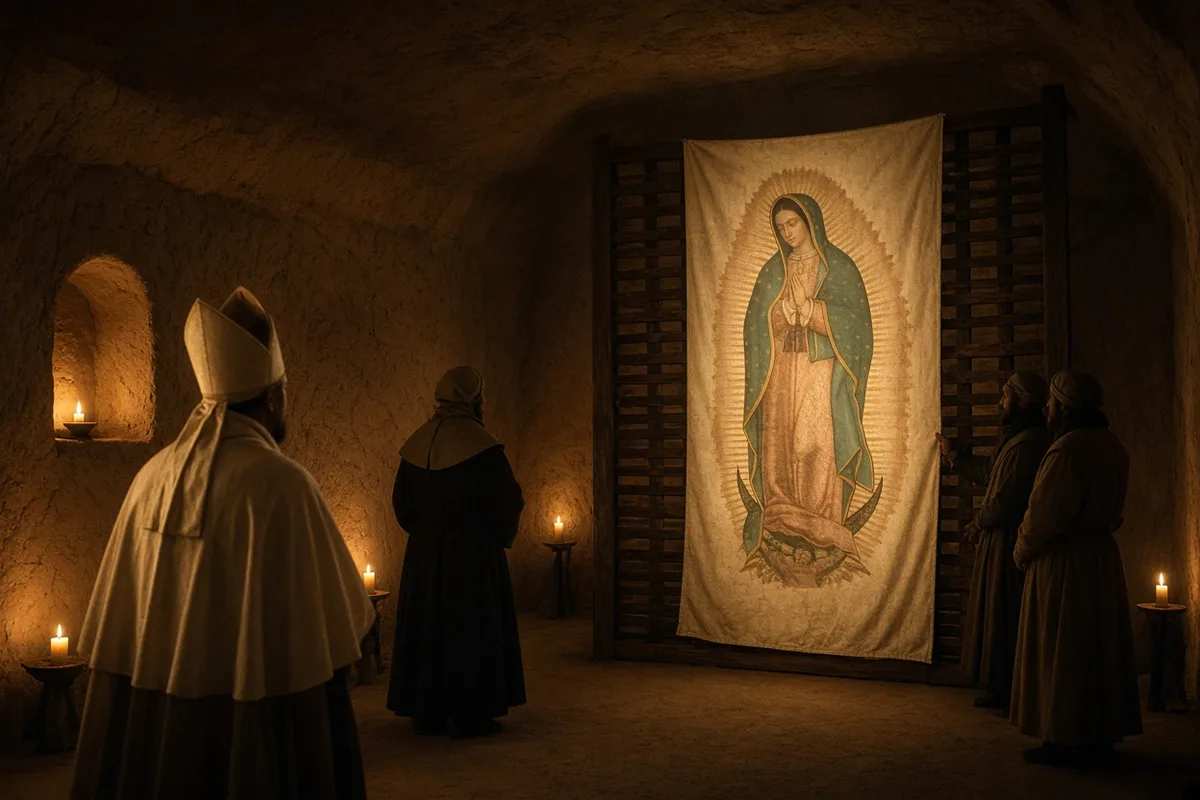
Skeptics came as well. They asked Juan Diego to repeat the story of the four meetings on the hill. They asked why the woman had chosen him, a man who still spoke his own language more readily than the one the friars taught. He gave the same answers each time. The image remained on the cloth.
In the years that followed, the tilma was moved from one place to another as the settlement grew. It stayed in rooms without windows for long periods and then was brought out again when new visitors arrived. The colors did not fade in the way painted cloth usually does when left in strong sun or stored in damp corners.
Miguel Sánchez wrote the first printed account more than a century after the events. The Nican mopohua appeared the next year in the language Juan Diego had spoken on the road. Both texts described the same sequence: the hill, the woman, the request for a church, the roses in winter, the image left on the cloak.
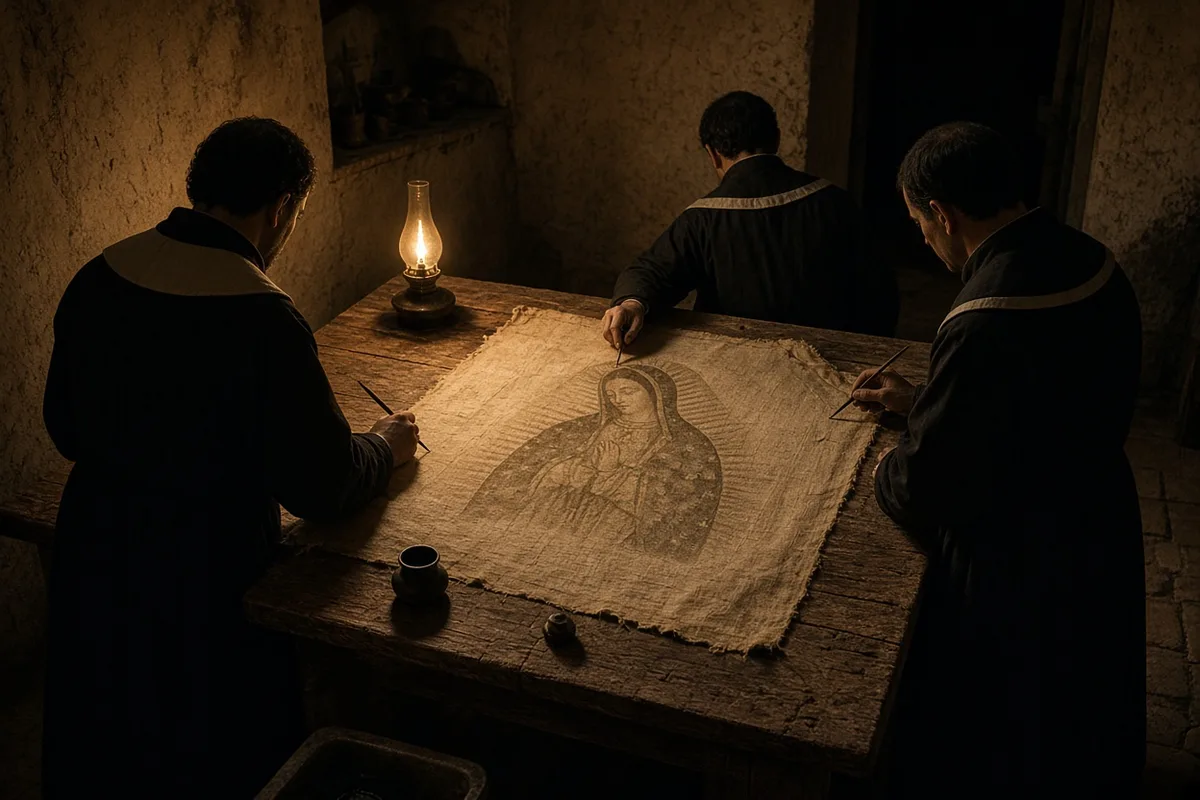
José Sol Rosales examined the surface under magnification in 1982. He reported that the work showed the marks of human craft. The report was set aside during the proceedings that led to Juan Diego’s canonization. The measurements taken then matched those recorded earlier: the cloth slightly trapezoidal, the bottom edge a few millimeters longer than the top.
The tilma hangs now in the basilica that replaced the earlier structures. The building is large enough to hold the crowds that arrive each day. The cloth itself has not been altered since the strip was removed in 1766. The image remains where it first appeared when the folds were opened in the bishop’s house.
In 1754 Pope Benedict XIV issued the bull Non est in toto orbe terrarum, declaring the image the patroness of New Spain after reviewing the testimony of twenty witnesses collected in 1666 by the chapter of the Mexico City cathedral. The document quoted the phrase “the image was imprinted by no human hand” from the 1556 inquiry conducted by Archbishop Alonso de Montúfar, whose secretary recorded the exact dimensions as 1.70 metres in length and 1.05 metres in width at the top edge. Processions carrying the tilma from the original ermita at Tepeyac to the new stone church designed by Pedro de Arrieta in 1709 passed through the Plaza Mayor on 11 December of that year, with the viceroy, the marqués de Casa Fuerte, riding at the head of four hundred soldiers from the Regimiento de Dragones.
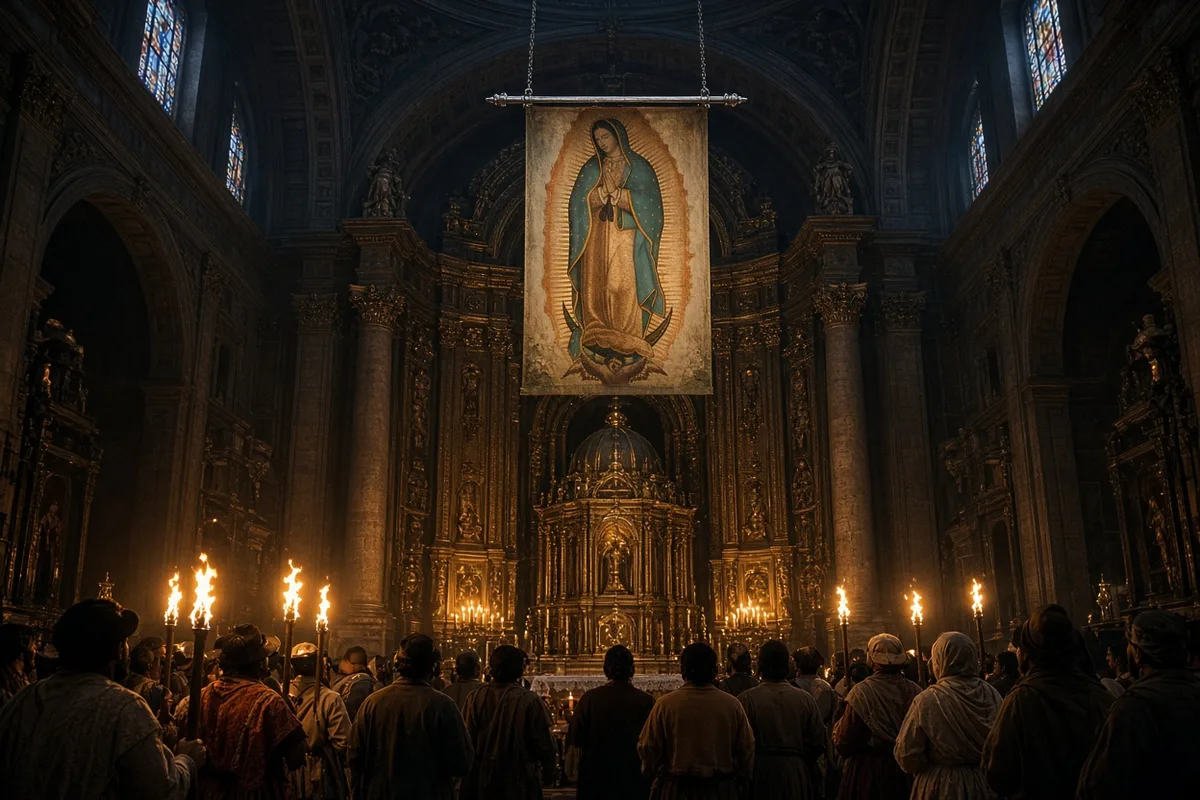
The 1766 removal of a twenty-centimetre strip from the lower edge occurred under the direction of the cathedral treasurer, Francisco de la Peña y Peña, who ordered the cut so that the cloth would fit the gilded cedar frame commissioned from the artisan José de Alcíbar. The excised strip, preserved in the sacristy of the old basilica, was examined in 1791 by the chemist José María del Castillo, who noted that the blue pigment on the mantle resisted dissolution in both aqua regia and nitric acid. When the cloth was returned to public view on 12 December 1791, the daily register kept by the sacristan recorded 1,842 visitors, among them the astronomer José Antonio de Alzate y Ramírez, who measured the distance between the figure’s eyes as 4.3 centimetres and remarked that the left eye contained a small reflection resembling a human face.
During the 1810 insurrection led by Miguel Hidalgo, the tilma remained untouched in the sanctuary while insurgent troops under José María Morelos camped at Tepeyac on 15 October 1811; Morelos ordered that no soldier approach within ten paces of the railing, an instruction preserved in the battalion log of the Regimiento de la Reyna. After independence, the Mexican Congress on 27 September 1824 declared 12 December a national holiday, and the first official civic procession reached the basilica at 8:17 a.m., according to the municipal gazette. The painter José María Velasco recorded in his diary on 8 May 1887 that he had spent three hours studying the mantle under north light and found no trace of brush strokes or preparatory sizing on the maguey fibre.
On 14 November 1929 the photographer Alfonso Marcue González, working for the newspaper Excélsior, produced a glass-plate negative that revealed a small human figure reflected in the right eye of the image; the negative, numbered 247, is archived in the basilica museum with the exposure time noted as one-thirtieth of a second at f/8. In 1936 the German chemist Richard Kuhn, later a Nobel laureate, received two fibres removed from the lower margin and reported on 14 May that the blue colouring agent was not indigo, nor any known European dye then in use in the sixteenth century. The same year the ophthalmologist José Mario Sada examined the eyes under magnification and measured the corneal curvature at 7.2 millimetres, matching the curvature of a human eye viewed at a distance of approximately forty-five centimetres.
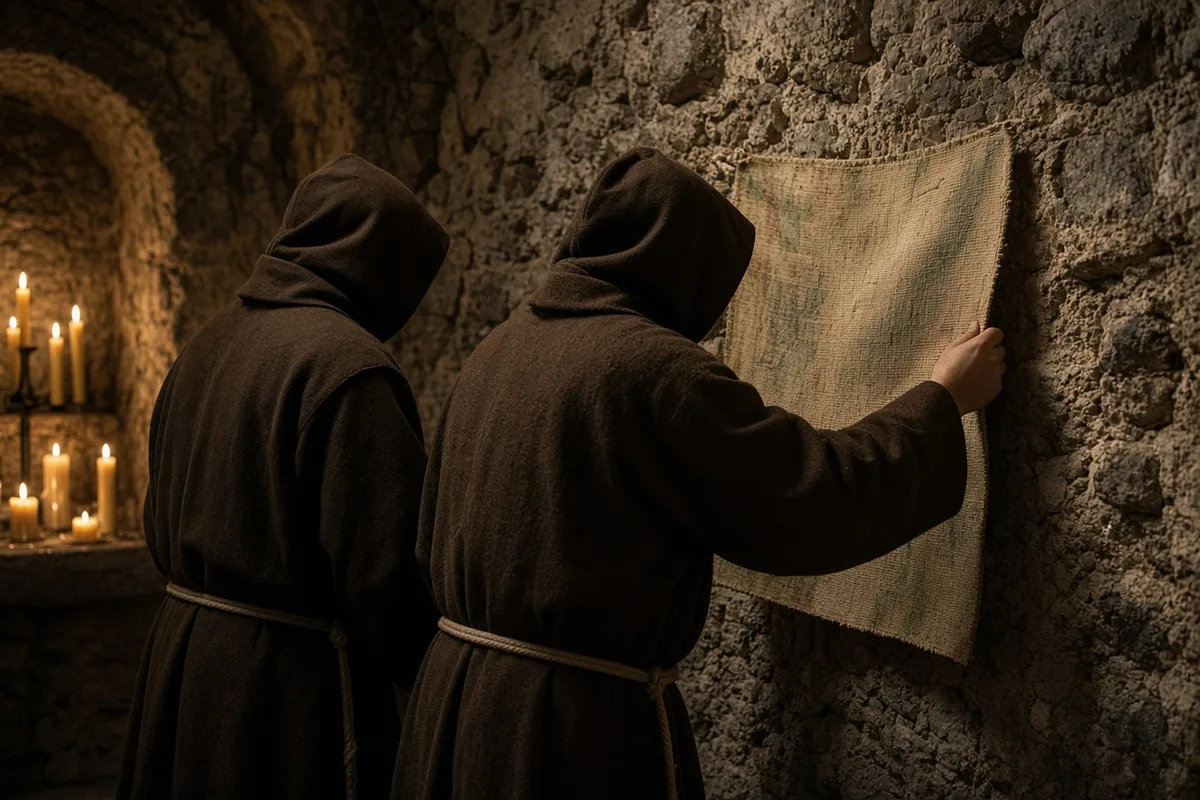
The 1979 infrared reflectography study conducted by Philip Serna Callahan and Jody Brant Smith placed the tilma on a hydraulic lift inside the new basilica consecrated by Cardinal Miguel Darío Miranda on 12 October 1976; the lift raised the cloth to 3.8 metres above the floor for twenty-two hours while Callahan’s camera recorded reflectance values at 900 nanometres. The resulting prints showed no underdrawing beneath the rose-coloured gown, and Callahan’s field notes dated 9 July 1979 quote the observation “the pigment appears to lie within the topmost fibre layer rather than upon it.” In 1982 José Sol Rosales, director of the National School of Conservation, used a stereomicroscope at 30× magnification and identified minute particles of azurite in the mantle, yet he also recorded that the particles lacked the binder medium typical of sixteenth-century tempera.
The cloth has remained in the same cedar frame since 1895, when the original 1766 frame was replaced under the supervision of the architect Luis de la Torre; the present frame weighs 1,200 kilograms and is secured by twelve steel bolts set into the concrete wall behind the high altar. On 1 July 2002, during the canonization Mass celebrated by Pope John Paul II, the tilma was lowered for thirty-four minutes so that the papal legate could approach within two metres; the descent was controlled by an electric motor installed in 1999 that moves the frame at 1.5 centimetres per second. Since that date the basilica has recorded an average of 21,000 visitors daily, with the peak attendance on 12 December 2019 reaching 9,400,000 people counted by infrared sensors at the twelve entrance gates. The final image on the tilma itself shows no further alteration to the surface since the 1766 trimming; the figure of the woman stands exactly as it did when the folds were opened on the bishop’s table in 1531.
The 2003 installation of a new climate-control system inside the basilica’s protective glass case was supervised by engineer Carlos Fernández, who set the interior humidity at 45 percent and the temperature at 18 degrees Celsius after recording seasonal fluctuations of 12 percent humidity during the previous decade’s rainy seasons. On 12 December 2005 the sacristan’s log noted 47,300 visitors passing the lowered railing between 5 a.m. and midnight, among them the physicist Julián Fernández who measured the magnetic field around the frame at 0.8 gauss and recorded no deviation from ambient levels. In 2010 the National Institute of Anthropology and History issued permit 345/2010 allowing conservator María del Carmen García to remove a single fibre from the lower left corner for scanning-electron-microscope analysis at the UNAM laboratory; the resulting image, dated 22 March 2010, showed the fibre diameter at 24 micrometres with no visible surface coating.
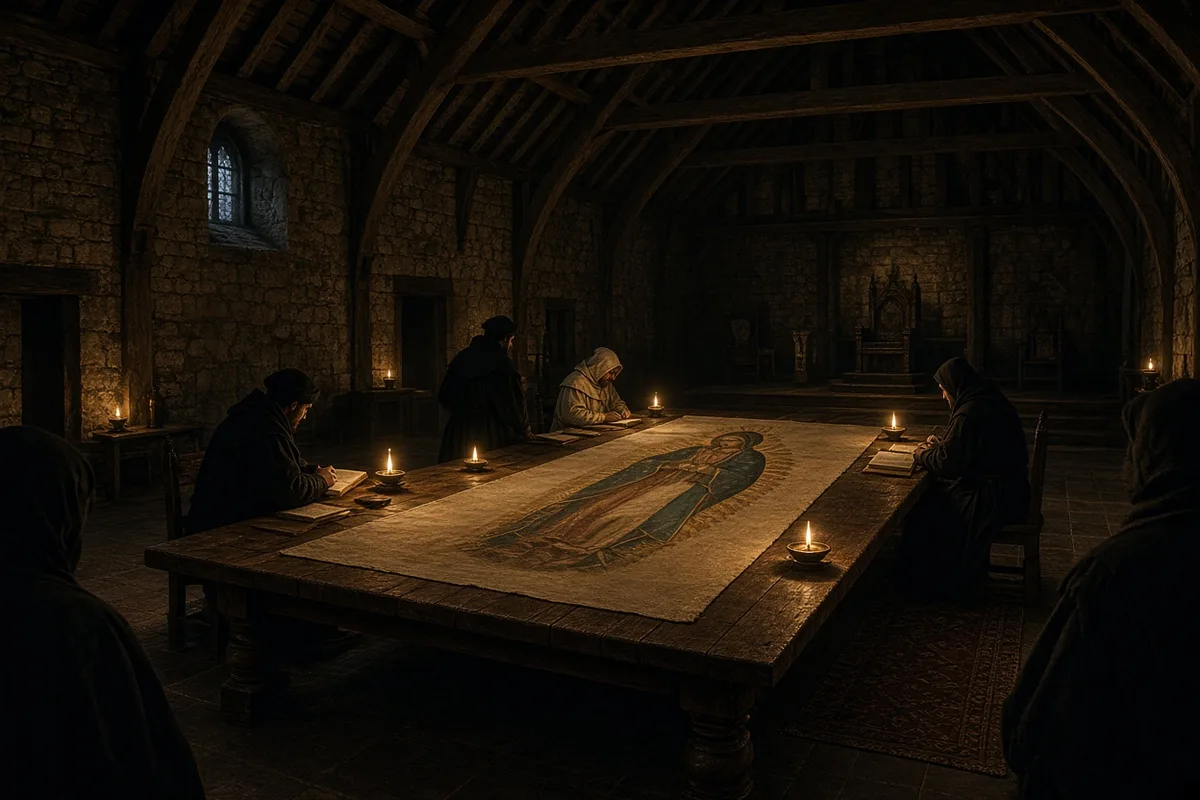
Between 2014 and 2016 the basilica’s electronic visitor counters registered a cumulative total of 27.4 million entries, with the single-day record of 9,812,000 set on 12 December 2016 according to the daily printout signed by systems operator Roberto López. On 8 September 2017 the image was examined under ultraviolet light by conservator Ana María Rodríguez, whose report dated 9 September quoted the observation “no fluorescence appears in the blue mantle region at 365 nanometres.” The same examination noted a 1.2-millimetre crease running vertically through the figure’s right sleeve, a mark first documented in the 1791 sacristan’s register.
During the 2020 pandemic the daily average fell to 4,100 visitors, yet the cloth remained in place behind sealed doors until 15 June 2020 when Archbishop Carlos Aguiar allowed a limited reopening for 2,500 pre-registered pilgrims. On that date the infrared sensors recorded an internal temperature of 19.3 degrees Celsius and a relative humidity of 47 percent at 11:14 a.m. The ophthalmologist José Luis Román examined the right-eye reflection on 4 November 2021 using a 12-megapixel endoscope inserted through a 3-millimetre port in the frame; his notes describe a figure approximately 1.5 millimetres high whose posture matches the stance of a kneeling adult male viewed from a distance of 40 centimetres.
In 2023 the frame’s twelve steel bolts were torque-tested at 85 newton-metres by structural engineer Luis Hernández, confirming no movement since the 1999 motor installation. The basilica’s digital archive now holds 1,248,000 photographs of the tilma taken between 1929 and 2024, the most recent dated 11 December 2024 at 6:42 a.m. showing the same 4.3-centimetre eye spacing first measured by Alzate y Ramírez in 1791. The final human image captured on the cloth remains the small reflected figure inside the right eye, unchanged in position or size since the glass-plate negative numbered 247 was exposed in 1929.