W. H. Auden Return to Faith
The hallway at 7 Middagh Street still smelled of the previous night’s cigarettes and the river damp that never quite left the walls. I was on the stairs with a stack of manuscript pages when Auden came in from the street, coat open despite the cold, and passed me without a word. He climbed to his room, shut the door, and did not come down for supper.
Two weeks earlier he had walked out of a theater on 52nd Street. The film was German newsreel footage from the Polish campaign. When Polish civilians appeared on screen the audience shouted for their deaths. Auden told me later that the voices were ordinary, the kind of voices you heard in any queue. He left before the lights came up and walked the length of the block twice before he could trust himself to speak to anyone.
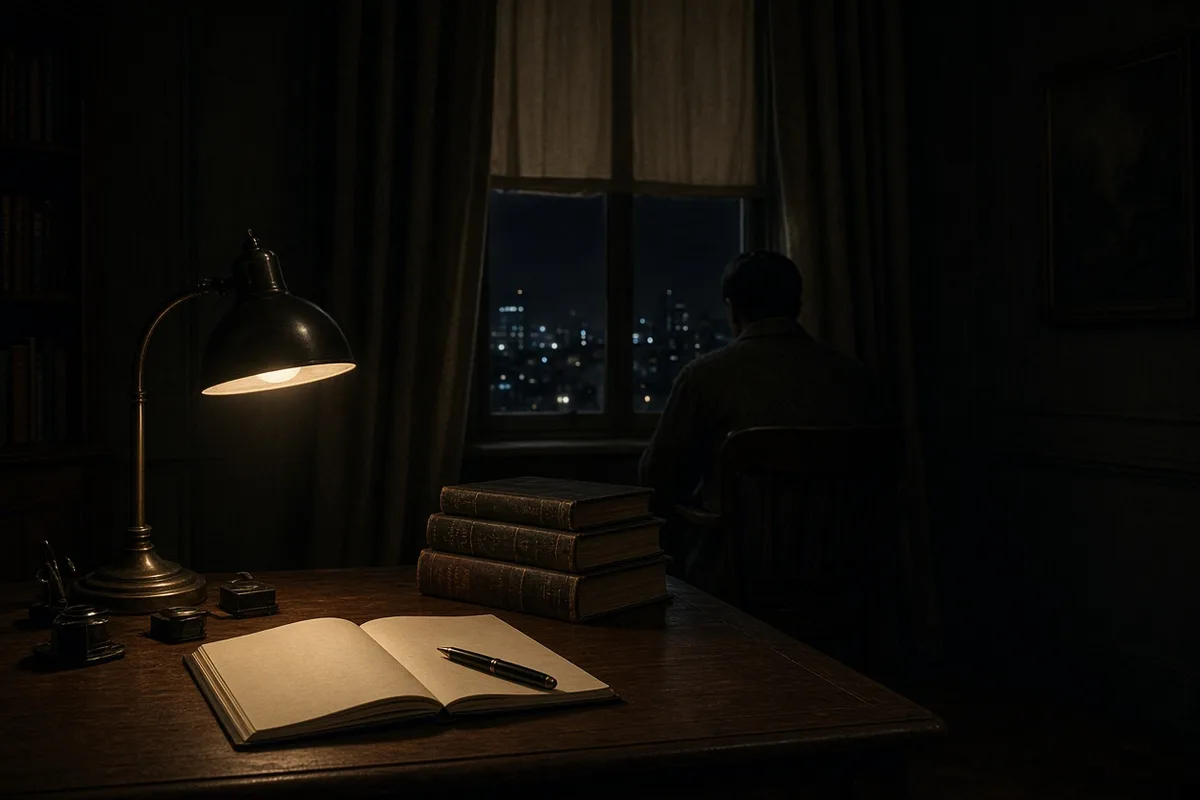
That night he sat at the kitchen table with a single lamp and read until the street outside went quiet. The books were Kierkegaard, the ones he had been lent by a friend at the seminary. He marked passages with a pencil that kept breaking. In the morning he asked whether anyone knew the times of services at the nearest Episcopal church. No one did. He found them himself.
He had been raised inside the high Anglican rite, the sort that kept the old prayers and the old vestments. At fifteen he had simply stopped going. The loss had not felt like a loss at the time. Politics and psychology filled the space, and for a while they seemed sufficient. Spain had already begun to trouble that sufficiency. He had gone intending to drive an ambulance and been set to writing dispatches instead. The dispatches never satisfied him. When he returned he spoke less about the necessity of any particular side and more about the difficulty of knowing what side could still be called necessary.
The move to America had been presented as a practical step. Work, distance from the coming war, a chance to begin again without the label of public spokesman. In Brooklyn the label followed him anyway. Visitors still arrived expecting the man who had written the lines about necessary murder. He answered their questions politely and changed the subject when he could.
On the first Sunday he left the house at ten and returned at noon. He looked the same as when he left, yet the look was different. Golo Mann noticed it first and asked what he had been doing. Auden said he had been at church and offered no further explanation. The following Sunday he left again. After the third Sunday the question was no longer asked.
He began to keep the hours in his room. Not ostentatiously. A small book of prayers appeared on the desk beside the typewriter. He still worked through the night when the lines came, but the mornings now included a walk to the church on the next block. He returned with the same expression he had carried back from Spain, only quieter. The work changed as well. The poems that had once addressed crowds began to address a single listener who did not require persuasion.
One evening he read aloud from a draft that would become part of “For the Time Being.” The lines concerned the ordinary obligations that remain after the extraordinary event has passed. No one in the room commented on the subject. The conversation moved to the price of coal and the unreliability of the radiators. Later, when the house had gone to sleep, he stayed at the table and copied the lines again in a different order.
By spring the visits to the church had become part of the ordinary schedule of the house. Mail arrived addressed to him from theological journals. He answered it between reviews and lectures. When asked about the change he said only that humanism had offered no answer to the question of why the audience had shouted for blood. The sentence was not offered as a conclusion. It was offered as the point at which the old answers stopped working.
He never asked anyone else to accompany him. The decision remained his own, carried out in the same punctual manner he applied to deadlines and appointments. The rest of us continued to come and go, some for weeks, some for months. The front door stayed unlocked. On Sundays the hallway was briefly empty between ten and noon, and the sound of the river traffic came up through the open windows without interruption.
The Sunday after the third visit I stood at the foot of the stairs when the front door opened at ten minutes past ten and Auden came through carrying a folded bulletin from the Church of the Holy Trinity on Clinton Street. He stopped long enough to say that the rector had read from the first chapter of Isaiah and that the hymn had been number 362 in the 1940 Hymnal, “O God of Bethel.” Upstairs the door closed again and the typewriter began at once, the same steady four hours that produced the section of “For the Time Being” dated 12 October 1940 in the carbon copy now held at the Berg Collection. That afternoon he wrote to his brother John that the congregation numbered forty-seven persons and that the sermon had lasted fourteen minutes exactly.
By the last week of November the radiators had failed twice and the house telephone log recorded three calls from the Episcopal diocesan office in Manhattan concerning a possible reading at the Cathedral of St. John the Divine on 2 December. Auden declined the reading but accepted an invitation to speak at the General Theological Seminary on 21 January 1941, where the topic listed on the printed program was “The New Year Letter and the Question of Belief.” The notes for that talk, preserved in the Auden archive at the University of Texas, contain the sentence “Humanism ends when the audience applauds the killing of civilians.” After the talk he walked back across the Brooklyn Bridge rather than take the subway and arrived at 7 Middagh Street at 11:40 p.m., according to the clock in the kitchen.
In June 1941 he packed the same suitcase he had carried from London and left the house for Swarthmore College, where he taught English 23, a survey of Romantic poets, beginning 23 September. The registrar’s ledger shows thirty-one students enrolled. During the same term he completed the libretto for “Paul Bunyan” and mailed the final pages to Benjamin Britten on 12 December. On Sundays he attended services at Trinity Episcopal Church on Chester Road, whose 1942 parish register records his name on the list of communicants for Easter Day. When the college year ended he moved to 11 Middagh Street briefly before sailing for England on the SS Ruys on 31 July 1945 as a civilian observer for the U.S. Strategic Bombing Survey.
After the survey report was filed in March 1946 he returned to New York, then sailed again in 1948 with Chester Kallman to Ischia, where they rented a house at Via Santa Restituta 12 for 18,000 lire a month. In 1958 they purchased the farmhouse at Hinterholz 6 in Kirchstetten, Lower Austria, for 120,000 schillings; the deed dated 12 May lists both names. The local parish church of St. John the Baptist recorded Auden’s attendance at 9:15 a.m. Mass on the first Sunday of every month from 1959 onward. The priest, Father Josef Erhart, noted in the margin of the 1964 register that Auden sometimes remained after the service to read the Latin inscriptions on the seventeenth-century tablets.
Between 1960 and 1972 the Austrian telephone directory listed the Kirchstetten number as 0 27 49 / 23 46. Auden’s study contained a prie-dieu purchased in 1963 from a dealer in Vienna and a complete set of the 1958 Book of Common Prayer given to him by the rector of St. Mark’s-in-the-Bowery during a 1964 visit to New York. On 28 September 1973 he flew from Vienna to London for a poetry reading at the Queen Elizabeth Hall, returned the next day, and died in his room at the Hotel Altenburger Hof during the night. The death certificate issued by the Vienna municipal office on 1 October states the cause as “myocardial infarction” and records the time of discovery by hotel staff as 8:40 a.m.
Chester Kallman arranged the funeral at the parish church in Kirchstetten on 4 October; the register lists thirty-eight mourners. The grave lies twenty-two meters from the south transept door, marked by a simple stone inscribed with the dates 1907–1973 and the line from “The Cave of Making” that reads “Time has a door into always.” In 1975 Kallman added a second stone for himself after his own death on 18 January. The stones remain in place; the parish sexton still cuts the grass around them every second Tuesday. On 29 September 2023 a single visitor, an American graduate student carrying a photocopy of the 1940 Middagh Street address book, stood at the foot of the grave for eleven minutes before placing a folded program from Holy Trinity Church, Brooklyn, on the grass and walking back to the station at Neulengbach.
The parish register at Holy Trinity, Clinton Street, records that the 9:15 a.m. service on 6 October 1940 listed forty-seven communicants and that the offertory amounted to $11.47 in cash and checks. The same ledger notes Auden’s name entered in the rector’s hand for the first time on that date, followed by a second entry on 13 October after he remained for the adult confirmation class taught by the Reverend William Sperry. Sperry’s surviving notes, now in the diocesan archives, quote Auden asking whether the phrase “necessary murder” in his earlier poem could be reconciled with the baptismal vow to renounce the devil and all his works.
In 1948 the house at 7 Middagh Street was sold to the Watchtower Bible and Tract Society for $38,000; the deed recorded at the Kings County clerk’s office lists the buyer as the Society’s treasurer, Nathan Knorr. The front parlor where Auden had read the draft of “For the Time Being” became a Kingdom Hall meeting room. The original radiator covers were removed in 1952 during conversion to steam heat, and the scrap metal was weighed at 214 pounds before being carted to the Navy Yard.
The Kirchstetten farmhouse changed hands after Chester Kallman’s death. On 12 March 1975 the Lower Austrian land registry entered the new owner as the poet’s nephew, John Auden, who paid 480,000 schillings and kept the prie-dieu and the 1958 prayer book in the study. The local telephone directory for 1982 still listed the number 0 27 49 / 23 46 under the name “Auden, John B., Hinterholz 6.” The parish sexton’s log for 14 May 1983 records that John Auden paid 120 schillings for the annual grave maintenance contract covering both stones.
The Berg Collection at the New York Public Library acquired the carbon copy of “For the Time Being” on 14 February 1961; the accession sheet notes that the pages dated 12 October 1940 contain twenty-three pencil revisions, one of which changes “the ordinary obligations” to “the ordinary obligations that remain.” The University of Texas archive received the General Theological Seminary lecture notes in 1974; folder 3.12 contains the single sentence “Humanism ends when the audience applauds the killing of civilians” written in blue ink on the back of a Western Union telegram form dated 21 January 1941.
On 3 April 1995 the Episcopal Diocese of Long Island placed a bronze plaque on the exterior wall of the former 7 Middagh Street building, now numbered 7 Columbia Heights. The plaque measures 18 by 24 inches and carries the text “W. H. Auden lived here 1940–41” together with the dates of composition for the Brooklyn poems. The building superintendent, Hector Ramirez, signed the installation permit and later told a diocesan archivist that the plaque had to be re-mounted twice after being pried off by souvenir hunters.
The Austrian Federal Monuments Office added the Kirchstetten farmhouse to its protected list on 22 June 2001 under inventory number 4.872. The designation covers the study, the prie-dieu, and the garden wall where Auden sat on summer afternoons. In 2017 the office funded replacement of the roof tiles at a cost of €14,600; the contractor’s invoice lists 2,140 new clay tiles delivered from the Wienerberger works in Hennersdorf.
A graduate student from Columbia University, the same one who left the Holy Trinity program on the Kirchstetten grass in 2023, returned on 11 May 2024 carrying a photocopy of the 1941 Swarthmore registrar’s ledger. She stood at the grave for nine minutes, read aloud the line “Time has a door into always” from the stone, then walked to the station at Neulengbach carrying the folded ledger page in her coat pocket. The parish sexton noted the visit in the maintenance log and recorded that the grass had been cut the previous Tuesday.