Long-Delayed China-North Korea Bridge Expected Open Thursday
60 sourcesUpdated Oct 17, 20263 min read
Large North Korean and Chinese flags went up on the pillars at the northern gateway of the New Yalu River Bridge on Tuesday, October 13, 2026. They had been absent until that day. The sudden display placed Kim Jong Un’s government and Beijing together in the final countdown to a joint ceremony.
Word had begun spreading in Dandong around June 2026 that the opening was imminent. Fresh lane markings appeared at the Chinese border crossing. Freight trucks and passenger vehicles ran tests across the span. Vehicles were recently spotted making the crossing itself, raising the possibility that those movements were already trial runs.
Xinhua reported on Wednesday, October 14, 2026, that the bridge would open the following day after consultations between the two sides. A joint inauguration ceremony was set for Thursday, October 15, 2026.

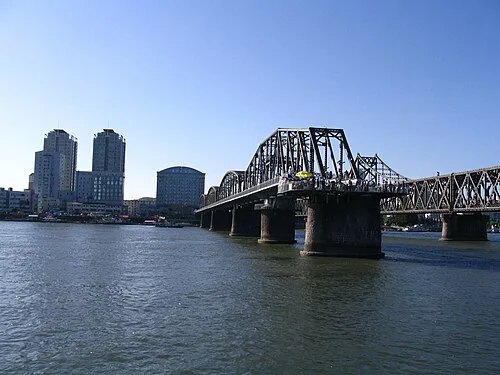
The New Yalu River Bridge connects Dandong, in China’s Liaoning province, with Sinuiju, in North Korea’s North Pyongan province. It stretches 3,026 meters across the Yalu—some sources put the length at 3,024 meters—and carries four lanes on a dual carriageway. The only other road link at this crossing is the Sino-Korean Friendship Bridge. Japan completed it in 1943. It was renamed in 1990. One rail track and a single lane of roadway share the deck. Only 150 to 200 vehicles cross it each day.
China has said the new bridge can handle up to 20,000 vehicles and 50,000 passengers daily. Against the limits of North Korean infrastructure on the far bank, the realistic early estimate is nearer 500 vehicles and 300,000 to 600,000 tons of goods. Four lanes now stand beside a single-lane choke point finished in wartime.
The project was agreed in 2009 during Wen Jiabao’s trip to Pyongyang. Construction started in 2010 per Kyodo and in 2011 according to other accounts. China completed work on its side in 2014, hoping to boost trade ties. That portion cost about 2.2 billion yuan, roughly $329 million. North Korea did not complete the connecting roads that would join the new span to its domestic road system. Customs facilities and quarantine measures on the North Korean bank also remained unfinished. Set against sanctions and tensions surrounding the nuclear program, the unfinished approach works left the bridge without a functioning far-side link. Ordinary vehicles could not cross. Twelve years after Chinese-side completion, there had still been no ordinary crossing.

Passenger train service between China and North Korea resumed in March 2026 after a six-year hiatus. Wang Yi visited Pyongyang in April 2026 and met with Kim Jong Un and Choe Son-hui. In June 2026 Xi Jinping held a summit with Kim Jong Un in Pyongyang.
Trade between China and North Korea reached approximately $1.51 billion in the first half of 2026, up 19.6 percent from the same period a year earlier. Full-year trade in 2025 came to about $2.74 billion, recovering to 98.1 percent of the pre-COVID level recorded in 2019. China’s exports to North Korea hit $2.3 billion in 2025, a six-year high and up 25 percent from the previous year.
Moon Il-hyun, a professor at China University of Political Science and Law, described the scale required once the span carries ordinary traffic: “To cover the considerable costs of maintaining and operating the bridge, there needs to be a high volume of both people and goods crossing.” Freight is the near-term load the span was built to carry.

The four open lanes leave the border’s entry rules untouched. No general reopening to Chinese tourists has been announced. No new visitor visa arrangements have been introduced. Chinese citizens holding ordinary passports still need a North Korean visa or tourist permit to enter. People-to-people exchanges have not normalized even as passenger trains and some flights returned.
“Even with the bridge open, movement will inevitably be limited as long as visas are not being issued,” Moon Il-hyun said. On the delays in visas to Chinese nationals he described “a strategic intent to extract more from China.”
Cho Han-bum, a senior research fellow at the Korea Institute for National Unification, set the longer pattern in one line: “There is always both wariness and cooperation in North Korea-China relations.”
On October 15, 2026, the bridge opens as the largest and most significant land crossing for trade between the two countries. Early traffic concentrates on freight rather than tourists. Thursday’s formal opening arrives with the visa gate still shut.
How it spread
Twelve years sitting empty seems like a huge waste of money on both sides. Hope it actually leads to more stable relations now.
It's about time they opened this bridge after all those years of delays. Better late than never for trade across the border.
Politicians
Most Powerful People in the World
26 candidates · 641 votes · vote on the order
History
Most Populous Countries in the World
100 candidates · 0 votes · vote on the order
Politicians
Most Influential World Leaders Alive Today
16 candidates · 0 votes · vote on the order
Politicians
Youngest World Leaders in History
18 candidates · 0 votes · vote on the order